
Mortgage rates in Canada are shifting, and August 2026 brings critical decisions for anyone considering a home purchase or renewal. At Financial Canadian, we’re tracking exactly where rates stand and what’s driving the changes.
The decisions you make in the coming months could save or cost you thousands. We’ll walk you through the current landscape and show you what to do next.
Where Canadian Mortgage Rates Stand Right Now
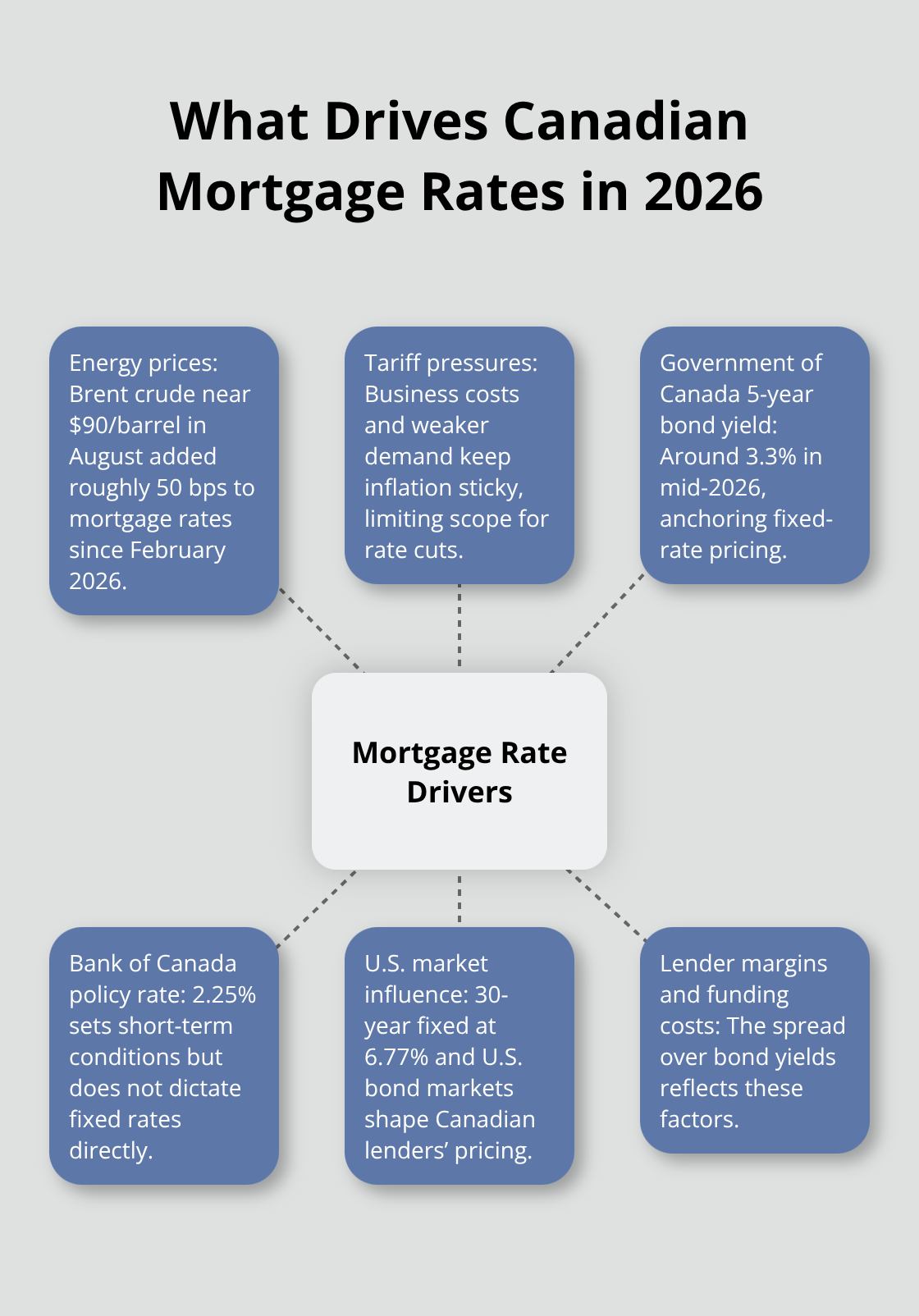
The Bank of Canada’s policy rate sits at 2.25% as of mid-August 2026, unchanged since October 2025. This stability masks significant movement in the rates that actually matter to homebuyers. The 5-year fixed mortgage-Canada’s most popular product-hovers around 4.14%, while 5-year variable rates sit near 3.49%. These aren’t theoretical numbers; lenders offer them today. If you shop for a mortgage now, you’ll encounter these rates or slight variations depending on your lender and financial profile. The 30-year fixed mortgage in the United States sits at 6.77% as of mid-August, which matters because Canadian lenders watch U.S. bond markets closely when pricing long-term mortgages. Canadian fixed rates move with the Government of Canada 5-year bond yield, which hovered around 3.3% in mid-2026. That spread between the bond yield and your actual mortgage rate reflects lender margins and funding costs. This dynamic explains why mortgage rates don’t move in lockstep with Bank of Canada decisions-they respond to broader market forces first and policy changes second.
Energy and Tariff Pressures Drive Rates Higher
Energy prices have become the dominant force shaping Canadian mortgage rates in 2026. Disruptions near the Strait of Hormuz pushed Brent crude near $90 per barrel in August, adding roughly 50 basis points to mortgage rates since February 2026. This geopolitical risk translates directly into your monthly payment. Tariff pressures compound the problem. A Canadian Federation of Independent Business survey found that 68% of small business owners faced negative impacts from tariffs, with 36% of exporters expecting major tariff effects. When businesses struggle, wage growth stalls and consumer spending weakens-both factors that keep inflation elevated and the Bank of Canada cautious about cutting rates.
Inflation Keeps the Bank of Canada on Hold
Inflation hit 3.0% in July 2026 according to Statistics Canada, above the Bank’s 2% target. Core inflation remained stubborn near 2.0%, signaling persistent price pressures. This inflation environment means the Bank of Canada won’t rush to cut rates, keeping fixed mortgage rates elevated through the remainder of 2026. Forecasts from Fannie Mae, the Mortgage Bankers Association, and Reuters all converge on similar expectations: rates will drift sideways in the mid-6% range through year-end with only modest declines. A Reuters poll from June 2026 projected 6.4% for Q3 2026 and 6.3% for Q4-rates that reflect current Canadian conditions translated to the U.S. context.
Renewal Shock Hits One-Third of Borrowers
Approximately 33% of Canadian mortgage holders face higher monthly payments at renewal before year-end 2026, according to nesto Canada’s Mortgage Rate Forecast. Three-quarters of those increases come from 5-year fixed mortgages renewing at higher rates, with average fixed-rate renewal increases around 20%.
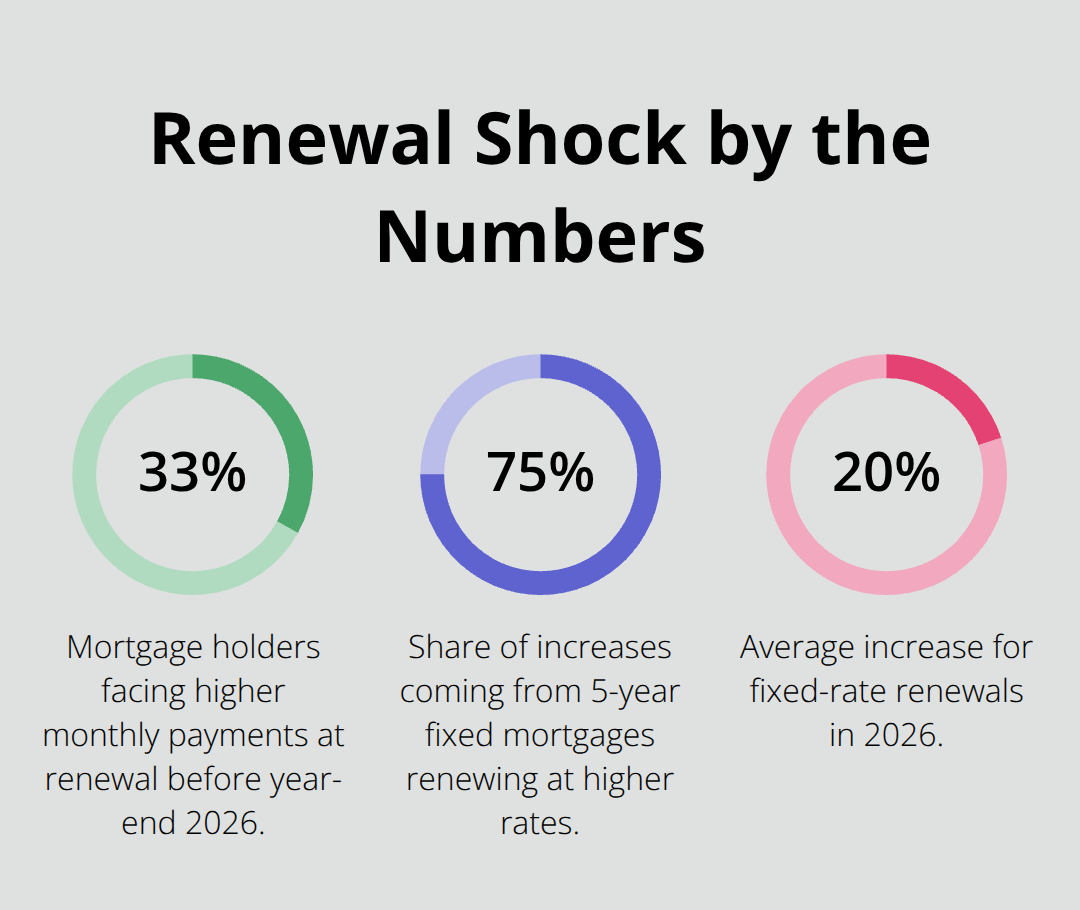
For variable-rate borrowers, the picture splits sharply. About 10% may see payments rise by more than 40%, while roughly 25% could see payments fall by at least 7%, depending on how they structured their payments and product type.
Household Budgets Face Real Strain
Household debt sits around 180% of disposable income according to Statistics Canada data, meaning most households have limited capacity to absorb significant payment increases. This isn’t a theoretical concern-Equifax Canada data shows mortgage delinquency balances up 32% nationally from a year earlier, with Ontario up 52%. The share of mortgages 90 or more days past due remains around 0.2%, but the trend moves upward. For someone renewing a typical Canadian mortgage of roughly $520,000 at today’s 4.0–4.2% rate on a 25-year amortization, the monthly payment sits around $2,800. A 1% rate increase at renewal would add approximately $400 monthly-money that many households simply don’t have in their budget. This reality makes today’s rate environment feel urgent rather than theoretical, and it explains why the decisions you make now about locking rates or choosing between fixed and variable products will shape your financial stability through the rest of 2026 and beyond.
What’s Really Driving Mortgage Rates Higher in 2026
Energy disruptions and tariff uncertainty push Canadian mortgage rates upward, overshadowing the Bank of Canada’s decision to hold its policy rate steady. While the central bank maintains rates at 2.25% through mid-August, the real action occurs in bond markets where Government of Canada 5-year bond yields rose to 3.26% on August 26, 2026. Geopolitical tensions near the Strait of Hormuz pushed Brent crude to nearly $90 per barrel in August, adding approximately 50 basis points to mortgage rates since February alone. This energy shock feeds directly into headline inflation, which Statistics Canada reported at 3.0% in July-well above the Bank of Canada’s 2% inflation target.
Tariffs compound the problem significantly. According to the Canadian Federation of Independent Business, 68% of small business owners faced negative tariff impacts, with 36% of exporters expecting major effects. When export-dependent businesses struggle, wage growth stalls and consumer spending weakens, keeping inflation sticky even as the central bank holds rates. The Bank of Canada won’t cut rates while inflation remains elevated, meaning fixed mortgage rates will likely drift higher through the remainder of 2026 despite the policy rate staying flat.
Why Waiting for Rate Cuts Leaves You Vulnerable
Forecasts from major institutions point to rates staying in the mid-6% range through year-end with only modest declines. Fannie Mae projects 30-year fixed rates around 6.4% for the rest of 2026, the Mortgage Bankers Association forecasts 6.5% in Q3 and Q4, and Reuters polling from June 2026 expected 6.4% in Q3 and 6.3% in Q4. For Canadian mortgages, this U.S. context matters because Canadian lenders price fixed rates by watching U.S. bond markets closely and hedge their positions through interest rate swaps.
The Bank of Canada faces a genuine dilemma. Core inflation sits near 2.0%, suggesting price pressures aren’t universal, yet headline inflation remains elevated due to energy and tariff effects. This mixed picture means rate cuts won’t materialize anytime soon. If you’re renewing a mortgage or considering a purchase, the stress-test qualifying rate-the higher of your contract rate plus 2% or 5.25%-should anchor your affordability calculations. Assuming rates stay higher through 2026 and potentially drift toward 4.5%–4.8% on 5-year fixed products by year-end, your monthly payments will reflect this elevated environment.
The Strategic Response to Rate Uncertainty
Betting on a meaningful rate decline before 2027 leaves you vulnerable to payment shock at renewal. The prudent approach involves locking rates when they stabilize, comparing offers from multiple lenders, and choosing term lengths strategically rather than hoping for relief that forecasters don’t expect to arrive soon. A shorter-term lock (2–3 years) offers flexibility to re-fix if conditions improve, while a longer term provides payment certainty through the uncertainty ahead.
Global Rate Expectations Constrain Canadian Options
The U.S. Federal Reserve held rates at 3.50%–3.75% through mid-2026 while American inflation sat around 4.2% year-over-year, keeping U.S. Treasury yields elevated. Canadian Government of Canada bond yields track closely to their U.S. counterparts due to capital flows and relative economic conditions. This global dynamic means the Bank of Canada has limited room to cut independently without weakening the Canadian dollar and importing inflation through higher import prices.
Major Canadian banks surveyed by the Bank of Canada show forecasts ranging from holding the policy rate at 2.25% through 2026 to modest hikes toward 2.50%–2.75% by 2027. This bias toward higher-for-longer rates reflects genuine uncertainty about inflation trajectories and tariff impacts. If tariff tensions ease or oil prices fall significantly, the Bank could gain flexibility to cut rates, potentially easing fixed mortgage rates in 2027. Until then, fixed rates will remain anchored to elevated Government of Canada bond yields rather than the policy rate itself.
This explains why your mortgage rate movements may feel disconnected from Bank of Canada announcements-the real drivers sit in global energy markets and government bond yields, both beyond the central bank’s direct control. Understanding this dynamic shifts your focus from waiting for policy changes to taking action within your control: locking rates strategically, shopping multiple lenders, and assessing your true affordability today rather than betting on tomorrow’s conditions.
Your 120-Day Rate Lock Window
Start Your Rate Search Now, Not at Renewal
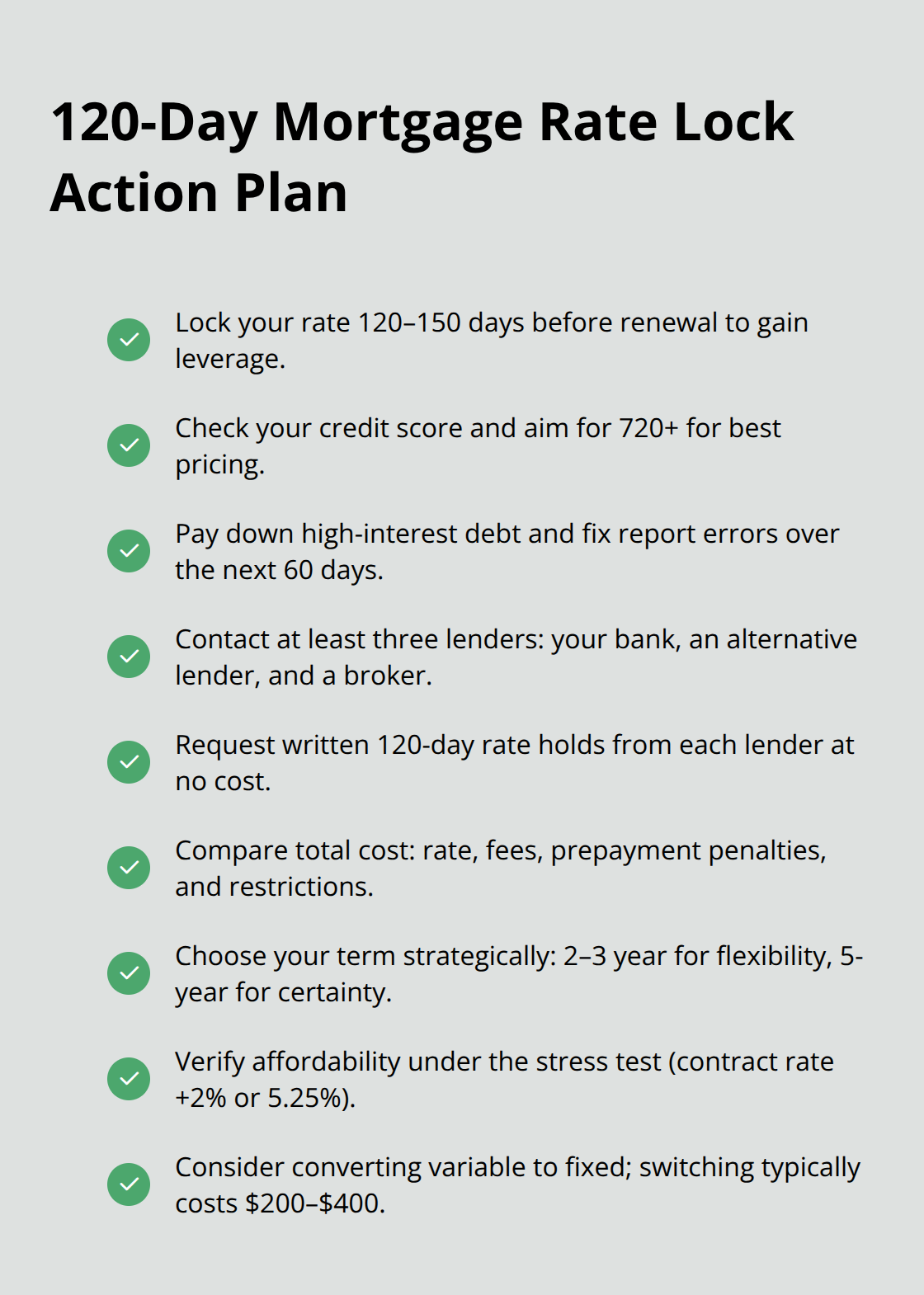
The decision to lock your mortgage rate should happen within 120 to 150 days before your renewal date, not on renewal day itself. This timing window gives you negotiating power with lenders while protecting you from further rate increases. If you renew in September through December 2026, start conversations with lenders now in late August. Waiting until your renewal notice arrives puts you at a disadvantage because lenders know you face time pressure. When you lock early, you control the timeline and can shop multiple offers without desperation driving your choices. For someone with a $520,000 mortgage, early locking provides meaningful savings compared to last-minute decisions.
Prepare Your Credit and Financial Profile
Start by checking your credit score through Equifax or TransUnion-lenders offer better rates to borrowers with scores above 720. If your score sits lower, spend the next 60 days paying down high-interest debt and correcting any errors on your report before approaching lenders. This preparation work directly impacts the rates you’ll receive. A stronger credit profile can save you thousands over the mortgage term.
Shop Multiple Lenders and Compare Total Costs
Contact at least three different lenders: your current bank, an alternative lender, and a mortgage broker who accesses multiple wholesale rates. Don’t assume your current lender will offer their best rate-banks reserve premium pricing for new customers, not renewals. Ask your lender explicitly what rate they’ll offer at renewal, then shop that exact offer to competitors. Request written rate holds from each lender; most provide 120-day locks at no cost. Once you receive multiple offers, compare the total cost including rate, fees, and any prepayment penalties or restrictions. A rate 0.25% lower sounds minor until you calculate the impact: on a $520,000 mortgage amortized over 25 years at 4.0% versus 4.25%, you save approximately $2,600 annually.
Choose Your Term Length Strategically
The 3-year fixed term currently offers the most attractive pricing relative to longer terms, providing payment certainty without locking you into rates for five years if conditions improve in 2028 or 2029. A 2-year fixed works if you want maximum flexibility and can tolerate refinancing sooner, while 5-year fixed suits borrowers who prioritize predictability and expect rates to stay elevated through 2027. Each choice reflects different assumptions about your future circumstances and rate movements.
Verify Your Affordability Under Stress-Test Rules
The affordability stress test requires you to qualify at the higher of your contract rate plus 2% or 5.25%, meaning you must prove you can carry the mortgage if rates spike further. Calculate your actual monthly payment at today’s rate, then add 2% and recalculate to see your stress-test payment. If that higher payment consumes more than 32% of your gross household income, you cannot afford the mortgage under current lending rules regardless of what the actual rate will be. For variable-rate borrowers, the math shifts because your payments fluctuate with rate changes. If you’ve locked in a payment amount despite rising rates, you’re building equity faster, but you’ll face payment shock when your rate adjustment occurs. Consider converting to fixed now while rates stabilize; the cost to switch typically runs $200 to $400 and protects you from further increases. Household debt at 180% of disposable income means most Canadian families lack financial cushion for payment surprises, making fixed-rate certainty worth the slightly higher rate compared to variable products.
Final Thoughts
Mortgage rates Canada 2026 will remain elevated through year-end, shaped by energy disruptions and tariff uncertainty rather than Bank of Canada policy alone. Lock your rate within 120 to 150 days before renewal, shop at least three lenders to capture meaningful savings, and choose your term length based on your actual financial capacity rather than rate forecasts. The 3-year fixed currently offers the best balance between payment certainty and flexibility, while variable rates expose you to payment shock that rising rates will eventually deliver.
Approximately 33% of Canadian mortgage holders will face higher payments at renewal before year-end, yet you can avoid that trap through early action. Verify your affordability under stress-test rules by calculating your payment at today’s rate plus 2%, ensuring you can sustain the mortgage if rates rise further. Start your rate search immediately, gather written offers from multiple lenders, and make your decision based on total cost rather than rate alone-the difference between shopping early and waiting until renewal day easily exceeds $2,600 over your mortgage term.
We at Financial Canadian track these rate movements and economic shifts to help you navigate decisions with real data rather than speculation. Our mortgage rate guides provide the analysis you need to move forward with confidence. Your financial stability through 2026 and beyond depends on actions you take now, not on hoping for rate cuts that forecasters don’t expect to arrive soon.










Leave a comment