
Getting a loan online in Canada has become simpler than ever, but the sheer number of options can feel overwhelming. We at Financial Canadian want to help you cut through the confusion and find the right fit for your financial situation.
This guide walks you through Canada’s online loan options, how to compare lenders fairly, and what to expect during the application process. By the end, you’ll know exactly where to start.
Canada’s Online Loan Options: Finding the Right Fit for Your Situation
Personal loans from online lenders remain the most flexible option for Canadian borrowers. These unsecured loans typically range from $500 to $60,000 and require no collateral, making them accessible to most people. Major Canadian banks like RBC, TD, CIBC, BMO, and Scotiabank all offer online personal loans with competitive rates tied to their prime lending rate. CIBC structures personal loan terms from 1 to 5 years with either fixed or variable rates, so your monthly payment either stays constant or moves with prime rate changes. The advantage is straightforward: you know exactly what you pay each month with a fixed rate, or you accept rate movement in exchange for potentially lower initial costs with a variable rate. Online lenders like LendDirect have operated since 2016 and offer line of credit products up to $10,000 with revolving access-you borrow, repay, and borrow again without reapplying. This flexibility costs more. LendDirect’s line of credit carries a 34.99% APR, but the revolving structure works well if you need ongoing access to funds rather than a single lump sum.
When a Line of Credit Makes Sense
Lines of credit differ fundamentally from traditional personal loans because you pay interest only on what you actually use. A bank line of credit typically offers lower interest rates than unsecured personal loans.
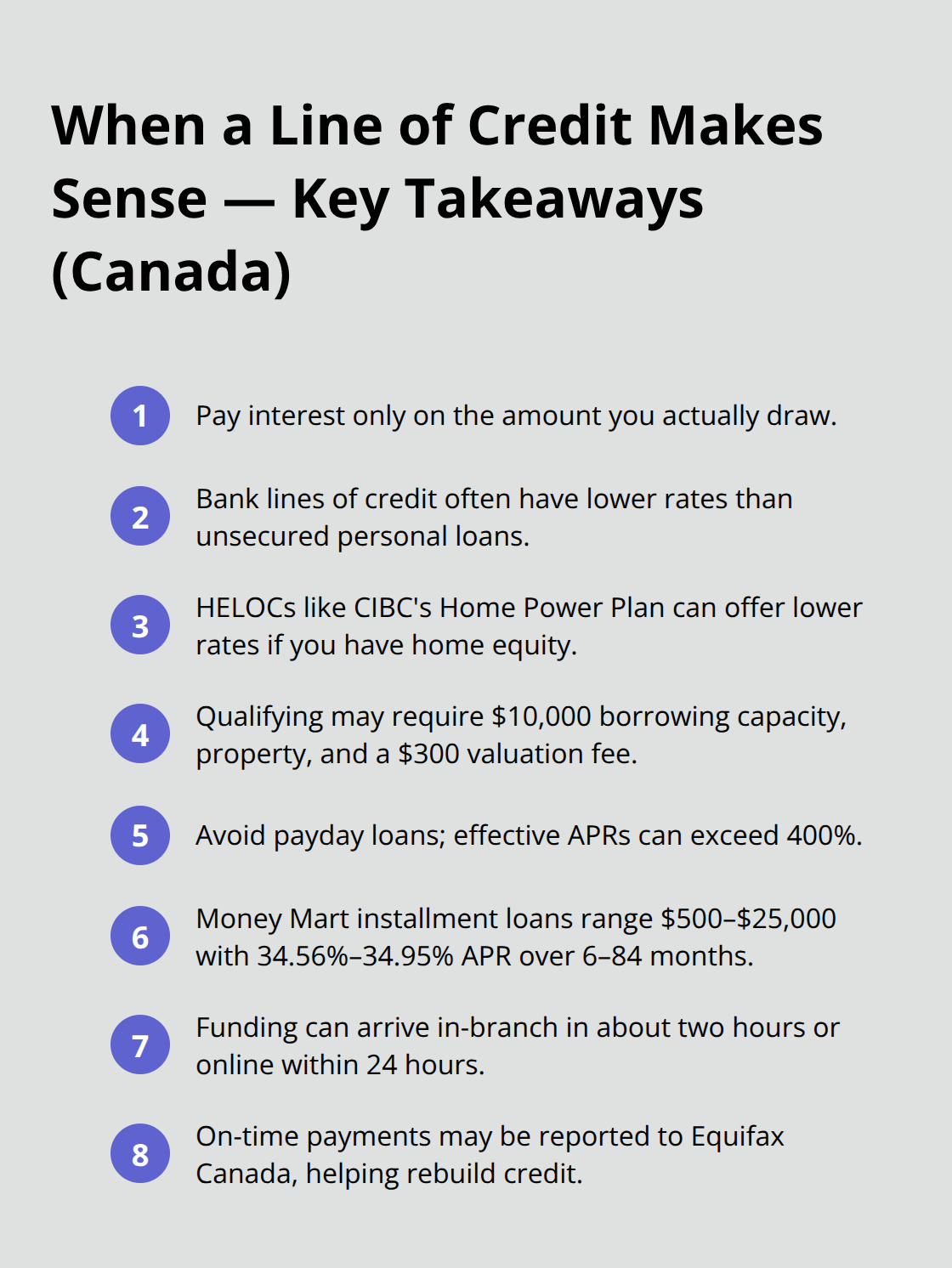
If you have home equity, CIBC’s Home Power Plan line of credit lets you tap into that equity at rates significantly lower than unsecured debt. The catch: you need a minimum of $10,000 in borrowing capacity and residential property to qualify, plus a $300 property valuation fee upfront. Payday loans represent a trap you should avoid entirely. These short-term loans charge fees that translate to annual percentage rates often exceeding 400%, and they’re designed to keep you borrowing repeatedly. Installment loans from Money Mart offer a middle ground-amounts from $500 to $25,000 with APRs between 34.56% and 34.95% and repayment terms spanning 6 to 84 months. Money Mart has served Canadian communities since 1982 and funds loans quickly: in-branch within about two hours via Interac e-Transfer, or online within 24 hours on business days. Fixed monthly payments match your pay frequency and withdraw automatically, eliminating the temptation to miss payments. For those with damaged credit, installment loans actually report on-time payments to Equifax Canada, which can gradually improve your credit score if you manage them responsibly.
How Credit Unions and Nonprofits Fit In
Credit unions consistently offer lower rates than online lenders for short-term borrowing, often with more flexible qualification criteria than banks. If traditional lenders reject you, a credit union membership might provide access to funds at reasonable rates. Local nonprofits and charities like the Salvation Army provide emergency assistance for genuine hardship situations, though these typically work better as supplementary resources than primary borrowing solutions. When you compare installment loans specifically, Money Mart lets you check eligibility without impacting your credit score through a soft check. Their loan calculator lets you preview exact repayment amounts before you commit. Early repayment carries no penalties, so if your financial situation improves, you can eliminate the debt faster without extra costs.
What Comes Next in Your Comparison
You now understand the main loan types available to Canadian borrowers and which situations suit each option best. The next step involves evaluating specific lenders against key criteria-APR, fees, repayment flexibility, and approval speed-to narrow your choices to the lenders that actually fit your needs and timeline.
How to Compare Online Lenders and Find the Best Fit
Calculate Total Cost, Not Just APR
Comparing online lenders means looking past advertised rates to the actual cost you’ll pay. APR is the starting point, but it’s meaningless without context. LendDirect’s line of credit charges 34.99% APR, while Money Mart’s installment loans range from 34.56% to 34.95% depending on payment frequency. On the surface, these look similar, but the real difference emerges when you calculate total cost.
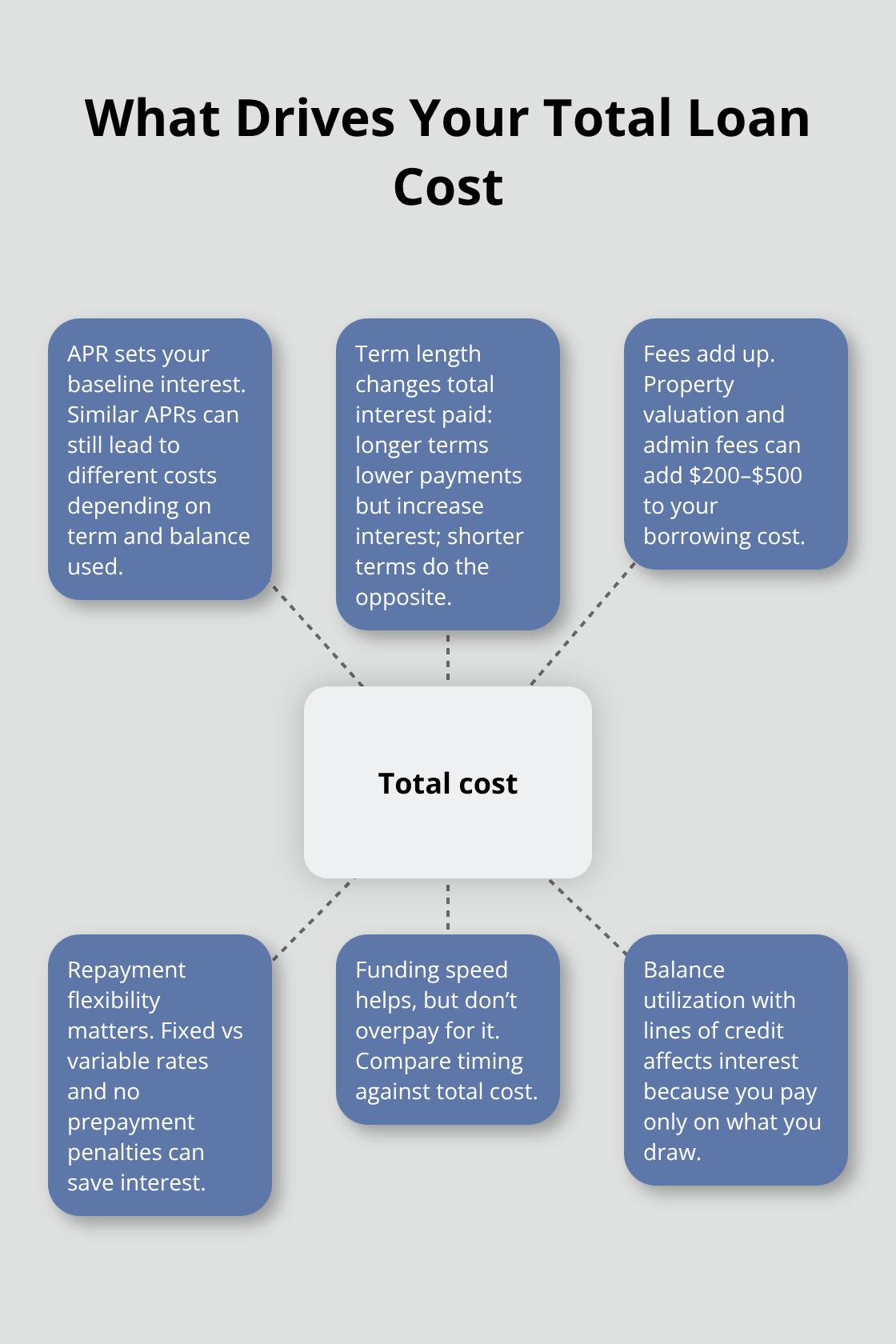
A $5,000 loan from Money Mart over 24 months at 34.95% APR costs approximately $2,060 in interest alone, while the same amount from a bank personal loan at a lower rate might cost $800 to $1,200. This gap matters.
Before you apply anywhere, use comparison tools from lenders to preview exact monthly payments and total interest. Most lenders now offer soft credit checks that don’t impact your credit score, so you can compare pre-approval amounts across multiple options without damage.
Watch for Hidden Fees That Add Up
APR alone doesn’t tell the full story. Money Mart charges no prepayment penalties, which means you can pay early without extra fees if your financial situation improves. Other lenders may hide fees in the fine print-property valuation fees like CIBC’s $300 charge for home equity lines of credit, or lien and security search fees that vary by province with secured loans. Read the terms document, not the marketing summary. Fees can add $200 to $500 to your actual borrowing cost, and lenders count on most people skipping this step.
Verify Credentials and Check Payment Reporting
Lender credentials matter more than most borrowers realize. Check if the lender holds proper Canadian licensing and appears on regulatory lists for your province. BBB accreditation indicates accountability, though it’s not a guarantee of safety. Look for lenders that report payment history to Equifax Canada-Money Mart does this, which means on-time payments actually help rebuild credit over time. Read recent customer reviews on independent sites, but weight them carefully. One angry customer posting doesn’t mean the lender is bad, but a pattern of complaints about funding delays or hidden fees is a red flag.
Speed Matters, But Not at Any Cost
Funding speed varies significantly. Money Mart funds in-branch within about two hours via Interac e-Transfer and online within 24 hours on business days. LendDirect offers faster e-Transfer funding as quick as 15 minutes for amounts up to $10,000. If you need money today, this difference is critical-but don’t let speed override everything else. Fast funding from a predatory lender costs more than waiting a day for a legitimate alternative.
Documentation Requirements Reveal Legitimacy
Application requirements also reveal lender legitimacy. Money Mart requires a recent pay stub within 30 days, two direct deposits shown on a bank statement, a voided cheque, and valid photo ID. This documentation requirement suggests responsible lending practices. Lenders advertising no credit check or no documentation are almost always charging fees that compensate for their risk-which means you pay significantly more. Once you’ve narrowed your options based on these criteria, the next step involves understanding what happens during the actual application process and what to expect from approval to funding.
Application Process and What to Expect
Prepare Your Documentation First
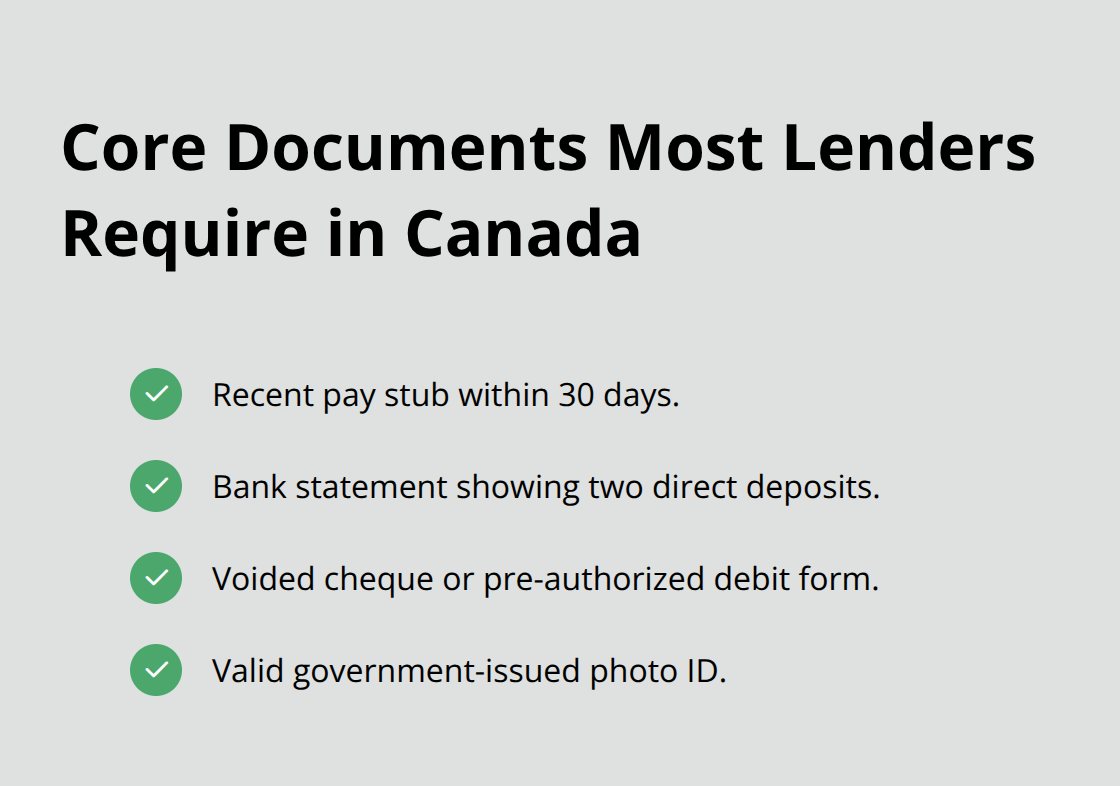
The application process for online loans in Canada follows a predictable path, but success depends on preparation. Most lenders require identical core documentation: a recent pay stub within 30 days, two direct deposits shown on a bank statement, a voided cheque or pre-authorized debit form, and valid government-issued photo ID. Money Mart, which has served Canadian communities since 1982, explicitly lists these requirements upfront, which signals responsible lending practices.
Lenders vary on whether they accept digital uploads or require in-branch visits for certain products. Money Mart’s secured loans require an in-branch visit because they need to inspect collateral, but unsecured installment loans can be completed entirely online.
Gather your documents beforehand to eliminate delays. Have your most recent pay stub, your last two months of bank statements showing direct deposits, and your ID ready before you click apply. This preparation cuts your approval timeline significantly.
Check Your Pre-Approval Without Risk
Before you apply formally, check eligibility through a soft credit check that won’t impact your credit score. This step costs nothing and shows you the approximate amount you could qualify for without committing. LendDirect offers immediate pre-approval decisions during business hours, while Money Mart lets you preview exact monthly payments through their loan calculator before you submit anything official. These tools remove guesswork from the process and let you compare multiple lenders without damage to your credit profile.
Understand Your Timeline From Submission to Funding
Once you submit your application, most lenders provide a quick decision within 24 to 48 hours on business days. Money Mart funds in-branch applications within about two hours via Interac e-Transfer and online applications within 24 hours. LendDirect can move funds as quickly as 15 minutes for e-Transfer amounts up to $10,000, though this speed depends on your bank’s processing system availability. Funding times vary based on whether you apply during business hours and which payment method you select.
Address Common Rejection Reasons
Applications fail for three consistent reasons: insufficient income relative to the loan amount you requested, recent missed payments or collections accounts showing up on your credit report, or employment instability that lenders view as high risk. If your application gets rejected, don’t immediately apply elsewhere. Each application generates a hard inquiry that damages your credit score temporarily. Instead, contact the lender’s support team to understand the specific reason. Some lenders have different criteria than others. A bank might reject you due to a collections account, but a credit union or LendDirect might approve you because they weight recent positive payment history more heavily.
Explore Alternatives When Rejections Occur
If you face repeated rejections, consider a smaller loan amount or a secured product like LendDirect’s secured loans up to $25,000, which use your vehicle as collateral and may qualify you for approval when unsecured options fail. Secured loans require more documentation and collateral inspection, but they open doors that unsecured lending closes. This approach trades convenience for accessibility when traditional paths don’t work.
Final Thoughts
You now have a clear picture of Canada’s online loan options and how to navigate them strategically. Personal loans from banks offer stability with fixed or variable rates, lines of credit provide flexibility when you need ongoing access to funds, and installment loans deliver predictable monthly payments with faster approval timelines. Each option serves different financial situations, and the right choice depends entirely on your timeline, credit profile, and how much you need to borrow.
Before you commit to any lender, take three concrete steps. First, gather your documentation now-pay stub, bank statements showing direct deposits, voided cheque, and photo ID. Second, run soft credit checks with multiple lenders to compare pre-approval amounts without damaging your credit score, then use their loan calculators to see exact monthly payments and total interest costs rather than just advertised APR. Third, read the full terms document and verify the lender holds proper Canadian licensing and reports to credit bureaus like Equifax Canada.
Your next move depends on your situation. If you have home equity and can wait for a property valuation, CIBC’s Home Power Plan offers significantly lower rates than unsecured borrowing. If you need funds within 24 hours and have stable employment, Money Mart’s installment loans deliver speed without predatory payday loan rates. Visit Financial Canadian to explore additional guides and tools that help you make informed decisions about Canada online loan options and strengthen your financial foundation.











Leave a comment