
Your credit score directly affects your ability to borrow money, rent an apartment, and even land certain jobs. At Financial Canadian, we’ve seen how small changes in financial habits can shift scores by 50 to 100 points within months.
This guide walks you through concrete credit score tips for Canada, from understanding how lenders calculate your rating to fixing mistakes that hold you back.
What Drives Your Credit Score in Canada
Payment history stands as the dominant force shaping your credit score in Canada, accounting for approximately 35% of your rating. Lenders care far more about whether you pay on time than any other factor. A single missed payment can drop your score by 50 to 100 points. Late payments stay on your credit report for six years, making consistent on-time payments non-negotiable if you want to build real credit strength.

Set up automatic payments on your accounts to eliminate the risk of missing a due date. If you’ve already missed a payment, contact your lender immediately to arrange a repayment plan; the longer a payment sits unpaid, the more damage it inflicts on your score.
How Much Credit You Actually Use Matters
Your credit utilization ratio-the percentage of available credit you’re actually using-accounts for roughly 30% of your score. Keeping this ratio at or below 30% significantly improves your rating. If you have a credit card with a $5,000 limit, you should carry no more than $1,500 in debt on that card. The math here is straightforward: pay down your balances aggressively or request a credit limit increase on existing cards to lower your utilization percentage. Many people miss an important tactic: pay your balance before your statement closing date rather than waiting until the due date. This approach reduces the amount the credit card company reports to the bureaus, which can immediately improve your utilization ratio without requiring you to change your overall spending patterns.
Credit History Length and New Applications
The age of your credit accounts contributes roughly 15% to your score, while new credit inquiries and recent accounts make up another 10%. This creates a direct conflict: you need diverse credit types to improve your score, but opening new accounts triggers hard inquiries that temporarily lower it. Space out credit applications by at least six months, and only apply when absolutely necessary. Never close old credit accounts after paying them off, even if you’re tempted to clean up your credit portfolio. Keeping those aged accounts open preserves your credit history length and maintains your available credit, both of which work in your favor.
These three factors form the foundation of your credit rating, but understanding them is only half the battle. The next section shows you exactly how to translate this knowledge into concrete actions that move your score upward.
How to Actually Improve Your Score This Month
Set Up Automatic Payments to Protect Your Rating
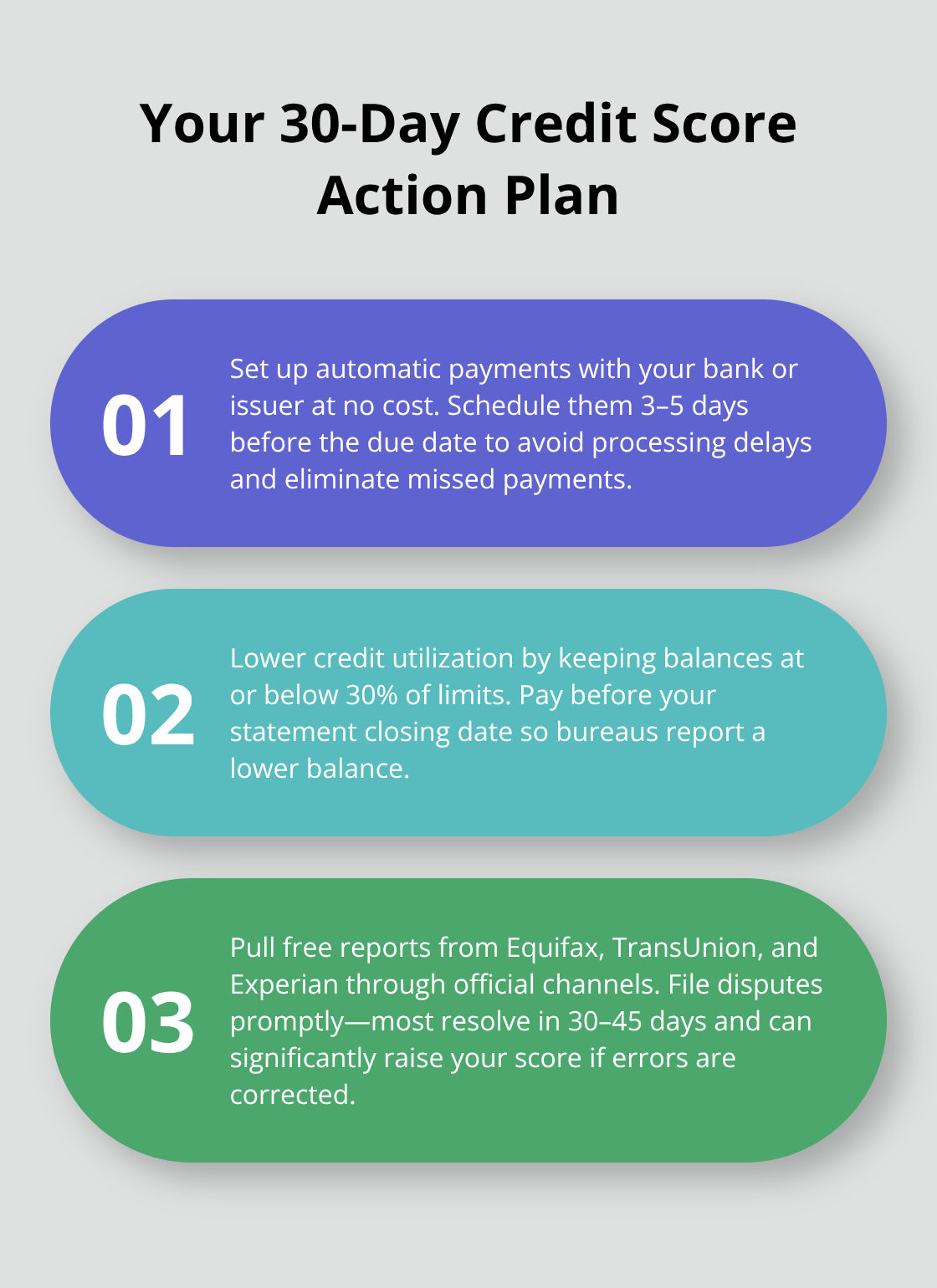
Automatic payments represent the single most effective action you can take right now. TransUnion research confirms that payment history drives 40% of your credit score, and missing even one payment can damage it by 50 to 100 points. Automatic payments eliminate human error entirely-you cannot forget a deadline if the money leaves your account automatically. Most Canadian banks and credit card issuers allow you to schedule automatic payments through their online portals at no cost.
Set payments to go out three to five days before your due date to account for processing delays. If you’ve already missed a payment, contact your lender within 30 days to discuss a repayment plan. Lenders often prefer to work with you rather than report late payments to the credit bureaus, especially if this is your first miss. The speed of your action matters more than the amount you can immediately pay back.
Lower Your Credit Card Balances Strategically
Reducing your credit card balances requires a two-pronged approach: lower your overall debt and time your payments strategically. Since credit utilization accounts for roughly 34% of your score, keeping balances at or below 30% of your limits produces measurable results. If you carry $8,000 across three credit cards with combined limits of $25,000, your utilization sits at 32%-just above the threshold that helps your score. Paying down $500 immediately drops this to 30%.
The tactical advantage comes from paying your balance before your statement closing date, not just before your due date. Credit card companies report your balance to the bureaus on your statement closing date, so a payment made before that date reduces the amount they report. This means you can maintain higher spending during the month and still show lower utilization to lenders. Request credit limit increases on your existing cards every 12 months if you’ve maintained on-time payments-this instantly lowers your utilization ratio without requiring you to pay down debt. Most issuers handle these requests in minutes through their apps.
Identify and Dispute Credit Report Errors
Monitoring your credit report actively identifies errors that directly suppress your score. You’re entitled to free credit reports from Equifax, TransUnion, and Experian through Canada’s official channels, though you may need to pay a small fee in some provinces. Pull your reports at least once annually and check for accounts you don’t recognize, incorrect payment histories, or duplicate entries.
Errors appear frequently-a 2023 study found that roughly 1 in 5 Canadian credit reports contained mistakes. Disputing inaccuracies through the formal dispute process with the bureaus takes 30 to 45 days but can increase your score significantly if errors are corrected. File disputes in writing and include documentation supporting your claim. Do not rely on contacting the original creditor alone; you must dispute directly with the credit bureau. Some errors resolve within weeks, while others require persistence across multiple submissions. The effort pays off because a corrected error removes a genuine drag on your rating.
These three actions form your immediate action plan, but your long-term score depends on understanding which habits actively damage your rating. The next section reveals the mistakes that hold most Canadians back and how to avoid them.
What Mistakes Quietly Destroy Your Credit Score
Late Payments Create Years of Damage
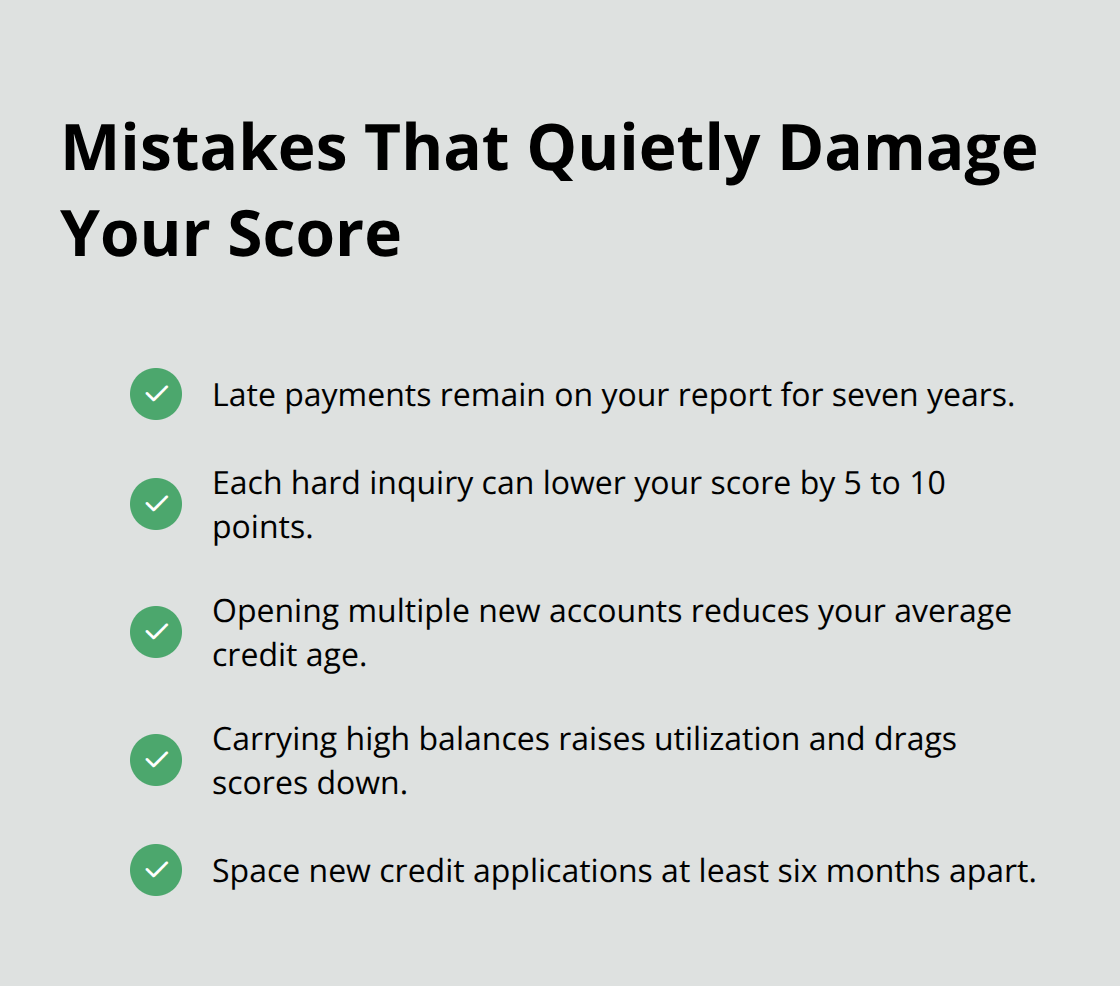
A single missed payment triggers an immediate and severe drop in your credit score. A payment that sits unpaid for 30 days reduces your score by 50 to 100 points, while 60-day and 90-day delinquencies cause progressively worse damage. The painful reality is that late payments remain visible on your credit report for seven years, meaning one mistake from today will shadow your borrowing power for years to come.
Lenders view payment delinquencies as proof that you’re a risky borrower. This perception translates directly into higher interest rates on future loans and credit cards if they approve you at all. The window to minimize damage closes fast. Contact your lender within 30 days and negotiate a repayment arrangement before the account officially defaults.
Lenders report to the credit bureaus monthly, so acting quickly prevents the late payment from appearing on your credit report at all. Once it’s reported, that clock starts ticking.
Multiple New Applications Compound Your Problems
Opening multiple new credit accounts within a short timeframe creates a double damage pattern that most Canadians don’t fully understand. Each application triggers a hard inquiry that temporarily lowers your score by 5 to 10 points. If you apply for three credit cards in one month, you’ve already knocked your score down 15 to 30 points before you’ve even used any new credit.
The second damage comes from the accounts themselves. New accounts lower your average credit history age, which accounts for 15% of your score. Bunching inquiries during a short time frame can help limit the negative impact on your credit score. Spacing applications at least six months apart allows each hard inquiry to age off your report and gives your average account age time to recover.
High Balances on New Cards Amplify the Damage
The third mistake compounds the first two: carrying high balances across multiple cards after opening them. If you open a new card with a $3,000 limit and immediately charge $2,000 to it, your utilization on that single card sits at 67%, which drags down your overall ratio even if your other cards stay under 30%.
The solution requires discipline. Open new credit accounts only when you genuinely need them, resist the urge to max out new accounts, and focus on paying down balances on existing cards before applying for anything else. This approach protects your score from the triple hit of new inquiries, lower average age, and elevated utilization all at once.
Final Thoughts
Building a stronger credit score requires consistent action, not perfection. Most Canadians see measurable improvements within 30 to 45 days of implementing automatic payments and reducing credit card balances, while more substantial gains typically emerge over three to six months as payment history accumulates and utilization ratios stabilize. Your timeline depends on your starting point-if you’re recovering from late payments or high balances, expect slower progress because negative items carry significant weight.
Several resources exist specifically for Canadian consumers who want to track their progress. TransUnion, Equifax, and Experian provide free annual credit reports you can request through official channels, and many Canadian banks now offer free credit score monitoring through their online banking platforms. If you’ve experienced identity theft or need help disputing errors, dedicated restoration specialists can guide you through the formal process.
The foundation of better credit rests on three actions: paying bills automatically, keeping balances low, and monitoring your reports for errors. These credit score tips Canada lenders actually care about aren’t complicated strategies, but they work because they address what matters most to lenders. Start with whichever action feels most manageable this week, then add the others as your habits solidify-or explore our credit score monitoring guide to learn how to track your progress effectively.











Leave a comment