
Your credit score directly affects your ability to borrow money, get approved for mortgages, and secure better interest rates. At Financial Canadian, we’ve seen how small, consistent habits can transform a mediocre score into an excellent one.
The good news is that building credit doesn’t require drastic changes. These credit score tips for Canada focus on practical actions you can start implementing today to see real results.
What Moves Your Credit Score in Canada
Payment history accounts for the largest portion of your credit score dominates your credit score more than anything else. A late payment from 2021 still affects your score today, though its impact weakens over time. Missing even one payment by 30 days can drop your score by 50 to 100 points depending on your overall profile. The solution is straightforward: set up automatic payments for at least the minimum amount due, or better yet, pay your full balance every month. This eliminates interest charges while you build a stronger payment history.
Your Payment Habits Create the Foundation
Lenders view your payment history as the clearest signal of your reliability. Every on-time payment strengthens your score, while each missed payment damages it. The longer you maintain a clean payment record, the more your score recovers from past mistakes. If you struggle with due dates, automatic payments remove the guesswork and protect your score without any effort on your part once you set them up.
Credit Utilization Determines How Much Lenders Trust You
Credit utilization measures how much of your available credit you actually use. If you have a $10,000 credit limit and carry a $6,000 balance across multiple cards, your utilization sits at 60 percent. This ratio matters significantly because it shows lenders whether you can manage credit responsibly. TransUnion Canada recommends keeping credit utilization below 30 percent to support a higher score. The practical approach involves paying down balances strategically rather than opening new credit cards to artificially increase your available credit. Every dollar you pay toward existing balances immediately improves this ratio.
The number 0% seems to be not appropriate for this chart. Please use a different chart type. If you carry high balances, consider using a 0 percent introductory transfer offer to consolidate debt and pay it down without accumulating interest charges during your payoff period.
Credit History Length and Account Variety Work Quietly in Your Favor
Your oldest account and the average age of all your accounts influence your score more than most people realize. A longer credit history generally supports a higher score, which means closing old accounts actually works against you. The variety of credit types you hold also matters. Having a mix of credit cards, an installment loan, and potentially a mortgage demonstrates that different lenders trust you with different types of credit. However, applying for multiple new accounts within a short timeframe signals financial desperation to lenders and temporarily lowers your score. If you need credit, space out applications by at least three to six months. Rent payments can also contribute to your score when reported to credit bureaus (provided you pay on time consistently), offering another avenue to build credit if you’re a renter.
What You Control Right Now
These three factors work together to shape your creditworthiness. Payment history remains non-negotiable-it’s the foundation everything else rests on. Your utilization ratio responds immediately to your actions, making it the fastest lever to pull for quick improvements. Credit history length requires patience, but avoiding unnecessary account closures protects what you’ve already built. With these mechanics in mind, the next section shows you the daily habits that activate these factors and produce measurable results.
Habits That Actually Move Your Score
Knowing what affects your score means nothing if you don’t act on it. The gap between understanding credit mechanics and implementing them is where most Canadians stumble. People get stuck because they treat credit improvement as a one-time project rather than a system of small, repeatable actions. The truth is that your score responds fastest when you build consistency into your daily financial routine.
Set Up Automatic Payments to Protect Your History
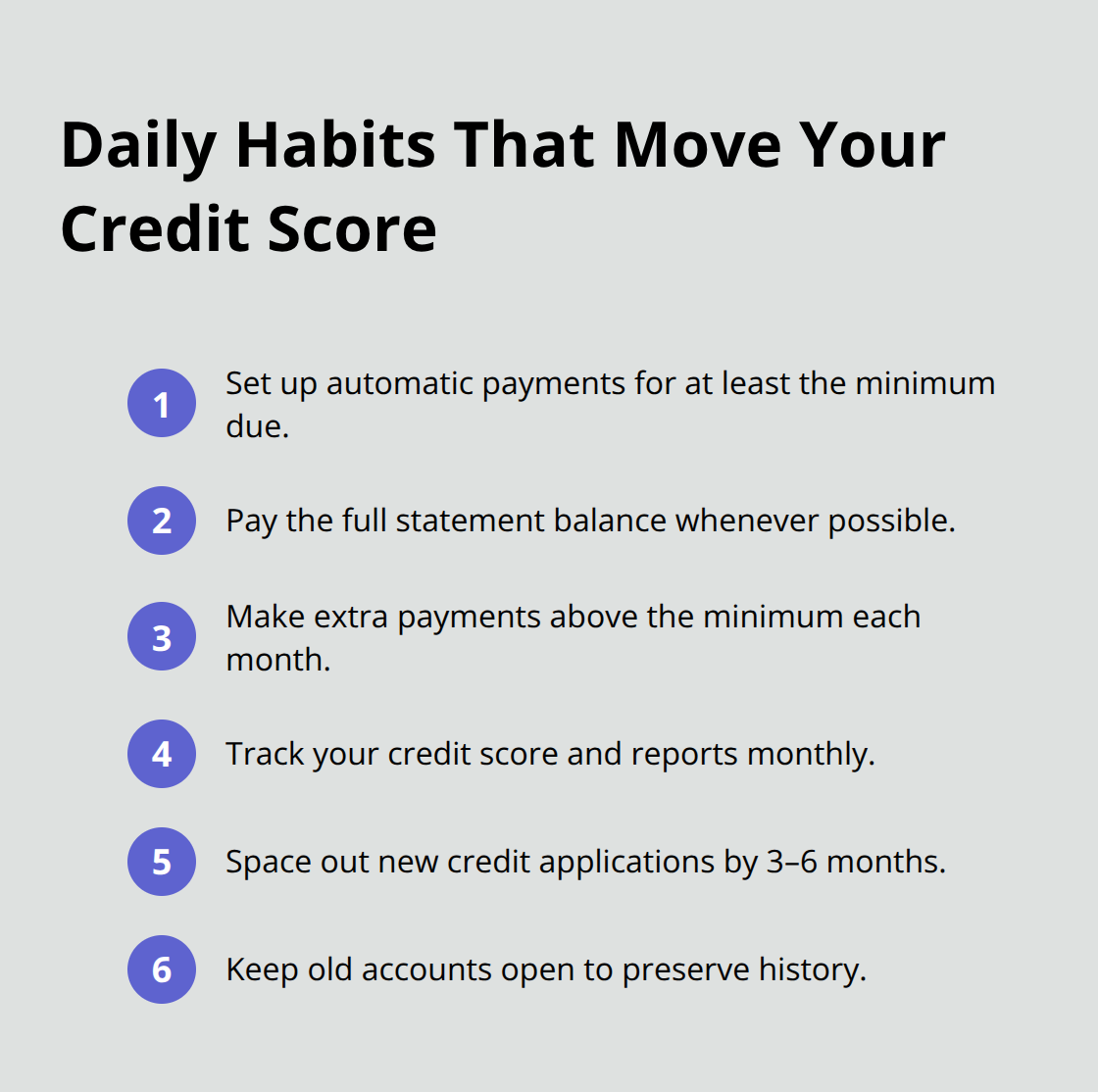
Setting up automatic payments removes emotion and forgetfulness from the equation. Your bank can deduct at least the minimum amount due on your due date automatically, which alone keeps your payment history perfect. This single step takes fifteen minutes and eliminates the most common reason scores drop: missed payments.
However, paying only the minimum costs you significantly in interest charges. If you carry a $6,000 balance on a card charging 21 percent interest, you pay roughly $105 monthly in interest alone before touching the principal. That money disappears. A more aggressive approach involves paying the full statement balance every month, which eliminates interest entirely and drops your utilization to zero immediately after each payment cycle.
Attack Your Balance With Extra Payments
If you cannot pay the full balance, pay as much as possible above the minimum. Even an extra $100 monthly compounds quickly and saves substantial interest costs while improving your credit utilization ratio faster than minimum payments ever could. Some Canadians see dramatic score improvements within three to four months of paying 50 percent more than their minimum, particularly if they started with high utilization.
Consider this concrete example: if you have a $10,000 credit limit with a $6,000 balance sitting at 60 percent utilization, paying just $200 extra per month drops that ratio to 58 percent within thirty days. That single action, repeated monthly, creates compound progress. Within six months of consistent $200 payments, your utilization falls to 48 percent, and your score begins climbing noticeably.
Track Your Progress Monthly
Checking your credit score once a year tells you almost nothing useful. You cannot see patterns, track improvements, or catch errors quickly. Tracking your score monthly reveals exactly how your habits translate into results. When you pay down a $2,000 balance, your score should reflect that improvement within thirty to forty-five days.
If it doesn’t, something is wrong: perhaps the payment hasn’t posted yet, or an error exists on your report. Monthly monitoring catches these issues fast. Many Canadians discover they have duplicate accounts, incorrect late payment records, or fraudulent activity only after reviewing their reports closely. These errors can cost you thirty to fifty points unnecessarily.
Checking monthly also keeps you motivated because you see concrete progress rather than wondering if your efforts matter. The speed of improvement depends entirely on your starting point, but the mechanism is identical for everyone. Once you establish these habits, the next section shows you the mistakes that undo all this progress and how to avoid them.
Common Credit Score Mistakes to Avoid
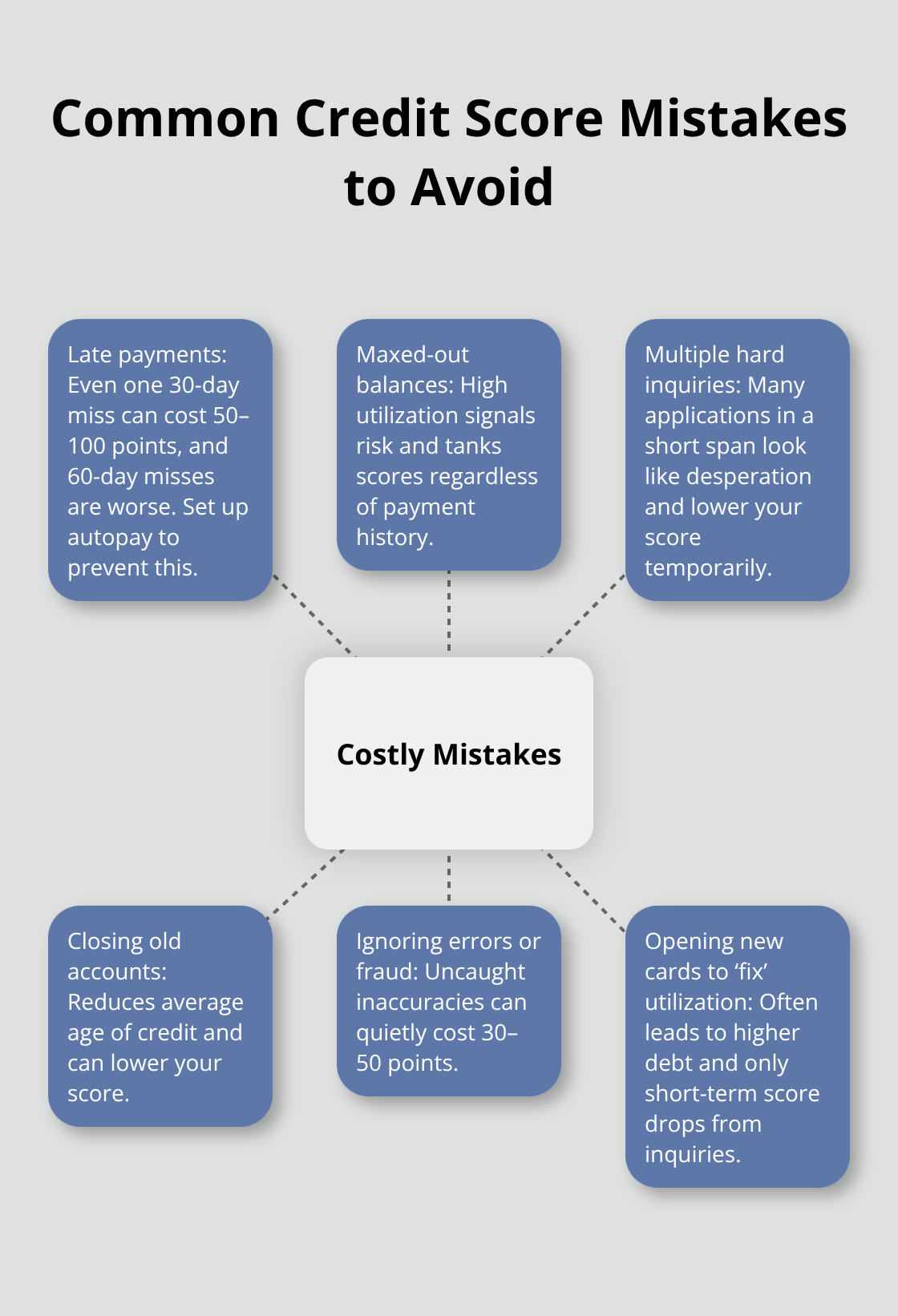
One late payment can erase months of careful credit building, yet many Canadians treat payment deadlines as flexible suggestions rather than hard requirements. A single missed payment stays on your credit report for six years in Canada, and the damage compounds if you miss multiple payments. Missing a payment by 30 days typically drops your score by 50 to 100 points depending on your overall profile. Missing by 60 days causes roughly double that damage. The worst part is that the impact doesn’t fade quickly-a 2021 late payment still damages your score today, though its influence weakens gradually over time. Automatic payments eliminate this risk entirely, yet many Canadians refuse to set them up, treating the extra five minutes of setup as too inconvenient.
If you struggle with remembering due dates, this single excuse costs you more than the effort required to fix it.
High Credit Card Balances Tank Your Score Immediately
The second critical mistake involves maxing out your credit cards, which immediately destroys your utilization ratio. Carrying a $10,000 balance on a $10,000 limit signals financial distress to lenders and tanks your score regardless of your payment history. Worse, high balances trap you in an interest spiral-that $10,000 balance costs you roughly $210 monthly in interest charges alone before you pay down any principal. You’re literally paying the credit card company for the privilege of damaging your score.
Some Canadians convince themselves that opening another credit card reduces their utilization, and technically it does. However, this approach backfires because new account inquiries lower your score temporarily, and the psychological effect of increased available credit often leads to more spending rather than faster payoff. TransUnion Canada data shows that people who open new cards to manage utilization typically maintain higher overall balances than those who focus on paying down existing debt.
Multiple Credit Applications Within Months Signal Desperation
The final mistake involves applying for multiple credit products within a short timeframe, whether that’s new credit cards, car loans, or personal loans. Each application generates a hard inquiry on your credit report and temporarily lowers your score by a few points. Multiple inquiries within 30 days appear as a single inquiry for rate-shopping purposes, but anything beyond that looks like financial desperation to lenders. Spacing applications by at least three to six months prevents this damage and signals that you’re making intentional decisions rather than scrambling for credit.
Final Thoughts
Your credit score improves when you treat it as something you actively manage rather than something that happens to you. Monthly monitoring holds you accountable and shows exactly how your actions translate into results-when your score climbs 15 points after you pay down a $2,000 balance, that concrete feedback reinforces the habit and motivates continued effort. The credit score tips Canada needs are the ones you can sustain for months and years: paying bills on time, keeping balances low, and tracking your progress.
Your timeline for improvement depends on where you start. If you have a recent late payment and high utilization at 60 percent, expect meaningful movement within three to four months of consistent extra payments and on-time behavior (someone with a clean payment history but elevated balances might see a 30 to 50 point improvement within two months of aggressive paydown). The oldest negative marks on your report fade gradually over six years, but their impact weakens significantly after two to three years of perfect payment behavior.
Your next step is simple: pick one habit from this article and implement it this week. Set up automatic payments if you haven’t already, make an extra payment toward your highest balance, or check your credit report for errors. At Financial Canadian, we help you establish the financial systems and resources that support your long-term goals and strengthen your entire financial foundation.










Leave a comment