
Your credit score shapes whether you get approved for a mortgage, what interest rate you’ll pay, and how much financial freedom you actually have. At Financial Canadian, we’ve seen firsthand how a stronger credit score can save Canadians thousands of dollars over their lifetime.
The good news? Your score isn’t fixed. With the right moves, you can improve it faster than you think.
How Your Credit Score Actually Works in Canada
The Five Components That Build Your Score
Your credit score is a three-digit number that lenders use to decide whether you qualify for credit and what interest rate you’ll pay. In Canada, most lenders rely on FICO Scores, with 90% of top lenders using this scoring model according to myFICO. The score ranges from 300 to 900, and understanding how it’s calculated matters far more than chasing a perfect number. FICO breaks down your score into five components: payment history accounts for 35% of your score, amounts owed makes up 30%, length of credit history contributes 15%, new credit accounts for 10%, and credit mix rounds out the remaining 10% according to FICO.
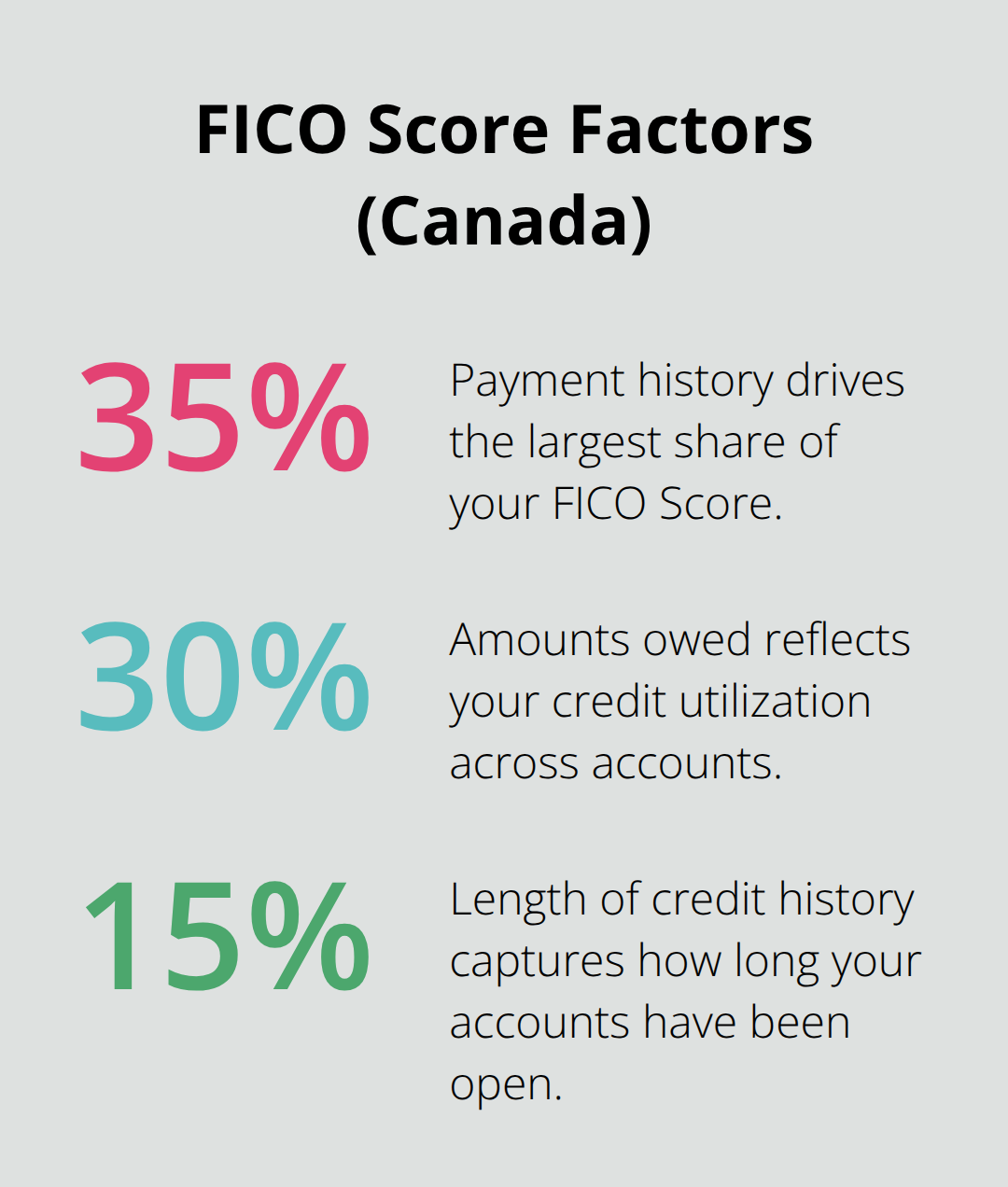
Payment history is the heavyweight champion here-one missed payment can damage your score for years, while consistent on-time payments build momentum faster than most people realize. The amounts owed category measures your credit utilization ratio, which is the percentage of available credit you’re actually using. If you have a $5,000 credit limit and carry a $4,500 balance, you’re at 90% utilization, which signals financial stress to lenders. Keeping your utilization below 30% is ideal, though lower rates are even better for your credit scores.
Why Your Credit History and New Applications Matter
Length of credit history rewards loyalty; closing old accounts actually hurts this factor, so your oldest credit card might be your most valuable financial asset even if you never use it. Hard inquiries happen when you apply for credit and can temporarily lower your score by a few points, while soft inquiries like checking your own score cause no damage whatsoever. Opening multiple new accounts within months signals risk to lenders and triggers a score dip, so spacing out credit applications matters more than most people understand.
How Your Score Translates to Real Money
A score above 750 typically qualifies you for the best mortgage rates and credit card offers, while a score between 650 and 750 puts you in the middle tier where you’ll pay higher rates but still get approved for most products. Below 650, lenders become cautious, and below 600, many mainstream lenders simply won’t work with you. On a $400,000 mortgage, the difference between a 750+ score and a 650 score can mean paying $50,000 to $100,000 more in interest over the life of the loan.
Lenders look beyond just your FICO Score though; they also consider your income, employment history, and the type of credit you’re requesting, so your score is necessary but not sufficient. Your credit report updates as new information arrives, and the timing varies depending on how quickly creditors report to the bureaus. These variables mean that two applicants with identical scores may receive different offers based on their complete financial picture.
Understanding these mechanics sets you up to tackle the specific behaviors that damage your score most-and that’s where most Canadians lose ground without realizing it.
What Damages Your Credit Score Most
Late Payments: The Most Expensive Mistake
A single late payment can reduce your score by 100 points or more, depending on how late it is and your current score level. A payment 30 days late damages your score differently than one 90 days late, and lenders report these delinquencies to credit bureaus on different timelines, so timing matters enormously. The damage compounds over time too: a late payment from six months ago hurts less than one from last month, but late payment reporting timelines to Canadian credit bureaus can remain on your credit report for up to seven years. This is why payment history accounts for 35% of your FICO Score-lenders care most about whether you actually pay what you owe.
Missing even one payment creates a permanent record that future lenders see, and it’s far easier to prevent this damage than to recover from it. Set up automatic payments for at least the minimum amount due, or better yet, use calendar reminders for payment dates two days before they’re due. If you’ve already missed a payment, catching up immediately stops the bleeding, though the damage to your score remains until time passes.
High Credit Utilization: The Silent Score Killer
High credit utilization is the second major score killer, and many Canadians don’t realize they’re damaging their score every single month. If you carry a $3,000 balance on a $5,000 limit, you’re at 60% utilization, which signals financial stress even if you pay on time. Dropping that balance to $1,500 brings you to 30% utilization and immediately starts rebuilding your score, though the improvement isn’t instantaneous.
The amounts owed category measures how much of your available credit you’re actually using, and lenders view high utilization as a warning sign. Lenders typically prefer that you use no more than 30% of your available credit. Paying down balances faster than minimum payments accelerates your score recovery and demonstrates financial control to future lenders.
Multiple Credit Applications and Hard Inquiries
Hard inquiries from credit applications stack up quickly and each one knocks a few points off temporarily, but the real danger is the pattern they create. Applying for three credit cards in two months tells lenders you’re desperately seeking credit, triggering a score drop that can last months. Spacing applications six months apart prevents this damage entirely. The hard inquiry itself fades after about three months, so your score recovers faster than most people expect, but the damage from multiple new accounts stays longer because credit bureaus track account age.
Close old accounts carefully since closing them actually increases your utilization ratio on remaining accounts-if you have two cards with $5,000 limits each and close one, your utilization percentage jumps even if your balance stays the same. This counterintuitive effect catches many Canadians off guard and undoes months of score improvement in a single decision.
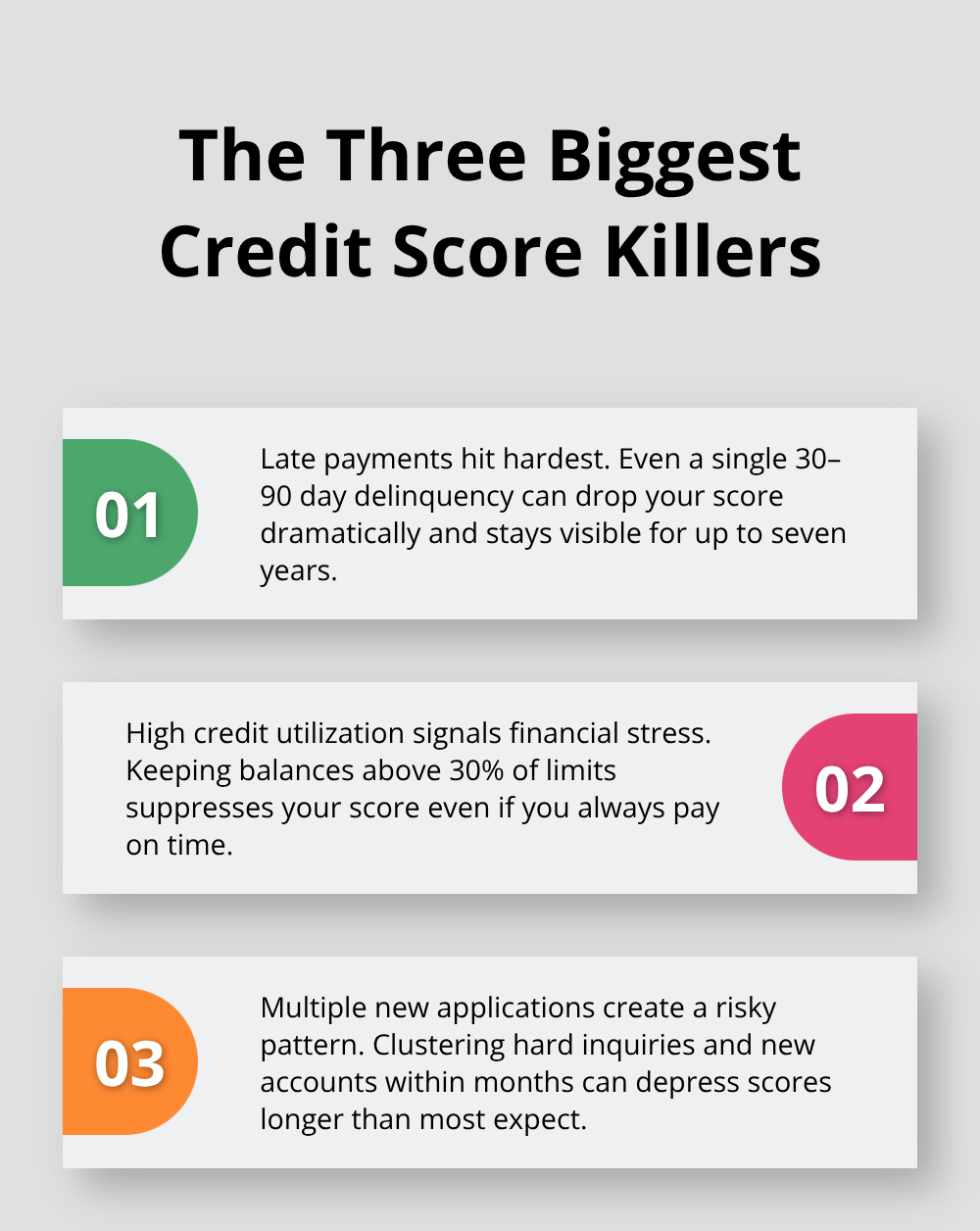
Understanding these three damage patterns positions you to avoid the mistakes that hold most people back. The next section reveals the specific strategies that actually work to reverse this damage and build momentum toward a stronger score.
How to Actually Rebuild Your Credit Score
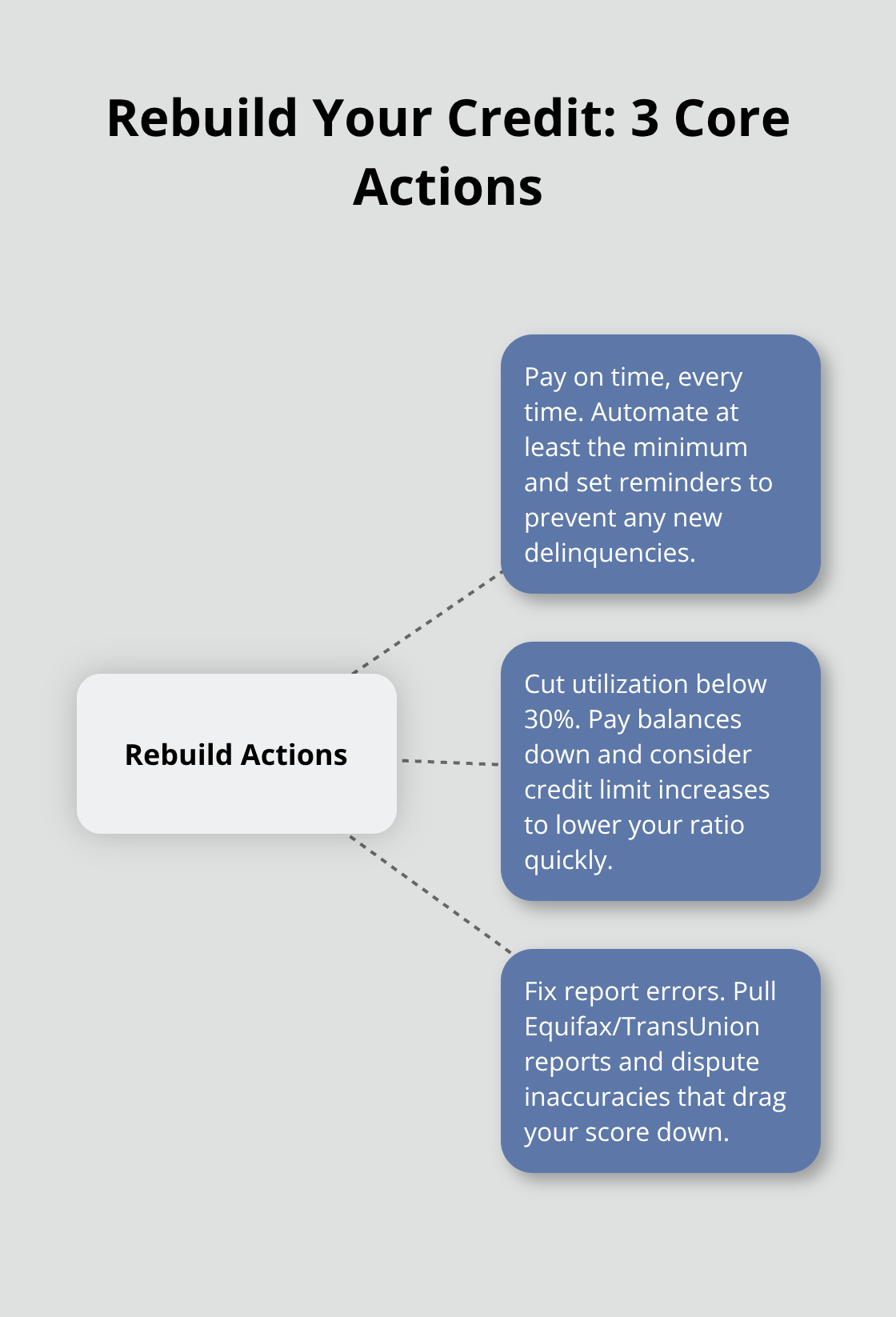
Fixing your credit score requires three distinct actions, and skipping any one of them will slow your progress dramatically. The first action is non-negotiable: you must stop the damage by making every single payment on time from this moment forward. Set up automatic payments through your bank for at least the minimum amount due on every credit account, or better yet, schedule them for the full balance if possible. One missed payment resets your momentum and adds another delinquency mark to your credit report that lasts seven years. If you’ve already missed payments, contact your creditor immediately and catch up, even if it requires cutting expenses elsewhere. The damage from the missed payment remains, but stopping further damage prevents the situation from deteriorating.
Two weeks before each payment due date, check your account balance to confirm the automatic payment will process, because technical failures aren’t an excuse that lenders accept.
Attack Your Credit Utilization Aggressively
The second action targets your credit utilization, which improves faster than payment history when you attack it aggressively. If you carry balances above 30% of your limits, your priority is paying those down, not paying off debt completely. A $5,000 balance on a $10,000 limit at 50% utilization hurts your score far more than the same balance on a $20,000 limit at 25% utilization, so requesting credit limit increases from your current lenders actually helps your score without increasing your spending. Contact your card issuer and ask for a limit increase; many approve these within days without a hard inquiry. Alternatively, pay balances down to below 30 percent immediately, even if you’re not paying off the entire balance yet. You’ll see score improvement within 30 to 45 days of reducing utilization, which is faster than most people expect.
Verify Your Credit Report for Errors
The third action involves verifying that your credit report contains no errors, because mistakes on your report directly damage your score. Request a free credit report from Equifax or TransUnion and scan it carefully for accounts you don’t recognize, incorrect payment statuses, or balances that don’t match your records. Disputing inaccurate information takes weeks or months, but successful disputes remove damaging false information that’s dragging your score down unnecessarily. If you find errors, file a dispute online with the credit bureau immediately rather than waiting, since corrections compound your other improvement efforts.
Final Thoughts
Building a stronger credit score in Canada requires consistency, not perfection. The three actions we’ve outlined-making every payment on time, reducing your credit utilization below 30%, and fixing errors on your credit report-work together to rebuild your financial reputation with lenders. Most Canadians see measurable score improvements within 30 to 45 days of attacking their utilization ratio, while payment history improvements take longer but compound over months and years.
Your timeline depends on your starting point. If you’re recovering from recent late payments, expect six to twelve months of consistent behavior before you see dramatic score movement. If your main issue is high utilization, you could see 50 to 100 point improvements within two months of paying balances down. Credit scores Canada residents check today reflect decisions made weeks or months ago, so patience matters as much as action.
Monitor your credit report quarterly through free reports from Equifax or TransUnion, watching for new errors or fraudulent accounts that could derail your progress. Set calendar reminders for payment dates, keep utilization below 30% permanently, and resist opening new credit accounts unless absolutely necessary. Your oldest accounts are assets that improve your score through length of credit history, so protect them even after you’ve paid them off.











Leave a comment