
Your credit score shapes your financial future in Canada. It determines whether you qualify for loans, what interest rates you’ll pay, and how lenders view your reliability.
We at Financial Canadian created this credit scores Canada guide to show you exactly how to build and protect your score. Whether you’re starting from scratch or recovering from past mistakes, the strategies here work.
How Your Credit Score Gets Calculated and What It Means
Your credit score in Canada is a three-digit number between 300 and 900 that reflects your borrowing history. Equifax and TransUnion, Canada’s two major credit bureaus, calculate this score based on five key factors. Payment history makes up 35 percent of your score, which means a single missed payment can drop your score by 50 to 100 points. Credit utilization accounts for 30 percent, so maxing out your credit cards signals financial stress to lenders even if you pay on time. The length of your credit history counts for 15 percent, which explains why closing old accounts actually hurts your score.
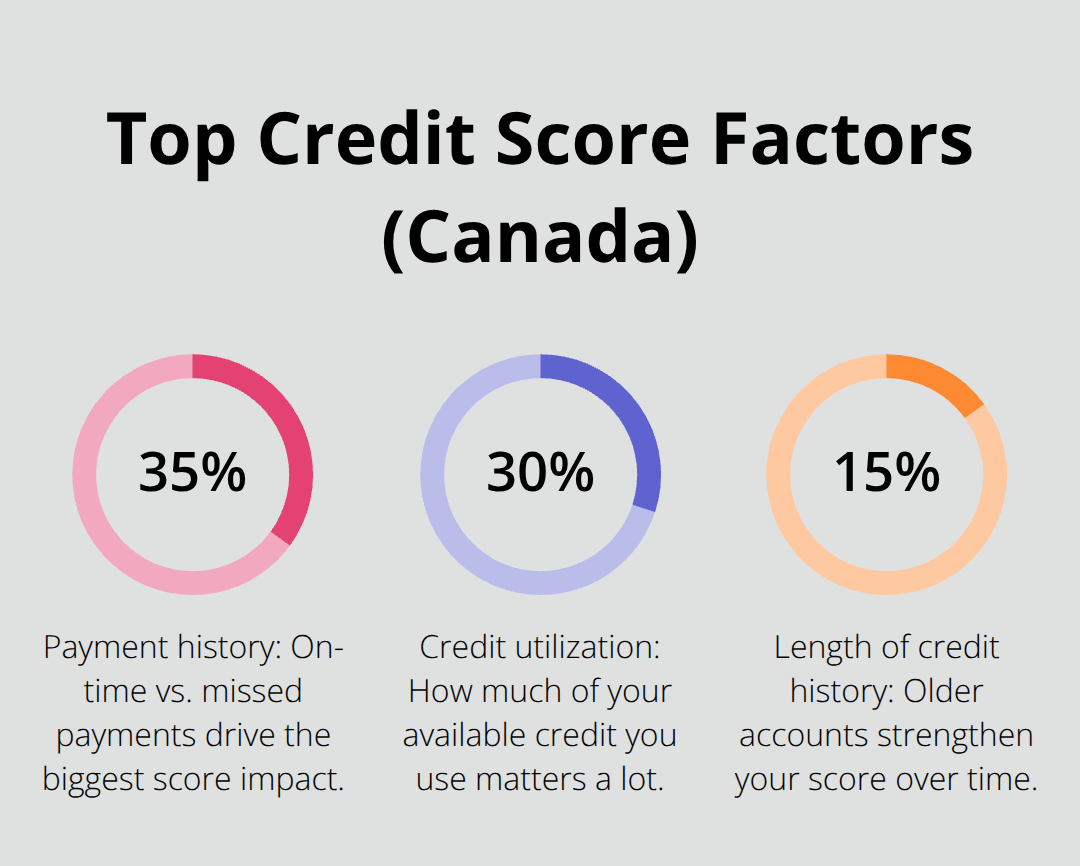
New credit inquiries represent 10 percent, and a hard inquiry from applying for credit can lower your score by 5 to 10 points. The final 10 percent comes from your credit mix, meaning a variety of credit types like credit cards, car loans, and mortgages strengthens your profile.
Understanding the Score Ranges That Matter
A score above 760 is considered excellent and qualifies you for the best interest rates available. Most lenders view scores between 700 and 759 as good, and you’ll qualify for most loans at reasonable rates. The 660 to 699 range is considered fair, but you’ll face higher interest rates and stricter lending conditions. Below 660 puts you in poor territory where lenders either reject your application or charge significantly higher rates.
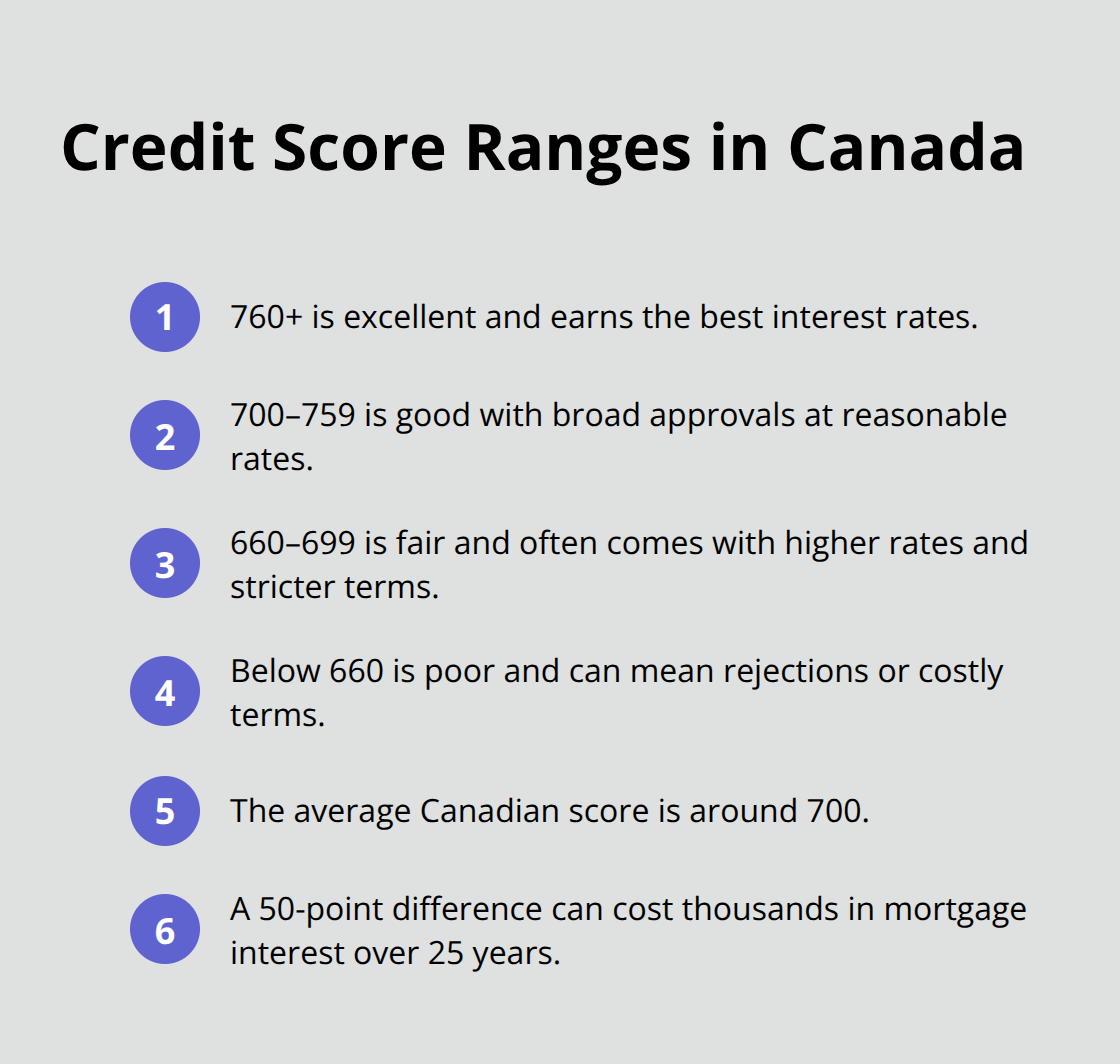
For context, the average Canadian credit score sits around 700 according to Equifax data. A score difference of just 50 points can cost you thousands in extra interest on a mortgage over 25 years.
How Your Score Directly Impacts Your Borrowing Costs
Mortgage rates shift dramatically based on your score. Someone with a 750 score might qualify for a 5.2 percent rate, while a person with a 650 score could face 6.8 percent on the same $400,000 mortgage. Over 25 years, that difference amounts to roughly $150,000 in additional interest paid. Credit card companies use your score to determine your interest rate and credit limit. A strong score gets you cards with rates around 19.99 percent, while weaker scores face rates above 21 percent. Car loan rates follow the same pattern, with a 100-point score difference potentially adding $2,000 to $3,000 in interest over a five-year loan.
What Happens Next
Your score determines your borrowing power, but you control the factors that build it. The next section shows you exactly how to improve your score through specific actions that work.
How to Actively Improve Your Credit Score
Master Payment History to Stop Score Damage
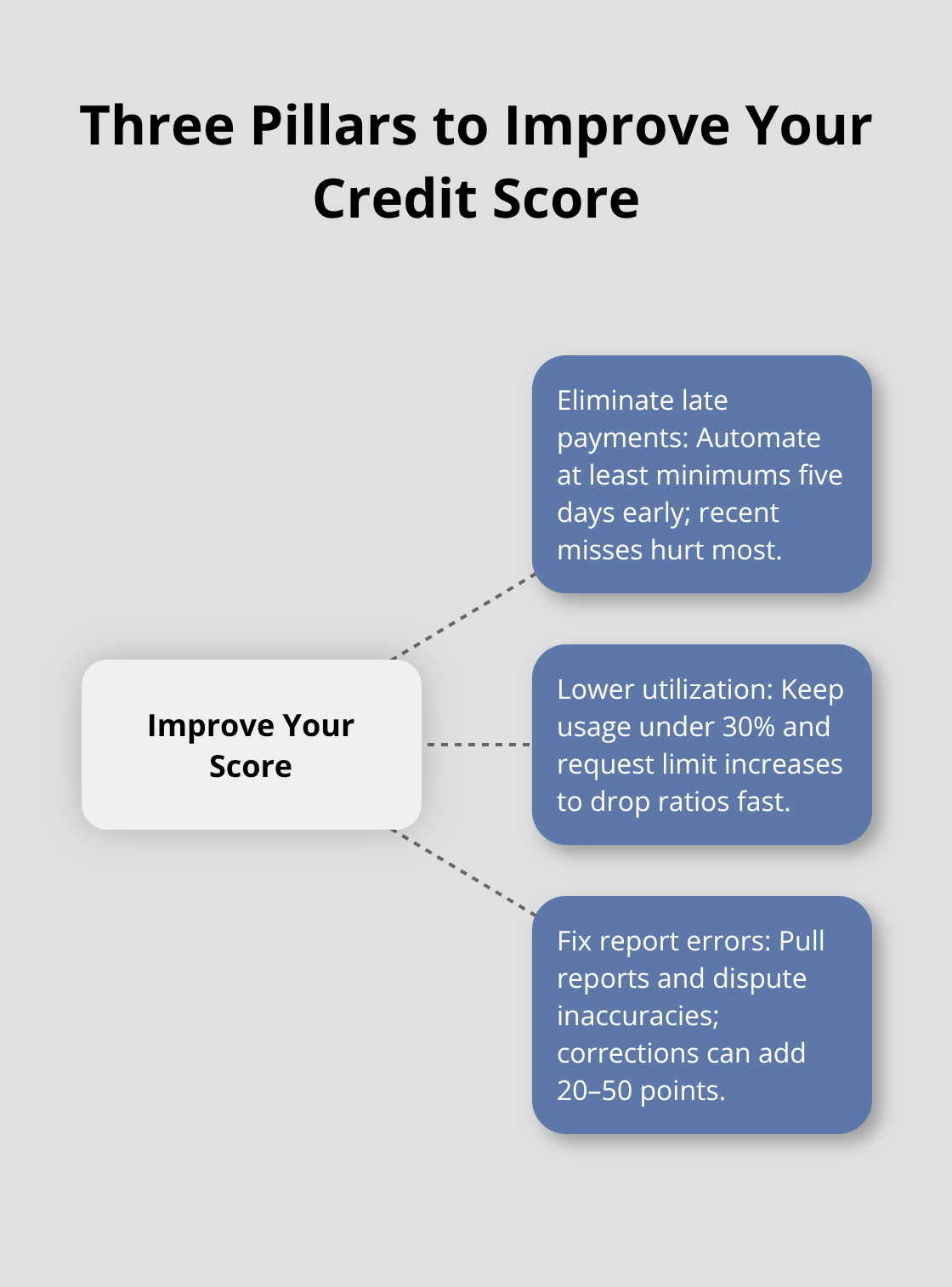
Payment history controls 35 percent of your credit score, making it your most powerful lever for improvement. Set up automatic payments for at least the minimum amount on every credit obligation five days before the due date. This eliminates the human error that causes most credit damage. If you’ve missed payments in the past, the impact fades over time, but recent missed payments hurt far more than older ones. A missed payment from six months ago affects your score roughly twice as much as one from two years ago. Start paying on time now, and you’ll see measurable improvement within three to six months as older delinquencies age out of your credit profile.
Lower Your Credit Utilization Ratio Quickly
Credit card balances represent the second-largest factor in your score at 30 percent, and this is where most Canadians leave money on the table. Your credit utilization ratio measures how much of your available credit you’re using, and keeping it below 30 percent signals responsible borrowing to Equifax and TransUnion. If you have a credit card with a $5,000 limit, try to carry no more than a $1,500 balance. The math is straightforward: someone with $8,000 in balances across $30,000 in available credit sits at 27 percent utilization and gets better scoring treatment than someone with the same $8,000 in balances across $20,000 in available credit at 40 percent utilization.
Pay down balances aggressively rather than spreading payments across multiple cards. Focus your payments on the card with the highest utilization ratio first, which produces faster score improvements than distributing payments evenly. Request credit limit increases from your existing card issuers without applying for new credit. This boosts your available credit and lowers your utilization ratio instantly without triggering hard inquiries.
Identify and Fix Errors on Your Credit Report
Your credit report itself often contains errors that drag down your score unfairly. Request your free annual credit report from Equifax or TransUnion and review it thoroughly for inaccuracies. Common errors include accounts listed twice, incorrect payment statuses marked as late when you paid on time, or accounts that don’t belong to you.
If you find errors, file a dispute directly with the credit bureau that reported the mistake. Provide documentation supporting your claim, and the bureau must investigate within 30 days. Correcting even one major error can boost your score by 20 to 50 points depending on the severity. Don’t assume your report is accurate simply because you’ve managed your credit well. Mistakes happen, and catching them early prevents long-term damage to your borrowing power.
What Comes Next
These three actions-eliminating late payments, reducing utilization, and fixing errors-form the foundation of score improvement. The next section shows you how to protect your score from damage and recover if fraud or other problems strike your credit profile.
Protecting Your Credit From Damage and Fraud
Your credit score improves slowly but gets damaged fast. A single missed payment can drop your score 50 to 100 points, while identity theft or fraudulent accounts take months to recover from. The best strategy involves catching problems before they destroy your score, not after.
Monitor Your Credit Report for Fraud and Errors
Check your credit report from Equifax or TransUnion at least twice yearly, and watch for accounts you don’t recognize, payment statuses that don’t match your records, or personal information that’s incorrect. Fraudsters opened accounts in the names of Canadians in 2023, and most victims discovered the theft only after their credit score tanked. Set phone reminders to review your report every six months so fraud doesn’t go undetected for years.
If you spot unauthorized accounts, dispute them immediately with the credit bureau and file a police report. The bureau must investigate within 30 days, and you’ll get a fraud alert added to your file that makes it harder for thieves to open new accounts in your name.
Avoid High-Risk Financial Behaviors
Certain financial behaviors trigger score drops that take years to reverse. Closing old credit accounts might seem smart, but it shrinks your available credit and eliminates your credit history length, both factors that hurt your score significantly. Try to keep old accounts open even if you don’t use them, since the age of your oldest account matters.
Hard inquiries from applying for new credit drop your score 5 to 10 points each, so avoid applying for multiple credit cards or loans within short timeframes. Space applications at least three months apart to minimize damage (this is especially important when you’re shopping for mortgages or car loans).
Rebuild Your Credit After Damage
If you’ve already damaged your credit through missed payments or high balances, recovery is possible but requires patience. Recent damage hurts more than older mistakes, so focus on perfect payments now and watch your score climb steadily. Someone with a missed payment from two years ago sees far less damage to their current score than someone with a recent missed payment.
Rebuilding typically takes 12 to 24 months of clean payment history to move from fair to good range, though the exact timeline depends on how severe the original damage was and how aggressively you tackle utilization ratios. The key is consistency-every month of on-time payments and low balances strengthens your profile and moves you closer to better interest rates and lending terms.
Final Thoughts
Your credit score determines your financial opportunities in Canada, and this credit scores Canada guide has shown you the specific strategies that work. Paying bills on time, reducing credit card balances, and fixing report errors form the foundation of score improvement. These aren’t theoretical suggestions-they produce measurable results within months.
Request your free credit report annually from Equifax or TransUnion and review it for errors. Set up automatic payments to eliminate missed payment risk, request credit limit increases to lower your utilization ratio, and monitor your report twice yearly to catch fraud before it damages your score. These actions cost nothing and take minimal time, yet they protect your borrowing power and save thousands in interest over your lifetime.
Start with one action today-pull your credit report if you haven’t checked it in the past year and identify one area to improve. We at Financial Canadian believe that strong financial health requires both smart credit management and a professional online presence, so explore our web design service to establish the digital foundation that supports your financial goals.









Leave a comment