
Credit card reward points can be worth anywhere from 0.5 cents to over 2 cents each, depending on how you redeem them. Most Canadians leave significant value on the table by not understanding point calculations.
We at Financial Canadian will show you exactly how to calculate the value of credit card reward points and maximize your returns. The right redemption strategy can double or triple your rewards value.
Types of Reward Programs Available in Canada
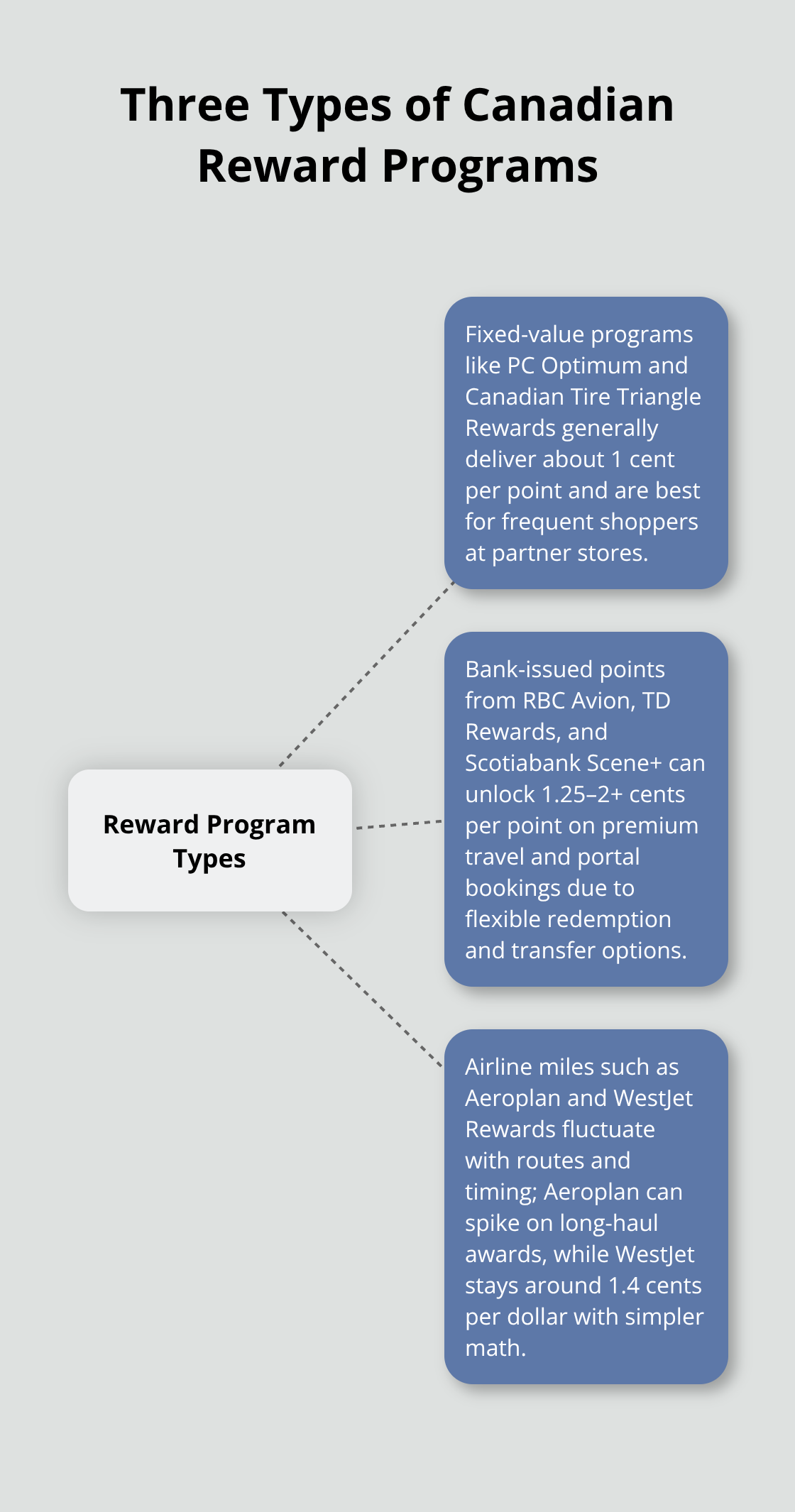
Canadian reward programs fall into three distinct categories, each with different value potential and redemption flexibility. Fixed-value programs like PC Optimum and Canadian Tire Triangle Rewards offer predictable 1-cent-per-point value but restrict your redemption options to specific retailers. These programs work best for frequent shoppers at partner stores but provide minimal flexibility for travel or cash redemptions.
Bank-Issued Points Programs Deliver Maximum Value
Major Canadian banks operate the most lucrative reward programs through cards like RBC Avion, TD Rewards, and Scotiabank Scene+. TD Rewards points typically provide 0.5 cents per point for cash redemptions but jump to 1.25 cents when you book travel through their portal. RBC Avion points offer similar baseline value but can reach 2+ cents per point for premium travel bookings.
Chase Ultimate Rewards and American Express Membership Rewards (while technically US programs) remain accessible to Canadian cardholders and consistently deliver 1.5-2.3 cents per point when transferred to airline partners. Bank programs win because they offer multiple redemption paths and transfer partnerships that multiply point value significantly.
Airline Miles Demand Strategic Approach
Air Canada Aeroplan and WestJet Rewards operate as distance-based programs where point values fluctuate dramatically based on route demand and timing. Aeroplan points vary in value depending on travel itinerary and demand periods, with seats subject to availability. WestJet Rewards maintains more stable rates at roughly 1.4 cents per dollar, which makes calculations simpler but limits peak value opportunities.
Cash Back Programs Offer Guaranteed Returns
Cash back programs like Tangerine Money-Back and Simplii Financial offer fixed 0.5-2% returns with zero complexity. These programs appeal to users who prefer guaranteed value over optimization strategies, though they cap your maximum potential returns.
Now that you understand the three main program types, you need specific formulas to calculate exactly what your points are worth across different redemption scenarios.
How Do You Calculate Point Values
The basic formula for point value calculation divides the cash price by the number of points required, then multiplies by 100 to get cents per point. A $300 flight that costs 20,000 points equals 1.5 cents per point ($300 ÷ 20,000 × 100). This calculation becomes your baseline for comparison across different reward programs. You must subtract taxes and fees from the cash price before calculation, since these costs apply regardless of payment method.

Compare Multiple Redemption Paths for Maximum Value
Smart cardholders calculate point values across all available redemption options before they choose. TD Rewards points worth 0.5 cents for cash back jump to 1.25 cents when you book travel through their portal. RBC Avion points provide similar baseline value but reach 2+ cents per point for premium cabin flights to Europe or Asia. American Express transfer partners include 20 different hotel and airline loyalty programs for maximum flexibility. The difference between worst and best redemption options often exceeds 300%, which makes comparison calculations essential for maximum returns.
Travel Bookings Reveal True Point Potential
Travel redemptions typically offer the highest point values, but calculations must account for route-specific rates and availability. Aeroplan points provide exceptional value on long-haul flights during off-peak periods, often reaching 2.5-3 cents per point for business class redemptions to Europe. WestJet Rewards maintains consistent 1.4 cents per dollar value across most routes (which makes calculations predictable). When using points for free hotel nights, each World of Hyatt point is worth 1.8 cents, while Marriott Bonvoy points typically deliver 0.8-1.2 cents per point based on property category and location.
Factor in Opportunity Costs and Fees
Point calculations require you to consider what you lose when you redeem versus save points for future use. Cash purchases earn you new points or miles that you miss when you use rewards now. Hotel bookings often include resort fees and taxes based on cash rates (regardless of point redemptions). Mixed redemptions that combine points and cash need adjusted calculations where you subtract the cash portion from the total cash price before you divide by points used.
Once you master these calculation methods, you need proven strategies to maximize your rewards across different spending categories and redemption scenarios.
How Can You Maximize Your Credit Card Rewards
Transfer your points to airline partners for the highest possible redemption values, especially during promotional periods when airlines offer bonus points. American Express Membership Rewards points transferred to Air Canada Aeroplan during transfer bonuses can reach high values for business class flights to Europe. Chase Ultimate Rewards points transferred to World of Hyatt consistently deliver strong value, while transfers to Southwest Airlines provide good redemption rates. Cash back redemptions cap at 1 cent per point and leave significant value on the table compared to travel transfers.
Time Your Purchases for Maximum Point Multipliers
Canadian credit cards offer bonus categories that multiply your points by 2-5x during specific periods. RBC Avion Visa Infinite offers 2x points on travel purchases year-round, while Scotiabank Gold American Express provides 5x points on groceries, restaurants, and gas (up to $2,500 monthly). TD First Class Travel Visa Infinite delivers 3x points on travel booked through their portal. Focus your major purchases during these bonus periods and shift expenditures to maximize category bonuses.

Purchase gift cards at grocery stores during 5x periods to effectively earn bonus points on all future categories.
Select High-Value Transfer Partners
World of Hyatt consistently provides excellent hotel transfer value across most properties. Air Canada Aeroplan offers exceptional value for long-haul business class flights, particularly to Europe and Asia during off-peak periods. Southwest Airlines transfers work best for domestic North American travel with competitive redemption rates. Marriott Bonvoy transfers typically underperform compared to direct hotel bookings through other programs.
Avoid These Point Devaluation Traps
Never redeem points for merchandise or gift cards since these options typically provide poor value. Airlines frequently devalue their programs – Air Canada has made changes to their Flight Reward Chart with a combination of increases and decreases, while WestJet eliminated fixed-point rates in favor of dynamic rates that increase costs during peak periods. Hotel programs like Marriott Bonvoy regularly move properties between award categories and increase point requirements overnight. Redeem your points quickly after you earn them rather than hoard for future use, since program devaluations consistently outpace inflation rates across all major loyalty programs.
Final Thoughts
Point value calculations turn your credit card rewards into a powerful wealth-building tool. The difference between 0.5 cents and 2+ cents per point creates thousands of dollars in annual value for strategic cardholders. You calculate the value of credit card reward points with a simple formula: divide cash price by points required, then multiply by 100.
Transfer points to airline and hotel partners instead of cash redemptions to maximize value. Focus spending on bonus categories during promotional periods to multiply your returns. Redeem points quickly since program devaluations reduce value faster than inflation across all major loyalty programs.
Track your point values across different redemption options and use online calculators to identify the best deals. Premium cards often justify their annual fees through increased rates and transfer partnerships (especially for high spenders). We at Financial Canadian provide comprehensive web design services that help businesses establish strong digital presence and drive growth.










Leave a comment