
Canadians carry an average of $22,837 in personal debt, excluding mortgages, according to TransUnion data. If you’re struggling with multiple debts, you’re not alone-and the good news is that a structured approach works.
At Financial Canadian, we’ve created this guide to help you build a clear debt management strategy. The steps ahead will show you how to assess your situation, choose the right repayment method, and use tools that actually accelerate your progress toward being debt-free.
Know Your Debt Before You Fix It
Start by writing down every debt you owe, along with the interest rate attached to each one. This isn’t fun, but it’s non-negotiable. Credit card debt in Canada typically carries rates between 19% and 22%, while personal loans average around 8% to 10%, and car loans sit closer to 5% to 7%. The difference matters enormously. A $5,000 credit card balance at 20% costs you roughly $1,000 per year in interest alone if you only make minimum payments. That same $5,000 on a personal loan at 9% costs around $450 annually. This is why knowing your exact rates transforms everything that follows.
Calculate What You Actually Owe Each Month
Grab a spreadsheet or use a simple document and list each debt with three columns: the balance, the interest rate, and your current minimum payment. Add them up. This total is your starting point, and it’s often shocking. If you have $15,000 in credit card debt, $8,000 in a personal loan, and $3,200 in payday loans, you’re looking at $26,200 in unsecured debt before considering car payments or lines of credit.
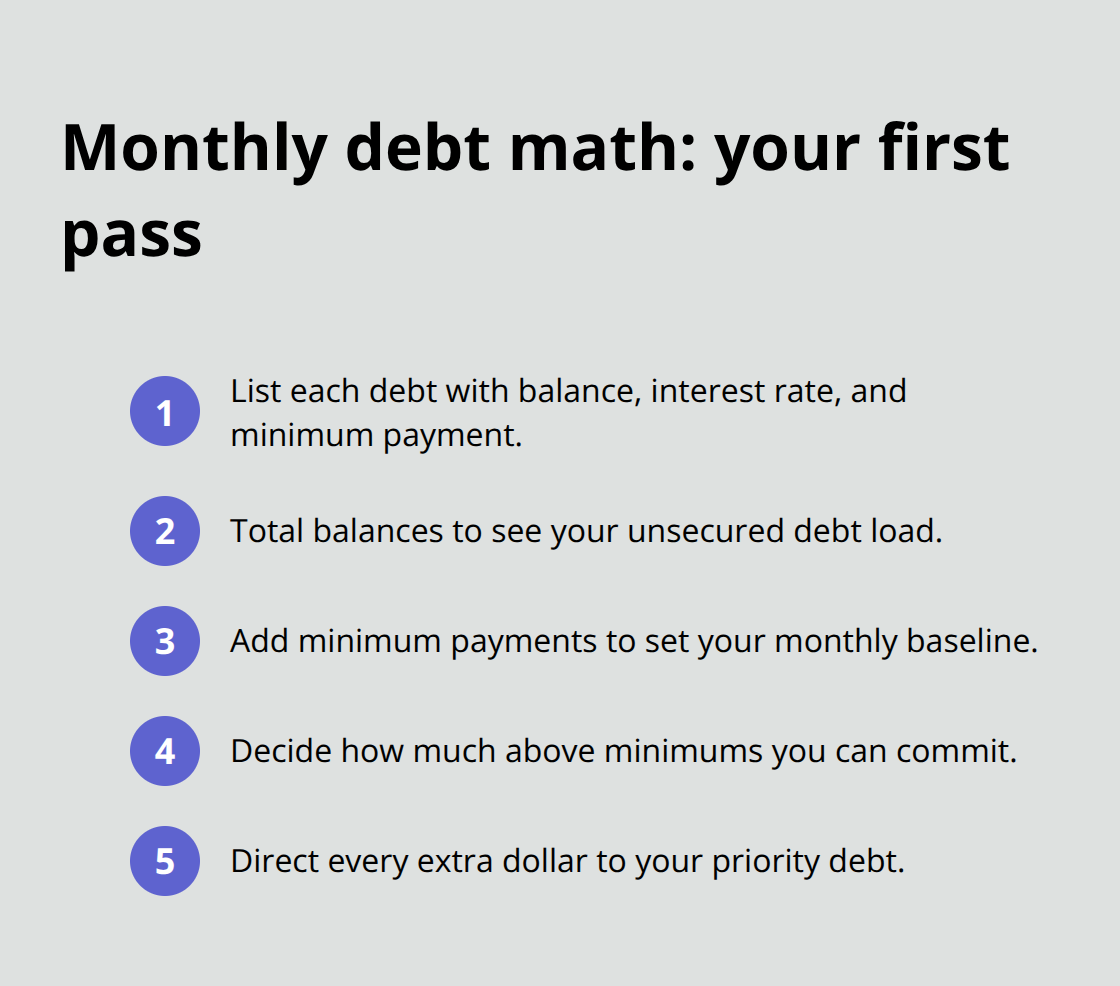
Now look at your minimum payments across all these debts. If they total $650 per month, that’s money you’re already committed to spending. The real question becomes: can you pay more than minimums, and if so, how much? This determines whether you’ll be debt-free in five years or fifteen.
Identify Which Debts Are Destroying Your Finances
High-interest debt is the enemy. Payday loans in Canada are capped at $1,500, but they’re also catastrophically expensive. Credit card debt comes second. Cash advances on credit cards accrue interest immediately and often carry extra fees, so if you’ve used this option, treat it as a priority. The snowball method works here: you pay minimums on everything else while you throw extra money at your highest-rate debt. Once that’s gone, you redirect that payment to the next highest-rate debt. A person who pays $100 per month on a $1,000 credit card balance clears it in roughly 10 months. The same person who pays only $50 stretches it to about 20 months. The difference is time and compounding interest working against you. Your monthly cash flow determines your speed toward freedom.
Move Forward With Your Strategy
Once you’ve identified your high-priority debts and calculated your available monthly cash flow, you’re ready to choose a repayment method that actually fits your situation. The next section shows you how to select between proven strategies and set payment targets that you can sustain.
Pick the Right Repayment Method for Your Situation
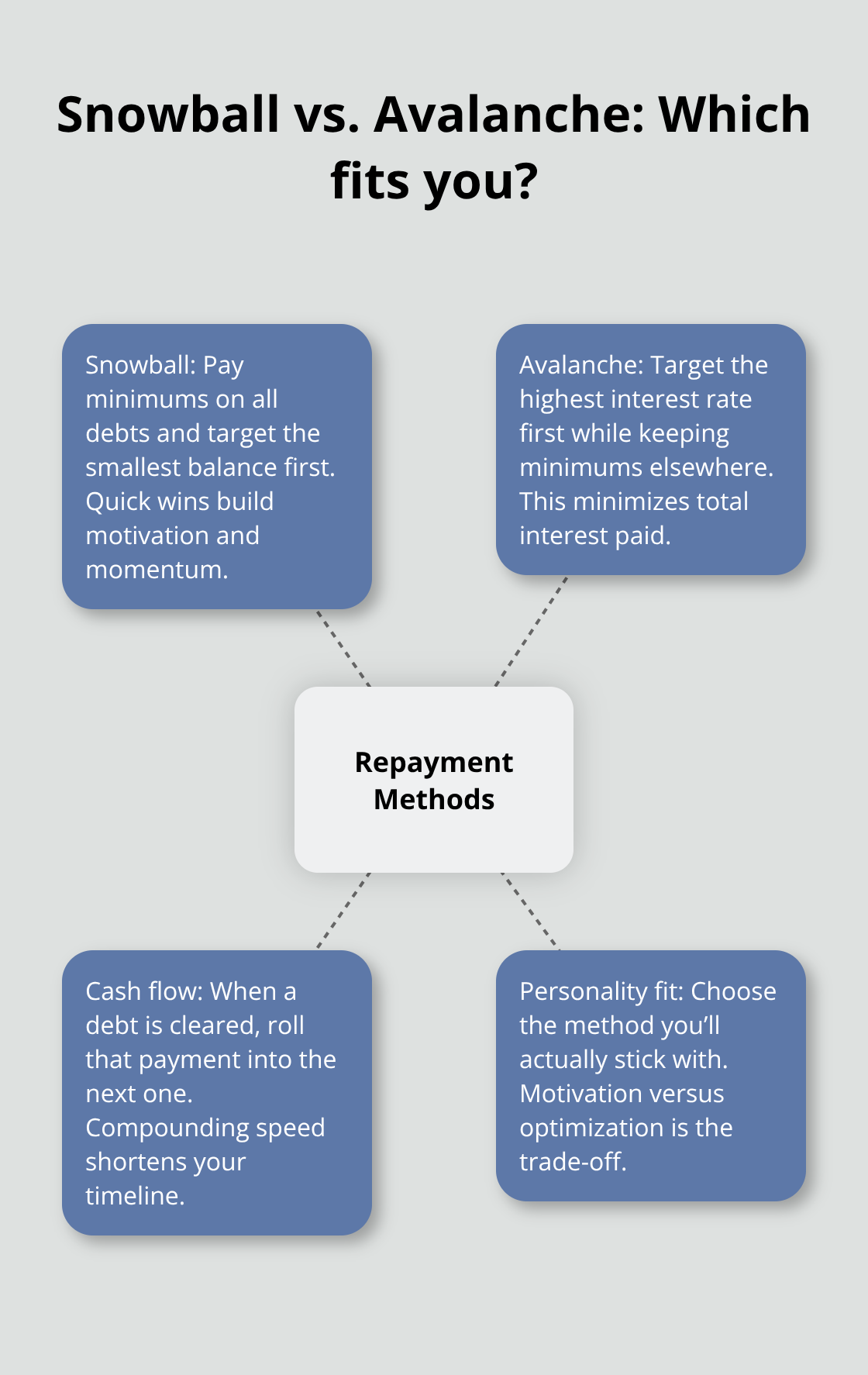
The debt snowball method and debt avalanche method aren’t equally effective for everyone, and we need to be honest about which one actually works. The snowball method asks you to pay minimums on everything, then throw extra money at your smallest debt first. Once it’s gone, you roll that payment into the next smallest debt. Psychologically, it feels good to eliminate debts quickly, and that momentum matters when you’re fighting discouragement. However, the avalanche method is mathematically superior if your goal is to pay the least interest possible. With avalanche, you focus on paying the loan with the highest interest rate first while maintaining minimums elsewhere.
A person with a $3,000 credit card balance at 20% and a $5,000 personal loan at 8% should absolutely prioritize the credit card. That 20% rate costs roughly $600 yearly in interest alone. The personal loan at 8% costs only $400 annually. Attacking the credit card first saves hundreds of dollars over time.
Choose Your Method Based on Your Personality
The snowball method works better for people who struggle with motivation and need quick wins. The avalanche works for people who want to minimize total interest paid and have the discipline to stick with it even when progress feels slow on the first debt. Choose based on your personality, not theory.
Set Specific Payment Targets and Automate Them
Once you’ve decided on a method, set specific payment targets. If your minimum payments total $650 per month and you can find an extra $150 in your budget, commit to paying $800 monthly. That $150 extra goes to your priority debt. Don’t say you’ll pay extra when you feel like it. Set up a bank transfer on payday so the money moves before you’re tempted to spend it. A person paying $800 monthly on a $5,000 credit card balance at 20% becomes debt-free in seven months instead of ten. Those three months represent roughly $300 in avoided interest. The numbers compound quickly when you commit to a specific amount.
Build a Budget That Actually Supports Debt Repayment
Most budget advice fails because it ignores reality. You need to separate fixed expenses like rent or mortgage from variable expenses like groceries and entertainment. Start by tracking what you actually spend for one month, not what you think you spend. Many Canadians underestimate variable expenses by 20 to 30 percent. Once you see your real spending, identify where you can cut without making life miserable. Eliminating a $15 daily coffee habit saves $450 monthly, which is substantial, but it also requires consistency. Small cuts rarely add up. Look for bigger reductions: can you lower your phone bill, cancel unused subscriptions, or reduce transportation costs? If you find an extra $200 per month through cutting, that $200 goes directly to your priority debt. The goal isn’t perfection; it’s finding money that actually exists in your current spending.
Explore Debt Consolidation When Budgeting Alone Falls Short
If budgeting alone won’t free up enough extra cash, debt consolidation becomes relevant. This combines multiple debts into one payment with ideally a lower interest rate. This works if you can secure a loan at a rate lower than your current debts. Someone with $15,000 in credit card debt at 20% and $5,000 in a personal loan at 10% might consolidate both into a single loan at 9%. The math works: monthly payments drop, and you’re paying less interest overall. However, consolidation requires decent credit. If your credit score is damaged, you may need a co-signer or collateral. A second mortgage or home equity loan can lower your monthly payment significantly, but this secured debt puts your home at risk if you default. Only pursue this route if you’re confident you can maintain payments. Your budget must support your repayment strategy, which means the extra money must actually exist and be protected from competing expenses. With your method chosen and your budget aligned, the next step involves identifying which tools and resources can accelerate your progress toward becoming debt-free.
Tools and Resources to Accelerate Debt Repayment
Debt consolidation holds more power than most Canadians realize. The mechanics are straightforward: you combine multiple debts into a single loan, ideally at a lower interest rate. If you carry $10,000 in credit card debt at 20% and $6,000 in a personal loan at 10%, consolidating both into one loan at 12% reduces your total interest expense significantly over time. A $16,000 balance at 12% versus the blended rate you currently pay saves hundreds of dollars annually. The catch is credit-dependent eligibility. Lenders want to see a credit score above 650, though some will work with lower scores if you provide a co-signer or collateral.
When Traditional Consolidation Loans Won’t Work
If your credit is damaged, a debt consolidation program through a non-profit credit counselling agency works differently than a traditional consolidation loan. These programs negotiate directly with your creditors to reduce or eliminate interest charges, consolidating unsecured debts into a single monthly payment. Credit Canada non-profit credit counselling agency offers this service with an A+ Better Business Bureau rating. Their Debt Consolidation Program accepts applicants even with poor credit, and participation remains entirely voluntary-you can leave anytime. The initial consultation is free and confidential, which removes the risk of exploring whether this path makes sense for your situation.
Balance Transfer Cards: High Reward, Higher Risk
Balance transfer credit cards sound appealing but demand caution. These cards offer 0% interest for a promotional period, typically 6 to 21 months, on transferred balances. The strategy works only if three conditions are met: you qualify for approval, the promotional rate covers your repayment timeline, and you avoid accumulating new debt during the promotional period. A person with $5,000 in high-interest credit card debt who transfers it to a 0% card for 12 months needs to pay roughly $417 monthly to clear it before interest kicks in. If that payment fits your budget, the math works-you avoid thousands in interest. However, balance transfer fees typically run 1% to 3% of the transferred amount, so that $5,000 transfer costs $50 to $150 upfront. More critically, if you fail to eliminate the balance within the promotional window, the regular interest rate applies retroactively to any remaining balance on many cards, making this strategy catastrophic if you miss your deadline.
The number 0% seems to be not appropriate for this chart. Please use a different chart type. Use balance transfers only if you have a concrete repayment plan and the discipline to stick to it.
Calculators and Apps That Track Real Progress
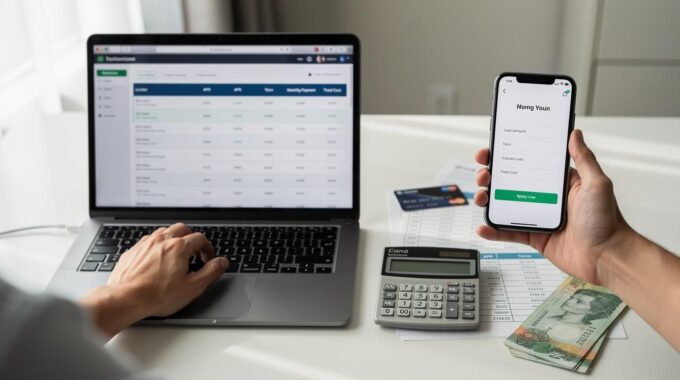
Budgeting apps and debt calculators remove guesswork from your planning. The MNP Budget Tracker Spreadsheet helps you set monthly budgets and allocate extra funds specifically to debt repayment rather than general spending. A Debt Calculator that factors in your province, income, assets, and total debts estimates your fastest path to becoming debt-free, showing you whether your chosen method will work within your financial reality. These tools transform abstract commitments into specific numbers you can track weekly, not just monthly. Butterfly, a budgeting app designed for newcomers to Canada, helps create realistic budgets that account for local costs and currency, and it’s free to use. On-demand counselling through non-profit agencies is available by phone or live chat with no appointment required, giving you immediate access to professional guidance when you need it most.
Final Thoughts
Debt freedom rests on three concrete actions: knowing exactly what you owe and at what rates, choosing a repayment method that matches your personality and financial reality, and protecting the extra money you find through budgeting so it actually reaches your priority debts. The debt management Canada tips we’ve covered work because they’re based on real numbers, not wishful thinking. A person earning $3,500 monthly with $26,000 in unsecured debt faces a different timeline than someone earning $5,500, but both can become debt-free if they commit to a specific strategy and stick with it.
Your credit score improves as you reduce debt-to-income ratios and demonstrate consistent payment history. Interest savings compound dramatically when you attack high-rate debt aggressively instead of spreading payments evenly. A person who pays $800 monthly instead of $650 on a $5,000 credit card balance at 20% saves roughly $300 in interest and becomes debt-free three months faster-that’s real money staying in your pocket.
If you’ve already calculated your total debt and identified your high-priority accounts, choose between the snowball and avalanche methods based on what will keep you motivated. If you’re still uncertain about which path works for your situation, access free confidential counselling through non-profit credit agencies. The sooner you act, the sooner interest stops working against you.









Leave a comment