
Personal loan rates in Canada vary significantly depending on where you borrow and your financial situation. At Financial Canadian, we’ve analyzed current rates across major banks, credit unions, and alternative lenders to help you understand what you’ll actually pay.
Your credit score, debt levels, and the loan term you choose all impact the rate you’ll qualify for. This guide walks you through the current landscape and shows you how to find the best deal for your needs.
What Personal Loan Rates Are You Actually Facing Right Now
The Bank of Canada held its overnight rate at 2.25% in December 2025, and this decision directly shapes what you’ll pay on a personal loan. Most Canadian banks tie their personal loan rates to the prime rate, which sits at 4.45% following the central bank’s hold. This matters because when the Bank of Canada moves, lenders adjust their rates within days or weeks, not months. If you’re shopping for a personal loan today, you’re operating in a stable rate environment, but that stability won’t last forever.

The next Bank of Canada decision comes January 28, 2026, and markets are already pricing in potential rate increases later in 2026, so locking in a fixed rate now could protect you from higher costs down the line.
Banks Offer the Lowest Rates, But Only if You Qualify
Major Canadian banks including Scotiabank, BMO, CIBC, RBC, and TD dominate the low-rate segment, typically offering 6% to 10% APR for borrowers with strong credit. Scotiabank ranges from 6% to 10%, while CIBC can go as low as 6% depending on your profile. The catch is real: these rates require a solid credit score, stable employment, and a low debt-to-income ratio. For a typical $5,000 personal loan, you’ll land somewhere in the 10% to 20% APR range across the major banks if you have decent but not exceptional credit. Origination fees add another layer of cost, typically ranging from 0.5% to 8% of your loan amount, which either reduces the cash you receive or gets rolled into your balance. CIBC requires a minimum gross annual income of $17,000 to qualify, and all major banks screen your credit history carefully. If you have a credit score below 600, the big banks will likely reject you outright, which is why alternative lenders exist.
Alternative Lenders Fill the Gap for Weaker Credit
Online lenders and credit unions serve borrowers the traditional banks won’t touch, but the cost is steep. Mogo charges 9.90% to 46.96% APR depending on creditworthiness, while Easyfinancial and Fora Credit operate in similar ranges. These lenders approve loans as small as $500 (Mogo and Easyfinancial) and up to $35,000 (Mogo) or $100,000 (Easyfinancial), offering flexibility that banks don’t. The real advantage of alternative lenders is speed: many return approval decisions within minutes and deposit funds to your account the same day. Credit unions typically sit between traditional banks and online lenders on both rates and approval timelines. If you’re subprime, you’re likely looking at 25% to 46% APR, which is brutal but legal since Canada’s criminal interest rate cap is 35% APR. The 35% cap means lenders can’t charge more than that threshold, though many stay below it to remain competitive.
Your Next Move: Understanding What Affects Your Rate
Your personal financial profile-not just the lender you choose-determines your actual rate. Credit score, debt-to-income ratio, employment status, and loan term all shift where you land within a lender’s rate range. A borrower with a 750 credit score and stable income qualifies for the 6% end of Scotiabank’s spectrum, while someone with a 620 score lands closer to 10%. The loan amount and repayment term matter too: a $50,000 loan over five years carries different pricing than a $5,000 loan over two years. Understanding these factors helps you know what rate you’ll actually qualify for before you apply, which saves time and protects your credit score from unnecessary hard inquiries.
What Determines Your Personal Loan Rate
Your credit score acts as the single biggest factor lenders evaluate, operating like a financial report card that directly translates to your APR. Bank loans usually require a good credit score, and major financial institutions offer personal loans at rates ranging from 6%-24%. Your credit history matters as much as your current score; a single missed payment from five years ago stays on your report and signals risk to underwriters, even if your score has recovered. Late payments, collections, or a bankruptcy add 5% to 15% to your rate compared to someone with a clean history.
Debt-to-Income Ratio Determines Your Borrowing Capacity
Lenders calculate your debt-to-income ratio by dividing your total monthly debt payments by your gross monthly income, and this number directly affects both approval odds and your rate. A DTI of 36% or less makes it clear that you can manage your monthly payments and puts you in strong territory for competitive rates. If you earn $4,000 monthly and already carry $1,200 in debt payments (mortgage, car loan, credit cards), a $400 personal loan payment pushes your DTI to 40%, which weakens your negotiating position. Employment status matters alongside DTI-salaried positions with the same employer for two years or longer receive better rates than contract workers or those with gaps in employment history. A job change within the past 90 days triggers approval delays or rate increases of 2% to 5%. Stable income isn’t just about having a job; it’s about demonstrating you’ll still have that job when you’re repaying the loan.
Loan Amount and Term Length Shape Your Final Rate
A $50,000 personal loan carries different pricing than a $5,000 loan because larger amounts spread administrative costs over more interest payments, allowing lenders to offer slightly lower rates. Most banks offer their best rates on loans between $15,000 and $50,000; amounts below $5,000 often trigger rate premiums of 1% to 3% due to fixed processing costs. Repayment term-whether you choose 24 months or 84 months-also affects your rate, though the relationship isn’t straightforward. A longer term reduces your monthly payment but typically increases your interest rate by 0.5% to 2% because the lender carries more risk over time. If you secure a $10,000 loan at 10% APR over 36 months, your monthly payment is roughly $322, but extending to 60 months might cost you 10.75% APR with a $207 monthly payment. The lower payment looks attractive until you realize you’re paying significantly more in total interest.
Fixed Versus Variable Rates: Protecting Yourself Against Future Increases
Lenders adjust rates based on whether you choose fixed or variable: fixed rates are typically 0.25% to 0.75% higher upfront, but they protect you if the Bank of Canada raises rates in 2026, which economists increasingly expect. A fixed rate locks your payment for the entire loan term, meaning you know exactly what you’ll pay each month regardless of what happens in the broader economy. Variable rates start lower but move with the prime rate, so your monthly payment could increase if the central bank tightens policy. For borrowers who plan to stay in their loan for the full term and want predictability, fixed rates make sense despite the higher initial cost. Those comfortable with payment uncertainty and confident rates will stay low might choose variable, though current forecasts suggest rates will rise, not fall, through 2026 and beyond. Your choice here depends on your risk tolerance and how long you plan to carry the debt.
Understanding these four factors-credit score, debt-to-income ratio, loan amount and term, and rate type-gives you the foundation to predict what rate you’ll actually qualify for before you apply. This knowledge helps you shop strategically across lenders and identify which ones will compete for your business. The next step is learning how to compare offers effectively and negotiate better terms based on your financial profile.

How to Compare Personal Loan Offers Without Wasting Time
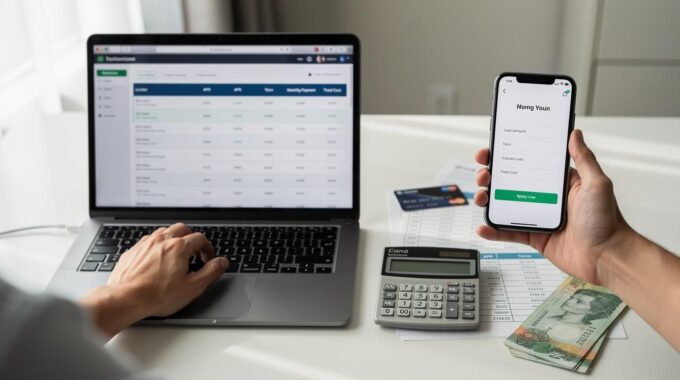
Shopping for personal loans across multiple lenders is non-negotiable if you want competitive rates, but most borrowers approach this backwards. Instead of applying to every lender you find, use a rate comparison tool first to see what you qualify for without damaging your credit. Once you’ve narrowed your options to three or four realistic choices, pull your credit report from Equifax Canada or TransUnion Canada to understand exactly where you stand. This step prevents surprises during the application process and gives you leverage when you negotiate. The difference between a 10% rate and a 12% rate on a $15,000 loan over five years costs you roughly $1,500 in extra interest, so the time you spend comparing is genuinely worth it. When you do apply formally, apply to all your chosen lenders within a two-week window so the hard inquiries cluster together and minimize damage to your score. Multiple inquiries in a short timeframe count as one event to credit bureaus, whereas spread-out applications signal desperation and hurt you more.

Fixed Rates Lock You In, Variable Rates Gamble on the Future
The choice between fixed and variable rates matters more now than it has in years because rate forecasts point upward. Fixed-rate personal loans in Canada typically cost 0.25% to 0.75% more upfront than variable rates, but they guarantee your payment stays the same for the entire loan term regardless of what the Bank of Canada does. If you secure a $20,000 fixed-rate loan at 10% APR today, your monthly payment remains locked even if rates spike to 5% or 6% in 2026. Variable-rate loans start cheaper, often 0.5% lower, but your monthly payment adjusts when the prime rate moves. Scotiabank and other major banks typically tie variable personal loans to prime plus a spread, so when prime rises, your payment rises too. Markets are pricing in potential rate increases through 2026 and beyond, which means variable-rate borrowers face real payment shock risk. For most people, the stability of fixed rates justifies the higher initial cost, especially if you’re stretching your budget to afford the monthly payment. If you can comfortably absorb a $50 or $100 monthly increase without stress, variable might work, but that’s the exception, not the rule.
Negotiate Your Rate by Timing Your Application and Leveraging Your Profile
Most borrowers accept whatever rate the lender offers without negotiation, which leaves money on the table. Lenders build margin into their initial quotes, meaning there’s room to move if you know how to push. Call the lender directly after you receive your offer and mention that you’ve received competing quotes at lower rates, even if you haven’t. Many lenders will match or beat a competitor’s offer to win your business, particularly if you have solid credit and a clean application. Timing matters too: apply early in the week and early in the month when lenders have higher approval quotas and are more motivated to compete. If your debt-to-income ratio sits right at the approval threshold, emphasize your stable employment history and any recent income increases to justify a better rate. Borrowers with existing relationships at a bank often qualify for small discounts, typically 0.25% to 0.5%, simply for being a customer. If you’re consolidating debt, mention this explicitly because lenders view debt consolidation as lower-risk than cash advances. The worst they can say is no, and the best outcome is a 0.5% to 1% rate reduction that saves hundreds of dollars over your loan term.
Final Thoughts
Personal loan rates in Canada sit in a stable window right now, but that window closes fast. The Bank of Canada’s hold at 2.25% has kept the prime rate steady at 4.45%, giving you predictable pricing across lenders through early 2026. Rate increases are coming, which means locking in a fixed rate today protects you from paying significantly more tomorrow-the difference between applying now and waiting six months could easily cost you 1% to 2% on your APR, translating to hundreds or thousands in extra interest over your loan term.
Your actual rate depends on four controllable factors: your credit score, debt-to-income ratio, loan amount, and whether you choose fixed or variable terms. Major banks offer the lowest rates, typically 6% to 10% APR, but only if you qualify with strong credit and stable income. If traditional banks reject you, alternative lenders fill the gap, though at higher costs. Pull your credit report from Equifax or TransUnion, calculate your debt-to-income ratio, and use a rate comparison tool to see what you actually qualify for without hard inquiries damaging your score.
When you apply, submit applications to multiple lenders within a two-week window to cluster hard inquiries and minimize credit impact. Call lenders directly and negotiate, mentioning competing quotes to push for better terms-emphasize stable employment, low debt-to-income ratios, and any existing relationships with the lender. A 0.5% rate reduction saves hundreds of dollars over your loan term, making negotiation worth your time. We at Financial Canadian help you build a strong online presence with responsive web design and SEO best practices, so explore how we can support your financial brand’s growth.









Leave a comment