
Borrowing money when you have a poor credit history or urgent financial needs can feel like your only option. High-risk lenders in Canada often target people in these situations, offering quick cash with terms that can trap you in a cycle of debt.
At Financial Canadian, we want you to know the warning signs before you sign anything. This guide walks you through what makes a lender risky and shows you better alternatives that won’t drain your finances.
Who Qualifies as a High-Risk Lender
High-risk lenders in Canada operate outside the traditional banking system, targeting borrowers who cannot access conventional financing. These lenders include payday loan companies, car title lenders, fast-cash installment lenders, and private mortgage brokers offering subprime products. According to the Bank of Canada Financial System Review, high-risk lenders rely heavily on non-bank funding and high-yield debt markets, making them sensitive to shifts in investor appetite. What separates them from traditional banks is their business model: they profit from lending to people with poor credit, unstable income, or urgent financial needs. Traditional banks assess your ability to repay through credit checks and income verification. High-risk lenders skip these steps or use minimal vetting, advertising no-credit-check approval within minutes.

This speed comes at a cost. Payday loans in Canada can carry annualized rates around 390% for short-term borrowing, while installment lenders advertise rates between 39.99% and 59.99% APR that balloon once fees are included. Car title loans offer quick cash but charge 35% or higher plus fees, risking vehicle repossession if you miss payments.
The True Cost of Fast Cash
The real danger lies in how these lenders structure their fees. Canada capped payday loan costs at $14 per $100 borrowed, but borrowers often don’t realize this is just the starting point. Predatory lending accounts for an estimated 40% of bankruptcies and consumer proposals in Canada. The typical borrower doesn’t approach one lender-they juggle multiple high-interest loans simultaneously, creating a debt spiral that’s nearly impossible to escape. Lenders deliberately offer short repayment terms, forcing borrowers to refinance or roll over loans repeatedly, which extends debt and increases total costs. Savings or credit repair loans masquerade as pathways to financial improvement while charging upfront fees and high interest with minimal real benefit. These products target broad demographics, including seniors and young adults who are particularly vulnerable to misleading marketing.
Why Speed Signals Danger
Lenders that guarantee approval and deliver funds within minutes aren’t being generous-they’re minimizing their own risk assessment burden. When a lender doesn’t ask questions about your income or existing debts, they’re not protecting you; they’re betting on your desperation. The strongest protection is demanding full disclosure of loan costs before you sign anything. Legitimate lenders assess your ability to repay and explain every charge. Predatory lenders obscure total costs behind low advertised rates and hidden fees, making the surface price completely misleading. In Canada, usury limits exist under the Criminal Code, prohibiting interest above 60% per year, but payday lending remains provincially regulated and exploits gaps in consumer protection. Upfront guarantee fees are prohibited, yet some lenders still demand them. If a lender asks for money before approving your loan, walk away immediately.
What Comes Next
Understanding how high-risk lenders operate is the first step toward protecting yourself. The next section reveals the specific red flags and tactics these lenders use to trap borrowers, so you can spot them before they cost you thousands.
Red Flags and Pitfalls to Watch Out For
High-risk lenders exploit information gaps between what they advertise and what you actually pay. The most dangerous red flag is when a lender refuses to disclose your total repayment amount upfront. Ontario payday lenders can legally charge $15 per $100 borrowed, but when you factor in rollovers and repeated refinancing, borrowers end up paying far more than the initial fee suggests. A borrower who rolls over a payday loan just three times pays roughly triple the original cost. Installment lenders advertising rates like 39.99% APR hide additional fees buried in the fine print-insurance charges, processing fees, and prepayment penalties that inflate the true annual cost beyond what’s advertised. Car title lenders operate similarly, quoting a 35% rate while tacking on documentation fees, storage fees if your vehicle is repossessed, and auction shortfall fees if the vehicle sells for less than you owe. The pattern is consistent: lenders quote a surface rate that sounds almost reasonable, then stack fees underneath to reach their actual profit margin. Demand a written statement showing your exact total repayment amount, the number of payments, and every single fee before signing anything.
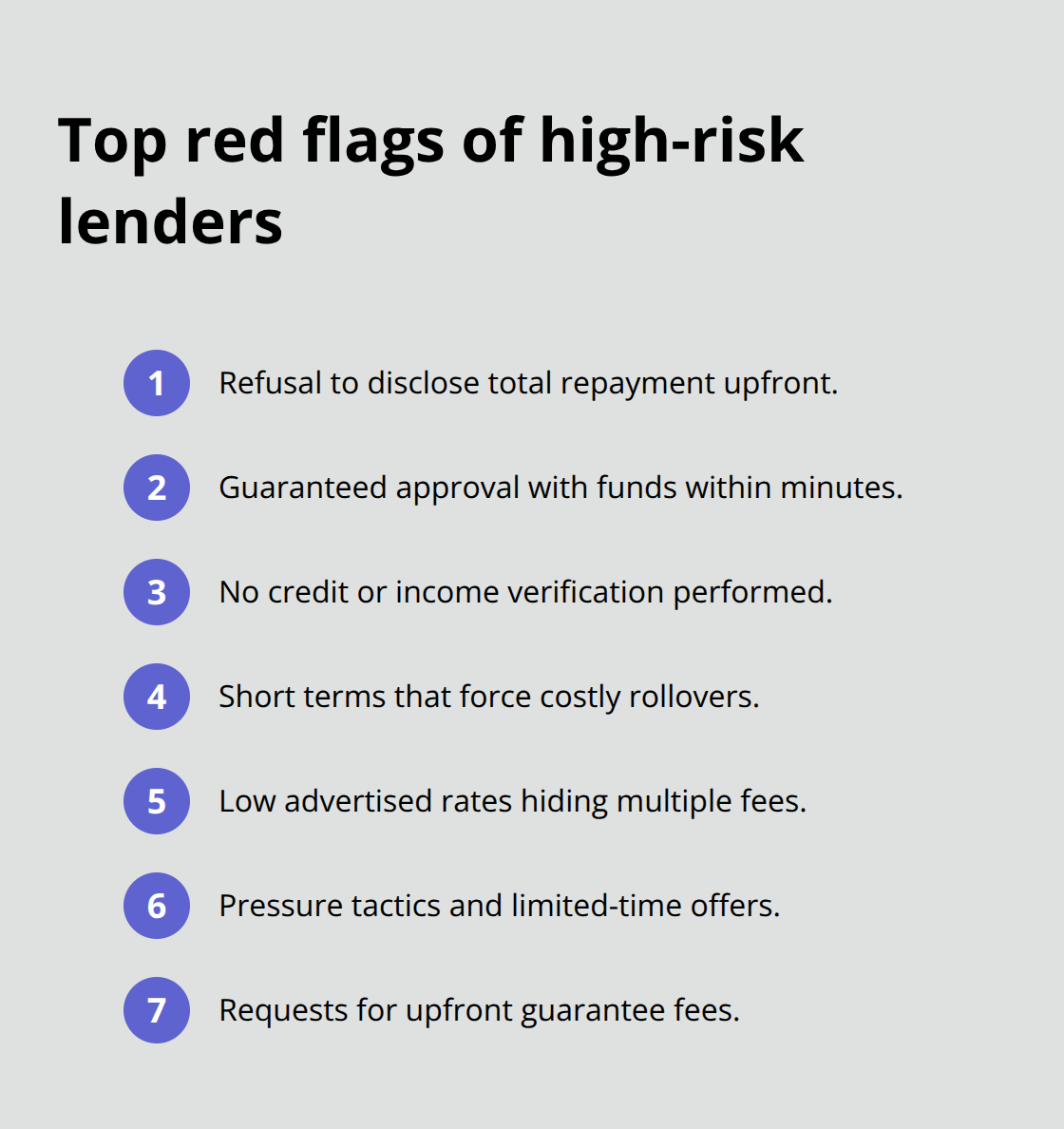
If the lender refuses or becomes defensive, that’s your signal to leave.
The No-Credit-Check Trap
Lenders advertising no-credit-check approval aren’t doing you a favor. Legitimate lenders verify your ability to repay because responsible lending protects both parties. When a lender skips credit assessment entirely, they shift all risk onto you. High-risk lenders compensate for skipped due diligence by charging rates that assume a high default rate, which means they’ve already priced in the expectation that many borrowers will fail. The speed of approval should alarm you, not comfort you. If funds arrive within minutes or hours, the lender conducted no meaningful income verification and made no attempt to assess whether you can actually repay. This speed exists solely to lock you into the loan before you have time to reconsider or shop for alternatives.
Pressure Tactics That Signal Danger
Pressure tactics follow naturally from this model. A lender that emphasizes limited-time offers, countdown timers on online applications, or phrases like “act now before this expires” deliberately triggers urgency to bypass your rational decision-making. Some lenders contact you repeatedly after an initial inquiry, treating borrowing like a high-pressure sales process rather than a financial decision. Resist this pressure completely. If you need time to think, any legitimate lender will wait. Lenders that guarantee approval and deliver funds within minutes aren’t being generous-they’re minimizing their own risk assessment burden. When a lender doesn’t ask questions about your income or existing debts, they’re not protecting you; they’re betting on your desperation.
Rollovers and the Debt Spiral
The most predatory feature of high-risk lending is the structured rollover trap. Payday lenders intentionally set repayment terms so short that most borrowers cannot repay in full when the due date arrives. Instead of defaulting, borrowers are offered a rollover: pay the fee again and extend the loan another two weeks. This cycle repeats until the borrower has paid hundreds in fees for a small initial loan. Research from Hoyes Michalos shows that the typical borrower approaching a high-risk lender already holds more than one high-interest loan, meaning they’re caught in an existing debt spiral before they even apply. Multiple simultaneous loans from different lenders create a payment schedule so packed that missing one triggers cascading defaults. Lenders know this. They’re betting on your desperation to keep rolling over rather than facing a missed payment. Some installment lenders disguise this same trap by offering low initial payments that balloon in later months, or by extending terms so long that total interest dwarfs the original amount borrowed. The math here is intentional. A lender offering 60-month financing on a small loan deliberately structures a product that keeps you indebted and returning for more borrowing.
Hidden Costs That Add Up Fast
The strongest protection is demanding full disclosure of loan costs before you sign anything. Legitimate lenders assess your ability to repay and explain every charge. Predatory lenders obscure total costs behind low advertised rates and hidden fees, making the surface price completely misleading. In Canada, usury limits exist under the Criminal Code, prohibiting interest above 60% per year, but payday lending remains provincially regulated and exploits gaps in consumer protection. Upfront guarantee fees are prohibited, yet some lenders still demand them. If a lender asks for money before approving your loan, walk away immediately. Savings or credit repair loans masquerade as pathways to financial improvement while charging upfront fees and high interest with minimal real benefit. These products target broad demographics, including seniors and young adults who are particularly vulnerable to misleading marketing.
Understanding these tactics positions you to spot predatory lenders before they trap you. The next section reveals better alternatives that offer transparent terms and genuine financial relief without the debt spiral.
Better Alternatives That Actually Work
Credit unions and community banks across Canada operate on fundamentally different models than high-risk lenders. These institutions prioritize member or customer relationships over extracting maximum fees, which means they assess your ability to repay seriously but don’t penalize you for past credit problems. Credit unions like Meridian, Coast Capital, and Conexus function as not-for-profit cooperatives, returning profits to members through better rates and lower fees. Community banks such as Tangerine and EQ Bank use streamlined online operations to reduce costs, passing savings to borrowers instead of pocketing them.

Why Credit Unions Beat High-Risk Lenders
The real advantage surfaces in their rates: a personal loan from a credit union can offer competitive rates depending on your credit profile, compared to 39% to 59% from installment lenders or 390% from payday operations. You’ll need to provide income documentation and explain your credit history, but credit unions specifically work with members rebuilding credit. Some credit unions offer second-chance lending programs that traditional banks reject outright. This approach costs far less than rolling payday loans repeatedly and actually improves your financial position instead of worsening it.
Online Lenders with Real Transparency
Online lenders operating transparently represent another legitimate path, though you must verify their credentials carefully. Lenders like Borrowell and LendingClub disclose your exact monthly payment and total interest cost before you sign anything, with rates ranging from 11% to 29% depending on credit quality. They process applications within 24 to 48 hours, which is fast enough for genuine emergencies without the no-questions-asked trap of payday lenders.
Government Programs Designed for You
Government-backed programs deserve serious consideration because they target people traditional lenders reject. The Canada Small Business Financing Program supports self-employed Canadians and entrepreneurs with lower rates than private lenders. Provincial student assistance programs and government emergency loans exist in most provinces for documented hardship situations. Contact your provincial ministry of social services or employment to identify what you qualify for, as eligibility varies significantly by province.
Debt Relief as Your Real Solution
The strongest move addresses the root problem rather than borrowing your way out of it. If you’re considering a high-risk lender because you’re short on cash, a consumer proposal administered by a licensed insolvency trustee can reduce your existing debt by up to 70% with no interest charges and no upfront fees. Many trustees offer free preliminary consultations to explain your options.
Immediate Actions That Cost Nothing
If you need emergency cash specifically, negotiate directly with your current creditors before approaching any lender. Credit card companies, utility providers, and landlords often work out temporary payment arrangements rather than watching you default. Borrowing from family or friends, while uncomfortable, costs nothing and preserves your financial independence. Building a small emergency fund of even $500 prevents the desperation that makes high-risk lenders attractive. Set up automatic transfers of $25 biweekly into a separate savings account until you reach that threshold. This small buffer absorbs car repairs, medical costs, or short-term income gaps without triggering a borrowing cycle.
Final Thoughts
High-risk lenders in Canada succeed because they exploit a critical gap: people need money fast, and traditional banks won’t lend to them. You now understand how that gap transforms into a trap. The warning signs stand out once you recognize them-no-credit-check approval, guaranteed acceptance, funds within minutes, refusal to disclose total costs, pressure tactics, and short repayment terms that force rollovers. These aren’t features; they’re mechanisms designed to lock you into debt.
The real protection comes from avoiding high-risk lending entirely and selecting alternatives that actually strengthen your finances. Credit unions assess your ability to repay without penalizing past credit problems. Online lenders with transparent terms show you exact costs before you commit. Government programs exist specifically for people traditional banks reject. A consumer proposal can eliminate up to 70% of your debt with no interest and no upfront fees. Negotiating directly with creditors costs nothing, and building a small emergency fund prevents the desperation that makes predatory borrowing attractive.
Your financial decisions compound over time, and one payday loan rolled over three times costs triple the original amount. Before you borrow from anyone, demand written disclosure of your total repayment amount, every fee, and the exact number of payments. If you’re already trapped in high-risk debt, contact a licensed insolvency trustee for a free consultation about your options, and we at Financial Canadian believe you deserve financial tools that strengthen your position rather than exploit your desperation.











Leave a comment