
When you need cash fast, payday loans Canada online can feel like the only option. But not all lenders are equal, and the wrong choice can trap you in a cycle of debt.
At Financial Canadian, we’ve compared the major lenders to show you exactly what you’ll pay, how quickly you’ll get funded, and whether a payday loan actually makes sense for your situation.
What You’ll Actually Pay for a Payday Loan in Canada
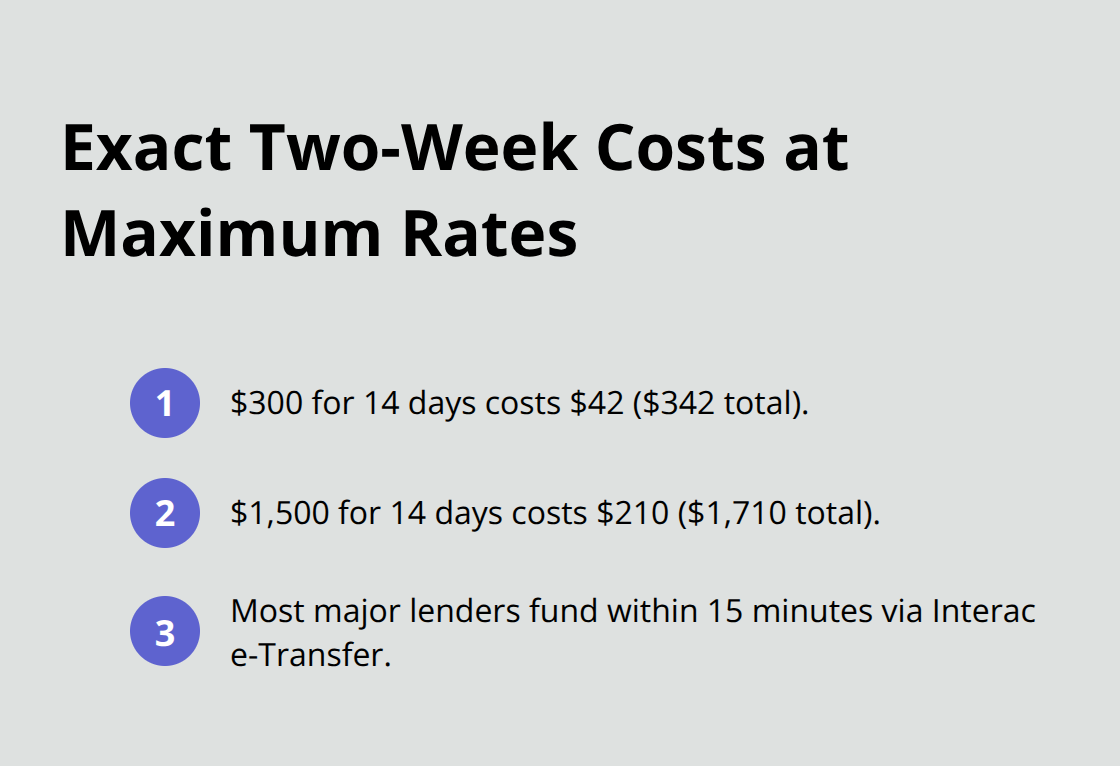
Payday loans in Canada range from $300 to $1,500, with most lenders funding within 15 minutes through Interac e-Transfer or direct deposit. The cost is what matters most. Maximum rates cap at 14% per $100 borrowed in British Columbia, Manitoba, Newfoundland and Labrador, Ontario, and Saskatchewan-a 365% annual percentage rate when annualized. A $300 loan for 14 days costs $42, meaning you repay $342 total. The application process moves quickly: apply online or by phone, complete verification, sign documents, and receive funds. You need to be 18 or older with valid ID, a steady income source, a chequing account, and a phone number. Employment insurance and disability income both count as acceptable income sources.
How Repayment Works
Repayment happens on your next scheduled income deposit, which is why these loans are called payday loans. If you receive pay bi-weekly, your loan is due in approximately 14 days. Early repayment saves you money since lenders charge you only for the time you borrow. A $500 loan that you repay after 7 days instead of 14 costs significantly less than the full two-week fee. This differs from credit cards-you don’t carry a balance indefinitely. The tradeoff is speed and accessibility. Lenders don’t require collateral or perfect credit, which is why approval rates are high and funding is fast. However, this accessibility comes at a premium price.
Application and Approval Timeline
The entire process from application to funded account typically takes under an hour. Online applications require basic information: income, employment details, and banking information. The lender performs a soft credit check during pre-approval, which doesn’t impact your credit score. Once you accept the loan and proceed to full approval, a hard inquiry may occur, which can temporarily lower your score by a few points. Payment is due in full on your next payday, with no option to extend or stretch payments across multiple months like traditional loans. This fixed repayment structure is intentional-payday loans are designed for short-term cash gaps, not ongoing borrowing.
Why Lenders Approve Fast
High approval rates exist because payday lenders accept applicants with poor credit histories and minimal collateral requirements. They assess your ability to repay based on income and employment status rather than credit score. This approach makes payday loans accessible when traditional banks reject your application. The speed and accessibility come with higher costs (the 365% APR reflects this risk premium). Lenders offset their risk by charging more per dollar borrowed, which is why comparing offers matters before you commit.
When to Consider Alternatives Instead
Before you accept a payday loan, explore whether a line of credit fits your situation better. Lines of credit offer up to $10,000 with flexible repayment and lower costs than payday loans. You borrow what you need and pay only for what you use, with the ability to repay and borrow again. This structure works well if you face ongoing cash flow challenges rather than a one-time emergency. The next section examines which lenders offer the fastest funding and lowest fees, plus when alternatives make more financial sense than payday loans.
Which Lenders Fund Fastest and Cost Least
Speed Matters, But Total Cost Matters More
Speed matters when you need cash today, but the cheapest option matters more over the long term. Most major Canadian payday lenders now deliver funds within 15 minutes through Interac e-Transfer, which means speed alone won’t separate the good options from the poor ones. What actually separates lenders is transparency on fees and willingness to work with applicants who have damaged credit. One lender advertises funding in as little as 15 minutes with loans up to $1,500, which matches the industry standard. Another emphasizes high approval rates and same-day funding for loans up to $1,000, positioning itself as an option when traditional lenders say no.
Calculate Your Exact Cost Before You Apply
The real distinction emerges when you compare total costs across loan amounts. A $300 loan for 14 days costs $42 at maximum rates in regulated provinces, but a $1,500 loan for the same period costs $210. The difference is substantial, which is why you should calculate your exact cost before you accept any offer rather than focusing only on approval speed. Avoid lenders that obscure their fee structure or use terms like flat fee without showing the annualized percentage rate. The 365% APR figure looks shocking but reflects the reality of short-term borrowing costs.
If a lender won’t clearly state their maximum rate per $100 borrowed or their total fee for a specific loan amount, move to the next option.
Who Qualifies and What Gets Reported
Lenders that accept employment insurance and disability income as valid income sources expand access for applicants traditional banks reject outright. This matters if you’re between jobs or receive government support. Some lenders report payments to Equifax Canada, which means on-time repayment builds your credit history over time, though missed payments damage it just as quickly. One lender has served Canadian customers for 34 years and processed more than 19 million loans since 2000, suggesting operational stability matters when you choose a provider.
Why Lines of Credit Offer a Better Path
Lines of credit remain your strongest alternative if you qualify, offering up to $10,000 with ongoing access and significantly lower costs than payday loans. You apply once for pre-approval without any credit score impact, then decide whether the hard inquiry for full approval makes sense for your situation. This flexibility allows you to borrow what you need and repay to free up more credit, rather than committing to a fixed repayment schedule tied to your next payday. The next section examines specific situations where payday loans actually make sense and when you should explore other options instead.
When Payday Loans Actually Make Sense
Payday loans work best for genuine emergencies that won’t repeat monthly. Your car breaks down and you need $800 for repairs before your next paycheck arrives in five days. Your furnace fails in winter and the landlord demands immediate replacement. A medical bill lands unexpectedly and your employer’s benefits haven’t kicked in yet. These are one-time events where the 365% annualized rate matters far less than accessing cash within hours. The math changes dramatically when you calculate the actual cost. A $800 payday loan for five days costs roughly $56 in fees at maximum provincial rates, which is painful but manageable when the alternative is losing your job or your housing.
The Debt Trap Most Borrowers Face
The problem emerges when people treat payday loans as recurring solutions. If you need cash every two weeks to cover regular expenses, a payday loan isn’t your real problem-your budget is. Payday lenders report that four out of five payday loans are rolled over or renewed within 14 days, suggesting most users fall into a trap rather than solving a temporary gap. This pattern repeats because the underlying cash shortage never gets addressed. You borrow $300, repay it on payday, then face the same shortage two weeks later. Each cycle costs you another $42 in fees (on a $300 loan), which adds up to $1,092 annually if you repeat this pattern 26 times per year. That’s money you’ll never see again, money that could have gone toward fixing your actual budget problem.
Lines of Credit Solve the Real Problem
A line of credit up to $10,000 addresses what payday loans mask: ongoing cash flow shortages. If you’re regularly short before payday, a line of credit lets you borrow $300 one week and $400 the next, paying interest only on what you use. You repay $300 the following week, freeing up that credit to use again. This flexibility costs significantly less than repeated payday loans because interest rates on lines of credit typically range from 19% to 29% annually, not 365%. The trade-off is that approval takes longer-usually one to two business days rather than 15 minutes-but the savings compound quickly. Over six months of borrowing $500 every two weeks, a payday loan costs roughly $780 in fees while a line of credit at 25% APR costs around $188. That’s a $592 difference for the exact same borrowing pattern. The hard inquiry for line of credit approval temporarily lowers your credit score by a few points, but on-time repayment rebuilds it faster than payday loan cycles damage it.
Credit Card Cash Advances Rarely Win
Credit card cash advances feel safer because you already have the card, but they’re almost never better than payday loans. Most credit cards charge 20% to 22% cash advance fees plus interest rates of 21% to 29% annually, starting immediately with no grace period like purchase transactions receive. A $500 cash advance costs $100 in fees alone, before any interest. You’d pay $600 total just to access the cash, then carry interest charges for months if you can’t repay quickly. Payday loans at least cap your fee at a fixed amount-a $500 payday loan for 14 days costs $70, period. If you have credit card access, you likely have better options available.
When Payday Loans Actually Make Financial Sense
The real answer to chronic cash shortages isn’t choosing between bad options; it’s fixing your budget or increasing income. If you absolutely must borrow, a line of credit beats both payday loans and cash advances on cost and flexibility, assuming you qualify. However, payday loans do make sense for true one-time emergencies where you need funds within hours and have no other option. The key distinction is frequency: if you borrow once or twice per year for genuine emergencies, the high cost is acceptable. If you borrow monthly or bi-weekly, you’re not solving an emergency-you’re masking a budget problem that will cost you thousands annually in fees.
Final Thoughts
Payday loans Canada online serve a specific purpose: they bridge genuine financial emergencies when you need cash within hours and have exhausted other options. If you face a one-time crisis like a car repair or medical expense, the fixed fee of $42 to $70 for a two-week loan is painful but manageable. The real danger emerges when you treat payday loans as routine solutions-four out of five borrowers roll over or renew their loans within 14 days, trapping themselves in cycles that cost thousands annually in fees alone.
Your first decision should address whether you actually need a payday loan or whether you need to fix an underlying budget problem. If you’re regularly short before payday, a line of credit up to $10,000 costs roughly one-third as much as repeated payday loans while offering flexibility to borrow and repay as needed. When you do choose a payday lender, compare total costs across loan amounts rather than focusing only on approval speed, since most major lenders now fund within 15 minutes.
Calculate your exact fee before you accept any offer, and avoid lenders that obscure their fee structure or refuse to state their maximum rate per $100 borrowed. On-time repayment builds your credit history when lenders report to Equifax Canada, while missed payments damage it quickly. We at Financial Canadian help you understand your borrowing options so you can make decisions that strengthen your finances rather than drain them.











Leave a comment