
Your home is likely your biggest asset, and a home equity line in Canada gives you access to the cash sitting in it. We at Financial Canadian believe most homeowners don’t realize how much borrowing power they already have.
This guide walks you through how HELOCs work, who qualifies, and the smartest ways to use one for debt consolidation, renovations, or investments.
What is a Home Equity Line of Credit in Canada
A home equity line of credit, or HELOC, is a revolving credit facility that lets you borrow against the equity you’ve built in your home. Unlike a traditional loan where you receive a lump sum upfront, a HELOC works more like a credit card attached to your property. You get approved for a maximum amount you can access, then withdraw funds as needed and pay interest only on what you actually borrow. HELOCs have become increasingly popular among Canadian homeowners, with over 2.1 million active accounts as of 2024. The appeal is straightforward: if your home is worth $500,000 and you owe $300,000 on your mortgage, you have $200,000 in equity that lenders will let you tap into. Most Canadian lenders allow you to access up to 65% of your home’s value minus what you still owe on your mortgage.
How HELOCs Work
When you open a HELOC, lenders evaluate your home’s current market value through an appraisal or automated valuation. They subtract your existing mortgage balance to determine your available equity, then approve you for a credit limit based on that figure. During the draw period, which typically lasts 5 to 10 years, you can withdraw money whenever you need it by writing a check, using a debit card, or making electronic transfers. Prime rate plus a margin of 0.5% to 2.5% is the standard pricing structure for HELOCs in Canada. As of September 2026, with the Bank of Canada’s policy rate at 3.75%, most HELOCs sit around 6.5% to 7.5%, making them significantly cheaper than credit cards but more expensive than fixed-rate mortgages.
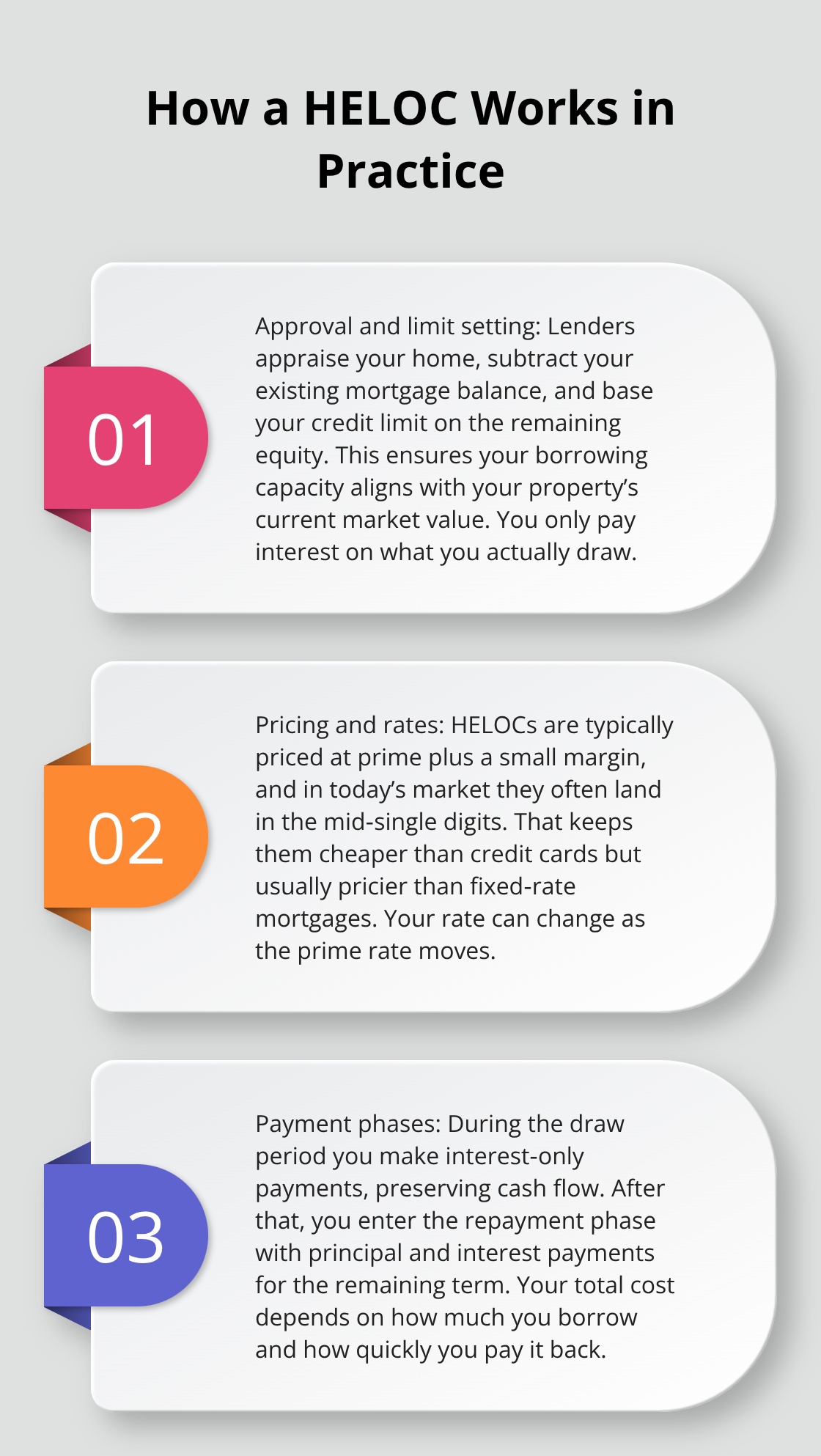
Once you withdraw funds, you make interest-only payments during the draw period, then transition to principal and interest payments during the repayment phase. The repayment period typically runs 10 to 20 years, and your total interest costs depend entirely on how much you borrow and how quickly you pay it back.
HELOCs Versus Home Equity Loans
A home equity loan is fundamentally different because it’s a one-time, fixed-amount loan with a set interest rate and fixed monthly payments. You receive all the money upfront, whether you need it immediately or not, and you start repaying it on a fixed schedule from day one. HELOCs offer flexibility that home equity loans don’t provide-you borrow only what you need, when you need it, and pay interest only on outstanding balances. This flexibility comes with a tradeoff: your HELOC rate fluctuates with the prime rate, while a home equity loan locks in your rate permanently. If interest rates drop, your HELOC becomes cheaper automatically. If rates climb, your monthly payments increase. Homeowners choosing between the two should consider whether they need immediate access to all funds or prefer taking money out gradually. A HELOC makes sense if you’re planning staged home renovations or have unpredictable expenses. A home equity loan works better if you need a specific amount for a single purpose and want payment certainty.
Current HELOC Rates and Lending Requirements
As of September 2026, HELOC rates in Canada range from 6.5% to 7.5% depending on your lender and credit profile (rates adjust quarterly with the Bank of Canada’s policy decisions). Lenders typically require a minimum credit score of 650, though scores above 700 qualify you for better rates and higher borrowing limits. Most lenders also want to see a debt-to-income ratio below 39%, meaning your total monthly debt payments shouldn’t exceed 39% of your gross monthly income. Your home’s location and condition matter too-lenders appraise properties to confirm they hold sufficient value to secure the credit line. The application process takes 5 to 10 business days once you submit your documentation, and lenders pull your credit report to assess your repayment history. Now that you understand how HELOCs function and what rates you can expect, the next step is calculating exactly how much equity you have available to access.
How to Access Your Home Equity
Calculating your available equity requires straightforward math, but most homeowners skip this step and face rejection or lower-than-expected approval amounts when they apply. Take your home’s current market value and subtract what you still owe on your mortgage. If your home is worth $450,000 and your mortgage balance sits at $280,000, you have $170,000 in equity. However, lenders won’t let you access all of it. Canadian banks typically cap HELOC borrowing at 80% of your home’s total value minus your existing mortgage debt. Using the same example, 80% of $450,000 equals $360,000, and subtracting your $280,000 mortgage leaves you eligible for a maximum $80,000 HELOC. Some lenders go up to 85%, but this depends heavily on your credit score and income stability. Get a recent home appraisal or use online valuation tools to establish your property’s current worth, since market values shift quarterly.
Calculate Your Available Equity
Your equity calculation starts with your home’s market value. Online tools provide rough estimates, but a professional appraisal gives you the number lenders actually use. Subtract your mortgage balance from this value to find your total equity.
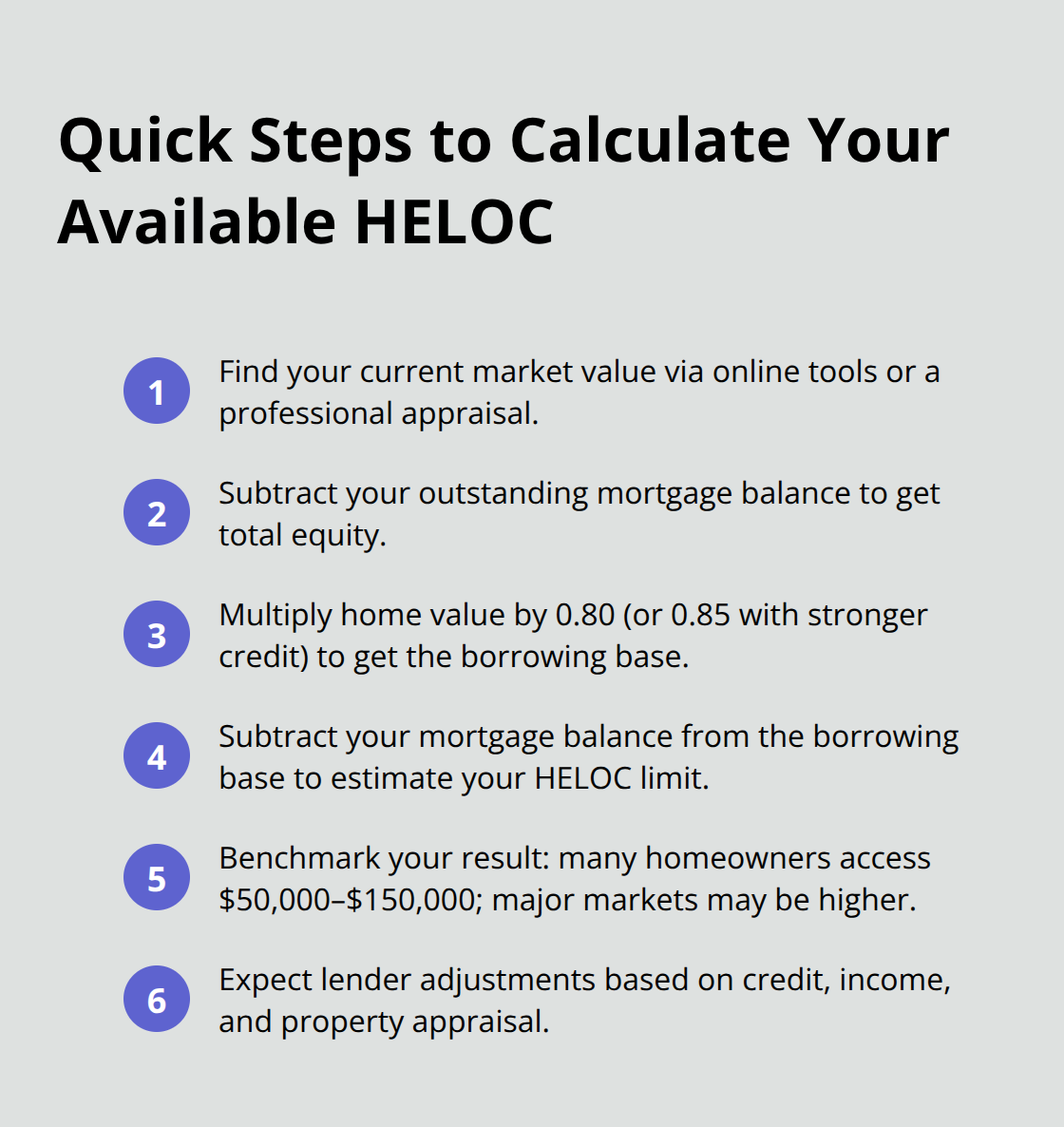
Then multiply your home’s value by 0.80 (or 0.85 with stronger credit) to find your maximum borrowing base. Subtract your mortgage balance from this figure to determine your HELOC limit. Most homeowners find they can access between $50,000 and $150,000, though properties in major markets like Toronto or Vancouver often yield higher amounts. The difference between what you calculated and what lenders approve depends entirely on your financial profile.
Qualification Requirements and Credit Score Thresholds
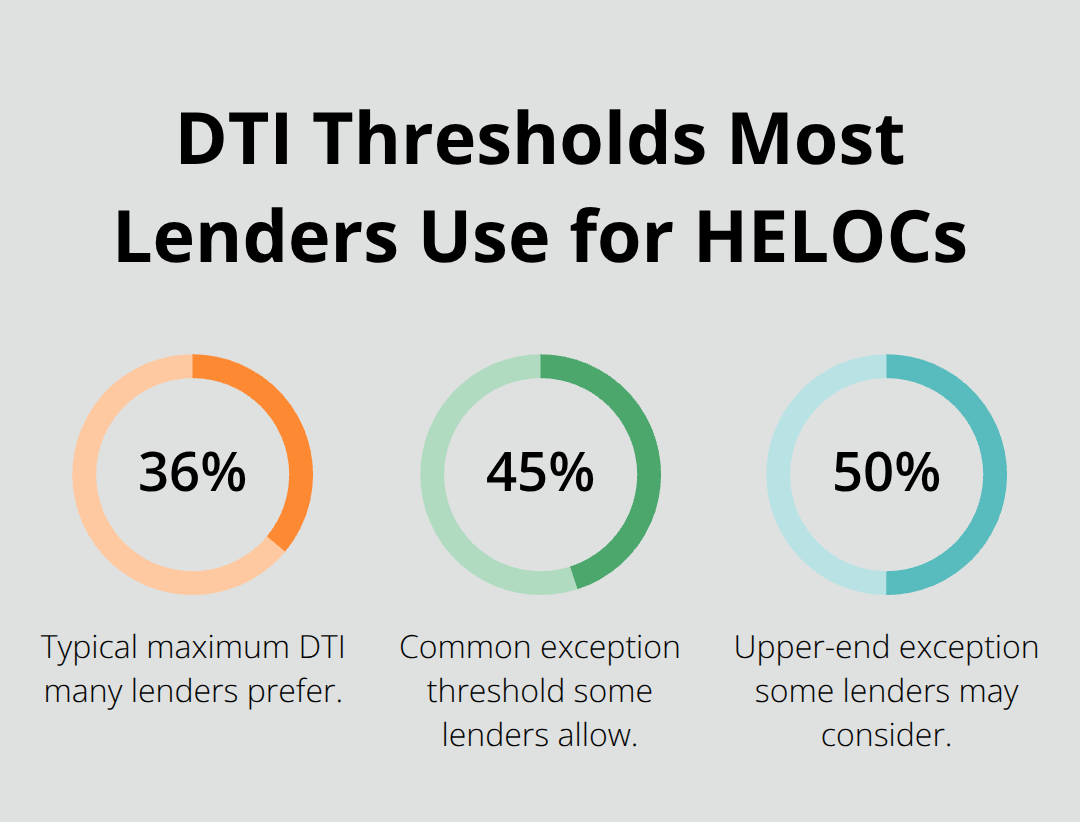
Lenders treat credit scores as the primary filter for HELOC approval, and the threshold matters more than most people realize. A score of 650 gets you approved, but rates will be higher and your borrowing limit lower. Scores between 700 and 749 qualify you for standard rates around 6.75% to 7.25%. Anything above 750 qualifies you for the best rates, often 6.5% or lower. Your debt-to-income ratio is equally important, and many homeowners overlook it entirely. Most home equity lenders look for a DTI ratio of no more than 36%, though some may allow exceptions up to 45 or even 50%. This includes your mortgage, car loans, credit cards, and any other monthly obligations.
Check your credit report through Equifax or TransUnion before applying, since errors could cost you half a percentage point or more in interest rates. Fixing errors takes 30 to 60 days, so address problems early. If your score is below 650, focus on paying down existing debt rather than applying immediately.
The Application Process With Canadian Lenders
Most Canadian lenders complete HELOC applications in 5 to 10 business days, but this assumes you submit everything correctly the first time. Lenders require proof of income (recent pay stubs or tax returns), your mortgage statement showing current balance, property tax assessments, and proof of home insurance. Many applicants waste time going back and forth because they submit incomplete documentation. Bring these items upfront rather than waiting for requests. The lender orders a property appraisal, which costs $300 to $500 and typically takes 7 to 14 days. You can sometimes negotiate who pays this fee, especially if you have strong credit. Online applications have sped up the process at some institutions, but traditional banks still require in-person verification. Once approved, funds hit your account within 3 to 5 business days. If you need money urgently, apply at least three weeks before you actually need it to account for appraisal delays. With your HELOC approved and funds available, the real opportunity emerges: deciding how to use this borrowing power strategically.
Maximizing Your HELOC Benefits
A HELOC sitting in your account unused represents wasted opportunity, but deploying it recklessly is worse. The smartest homeowners treat their HELOC as a strategic financial tool, not an emergency fund or impulse spending account. Debt consolidation tops the list of legitimate uses because the math works decisively in your favor. If you carry $25,000 across credit cards at 19% to 21% interest, consolidating that debt into your HELOC at rates just above 8% saves you roughly $3,250 annually in interest alone. That money stays in your pocket instead of going to creditors.
Using a HELOC for Debt Consolidation
The consolidation strategy works best when you commit to not re-accumulating debt on those credit cards after paying them off. Statistics from Equifax show that 40% of Canadians who consolidate debt end up carrying new balances on cleared credit cards within two years, completely erasing their savings. Close or freeze those accounts immediately after consolidation, or your HELOC becomes an expensive bridge to deeper financial trouble. Your HELOC payment stays the same each month during the draw period, unlike credit card minimums that shrink as your balance falls. This consistency prevents the temptation to spend the freed-up cash flow elsewhere.
Renovations and Home Improvements
Home renovations represent the second major HELOC use case, and this is where borrowing becomes an investment rather than consumption. Canadian homeowners spent $48.6 billion on residential renovations in 2023 according to Statistics Canada, with kitchen and bathroom upgrades commanding the highest resale value returns. A kitchen renovation costing $35,000 typically returns 50% to 60% of that investment in home value appreciation, meaning you recover $17,500 to $21,000 of your spending through increased property worth. This math changes completely if you finance at credit card rates versus HELOC rates. Your HELOC’s rate versus a credit card’s 20% rate cuts your effective borrowing cost by roughly two-thirds. Staged renovations work particularly well with HELOCs because you draw funds as contractors complete phases, avoiding interest charges on money sitting unused.
Investment Opportunities and Business Funding
The third category, investment opportunities and business funding, demands the most caution because borrowing against your home transfers real estate risk into market risk. If your business fails or markets crash, you still owe the full HELOC balance secured by your primary residence. Only pursue this approach if you have existing business experience, a detailed financial plan, and reserves covering at least six months of HELOC payments. Investors using HELOCs for real estate purchases or rental property down payments face slightly better odds because real estate generates predictable rental income. You must stress-test your numbers against 8% mortgage rates and 5% vacancy rates to confirm the numbers work before committing funds.
Final Thoughts
A home equity line in Canada makes financial sense when you have a specific, high-return purpose and the discipline to avoid lifestyle inflation. Debt consolidation works because the math is undeniable-moving $25,000 from credit cards at 20% to a HELOC at 7% saves thousands annually. Home renovations justify borrowing when you focus on upgrades that recover 50% or more of their cost through resale value, while investment opportunities demand caution because you risk your primary residence on market performance.
The trap most homeowners fall into is treating their HELOC as free money rather than debt that requires repayment. Your home secures this credit line, meaning missed payments put your property at risk, so you must confirm you can sustain payments if rates climb another 2% or your income drops. If you’re uncertain about your financial stability, a home equity line Canada isn’t the right tool for your situation.
Your next step depends on where you stand financially. If your credit score sits below 650, focus on paying down existing debt first-this improves your approval odds and rate. If you’re ready to apply, gather your documentation now rather than scrambling later, get a professional home appraisal to confirm your equity accurately, and compare rates across at least three lenders because a 0.5% difference on a $100,000 HELOC costs $500 annually.











Leave a comment