
Mortgage rates in Canada have shifted dramatically over the past two years, and where you lock in matters more than you might think.
At Financial Canadian, we’ve seen borrowers leave thousands of dollars on the table simply by not understanding rate movements or shopping around properly. This guide walks you through current trends, what influences your personal rate, and concrete strategies to secure the best deal available to you.
Current Mortgage Rate Trends in Canada
Fixed vs Variable Rate Movements
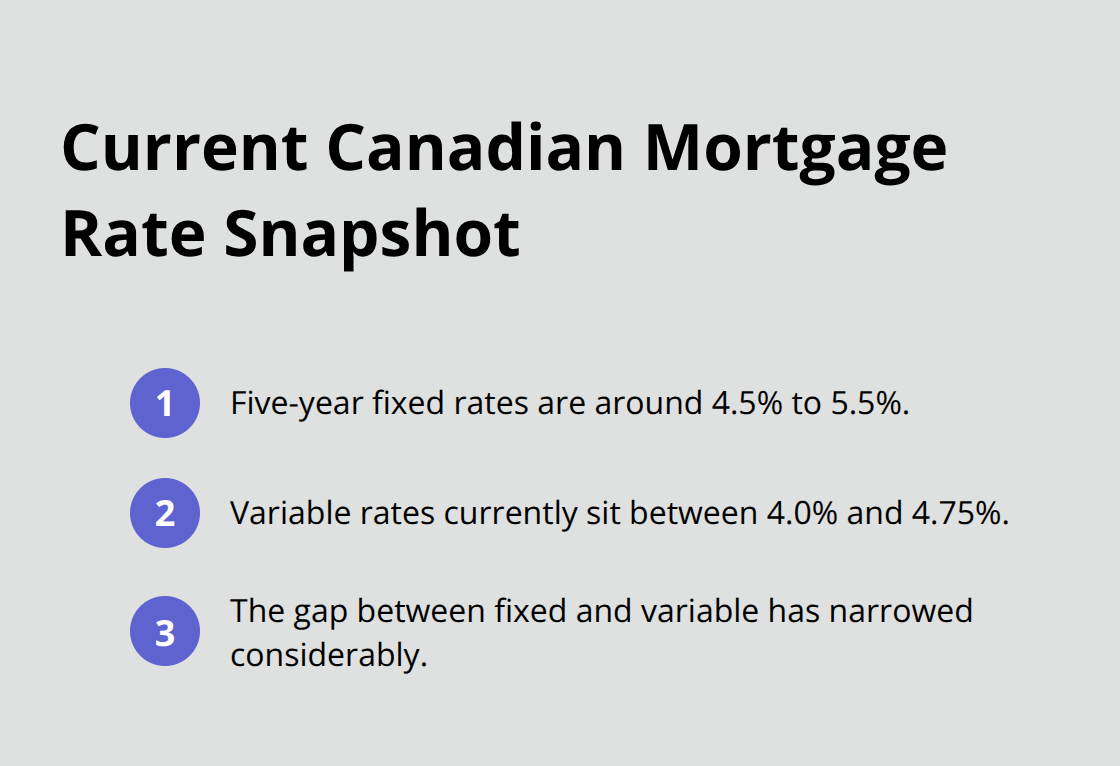
Canada’s mortgage landscape has fundamentally changed since the Bank of Canada’s aggressive rate-hiking cycle that peaked in mid-2023. Fixed rates have stabilized around 4.5% to 5.5% for five-year terms, while variable rates currently sit between 4.0% and 4.75%, depending on your lender and creditworthiness. The gap between fixed and variable has narrowed considerably, making variable rates less attractive than they were during the pandemic era when spreads were massive.
Fixed rates offer payment predictability while variable rates expose you to future increases if the Bank of Canada raises rates again (which remains unlikely in the near term but shouldn’t be dismissed entirely). Most borrowers are gravitating toward fixed rates simply because the psychological comfort of knowing your exact payment for five years outweighs the marginal savings variable rates might provide.
Historical Context and What It Means for You
Mortgage rates in Canada averaged 3.64% in 2022 before climbing sharply through 2023, hitting peaks near 7% for some products. Today’s rates represent a significant decline from those highs, yet they remain substantially elevated compared to the 2.4% average Canadians enjoyed in 2020 and 2021.
This matters because it means your renewal or new mortgage will likely cost hundreds of dollars more monthly than borrowers locked in during the pandemic. If you’re renewing soon, expect rates 1.5% to 2% higher than your current rate, which translates to roughly $300 to $400 additional monthly costs on a $400,000 mortgage.
Regional Rate Variations Across Canada
Regional differences are stark: borrowers in Ontario and British Columbia face competitive pressure that keeps rates slightly lower, while Prairie provinces sometimes see rates 0.25% to 0.5% higher due to lower demand from lenders. What drives mortgage rates in Canada depends on economic factors that vary by region, and the Bank of Canada’s next moves will determine whether rates drift lower or stabilize, but most economists don’t anticipate returns to sub-3% territory within the next two years.
Understanding these regional patterns helps you assess whether your rate quote aligns with what lenders are actually offering in your province. Your location influences not just the rate itself but also the urgency with which you should act on a mortgage application.
What Actually Controls Your Mortgage Rate
The Bank of Canada’s Influence on Your Personal Rate
Your mortgage rate isn’t arbitrary. The Bank of Canada’s policy decisions filter through to your personal rate, but they represent only part of the equation. When the Bank of Canada holds its overnight rate steady, lenders don’t automatically pass identical rates to all borrowers. Instead, they adjust spreads based on risk assessment, and that’s where your credit score, down payment, and amortization choices come into play.
A borrower with a 750 credit score will secure a rate 0.3% to 0.5% lower than someone with a 680 score, even when shopping at the same lender. This spread exists because lenders price risk differently. Someone putting down 20% on a property faces lower default probability than a borrower with 5% down, so the second borrower pays more. Similarly, stretching your amortization to 25 years instead of staying at 20 years signals to lenders that you’re managing cash flow tightly, and they compensate by charging 0.15% to 0.25% higher rates.
These aren’t theoretical distinctions. On a $500,000 mortgage, a 0.4% rate difference costs you roughly $2,000 annually. Over five years, that’s $10,000 in additional interest you’re paying simply because your credit profile or down payment size didn’t align with what lenders prefer.
How Your Credit Score Shapes Your Rate
Your credit history matters more than most borrowers realize. Equifax and TransUnion data shows that Canadians with scores below 650 face rejection rates exceeding 40% at traditional banks, forcing them toward alternative lenders charging premium rates. If your score sits between 650 and 700, you’re in the friction zone where rates spike noticeably.
Pull your credit report from Equifax or TransUnion at least three months before applying for a mortgage. Identify negative items and dispute inaccuracies immediately. Paying down revolving debt before applying raises your score faster than most other actions. Lenders also scrutinize employment history, debt-to-income ratio, and savings patterns. A borrower with 18 months of employment at a new job faces higher rates than someone with five years at the same employer, even with identical credit scores.
Down Payment and Amortization: The Hidden Rate Drivers
Down payment size directly influences rate availability. At 20% down, you unlock the best rates most lenders offer. Drop to 15% down, and rates climb slightly. Below 10% down, you’re forced into mortgage default insurance, which adds costs and makes lenders more cautious with pricing.
Amortization period extensions beyond 20 years signal financial strain to underwriters. The difference between a 20-year and 25-year amortization might seem minor monthly, but lenders view it as a risk indicator and price accordingly. The Bank of Canada’s current policy stance suggests rates will remain relatively stable through 2026, meaning your personal profile becomes the dominant factor in rate pricing. This shift makes your financial preparation far more valuable than timing the market.
Strategies to Secure the Best Mortgage Rate
Shop Multiple Lenders and Brokers
Shopping multiple lenders isn’t optional if you want the best rate available to you. Most borrowers contact one or two banks and accept whatever rate they’re quoted, which is a costly mistake. Borrowers who shopped at least three lenders secured rates 0.25% to 0.5% lower than those who didn’t compare. On a $400,000 mortgage, that 0.35% difference translates to roughly $1,400 annually. Over a five-year term, you’re looking at $7,000 in unnecessary interest payments simply because you didn’t shop around.
The competitive landscape has shifted dramatically, and lenders now price differently based on product type, amortization length, and borrower profile. A rate that’s excellent at one bank might be 0.3% higher at another, yet borrowers rarely know this because they never ask. Start with your current bank, then contact at least two other major banks and one mortgage broker. Mortgage brokers access lenders that don’t deal directly with the public, which means you’ll see rates and products unavailable through traditional channels. Request rate quotes in writing and confirm they’re valid for at least seven days so you can compare properly.
Lock In Your Rate at the Right Time
Timing your rate lock requires understanding how lenders structure rate holds. Most Canadian lenders offer 120-day rate holds at no cost, meaning once you receive a quote, that rate stays valid for four months. This gives you time to prepare your application without watching rates move daily. Don’t lock in a rate immediately upon receiving a quote unless you’re certain you’ll close within 30 days. Instead, wait until you’ve received multiple quotes from different lenders, then select the best rate and lock it with your chosen lender.
Negotiate Terms Before You Sign
Negotiation happens after you’ve chosen your lender but before signing the mortgage agreement. Ask about rate discounts for setting up automatic payments, bundling products, or committing to a longer amortization. Some lenders reduce rates by 0.1% to 0.15% for borrowers who agree to automatic payments, which costs you nothing but saves thousands over the mortgage term. These small concessions compound significantly over five years.
Improve Your Credit Before Applying
Improving your credit requires action at least three months before you plan to submit your mortgage application. Request your credit report from Equifax or TransUnion and dispute any inaccuracies immediately because errors can suppress your score by 50 to 100 points. Pay down revolving credit card balances to below 30% of your credit limit, as utilization ratio heavily influences scoring.
Avoid opening new credit accounts or making large purchases on credit in the months before applying, since recent credit inquiries and new accounts signal financial stress to underwriters. If your score currently sits below 700, focus on these steps first before contacting lenders, because improving your score by 50 points might unlock rate reductions worth far more than any negotiation you could achieve with a lower score.
Final Thoughts
Mortgage rates in Canada remain elevated compared to pandemic lows, but they’ve stabilized enough that your personal financial profile now matters more than market timing. The strategies outlined above-shopping multiple lenders, locking in rates strategically, and improving your credit before applying-directly control how much you’ll pay over your mortgage term. A borrower who implements these tactics can save $10,000 to $15,000 compared to someone who accepts the first rate offered by their bank.
Pull your credit report this week and dispute any errors you find. Contact at least three lenders or brokers within the next two weeks to gather rate quotes in writing, then compare those quotes side by side and lock in your rate with the lender offering the best terms for your situation. Rate holds expire, so waiting another month could cost you thousands if market conditions shift.
We at Financial Canadian provide the practical guidance you need to make informed financial decisions about mortgage rates in Canada and beyond. Visit Financial Canadian to explore resources that support your financial journey and help you secure the rate that reflects your actual financial strength.











Leave a comment