
Carrying multiple debts drains your finances and mental energy. At Financial Canadian, we’ve created this Canada debt consolidation guide to show you exactly how to combine your debts into one manageable payment.
Most Canadians don’t realize they’re paying thousands in unnecessary interest across credit cards, personal loans, and lines of credit. We’ll walk you through the entire process, from assessing your situation to choosing the right consolidation option for your circumstances.
What Debt Consolidation Actually Means
Debt consolidation takes your existing debts-credit cards, personal loans, lines of credit, store cards-and combines them into a single loan with one monthly payment. The new loan pays off all your old debts immediately, leaving you with just one creditor to deal with instead of juggling multiple payment dates and interest rates. This works because most consolidation loans come with lower interest rates than what you’re currently paying across your various debts.
If you’re paying 19.99% on a credit card, 12% on a line of credit, and 8% on a personal loan, consolidation lets you combine everything into a single loan at perhaps 7-9%, depending on your credit score and lender. The math becomes immediately obvious: lower rates mean less money flowing to creditors and more staying in your pocket.
How Interest Rate Cuts Lower Your Monthly Payments
The interest rate reduction is only part of the story. When you consolidate, you also extend your repayment timeline, which further lowers your monthly obligation. Say you owe $30,000 across three debts with varying interest rates. Your current minimum payments total $850 monthly. A consolidation loan at a lower rate spread over five years instead of the mixed timelines you currently have could reduce that to $600-$700 per month. That’s real breathing room in your budget.
While lower monthly payments help immediately, extending your loan term means you’ll pay more interest overall if you keep the loan for the full period. The key is accelerating payments when your budget allows, which you can do without penalty on most consolidation loans. Many Canadians use this strategy: they get the lower payment for cash flow relief, then redirect the savings toward paying down the principal faster once their situation stabilizes.
Three Consolidation Paths Available to Canadians
A debt consolidation loan from a bank, credit union, or online lender is the most straightforward option. You borrow a lump sum and use it to pay off everything else immediately. Banks like RBC and TD offer these, as do online platforms, and your approval depends heavily on credit score, income, and debt-to-income ratio.
A home equity line of credit (HELOC) or home equity loan works if you own property with built-up equity. Lenders will typically let you borrow up to 80% of your home’s value minus your mortgage balance. These carry the lowest rates because your home secures the loan, but they put your house at risk if you default.
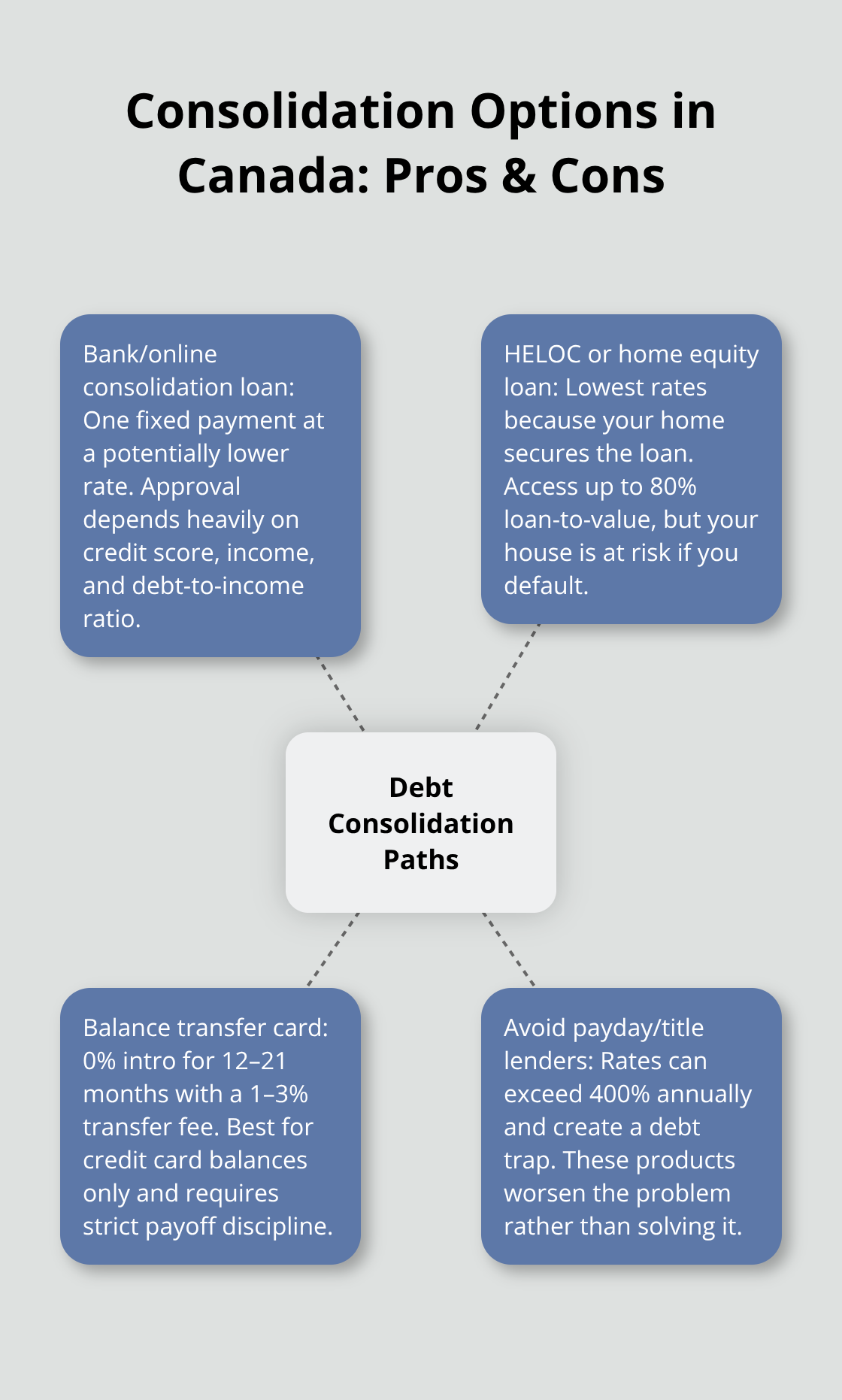
A balance transfer credit card lets you move high-interest balances to a card offering 0% introductory rates for 12-21 months. This option only works for credit card debt, not other loans, and you’ll face a 1-3% transfer fee. The worst consolidation option is borrowing from a payday lender or title loan company; their rates exceed 400% annually and create a debt trap rather than solving the problem.
Your choice depends on what you own, your credit standing, and what types of debt you’re consolidating. Once you understand which option fits your situation, the next step involves assessing exactly what you owe and comparing the specific lenders and rates available to you.
Does Debt Consolidation Actually Save You Money?
The Real Numbers Behind Consolidation Savings
Consolidation saves money for most people, but the math depends entirely on your current interest rates and how disciplined you stay. The average Canadian carrying credit card debt pays 21.99% annually according to the Bank of Canada’s lending rates. If you consolidate that into a loan at 8-10%, you’re looking at genuine savings. A person with $25,000 in credit card debt at 21.99% pays roughly $458 monthly in interest alone over five years.

Consolidate that same debt at 9% and interest drops to $187 monthly. That’s $271 per month staying in your account instead of going to creditors. Over five years, consolidation saves $16,260 on that single scenario. The savings multiply when you’re juggling multiple high-interest debts.
The Trap of New Debt After Consolidation
This advantage evaporates if you treat your consolidation loan as permission to accumulate new credit card debt. Many people consolidate, then run up balances again because the psychological weight of multiple debts disappears. You end up trading one problem for two: the original consolidation loan plus fresh debt. The real win comes from consolidating, then committing to stop borrowing while you pay down the principal aggressively.
Why Payment Simplification Matters More Than You Think
Your payment simplification matters more than people admit. Managing five different due dates, five different creditors, and five different interest rates creates decision fatigue that leads to missed payments. One missed payment on one card can trigger penalty rates of 22-29.99%, instantly destroying your consolidation savings. Setting up automatic payments for your consolidation loan eliminates human error from the equation entirely.
The Hidden Costs of Extending Your Timeline
On the downside, extending your repayment timeline costs you more in total interest paid over the life of the loan, even at the lower rate. A $30,000 debt paid over three years costs less in total interest than the same debt paid over seven years, regardless of interest rate. Your credit score also takes an immediate hit when you apply for consolidation because lenders perform hard inquiries and you’re adding a new account to your credit file. This dip typically recovers within 3-6 months if you make on-time payments.
When Consolidation Won’t Work
Consolidation also doesn’t work if you’re already in severe financial distress with income instability or if your credit score falls below 600, because lenders simply won’t approve you. In those situations, a consumer proposal or bankruptcy filing through a Licensed Insolvency Trustee becomes the realistic path forward, not consolidation. Understanding whether consolidation fits your circumstances requires an honest assessment of your current debt situation and what you actually owe.
How to Get Your Consolidation Approved
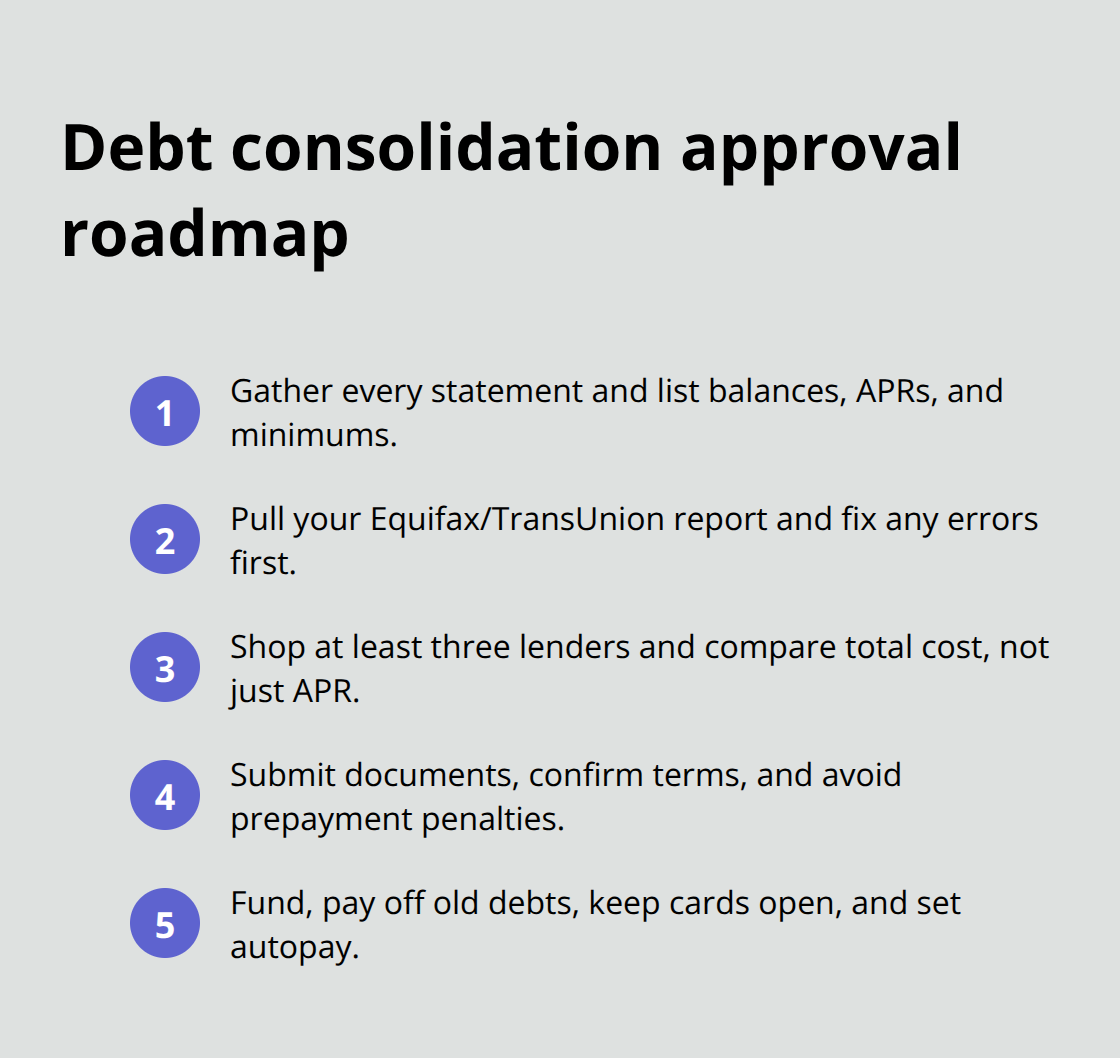
Start by gathering every debt statement you have. Pull your credit card statements, personal loan documents, lines of credit agreements, store card statements, and any other borrowing. Write down the exact balance, interest rate, and minimum monthly payment for each. Most Canadians realize they’re paying far more monthly than expected once they see the full picture on paper. Calculate your total debt amount and add up all minimum payments. This number matters because lenders will scrutinize your debt-to-income ratio during the application process. Canadian banks typically want to see your total monthly debt payments at no more than 40-50% of your gross monthly income.
If you earn $5,000 monthly and your debt payments total $2,500, you’re at the upper limit of what most mainstream lenders will approve.
Check Your Credit Report and Score
Next, check your credit report from Equifax or TransUnion before applying anywhere. You can access your report free through equifax.ca or transunion.ca. Look for errors, missed payments, collections accounts, or other negative marks that might tank your approval odds. If you spot inaccuracies, dispute them immediately because fixing errors can raise your score by 50-100 points within weeks. Your credit score heavily determines which consolidation option you qualify for and what interest rate you’ll receive. Someone with a 750+ score gets approved for bank consolidation loans at 6-8%, while someone with a 650 score gets offered 11-14%. The difference on a $30,000 loan over five years amounts to roughly $4,000 in extra interest paid. This is why some people improve their credit first before consolidating rather than applying immediately. If your score sits below 650, contact a Licensed Insolvency Trustee to discuss whether consolidation makes sense or whether a consumer proposal would serve you better.
Compare Rates From Multiple Lenders
Once you know your numbers and credit standing, shop rates from at least three different sources. Check your primary bank, a credit union, and one online lender. Each will offer different rates based on their lending criteria and risk appetite. Banks like RBC and TD offer consolidation loans but move slowly through their approval process, typically taking 5-10 business days. Credit unions often approve faster, within 2-3 business days, and may offer slightly better rates than banks because they’re member-owned. Online lenders approve within 24 hours but sometimes charge origination fees of 1-3% that get added to your loan amount. A $25,000 loan with a 2% origination fee becomes a $25,500 loan, instantly raising your effective interest rate. When comparing offers, look at the total interest paid over the loan term, not just the advertised rate. A loan at 8% might genuinely cost less than one at 7% if the second loan has hidden fees or a longer term that inflates total interest. Request quotes from each lender without allowing them to pull your credit hard until you’re ready to apply. Soft inquiries don’t damage your score.
Submit Your Application and Documentation
Once you’ve selected your lender, gather pay stubs from the last two months, recent tax returns, and proof of residence like a utility bill. Lenders need to verify your income and confirm you’re a Canadian resident. The application itself takes 15-30 minutes online or over the phone. Most lenders will give you a decision within 24 hours for online applications. If approved, review the loan agreement carefully before signing. Confirm the interest rate matches what was quoted, the loan term is what you agreed to, and there are no prepayment penalties if you want to accelerate payments. Many consolidation loans allow you to pay down principal without penalty, which matters if you plan to redirect your monthly savings toward faster repayment.
Execute Your Consolidation Strategy
Once you sign, the lender deposits funds directly into your account, typically within 2-5 business days. From there, you immediately pay off each of your existing debts. Don’t close old credit card accounts after paying them off; closing accounts lowers your available credit and damages your credit utilization ratio. Instead, keep them open with zero balances. Your consolidation loan now becomes your single monthly payment, and you set up automatic payments to avoid missing due dates (this eliminates human error and protects your credit score from penalty rates that can reach 22-29.99% on missed payments).
Final Thoughts
Debt consolidation works when you commit to the process and avoid accumulating new balances afterward. The math is straightforward: lower interest rates reduce what you pay to creditors, simplified payments eliminate missed deadlines that trigger penalty rates of 22-29.99%, and a single monthly obligation gives you mental clarity. Most Canadians who consolidate save thousands in interest while freeing up monthly cash flow, but only if they treat consolidation as a reset button, not permission to borrow more.
Your next step involves gathering your debt statements and checking your credit report through Equifax or TransUnion. Know your exact numbers before contacting lenders because this information determines which consolidation options you qualify for and what rates you’ll receive. Shop at least three lenders, compare total interest costs rather than advertised rates alone, and watch for hidden fees that inflate your effective borrowing cost (origination fees of 1-3% can add hundreds to your loan amount).
Visit our Canada debt consolidation guide resources to explore how we support Canadians in simplifying their debt situations and taking control of their finances.











Leave a comment