
Finding the best mortgage lenders in Canada means understanding where rates stand right now and how to compare your options effectively.
At Financial Canadian, we’ve analyzed current offerings across major banks, credit unions, and online lenders to show you which institutions deliver competitive rates and what factors actually move the needle on your monthly payments.
Current Mortgage Rate Landscape in Canada
How Rates Have Changed Over the Past Year
Canadian mortgage rates have shifted dramatically since 2024. The Bank of Canada cuts its policy rate on eight fixed dates throughout the year, and mortgage rates followed this trajectory downward. A five-year fixed mortgage that cost 5.5% in mid-2024 now sits around 4.2% to 4.5% depending on your lender and down payment. This matters because a $500,000 mortgage at 5.5% costs roughly $2,840 monthly, while the same mortgage at 4.3% drops to $2,460 monthly-a difference of $380 per month or $4,560 annually.
What Moves Your Rate
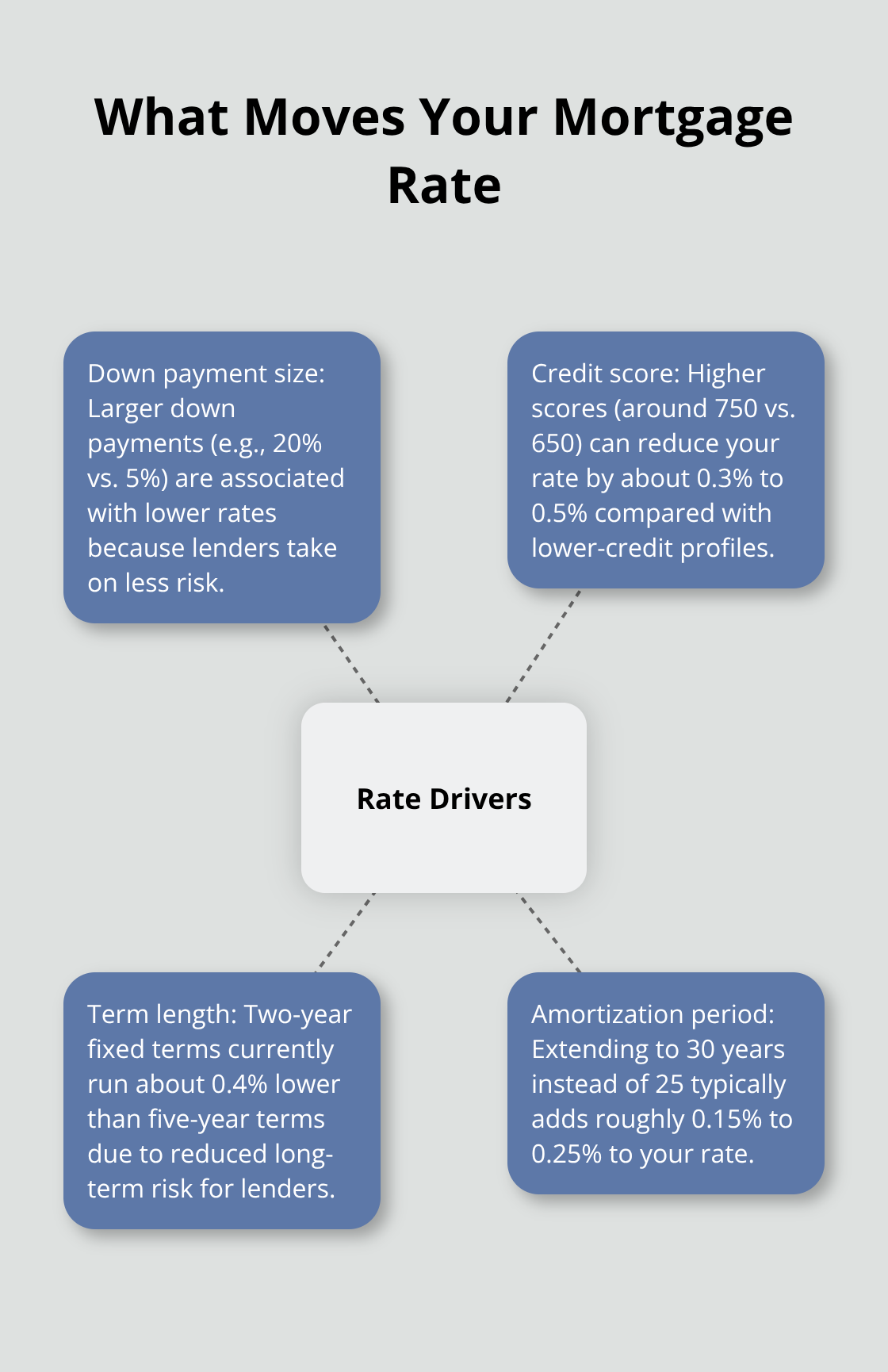
Your personal factors matter more than general market conditions. A borrower with a 20% down payment and a 750 credit score qualifies for rates 0.3% to 0.5% lower than someone with 5% down and a 650 score. Mortgage term length also drives pricing-a two-year fixed currently runs 0.4% lower than a five-year fixed because lenders take on less long-term risk. Amortization period affects your rate too: stretching payments over 30 years instead of 25 years typically adds 0.15% to 0.25% to your rate.
How the Bank of Canada Influences Your Payments
The Bank of Canada influences short-term interest rates, which banks use as their baseline for variable-rate mortgages and home equity lines of credit. When the central bank moves, lenders typically adjust within days, so timing your application around rate announcement dates in September, October, and December can save you thousands. The competition between Canada’s big five banks-Royal Bank, TD, Scotiabank, BMO, and CIBC-keeps rates relatively tight, typically within 0.1% to 0.2% of each other for similar products.
Regional and Lender Variations
Regional variations exist but are subtle among major lenders; Alberta and Saskatchewan see slightly lower rates than Ontario and British Columbia, though differences rarely exceed 0.15% between provinces. Credit unions in provinces like Ontario and British Columbia occasionally undercut the big banks, particularly for insured mortgages under $500,000. Online lenders and mortgage brokers now offer rates competitive with traditional banks, and brokers can access products from 30+ lenders simultaneously, making rate shopping through a broker worthwhile if you’re willing to compare options carefully. Understanding these variations positions you to evaluate which lenders actually compete for your business.
Where to Find Competitive Mortgage Rates Right Now
Major Banks vs. Alternative Lenders
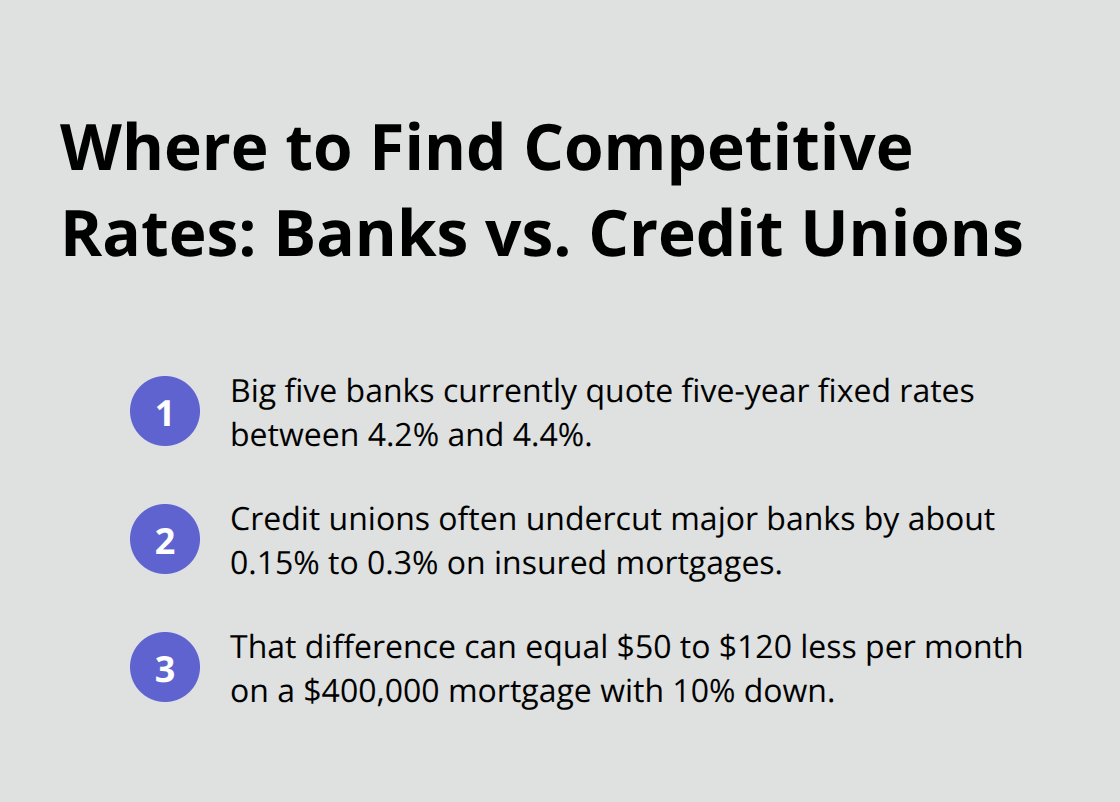
Canada’s big five banks dominate mortgage lending but don’t automatically offer the best rates for your situation. Royal Bank, TD, Scotiabank, BMO, and CIBC currently quote five-year fixed rates between 4.2% and 4.4%, with variation tied directly to down payment size and credit profile rather than which bank you choose. The real advantage appears when you move beyond these household names. Credit unions in Ontario and British Columbia consistently undercut the major banks by 0.15% to 0.3% on insured mortgages, which means a $400,000 mortgage with 10% down costs $50 to $120 less monthly through a credit union than through RBC or TD.
Online Banks and Brokers
Tangerine, EQ Bank, and Simplii Financial have stripped away branch overhead and pass savings to borrowers, typically offering rates 0.2% to 0.4% below the big five for both fixed and variable products. Online mortgage brokers represent the most practical option for rate shopping because they compare at least three mortgage lenders and identify which lender actually competes for your specific profile. A broker costs nothing upfront since lenders pay their commission, yet their ability to compare rates across major banks, credit unions, and alternative lenders saves most borrowers between $3,000 and $8,000 over a five-year term. Brokers also handle the paperwork and communicate directly with lenders, eliminating the repetitive applications you’d submit if calling banks individually.
Timing Your Application
The timing advantage matters more than which lender you select. If you apply one week before the Bank of Canada’s rate decision in September, October, or December, you lock in a rate before potential cuts take effect, then potentially renegotiate downward if rates drop within your lender’s hold period (typically 120 days). Two-year fixed mortgages currently run 0.4% lower than five-year terms, making them attractive if you believe rates will stabilize or decline over the next 24 months, though this strategy carries risk if rates spike unexpectedly.
Variable Rates and Renewal Strategy
Variable-rate mortgages have become competitive again as the central bank nears the end of its rate-cutting cycle, currently offering 0.3% to 0.5% below comparable five-year fixed rates, but borrowers must accept payment fluctuation risk. Don’t rely on your current bank’s retention offer when your mortgage renews; shop aggressively because banks rarely match outside offers, and switching lenders typically costs nothing beyond a small discharge fee of $100 to $300 on your existing mortgage. This competitive approach to renewal positions you to evaluate which lenders actually compete for your business and which questions matter most before you commit.
How to Compare Mortgage Rates and Lock in the Best Deal
Access multiple lenders simultaneously
Mortgage brokers remain the fastest path to competitive rates because they simplify the mortgage shopping process by giving borrowers access to multiple lenders and financing options. When you contact a broker, they ask about your down payment percentage, credit score, employment status, and desired mortgage term, then return quotes from lenders who will actually compete for your business. This approach saves hours compared to calling RBC, TD, Scotiabank, BMO, and CIBC individually, and brokers cost nothing since lenders pay their commission. Online comparison tools like Ratehub.ca and Nesto display rates from multiple lenders, though these show posted rates rather than the discounted rates you can negotiate directly. Brokers access lender-specific discounts and lock in rates on your behalf, whereas comparison sites show you options but leave the negotiation to you.
Ask Lenders Three Critical Questions Before Applying
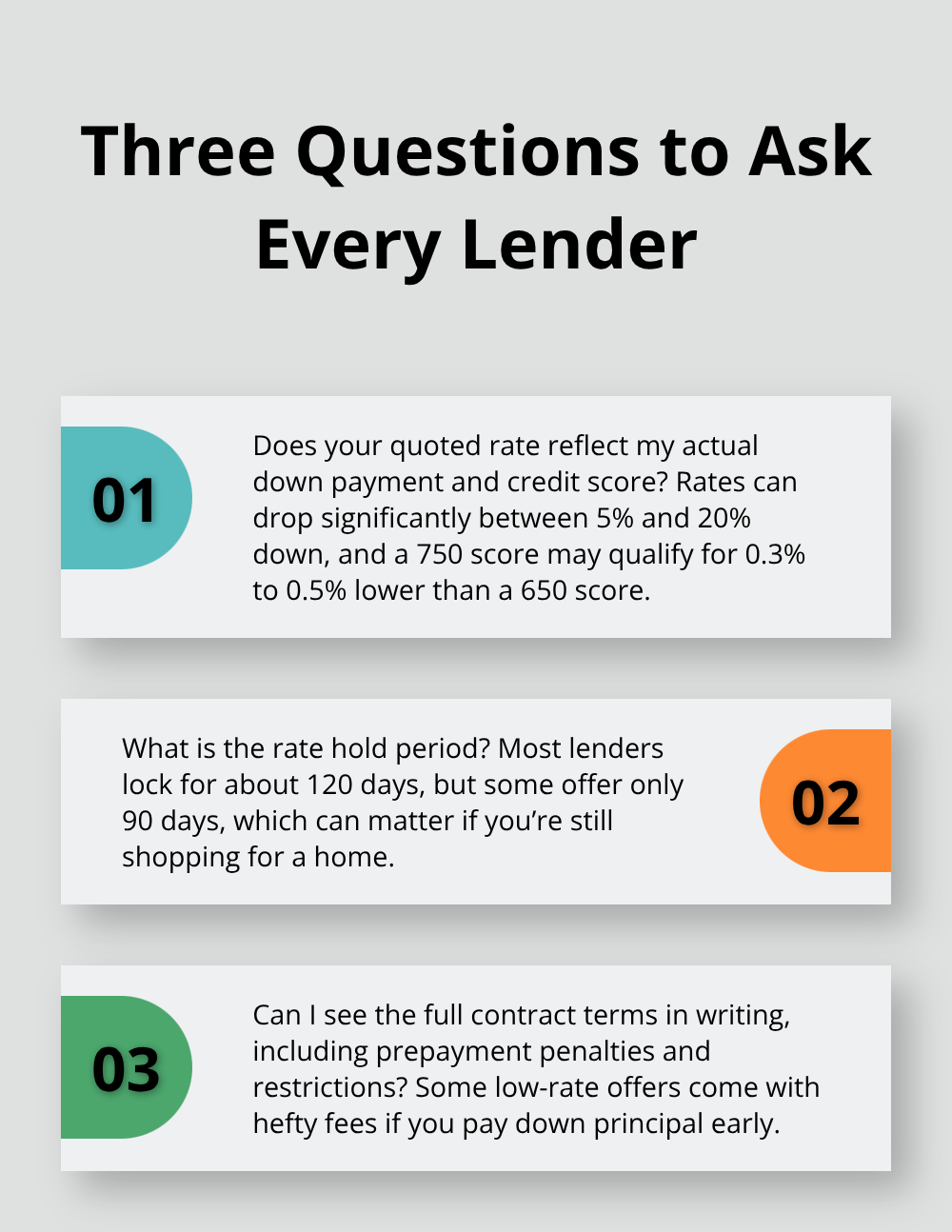
Confirm whether the rate quote assumes your specific down payment percentage and credit score, because rates drop significantly between 5% and 20% down, and a 750 credit score qualifies for rates 0.3% to 0.5% lower than a 650 score. Ask what the rate hold period lasts, since most lenders lock rates for 120 days but some offer only 90 days, which matters if you’re still in the home-buying process. Request the actual mortgage contract terms in writing before committing, including prepayment penalties or restrictions, because some lenders advertise low rates but charge hefty fees if you pay down principal early. These three questions reveal whether their quoted rate is actually achievable for your situation.
Time Your Application Around Rate Announcements
Apply one week before the Bank of Canada rate announcements in September, October, and December, because if rates drop within your lender’s hold period, you can often renegotiate downward without reapplying. Two-year fixed mortgages currently offer 0.4% savings versus five-year terms, making them worth considering if you believe rates will stabilize or decline over the next 24 months (though this strategy fails if rates spike unexpectedly and you face renewal at significantly higher levels). The timing advantage matters more than which lender you select because lenders rarely match outside offers at renewal, and switching lenders typically costs nothing beyond a small discharge fee of $100 to $300 on your existing mortgage.
Evaluate Variable-Rate Mortgages Strategically
Variable-rate mortgages have become competitive again as the central bank nears the end of its rate-cutting cycle, currently offering 0.3% to 0.5% below comparable five-year fixed rates. Borrowers must accept payment fluctuation risk when they choose variable rates, so this option works best if you have financial flexibility to absorb potential payment increases. Shop aggressively at renewal time because banks rarely match outside offers, and this competitive approach positions you to evaluate which lenders actually compete for your business and which questions matter most before you commit.
Final Thoughts
The best mortgage lenders Canada offers aren’t always the household names you recognize. We at Financial Canadian have shown you that competitive rates come from major banks, credit unions, online lenders, and brokers depending on your specific situation. A borrower with 20% down and a strong credit score might find the big five banks adequate, while someone with 10% down qualifies for better rates through a provincial credit union or online alternative.
Your down payment size, credit score, and mortgage term matter far more than brand loyalty. A 0.3% rate difference between lenders translates to $120 monthly savings on a $400,000 mortgage, which compounds to $7,200 over five years. Timing your application around Bank of Canada rate announcements in September, October, and December positions you to lock in rates before potential cuts, then renegotiate downward if rates drop within your hold period.
Contact a mortgage broker or use online comparison tools to gather quotes from at least three lenders. Ask each lender whether their rate quote reflects your specific down payment and credit profile, what their rate hold period lasts, and request contract terms in writing before committing. Shop aggressively at renewal time because banks rarely match outside offers, and switching lenders costs nothing beyond a $100 to $300 discharge fee-this competitive approach ensures you evaluate which lenders actually compete for your business rather than accepting whatever your current bank offers.










Leave a comment