
Buying your first home is one of the biggest financial decisions you’ll make. At Financial Canadian, we know that navigating a first time mortgage in Canada can feel overwhelming without the right guidance.
This guide walks you through everything you need to know-from understanding how mortgages work to finding the best rates for your situation. We’ll show you exactly how to prepare financially and avoid the mistakes that cost first-time buyers thousands of dollars.
How Mortgages Work in Canada
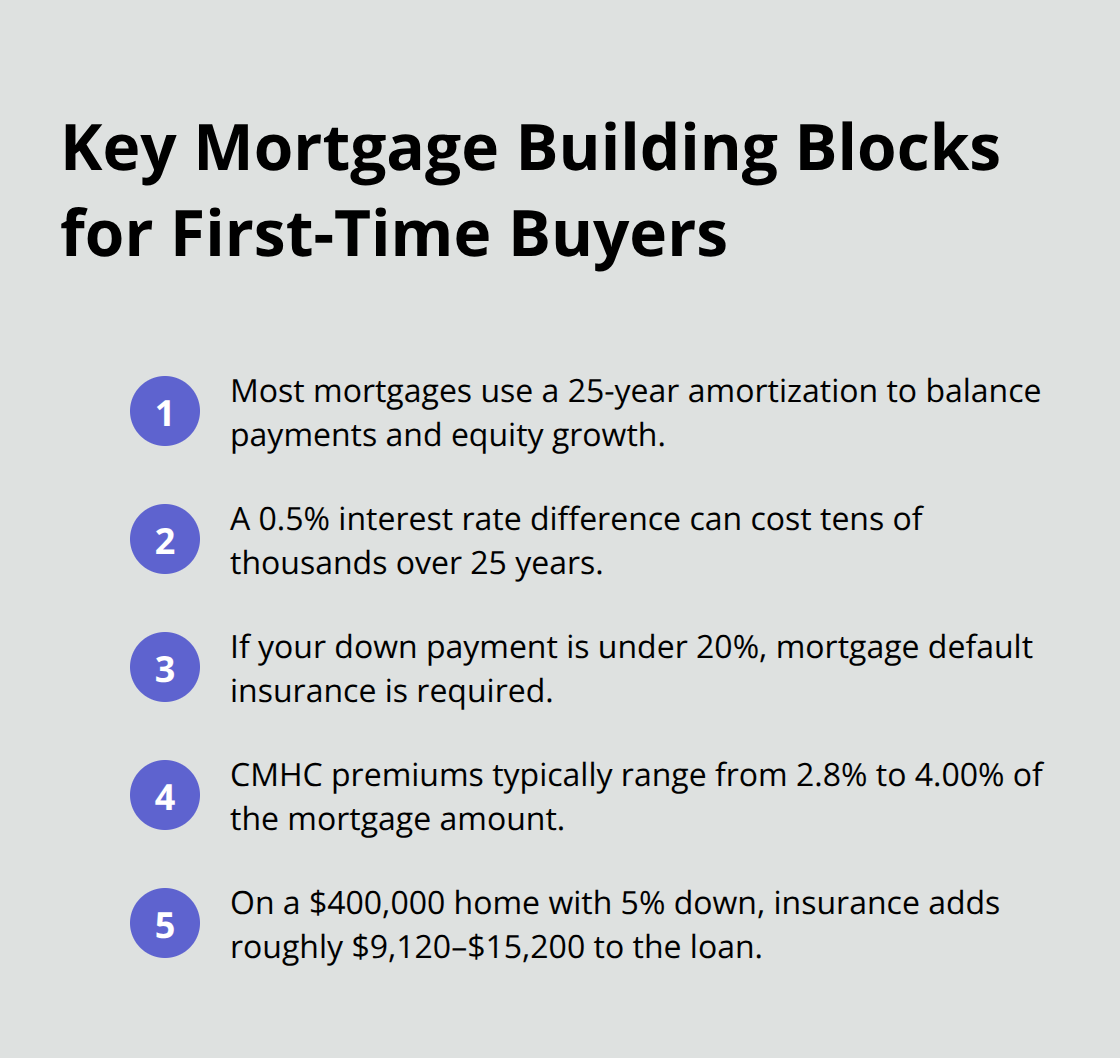
A mortgage is a loan secured by your home, meaning the lender holds a claim against the property until you repay the full amount. In Canada, most mortgages carry a maximum amortization period of 25 years, though you can select shorter terms like 20 or 15 years if you want to build equity faster. The mortgage amount you borrow is called the principal, and you repay it through monthly payments that include both principal and interest. Your interest rate determines how much extra you pay on top of the borrowed amount-even a 0.5% difference in rate costs you tens of thousands of dollars over 25 years, which is why shopping around with multiple lenders matters significantly. Canada’s mortgage system requires mortgage default insurance if your down payment falls below 20%, which protects the lender but adds to your monthly costs. CMHC is the largest mortgage insurer in Canada, and their insurance premiums typically range from 2.8% to 4.00% of your mortgage amount depending on your down payment size. For example, on a $400,000 home with a 5% down payment ($20,000), you need a $380,000 mortgage plus insurance costs of roughly $9,120 to $15,200, which gets added to your loan.
Fixed-Rate Mortgages: Predictable Payments
Fixed-rate mortgages lock in your interest rate for the entire term, so your payment stays the same whether rates rise or fall. Most Canadian first-time buyers choose fixed rates because they provide payment certainty and are easier to budget around. Your monthly payment never changes, which means you can plan your finances with confidence. This stability appeals to buyers who want to avoid surprises or who operate on tight budgets.
Variable-Rate Mortgages: Lower Starting Costs
Variable-rate mortgages fluctuate with the Bank of Canada’s prime lending rate, so your payment can increase or decrease every few years when the rate adjusts. Variable rates typically start lower than fixed rates-sometimes 0.5% to 1% cheaper-but you risk paying more if rates climb. If you can absorb rate increases and plan to sell or refinance within five years, a variable rate might save you money. The trade-off is simple: you accept payment uncertainty in exchange for lower initial costs.
Choosing Your Rate Strategy
If you’re risk-averse or have a tight budget, fixed rates make sense because you’ll never face payment shock. If you can handle potential increases and have flexibility in your timeline, variable rates offer savings opportunities. Your mortgage term is separate from amortization-a term typically runs 1 to 10 years, and when it ends, you renew at the current rate even if you haven’t finished paying off the principal. This distinction matters because your rate can change at renewal even if you stay with the same lender. Understanding these mechanics helps you calculate realistic monthly payments and positions you to compare actual mortgage offers from lenders.
Getting Your Finances Ready for a Mortgage
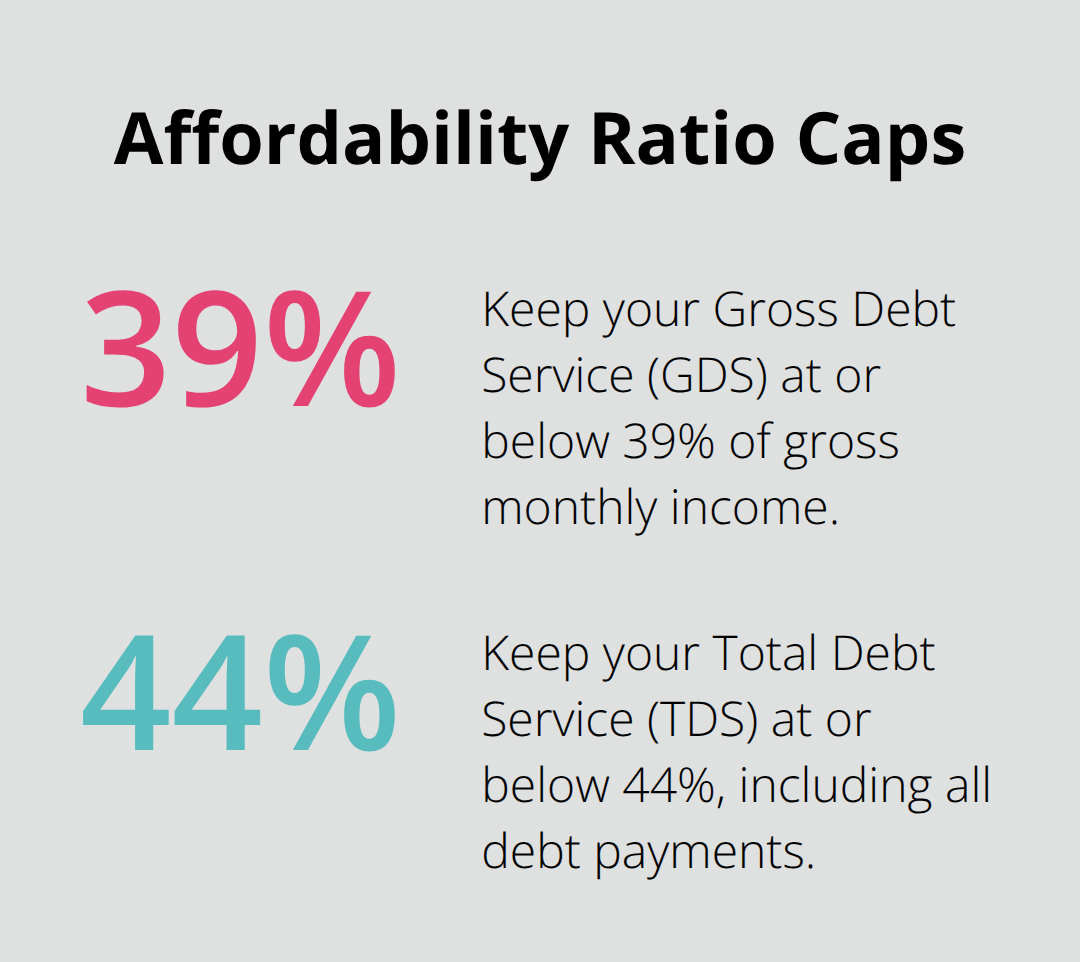
Your financial health determines whether lenders approve you and what rates you’ll qualify for. Start by calculating how much home you can actually afford, not just what a lender might approve you for. Your gross debt service ratio should stay below 39%, meaning your mortgage payment, property taxes, heating, and condo fees combined shouldn’t exceed 39% of your gross monthly income. Your total debt service ratio caps at 44%, which includes all debt payments like car loans, credit cards, and student loans on top of housing costs. If you earn $5,000 monthly, your mortgage payment plus housing costs shouldn’t exceed $1,950, and total debt payments shouldn’t exceed $2,200. CMHC’s affordability calculator lets you test different scenarios before you start house hunting, since this gives you a realistic price range instead of wasting time on homes you can’t qualify for.
Build Your Down Payment Strategically
Down payment size directly affects your mortgage costs. A 5% down payment triggers mortgage insurance that adds roughly 2.8% to 4.00% to your loan amount, while 10% down still requires insurance but at lower rates. If you’re saving for a $400,000 home, putting down 5% costs $20,000 upfront but adds $9,120 to $15,200 in insurance fees to your mortgage. Jumping to 10% down ($40,000) reduces insurance costs significantly and lowers your monthly payment. Automate your savings into a high-yield savings account with a monthly target rather than hoping you’ll save sporadically. Local moving costs run up to about $2,600, and closing costs typically consume 2% to 6% of your loan amount, so factor these expenses into your total savings goal. Start saving now, even if you’re not buying for two years, because interest compounds in your favor.
Fix Your Credit Before Applying
Lenders check your credit score when you apply for a mortgage, and even small score improvements save thousands in interest. Obtain free credit reports from Equifax, Experian, and TransUnion, then dispute any errors you find because mistakes directly damage your score. Pay all bills on time for at least six months before applying, as payment history accounts for 35% of your credit score. Keep existing credit cards open even if you don’t use them, because closing accounts increases your credit utilization ratio and tanks your score. Avoid opening new credit accounts or applying for new credit while shopping for mortgages, since each application triggers a hard inquiry that temporarily lowers your score. Multiple hard inquiries within 30 days count as a single pull for mortgage purposes, but inquiries outside that window damage your score separately. If your score sits below 650, work on improving it for three to six months before applying for a mortgage, since lenders charge significantly higher rates for weaker credit profiles.
Understand What Lenders Actually Check
Mortgage qualification goes beyond your credit score. Lenders verify your income through tax returns, pay stubs, and employment letters, and they scrutinize employment gaps longer than two months. Self-employed applicants need two years of business tax returns and accounting statements, not just one year. Your down payment source matters too-lenders want to see that you saved the money yourself rather than borrowed it, so avoid taking out loans to fund your down payment. Lenders also check your employment stability and may reject you if you’ve changed jobs within the last 90 days, even if you’re in the same industry. Debt consolidation before applying can help your debt service ratios, but paying off debt three months before applying looks suspicious to lenders. Consolidate debt at least six months before applying so lenders see a pattern of lower payments, not a sudden manipulation of your ratios.
Prepare for the Next Stage
Your financial foundation now supports a strong mortgage application. With your down payment saved, credit score improved, and employment history stable, you’re ready to shop for the best rates available. Lenders compete aggressively for qualified borrowers, which means your preparation directly translates into better offers and lower costs over the life of your loan.
How to Get the Best Mortgage Rate in Canada
Shopping around with multiple lenders is the single most important step you’ll take to reduce your mortgage costs, yet most first-time buyers skip it entirely. Freddie Mac research shows that homebuyers can potentially save $600–$1,200 annually by applying for mortgages from multiple lenders. On a $380,000 mortgage amortized over 25 years, that difference compounds to $15,000 to $30,000 in total savings. Start with preapprovals from at least three different lenders-banks, credit unions, and online mortgage providers-because each one prices risk differently and offers distinct rate discounts. Complete all preapproval inquiries within a 30-day window so they count as a single credit pull rather than multiple inquiries that damage your credit score separately.
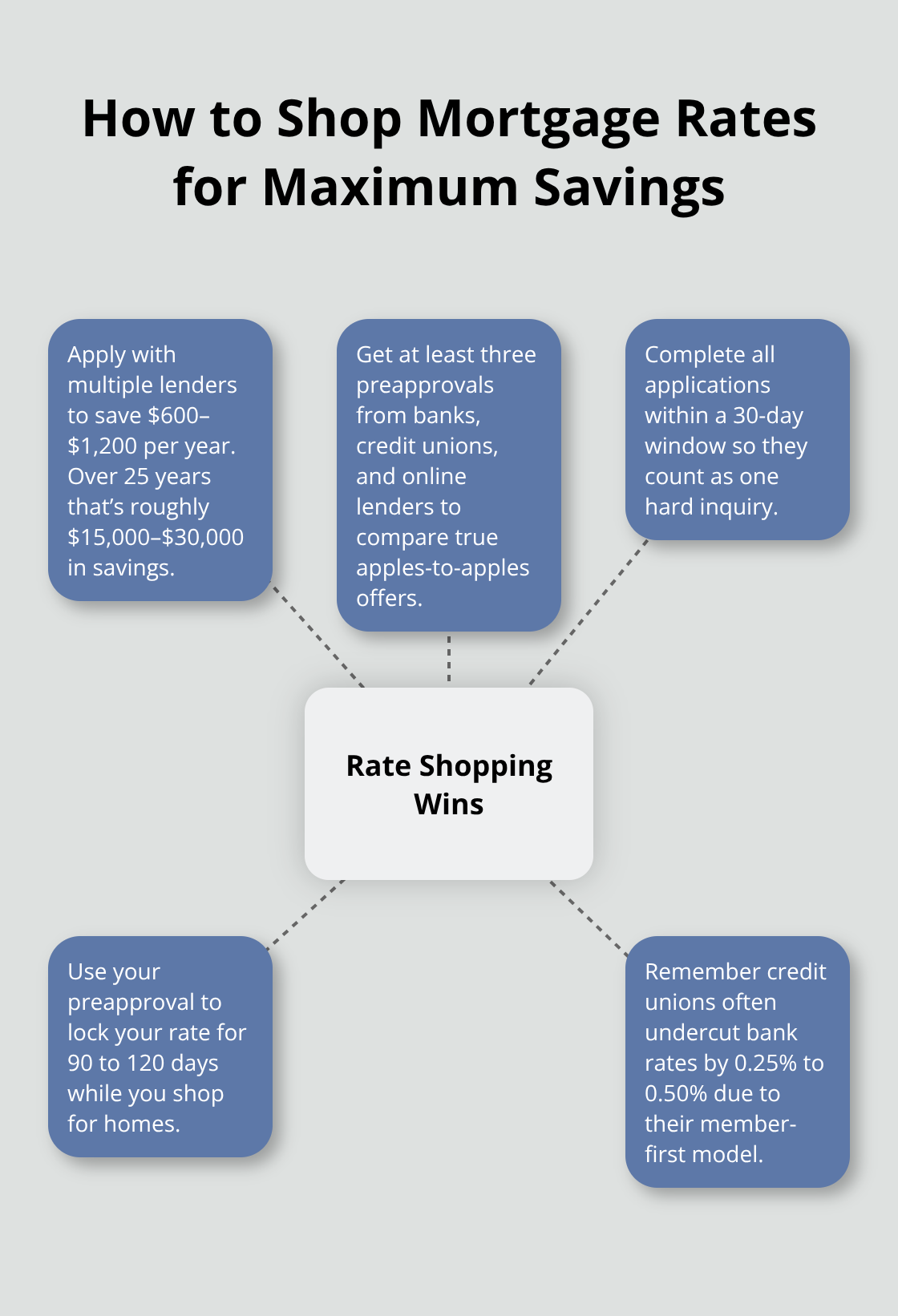
Your preapproval letter shows sellers you’re a serious buyer and locks in your rate for 90 to 120 days, which gives you time to search for homes without losing your pricing power. Never accept the first rate offered, and never assume your bank offers the best deal just because you have accounts there. Banks often reserve their lowest rates for their most profitable customers, not for first-time buyers with smaller down payments. Credit unions frequently undercut bank rates by 0.25% to 0.50% because they operate on a non-profit basis and return earnings to members rather than shareholders. Online lenders compete aggressively on rates but may have stricter documentation requirements and slower closing timelines. Compare mortgage rates across multiple lenders in writing from each one so you can compare apples to apples, including the interest rate, term length, amortization period, and any fees or discount points they’re offering.
Mortgage Brokers Access Wider Rate Options
A mortgage broker accesses rates from 50 to 100 different lenders instead of forcing you to contact each one individually, which streamlines your shopping process dramatically. Brokers earn commissions from lenders, not from you, so their services cost nothing upfront-the lender pays them when you close. This creates a conflict of interest where some brokers push you toward higher-rate products to earn bigger commissions, so interview brokers about their process and ask which lenders they work with most frequently. The best brokers specialize in first-time buyers and understand CMHC mortgage insurance nuances, because they can structure your down payment to minimize insurance costs or recommend alternative insurer options like Sagen or Canada Guaranty. A skilled broker might suggest putting down 9.99% instead of 5% if the insurance savings outweigh the extra down payment required, which turns complex math into actionable strategy. Avoid brokers who pressure you toward variable-rate mortgages just because they carry higher commissions, and avoid those who won’t provide rate quotes in writing before you commit. The best approach combines quotes from your own lender shopping plus a broker’s quotes, then compares all options side by side. This dual approach takes four to six hours of your time but protects you against biased recommendations and ensures you see the actual lowest rates available in the market.
Negotiate Terms Beyond Just the Rate
Your rate matters, but terms like prepayment options and renewal flexibility matter equally for long-term flexibility. Ask every lender about prepayment privileges-specifically, whether you can make lump-sum payments without penalty and how much you can accelerate payments annually. Some lenders allow 20% annual prepayments while others cap it at 10%, and this difference determines how quickly you can pay down your principal. Confirm your lender’s renewal policy before signing anything, because some lenders automatically renew at the posted rate if you don’t contact them 120 days before maturity, while others offer rate holds for existing customers. If rates drop significantly at renewal, you want the flexibility to shop around rather than being locked into your lender’s posted rate. Fixed-rate terms of five years dominate the Canadian market because they balance rate certainty with the ability to shop around at renewal, but some buyers benefit from shorter three-year terms if they plan to sell within that window. Closing costs typically run 2% to 6% of your mortgage amount, and some lenders absorb specific costs like appraisals or legal fees to win your business, so negotiate which party covers what before you commit. Ask whether the lender offers rate holds beyond your preapproval period if rates spike while you’re house hunting, because a 90-day hold becomes worthless if your home search extends to four months.
Final Thoughts
Your first-time mortgage in Canada succeeds when you act before you apply. Start by calculating your actual affordability using CMHC’s tools, save aggressively toward your down payment, and improve your credit score by obtaining free reports from all three bureaus, disputing errors, and paying bills on time for at least six months. Verify your employment stability and avoid job changes or new credit applications during this preparation phase, since these steps take three to six months but eliminate rejection risk and position you for better rates.
First-time buyers commonly make expensive mistakes that cost thousands in extra interest. Many skip the preapproval process entirely and waste time viewing homes they cannot actually afford, while others accept their bank’s first rate offer without shopping around and leave $600 to $1,200 annually on the table. Some rush into variable-rate mortgages without understanding payment shock risk, consolidate debt too close to applying (which lenders view with suspicion), or borrow money to fund their down payment, which lenders reject outright.
Contact at least three lenders for preapproval quotes within a 30-day window, then compare their rates and terms in writing. Consider speaking with a mortgage broker who accesses 50 to 100 lenders and specializes in first-time buyers, and negotiate prepayment privileges and renewal flexibility alongside your interest rate. We at Financial Canadian help you establish a strong financial foundation through our comprehensive mortgage guidance, so you can move forward with confidence in your decisions.











Leave a comment