
Debt weighs on millions of Canadians. Credit card balances, personal loans, and mortgages can quickly spiral into a financial crisis that feels impossible to escape.
At Financial Canadian, we know that Canada debt relief options exist-but choosing the right one requires understanding your specific situation. This guide walks you through the most effective strategies available to regain control of your finances.
Know Your Actual Debt Picture
List Every Debt You Carry
Before exploring relief options, you need hard numbers on your debt situation. This isn’t about feeling bad about what you owe-it’s about gathering the facts that will determine which strategy works best for you. Start by listing every debt you carry. Write down credit card balances, personal loans, car loans, payday loans, student loans, tax debt, and any other money you owe. Next to each, add the current interest rate and minimum monthly payment.
Many Canadians discover they’re paying wildly different rates across their debts, which matters enormously when choosing a relief strategy. A credit card at 21% interest behaves very differently than a car loan at 6%. This gap directly affects which debts you should prioritize and which relief options will actually help.
Calculate Your Debt-to-Income Ratio
Add up your total monthly debt payments-not just minimums, but what you’re actually paying. Then calculate your gross monthly income from all sources. Divide total debt payments by gross income to get your debt-to-income ratio. If this ratio exceeds 36%, you’re carrying more debt than most lenders consider manageable.
Statistics Canada shows that the average Canadian household carries around $7,000 in consumer debt, but this masks the real problem: many households carry far more while others carry none. Your specific number tells you how urgent your situation is. A person with $20,000 in debt and $3,000 monthly income faces a different crisis than someone with $50,000 in debt and $6,000 monthly income, even though both need help.
Distinguish Between Secured and Unsecured Debt
The type of debt matters just as much as the amount. Unsecured debts like credit cards, personal loans, and payday loans can be addressed through consumer proposals or bankruptcy. Secured debts like mortgages and car loans cannot-those creditors hold collateral and have different legal rights.
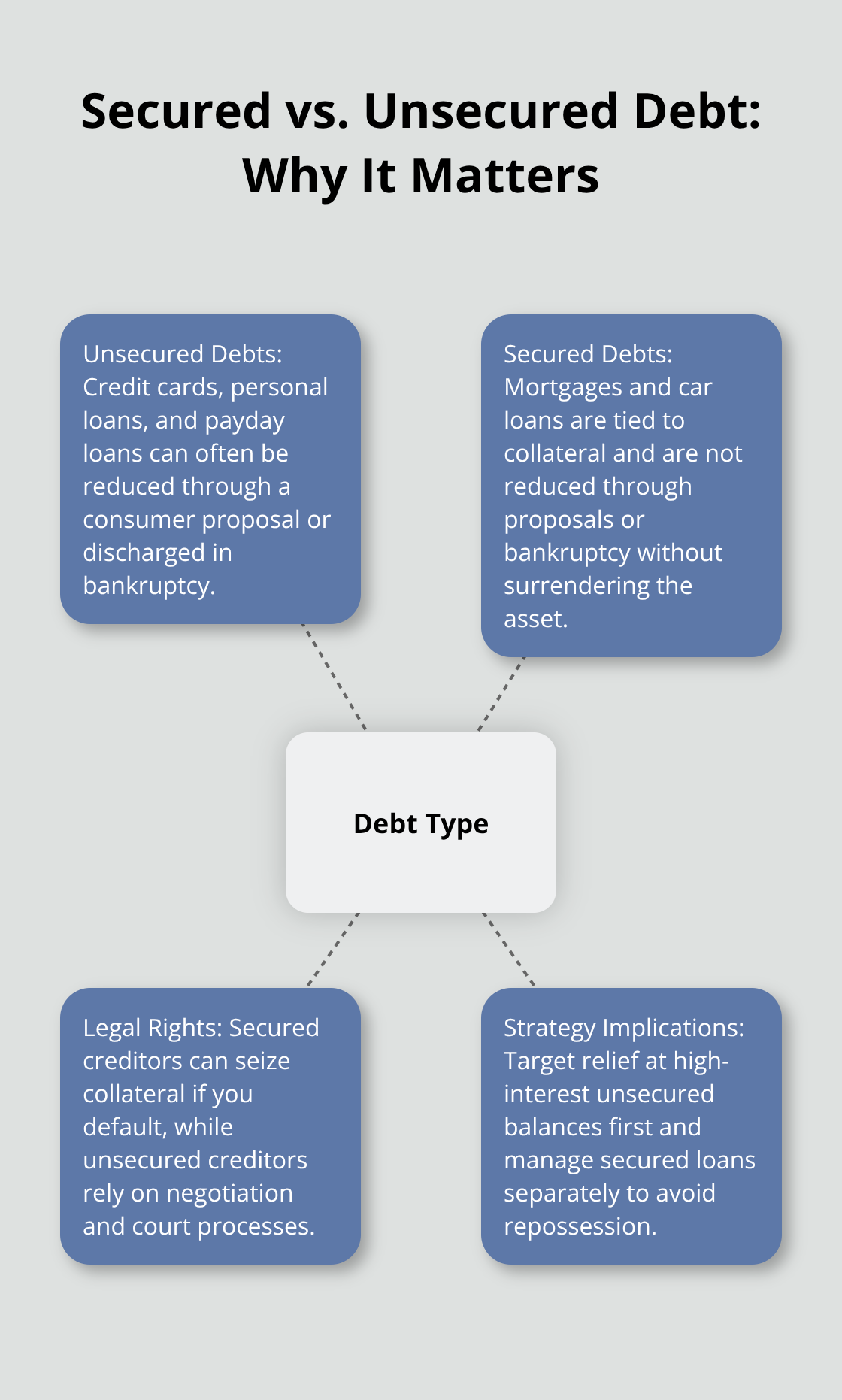
If you’re struggling primarily with credit card debt, your options differ significantly from someone drowning in student loans or tax debt. Know which debts qualify for relief under Canada’s Bankruptcy and Insolvency Act and which ones don’t. This clarity prevents wasted effort pursuing solutions that won’t touch your actual problem.
Understanding your debt picture-the total amount, the interest rates, the monthly obligations, and the type of debt-positions you to evaluate which relief strategy actually fits your circumstances. With these numbers in hand, you can now compare the specific options available to Canadian debtors.
Debt Relief Options Available in Canada
Canada’s debt relief landscape offers five main paths, but only three warrant serious consideration for most people struggling with unsecured debt. Consumer proposals and bankruptcy provide legal protection under the Bankruptcy and Insolvency Act, administered by Licensed Insolvency Trustees. Debt consolidation loans merge multiple debts into a single payment, often at lower interest. Credit counselling through non-profit agencies creates structured repayment plans. Debt settlement and informal negotiations rarely work and often cost more in fees than they save. Your choice depends entirely on how much debt you carry, what type it is, and whether you can actually afford to repay it.
Consumer Proposal: Negotiate Your Way Out
A consumer proposal lets you settle unsecured debts for less than you owe, up to $250,000 in total. You make one monthly payment to a Licensed Insolvency Trustee for up to five years, then the remaining debt disappears. The catch: creditors must accept the deal, though acceptance rates reach 99% on filed proposals.
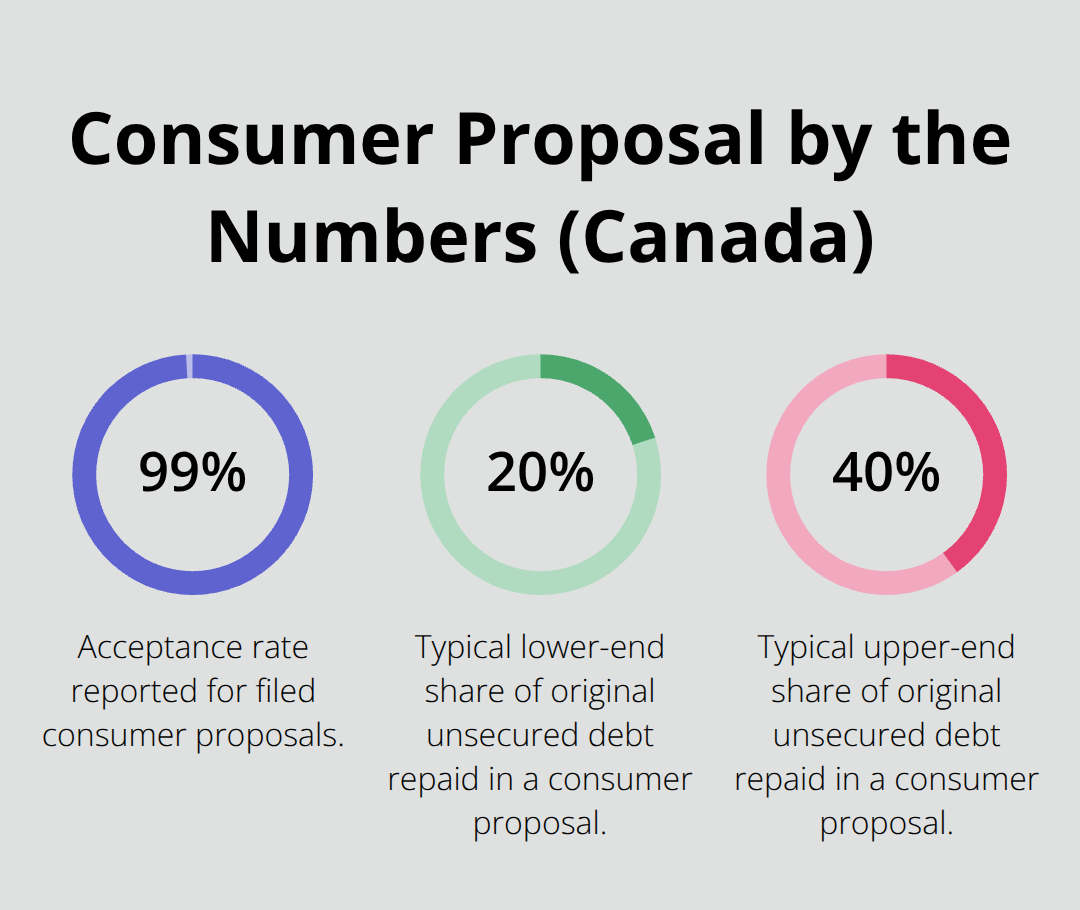
A consumer proposal settles debt at roughly 20% to 40% of what you originally owed, though this varies based on your income and assets. If you earn $3,000 monthly with $40,000 in credit card debt, you might propose paying $8,000 to $12,000 total over five years, or about $160 to $200 monthly. Credit bureaus report a consumer proposal as an R7 rating, which stays on your file for three years after completion or six years after filing, whichever comes first. This matters because it affects your ability to obtain credit, though not as severely as bankruptcy. You keep your house, your car, and your assets. You avoid the stigma and finality of bankruptcy. Most importantly, you stop paying interest immediately once the proposal is filed. The Licensed Insolvency Trustee handles all creditor communication, so collection calls stop and wage garnishments freeze.
Debt Consolidation: Only if Interest Savings Are Real
Debt consolidation combines multiple debts into one loan, typically at a lower interest rate. This works only if the new loan’s total cost is genuinely less than what you’re currently paying. If you owe $15,000 across three credit cards at 20% interest and consolidate into a personal loan at 10% over five years, you save thousands in interest. However, consolidation does not erase debt. You still owe the full principal. Borrowers with credit scores above 740 qualify for the best consolidation rates; those between 670 and 739 face higher rates; anyone below 670 may be denied. Before consolidating, calculate the exact total cost of the new loan versus continuing current payments. A balance-transfer credit card offering 0% interest for 12 months can work if you aggressively pay down the principal during the promotional period, but the 0% expires and rates jump to 21% or higher. This strategy only succeeds if you have the discipline and income to eliminate the debt before the promotion ends. Debt consolidation also temporarily lowers your credit score due to the hard inquiry and new account, though the score recovers as you make on-time payments and reduce your credit utilization ratio. The risk is real: many people consolidate and then accumulate new credit card debt on top of the consolidation loan, ending up worse off.
Credit Counselling and Debt Management Plans
Non-profit credit counselling agencies create a formal debt management plan where you make one monthly payment to the agency, which distributes it to your creditors over three to five years. Creditors may accept lower interest rates, but they’re not obligated to. The monthly payment is typically lower than what you’re currently paying, which improves cash flow. However, debt is not eliminated, only reorganized. The plan may restrict your ability to take on new credit, which matters if you need access to borrowing. Credit counselling includes two mandatory sessions to rebuild your budgeting skills, which is genuinely valuable. A debt management plan affects your credit but less severely than bankruptcy or a consumer proposal. The major downside: creditors control whether they accept the plan, and acceptance is not guaranteed. You’re also dependent on the agency’s follow-through in distributing payments correctly each month. If a creditor refuses to participate, your plan falls apart.
Moving Forward With Your Choice
Each option carries different costs, timelines, and credit impacts. The next section walks you through how to compare these factors and select the path that actually fits your financial reality.
Comparing Costs, Timelines, and Credit Impact
The True Cost of Each Debt Relief Path
The real cost of debt relief extends far beyond the monthly payment. A consumer proposal might cost you $200 monthly for five years, totaling $12,000 to settle $40,000 in debt. A debt consolidation loan might stretch across seven years with higher total payments but no debt forgiveness. Credit counselling through a debt management plan keeps you paying the original debt amount with only modest interest relief, if creditors cooperate. The choice hinges on what you actually owe versus what you can afford to pay, combined with how quickly you need this resolved.
If you earn $3,000 monthly with $20,000 in unsecured debt and no assets, a consumer proposal costing roughly $150 to $200 monthly for five years works. If you earn $5,000 monthly with the same $20,000 debt and own a house, a debt consolidation loan might cost less overall. The math matters more than the marketing.
How Quickly Each Option Resolves Your Debt
Consumer proposals typically discharge in five years or less, assuming you make all payments on time. Bankruptcy for a first-time filer with no surplus income discharges in roughly nine months, making it dramatically faster, though the credit damage is worse. Debt consolidation loans run five to seven years depending on your terms.
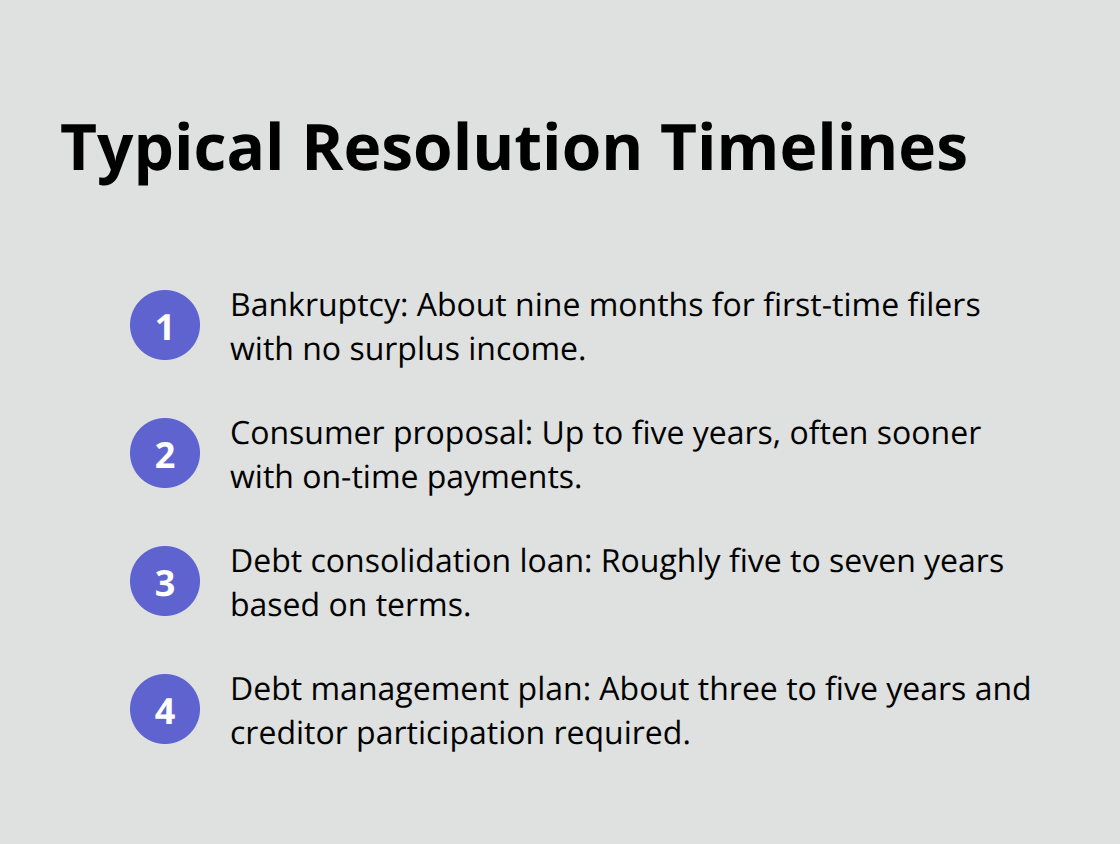
Debt management plans stretch three to five years with no guarantee of creditor participation.
Speed matters if you’re young and want to rebuild credit quickly, but cost matters more if you’re older and simply want the smallest monthly hit to your budget. Most Canadians choose based on monthly payment affordability first, then consider timeline. This is backwards. Calculate the total cost of each option in absolute dollars, then determine which monthly payment fits your actual income without forcing you to cut essentials.
Credit Score Recovery: The Timeline That Actually Matters
Your credit score recovers differently depending on which path you choose, and this reality should heavily influence your decision if you plan to borrow again within the next five to seven years. A consumer proposal results in an R7 credit rating, remaining on your file for up to three years after completion or six years from the filing date, whichever comes first. Bankruptcy results in an R9 rating, staying for six to seven years after discharge. Debt consolidation temporarily lowers your score due to the hard inquiry and new account, but your score recovers faster as you make on-time payments and reduce utilization. A debt management plan sits between these extremes, affecting your credit less severely than bankruptcy but more than consolidation.
If you need a mortgage or car loan within three years, a consumer proposal is superior to bankruptcy. If you can wait seven years, bankruptcy might offer better long-term savings despite the temporary credit hit. The critical mistake most Canadians make is choosing based on credit impact alone. A person with $60,000 in debt and $3,500 monthly income cannot afford a debt consolidation loan that extends payments across seven years just to protect their credit score for two extra years. The financial reality must come first.
Matching Your Choice to Your Financial Reality
Your ability to execute the plan you choose matters far more than which option looks best on paper. What matters is whether you can actually stick with it. If you select debt consolidation and then accumulate $10,000 in new credit card debt because the monthly payment leaves you stressed, you’ve made your situation worse. If you select a consumer proposal and cannot find $200 monthly because your income is unstable, the proposal fails and you’re back where you started. Success depends on honest assessment of your income stability and spending habits, not on credit score recovery timelines or theoretical savings.
Final Thoughts
Selecting the right Canada debt relief option comes down to three concrete factors: what you owe, what you can afford to pay monthly, and how quickly you need this resolved. Most Canadians prioritize credit score impact or timeline when they should prioritize affordability first. A consumer proposal that costs $200 monthly is worthless if your income only allows $150, and a debt consolidation loan that saves money over seven years fails if you cannot sustain the payments without accumulating new debt.
Book a free consultation with a Licensed Insolvency Trustee to review your specific debts, income, and assets. The trustee will present realistic options tailored to your situation, handle the paperwork, negotiate with creditors, and manage the entire process without cost or obligation. This professional guidance eliminates guesswork and prevents costly mistakes that leave you worse off than before.
Your next step depends on what the trustee recommends, and Financial Canadian offers comprehensive resources to help you navigate these decisions with clarity. Avoid debt settlement firms that charge fees to refer you to a trustee-you can contact a trustee directly for free. Your debt relief path exists, and Licensed Insolvency Trustees operate across Canada with phone and video consultations available.










Leave a comment