
Getting mortgage pre-approval in Canada is one of the smartest moves you can make before house hunting. It shows sellers you’re serious, strengthens your negotiating position, and gives you a clear picture of what you can actually afford.
At Financial Canadian, we’ve helped thousands of Canadians navigate this process. This guide walks you through everything you need to know about mortgage pre-approval, from what lenders examine to how long it takes.
What Pre-Approval Actually Means for Your Home Purchase
Understanding Pre-Approval vs. Pre-Qualification
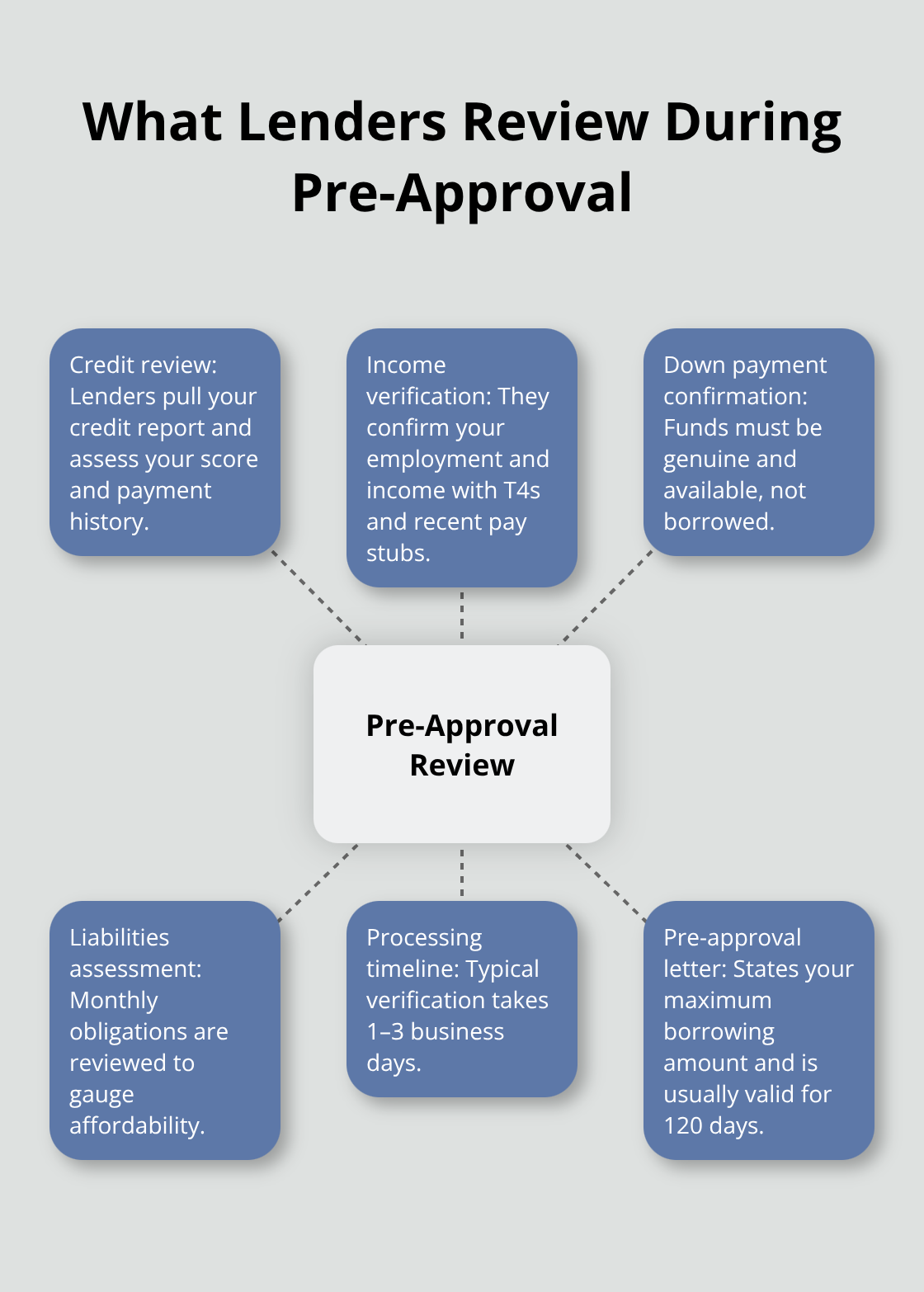
Pre-approval is a lender’s conditional commitment to loan you a specific amount based on your financial situation. It’s not a guarantee, but it’s significantly more powerful than pre-qualification, which is just an estimate based on information you provide without verification. When a lender pre-approves you, they review your credit report, verify your income through documents like T4s and pay stubs, confirm your down payment funds, and assess your monthly liabilities. This verification process typically takes 1-3 business days. The result is a pre-approval letter stating your maximum borrowing amount, usually valid for 120 days.
Why Sellers Prefer Pre-Approved Buyers
Sellers take pre-approval seriously because it proves you can actually close the deal. A pre-qualified buyer might walk away when financing falls through, but a pre-approved buyer has already passed the lender’s scrutiny. This distinction matters enormously in competitive markets. When multiple offers exist on a property, sellers often choose the pre-approved buyer over others, even if the offer price is slightly lower. Your negotiating power increases because the seller knows financing won’t collapse during the purchase process.
Maximizing Your Qualifying Income
If you have bonuses or rental income, pre-approval allows lenders to average your income using T4s and include these additional sources in your qualifying income, which directly increases your buying power. Some lenders also count Canada Child Benefit as qualifying income, though this varies by institution. You can also lock in a rate hold, though these rates are typically less competitive than rates offered after you have a signed purchase agreement, so timing matters.
Preparing Your Documents for Speed
Prepare your recent pay stubs, last two years of T4s, proof of down payment from bank or investment statements, and a list of monthly liabilities before applying. This proactive approach prevents delays and shows lenders you’re organized. Pre-approval eliminates guesswork from your house search and strengthens your position dramatically when making an offer. You know exactly what price range you can afford, which prevents wasting time viewing homes outside your budget.
The pre-approval becomes your roadmap for house hunting, eliminating uncertainty and positioning you as a serious buyer that sellers want to work with. Once you’ve assessed your credit, calculated your borrowing capacity, and mapped out your down payment sources, you’re ready to move forward with the next steps in your home financing journey.
What Documents You Actually Need for Pre-Approval
Income Verification Documents
Lenders require hard evidence of your financial position, and submitting the right documents upfront saves you days of back-and-forth emails. Start with your most recent pay stubs and your last two years of T4s, which verify your employment and base income. If you receive bonuses, commissions, or other variable income, those T4s become critical because lenders use them to average your earnings over time and include that extra money in your qualifying income.
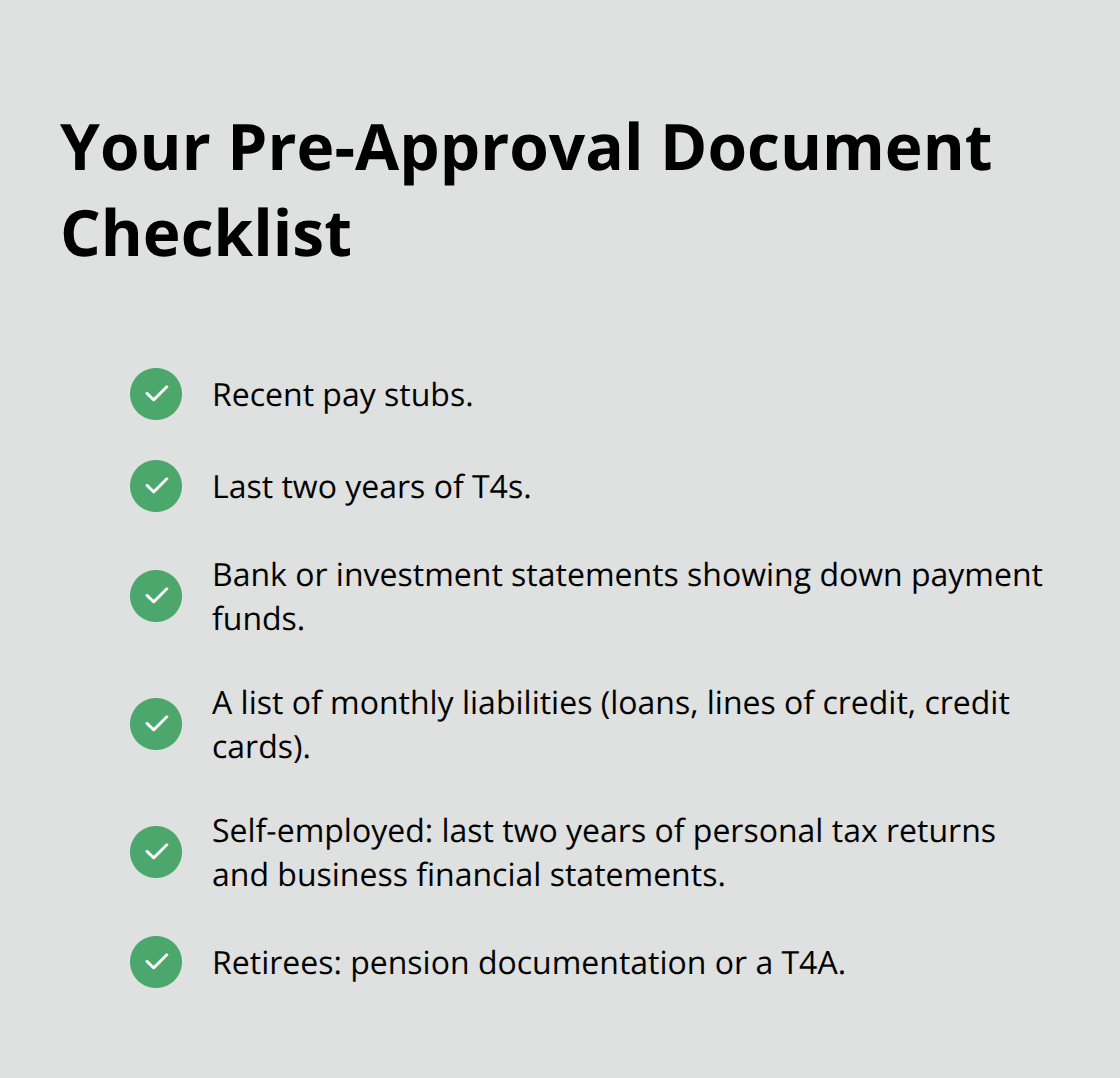
Self-employed applicants face different requirements. Lenders typically want your last two years of personal tax returns and business financial statements to verify income stability. Retirees should gather their pension documentation or a T4A if they receive pension income.
Down Payment and Liability Documentation
Bring bank statements or investment statements showing where your down payment funds came from, typically covering the last two to three months. You’ll also need a list of your monthly liabilities including car payments, student loans, lines of credit, and credit card balances, since lenders calculate your debt service ratios against your income.
Some lenders accept Canada Child Benefit as qualifying income, though this varies significantly by institution. Confirm this possibility with your chosen lender before assuming it counts toward your qualifying income.
What Lenders Actually Examine
Lenders examine three core areas during assessment. First, they pull your credit score, payment history, and current debt levels to gauge your reliability. Second, they verify your income through the documents you’ve submitted, calculating your gross monthly income and determining how much you can borrow based on standard lending ratios.
Third, they confirm your down payment is genuine and available, not borrowed from someone else. Most lenders won’t accept gifted funds without written documentation from the gift giver stating it doesn’t need to be repaid. This three-part examination typically takes one to three business days, though complex situations with multiple income sources or self-employment can extend to five to seven business days.
Timeline and Processing Speed
The entire process moves faster when you organize your paperwork in advance rather than scrambling to find documents after applying. Most lenders issue a pre-approval within one to three business days once you submit everything, though some cases take longer depending on income complexity. A rate hold typically comes with this pre-approval, locking your rate for 120 days in most cases, though these held rates are generally less competitive than rates you’ll receive after signing a purchase agreement.
With your documents organized and submitted, you’re ready to understand how to select the right lender and complete your pre-approval application.
Choosing Your Lender
Banks, Credit Unions, and Alternative Lenders
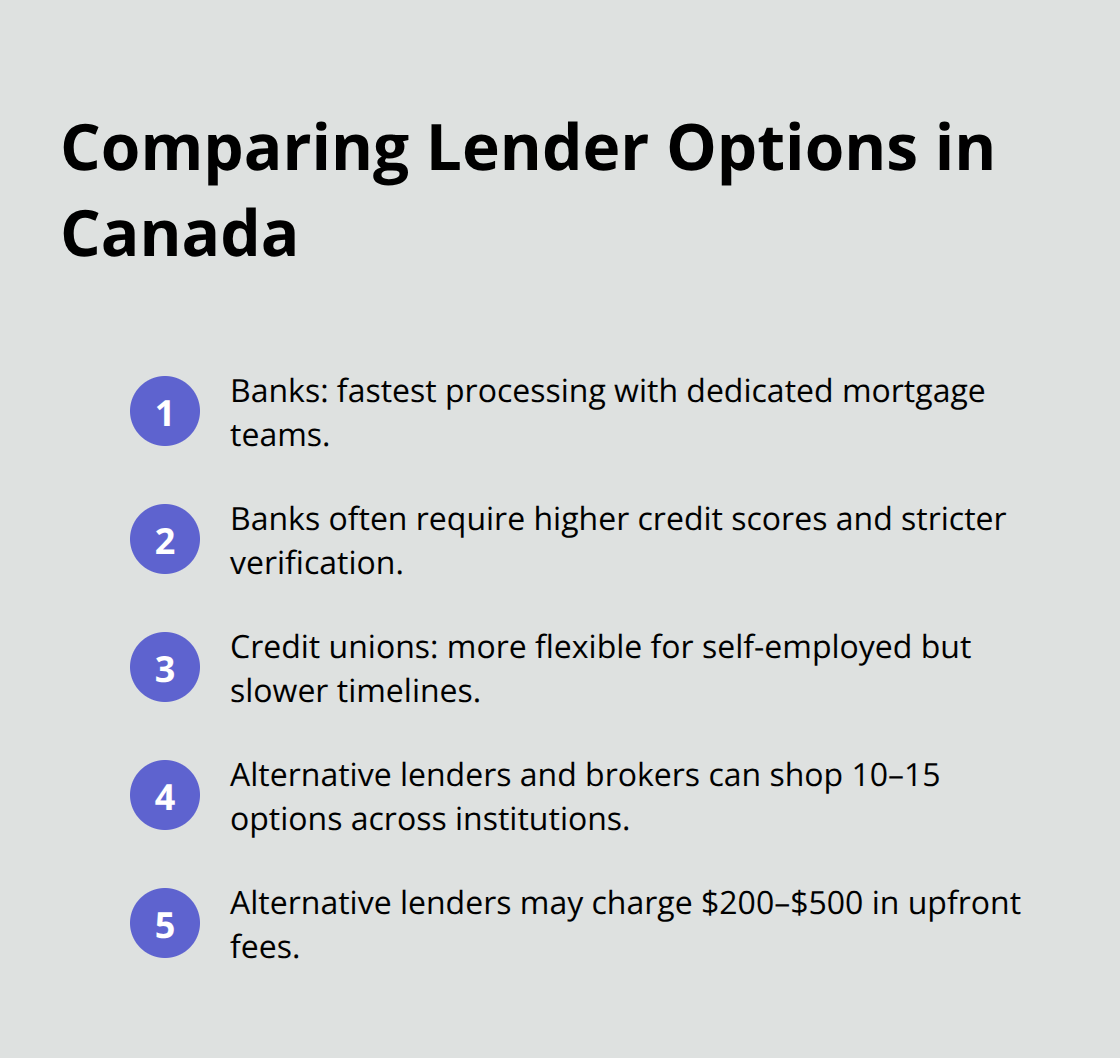
Banks like TD, RBC, and BMO process pre-approvals quickly-often within 24 hours-because they maintain dedicated mortgage teams and streamlined systems. However, banks typically require higher credit scores (usually 680 or above) and stricter income verification. Credit unions such as Meridian and Conexus may show more flexibility with self-employed applicants, though their pre-approval timelines can stretch to 3-5 business days due to smaller staff sizes. Alternative lenders and mortgage brokers work with multiple lenders simultaneously, meaning they can shop your application across 10-15 different options rather than locking you into one institution’s criteria. This approach matters significantly if you have non-traditional income, recent job changes, or lower credit scores. The tradeoff is that alternative lenders sometimes charge higher fees upfront, ranging from $200 to $500, though this cost often disappears when you close your mortgage.
Questions to Ask Before You Commit
Before committing to any lender, ask whether they count Canada Child Benefit as qualifying income, since this varies dramatically between institutions and could increase your borrowing power by $200-400 monthly. Ask their specific timeline for pre-approval-get it in writing rather than accepting vague estimates. Request their posted rates versus their discounted rates, as many lenders advertise posted rates publicly but offer 0.5-1.5% discounts to qualified borrowers. Ask if they charge for rate holds and whether those held rates are truly competitive or artificially high to push you toward locking in early. Question their flexibility on alternative income documentation if you are self-employed or have rental income.
The Digital Application Advantage
Apply online rather than in-person when possible, as online applications move faster and you can submit documents digitally without scheduling appointments. Most lenders now offer fully digital pre-approval processes where you upload documents through secure portals, receive conditional approval within hours, and get your pre-approval letter emailed before business closes. This digital approach eliminates unnecessary delays and keeps your application moving forward efficiently.
Managing Multiple Lender Inquiries
Avoid submitting applications to multiple lenders simultaneously, as each inquiry temporarily lowers your credit score by 5-10 points. Instead, gather quotes from 2-3 lenders within a two-week window, since multiple inquiries within this period count as a single hard inquiry on your credit report. This strategy protects your credit while still allowing you to compare your options across different institutions.
Final Thoughts
Mortgage pre-approval in Canada transforms your home buying experience from uncertain to strategic. You now understand that pre-approval isn’t just paperwork-it’s your proof of financial credibility that sellers respect and that gives you a concrete budget for house hunting. The documents you gather, the lender you choose, and the timeline you follow all work together to position you as a serious buyer ready to move forward.
Lock in your rate hold if market conditions feel right, but recognize that held rates are typically less competitive than rates you’ll receive after signing a purchase agreement, so avoid rushing this decision. Start your house search within your approved budget range, knowing exactly what you can afford eliminates wasted time viewing properties outside your reach. When you find the right home and make an offer, your pre-approval letter becomes your competitive advantage, signaling to sellers that financing won’t derail the transaction.
At Financial Canadian, we help you establish a strong foundation for your home purchase through expert guidance and comprehensive information. Whether you’re a first-time buyer or returning to the market, explore our mortgage resources to support your journey toward homeownership with practical advice and reliable information every step of the way.











Leave a comment