
Mortgage rates in Canada swing based on economic conditions, lender competition, and Bank of Canada policy. Getting the best rate requires more than accepting the first offer your bank presents.
At Financial Canadian, we’ve built this guide to help you compare mortgage rates Canada strategically. You’ll learn what moves rates, how to shop effectively, and which tools actually save you money.
How Mortgage Rates Work in Canada
Fixed vs Variable Rate Mortgages
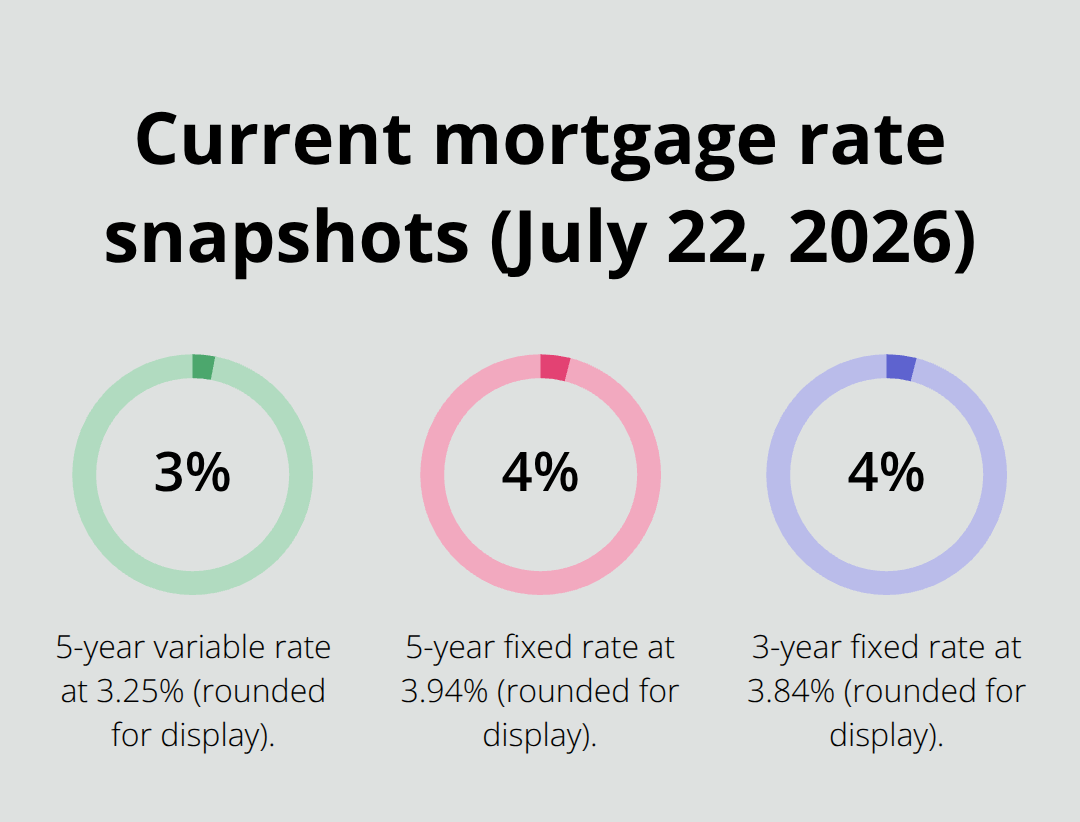
Fixed-rate mortgages lock your interest rate for the entire term, so your payment stays the same whether rates climb or fall. Variable-rate mortgages tie your rate to the Bank of Canada’s overnight rate, which means your payment fluctuates with market conditions. As of July 2026, the national prime rate sits at 4.45% across major banks, with variable mortgages currently at 3.25% for a 5-year term compared to 3.94% for fixed 5-year rates.
Fixed rates carry a premium because lenders absorb the risk of rate movements, but this premium protects your budget from shocks. Variable rates cost less upfront but demand discipline-if the Bank of Canada raises rates, your payment climbs. The real choice comes down to risk tolerance. First-time homebuyers often prefer fixed rates for predictability, while experienced borrowers comfortable with rate fluctuations can pocket thousands by choosing variable.
One practical strategy involves selecting a shorter fixed term like 3 years, which typically offers better rates than 5-year terms while you learn the market before renewal.
What Affects Your Mortgage Rate
Your mortgage rate depends on several factors beyond the overnight rate alone. Lenders charge higher rates for shorter amortizations, investment properties, condos, and borrowers with credit scores below 700. A 600 credit score qualifies you for insured mortgages, but prime borrowers at 700+ receive the best pricing.
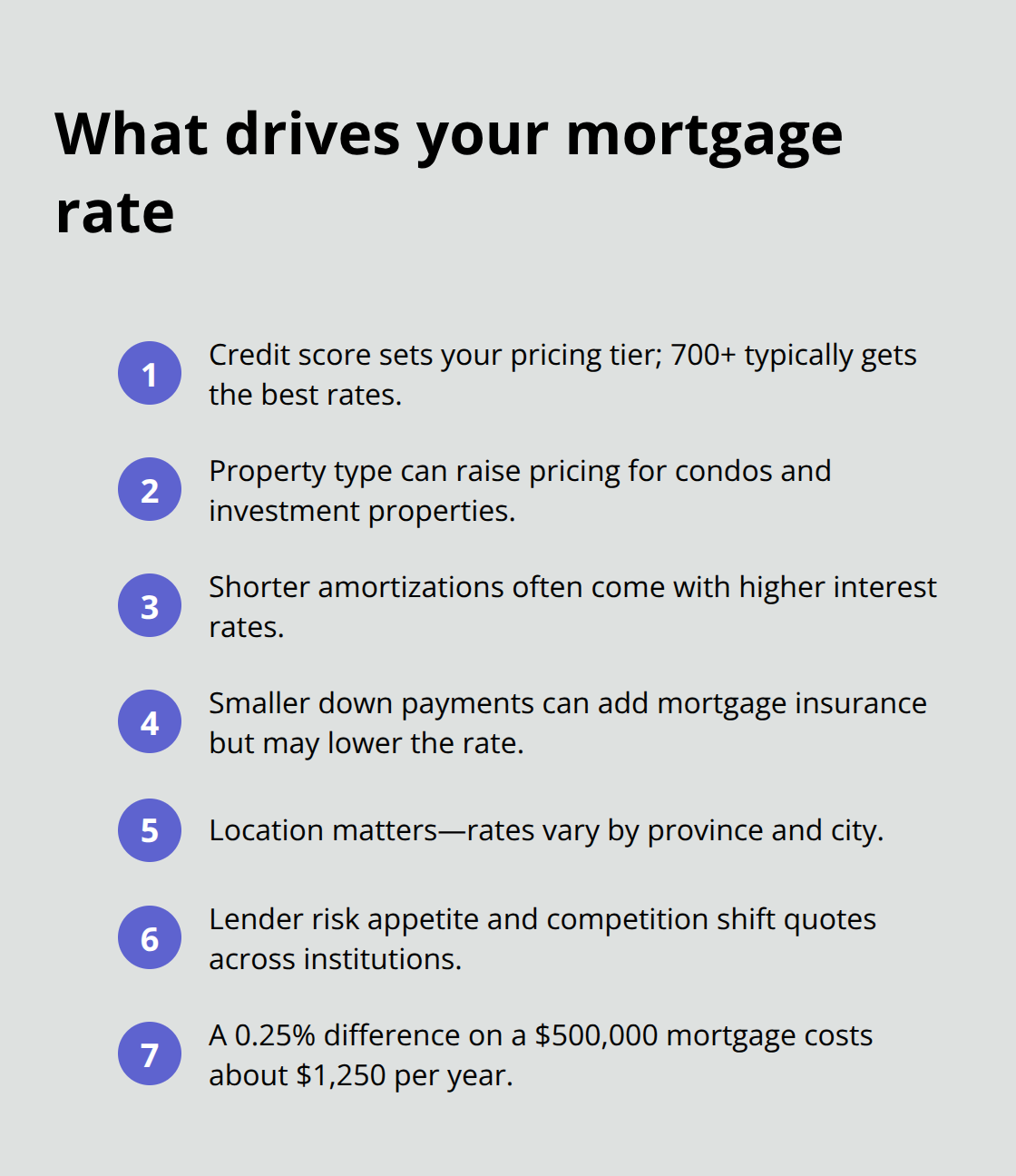
Down payment size matters significantly-putting down less than 20% triggers mortgage insurance premiums ranging from 0.6% to 4.5% of the mortgage amount, though insured mortgages often carry lower rates than uninsured options. Location influences pricing substantially; rates vary by province and city, so a Toronto rate differs from a Calgary rate. Lenders also factor in their own risk appetite and competitive positioning, which is why shopping across multiple lenders saves you money. A 0.25% rate difference on a $500,000 mortgage costs roughly $1,250 annually, making comparison essential.
How the Bank of Canada Influences Rates
The Bank of Canada’s overnight rate acts as the master control for mortgage pricing. When it rises, variable rates climb immediately, and fixed rates follow within weeks as bond yields adjust. This connection means you cannot ignore central bank policy when choosing between fixed and variable options.
Understanding rate movements helps you time your mortgage decision strategically and prepares you to compare offers effectively across lenders.
Smart Strategies for Comparing Mortgage Rates
Get pre-approval Before House Hunting
A pre-approval letter from a lender shifts the entire dynamic in your favor. The lender shows sellers you’re serious and gives you a concrete rate quote valid for 120 days, protecting you from rate swings during your search. More importantly, pre-approval forces you to understand your actual borrowing power instead of guessing. When you apply, lenders pull your credit and verify income, which means the rate they quote reflects your real financial profile, not a promotional rate designed for someone else.
Pre-approval tells you exactly where you stand and prevents wasted time pursuing properties outside your reach.
Request Quotes from Multiple Lenders
Once pre-approved, request formal rate quotes from at least three lenders before committing. This isn’t optional if you want competitive pricing. On a $500,000 mortgage, a 0.25% rate difference costs $1,250 annually, which compounds to over $12,500 across a 10-year period.
Major banks, credit unions, and mortgage brokers all offer different rates for the same borrower because they price risk differently and compete on different segments. WOWA aggregates rates from over 50 lenders and updates them three times daily, showing you the lowest 5-year fixed at 3.94% and 5-year variable at 3.25% as of July 22, 2026. Ratehub.ca provides similar comparisons with province and city-specific pages, since rates genuinely vary by location.
Don’t settle for your bank’s initial offer. A mortgage broker can access a wider panel of lenders and sometimes negotiate better terms or rate buy-downs on your behalf, which is worth exploring even if you ultimately choose a bank.
Calculate Total Costs, Not Just the Rate
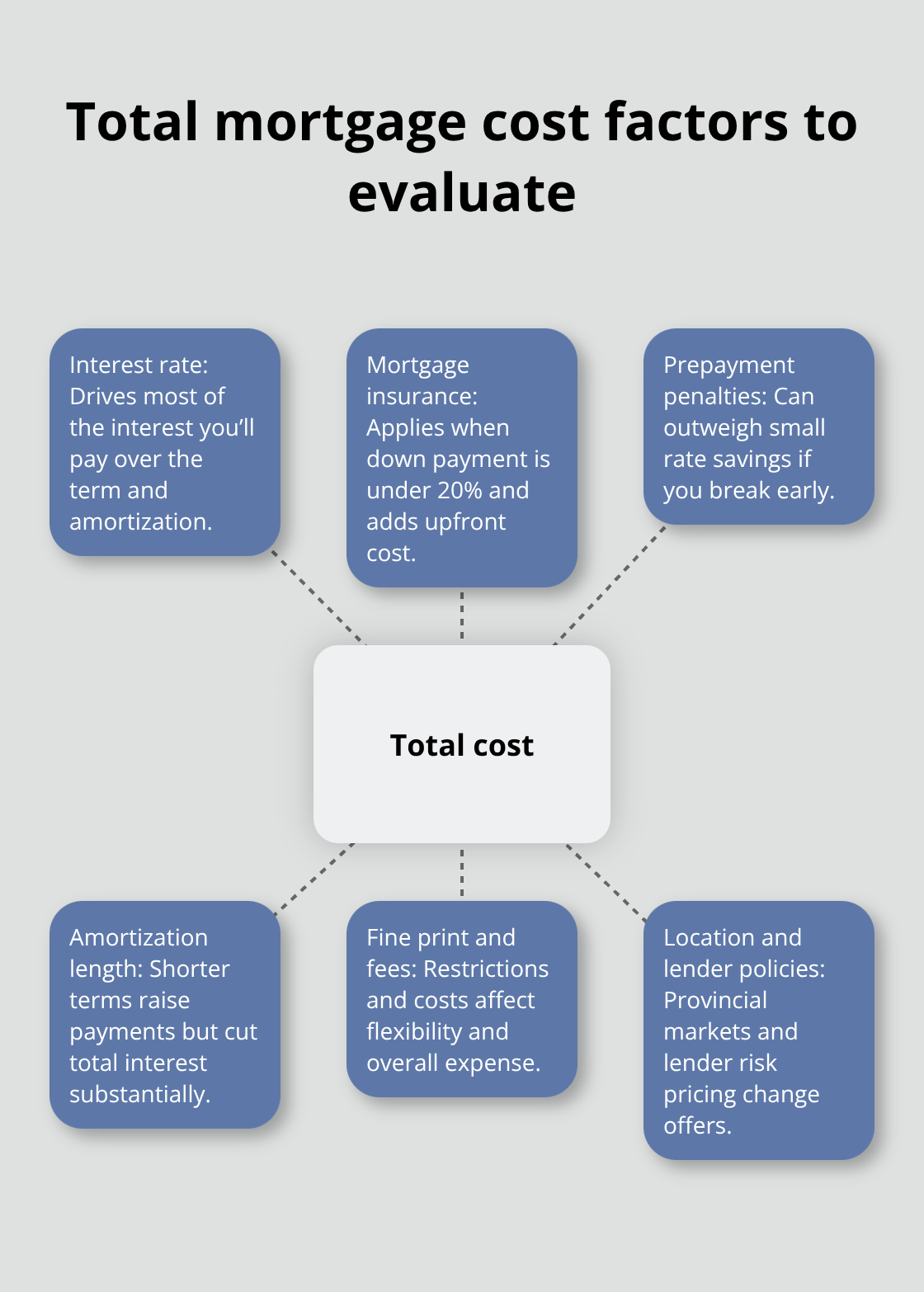
The interest rate matters far less than total cost, yet most people fixate on the number alone. Your true cost includes the interest rate plus mortgage insurance premiums if your down payment is under 20%, plus penalties and prepayment restrictions buried in the fine print.
If you’re putting down 15%, expect mortgage insurance premiums calculated as a percentage of the loan based on your down payment size. A $500,000 mortgage with a 15% down payment triggers insurance adding roughly $10,000 to $18,000 upfront. Ratehub’s mortgage penalty calculator and renewal calculator help you model these scenarios before applying.
Shorter amortizations like 20 years instead of 25 years save hundreds of thousands in interest but raise monthly payments substantially. Variable-rate mortgages typically carry lower prepayment penalties than fixed-rate mortgages, which matters if you plan to refinance or sell within five years. Compare quotes on total cost, not just the advertised rate, and you’ll uncover savings that the rate alone never reveals.
Tools and Resources for Mortgage Comparison
Compare Rates Across Multiple Platforms
WOWA updates mortgage rates three times daily from over 50 lenders and brokerages, displaying the lowest rates first without sponsor bias. This real-time data prevents you from overpaying based on outdated information. As of July 22, 2026, WOWA showed the lowest 5-year fixed at 3.94% and 5-year variable at 3.25%, alongside 3-year fixed rates at 3.84%. Ratehub.ca operates similarly but adds province and city-specific rate pages, recognizing that a Toronto mortgage rate genuinely differs from Vancouver or Calgary pricing.
Both platforms offer free calculators for payments, affordability, penalties, and refinancing scenarios. You can model different amortization lengths and down payment amounts before committing to any application, which takes the guesswork out of your decision.
Use Mortgage Calculators to Model Scenarios
Free calculators on WOWA and Ratehub let you test how amortization length affects your monthly payment and total interest cost. A shorter 20-year amortization versus 25 years reveals hundreds of thousands in interest savings, though your payment climbs substantially. You can also input different down payment percentages to see how mortgage insurance premiums impact your total cost.
These tools eliminate surprises when you receive formal quotes. Testing scenarios upfront means you walk into conversations with lenders knowing exactly what you can afford and what trade-offs matter most to your situation.
Work with Mortgage Brokers for Wider Access
Mortgage brokers access lender panels that retail banks don’t advertise publicly. A broker can negotiate rate buy-downs or better terms on your behalf, and their compensation structure sometimes passes savings directly to you rather than adding cost.
The critical step involves comparing any broker offer against the best rates you find on WOWA or Ratehub, since brokers occasionally push exclusive deals that underperform standard lender rates when you examine the fine print. Always verify term lengths, rate guarantee expiration dates, and prepayment restrictions on the lender’s website before applying, because broker quotes sometimes omit these details.
Verify Offers Before You Commit
Never accept a quote at face value without checking the underlying terms. A lower rate means nothing if the prepayment penalty locks you in for years or if the rate guarantee expires in two weeks. Compare broker recommendations against other options systematically to spot which offer truly saves you money over your intended holding period.
Financial Canadian provides expert comparisons and guides on mortgages tailored to Canadian consumers, helping you evaluate offers against other options with confidence.
Final Thoughts
Comparing mortgage rates Canada strategically saves thousands over your loan’s lifetime. A 0.25% rate difference on a $500,000 mortgage costs $1,250 annually, which reaches $12,500 over a decade. You now understand how fixed and variable rates work, what factors lenders consider when pricing your mortgage, and how the Bank of Canada’s overnight rate influences everything.
Get pre-approved with at least one lender, then request formal quotes from two or three additional sources. Use WOWA or Ratehub to benchmark those quotes against current market rates, and consider speaking with a mortgage broker to access lenders outside the major banks. Model different scenarios using free calculators to understand how amortization length and down payment size affect your total cost, not just your monthly payment.
Before you commit to any offer, verify the fine print on rate guarantees, prepayment penalties, and term lengths (a lower advertised rate means nothing if hidden restrictions lock you into unfavorable terms). We at Financial Canadian provide resources and expert guidance to help you make confident financial decisions. The mortgage market rewards borrowers who shop deliberately and compare offers thoroughly.











Leave a comment