
Personal loan rates in Canada are climbing, and lenders are tightening their standards. If you’re shopping for a loan right now, the difference between a 7% APR and a 12% APR could cost you thousands in interest.
At Financial Canadian, we’ve analyzed current rates across major lenders to show you exactly where to find the best deals. This guide walks you through comparing offers, understanding what affects your rate, and the concrete steps to lower what you’ll pay.
Personal Loan Rates Look Like Right Now in Canada
Canadian lenders quote personal loan APRs ranging from roughly 6% to 47%, depending entirely on your credit profile and which lender you approach. Major banks like Scotiabank advertise starting rates around 6% to 10% APR for borrowers with excellent credit, while BMO, TD, and CIBC cluster in the 8.99% to 23.99% range. Online lenders and alternative providers push much higher-Easyfinancial and Mogo can reach 46% to 47% APR. The prime rate across Canada’s major banks sits at 4.45%, which serves as the foundation for most personal loan pricing. The reality is stark: a borrower with a 750+ credit score might qualify for 7% APR, while someone with a 600 score could face 25% or higher. This 18-percentage-point gap on a $15,000 loan over four years means the difference between paying roughly $352 monthly at 6% APR (about $1,909 in total interest) versus $417 monthly at 15% APR (about $5,038 in total interest). That’s over $3,000 more out of your pocket for the same loan amount.
Credit Score Drives Your Rate
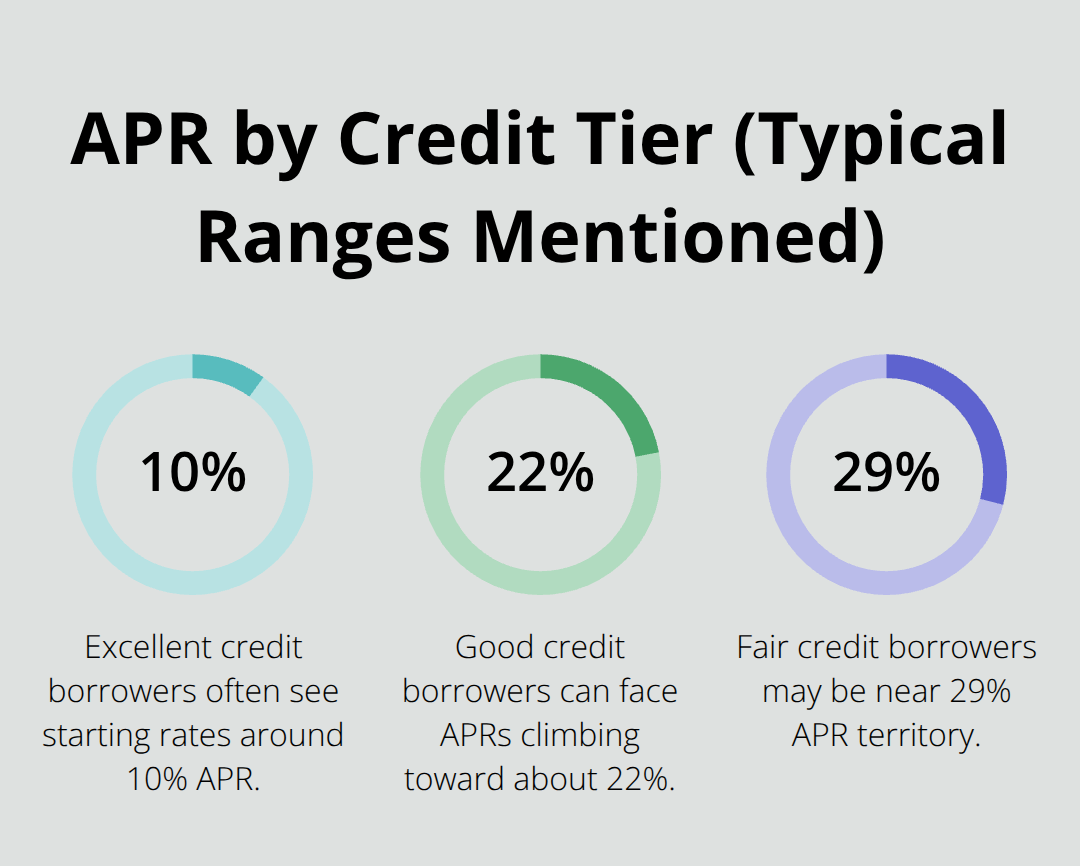
Your credit score is the single most important factor lenders examine. Borrowers with excellent credit (typically 740+) secure rates starting around 9% to 10%, while those in the good range (670–739) face rates climbing toward 19% to 22%. Fair credit (580–669) pushes you toward 29% APR territory. Lenders also scrutinize your debt-to-income ratio-if you already carry high monthly debt payments relative to your income, approval becomes harder and rates climb.
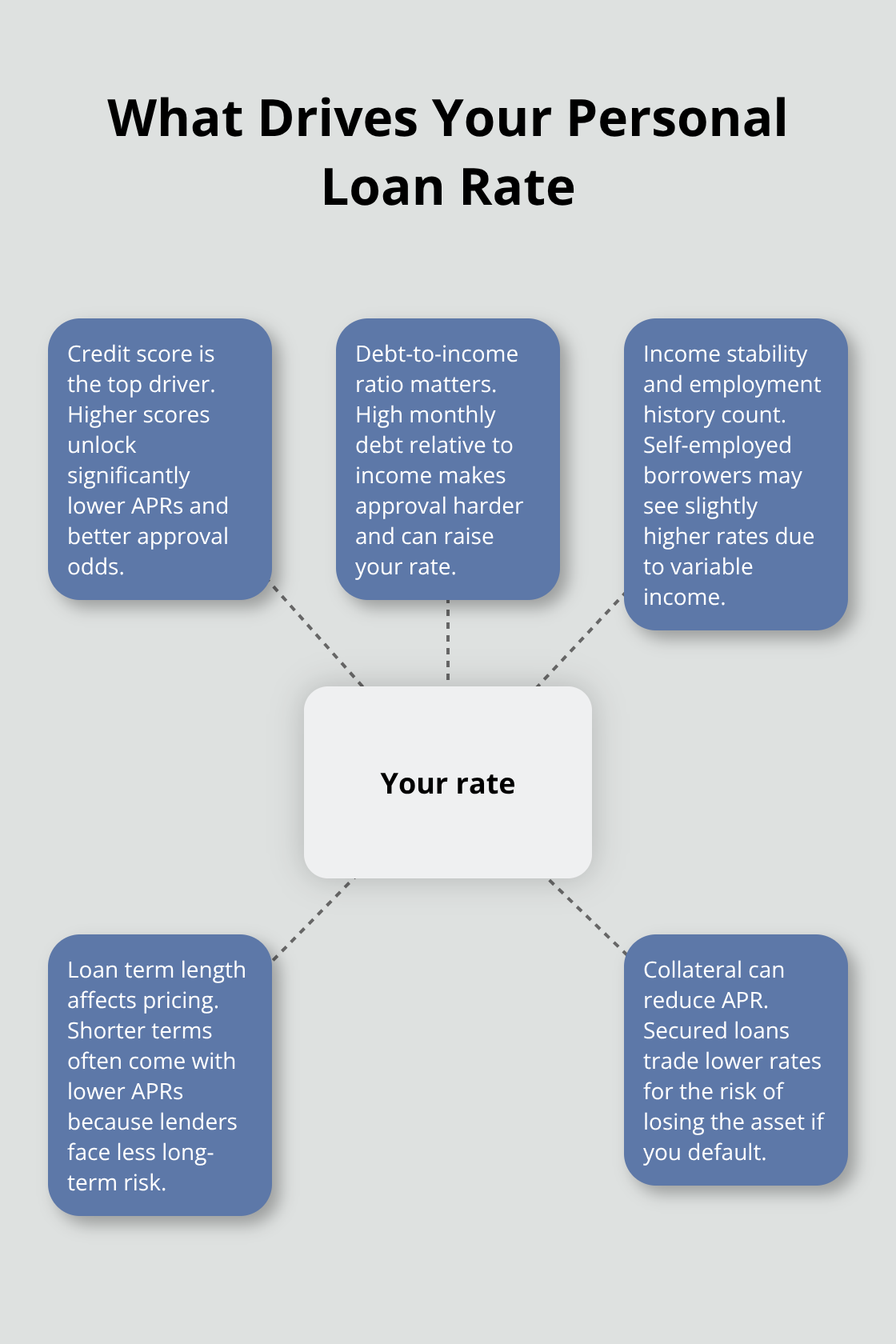
Income stability and employment history matter too; self-employed borrowers often face slightly higher rates because lenders view income as less predictable.
Fees and Loan Structure Add Hidden Costs
Origination fees, typically 0.5% to 8% of your loan amount, get added to your balance or deducted upfront, so a $10,000 loan with a 5% origination fee actually costs you an extra $500. Some lenders charge zero origination fees, which is why comparing the full APR-not just the headline rate-saves you hundreds or thousands. Loan term length also influences your rate; shorter terms (3 years instead of 5 years) generally carry lower APRs because lenders face less long-term risk.
Secured Versus Unsecured Loans
A secured personal loan, where you pledge collateral like a vehicle or savings account, typically qualifies for lower rates than an unsecured loan, but you risk losing that asset if you default. Understanding this trade-off helps you decide whether the rate savings justify the collateral risk. Your next step involves learning how to compare these offers across multiple lenders and identify which rates actually work for your financial situation.
How to Compare Personal Loan Offers Without Wasting Time
Check Your Credit Before You Apply
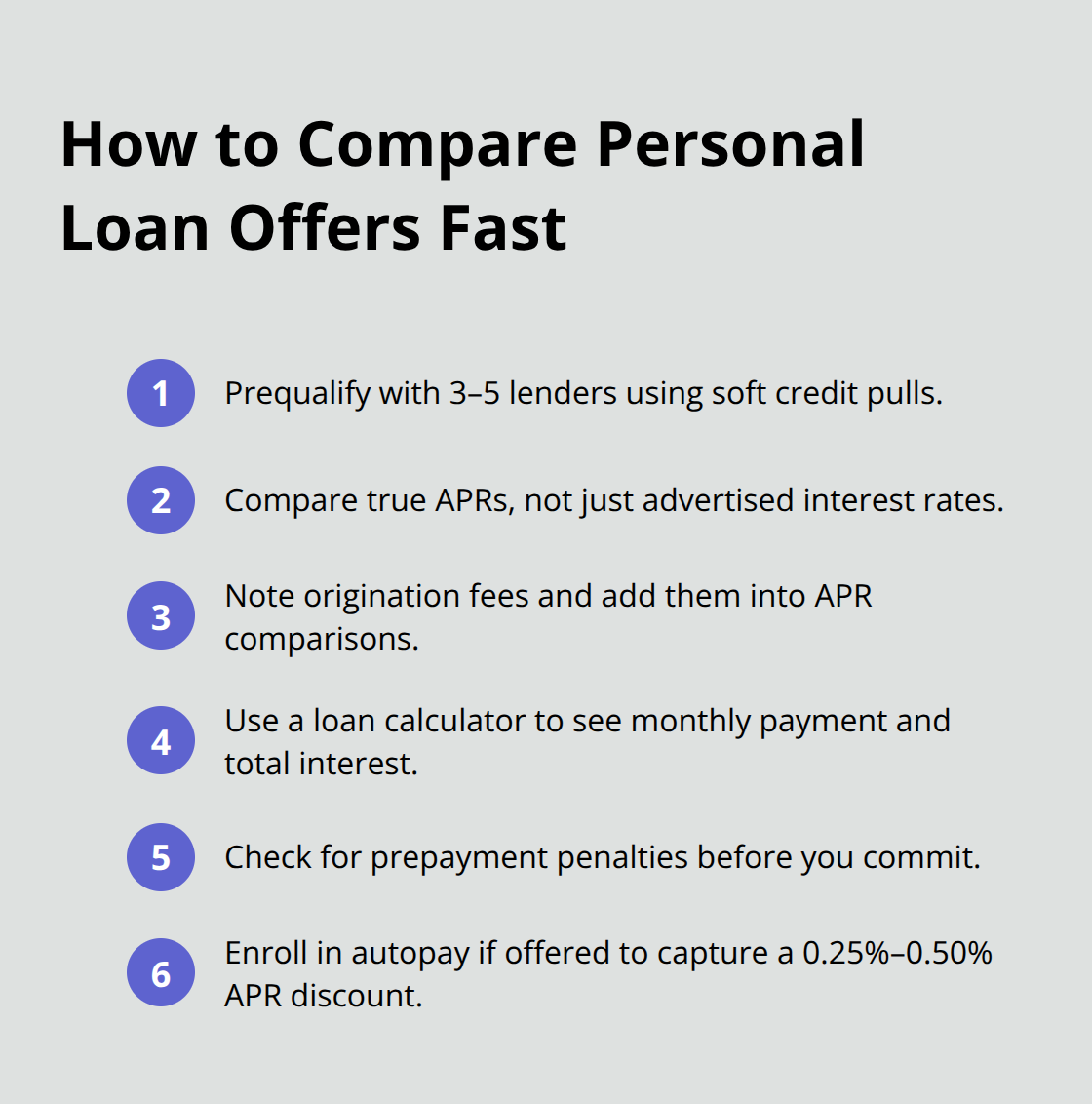
You need to review your credit reports through Equifax Canada or TransUnion Canada before you apply anywhere. Lenders pull your credit during the application process, and multiple hard inquiries within a short window can temporarily lower your score. The smarter approach uses soft inquiries first through prequalification, which doesn’t affect your score at all. When you prequalify with multiple lenders, you receive a ballpark APR range based on your financial profile without triggering a hard pull. This step costs nothing and takes minutes online.
Compare APRs Across Multiple Lenders
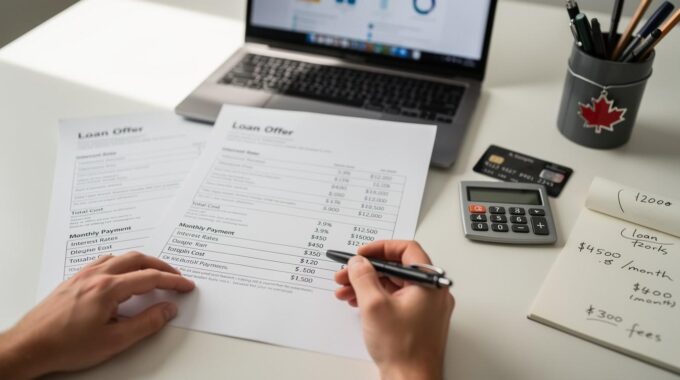
Once you’ve prequalified with at least three to five lenders, you can compare actual APR quotes side by side. Focus strictly on the APR, not the advertised interest rate, because APR includes origination fees, insurance, and other charges that dramatically change what you actually pay. A lender advertising 8% might hit you with a 3% origination fee, pushing your real APR to 11%. Personal loan rates in Canada start at 6.20% if you have stellar credit and stable income, though the typical APR range is between 8% and higher depending on your profile. On a $15,000 loan over four years, the difference between 6% APR and 12.5% APR costs you roughly $2,200 in extra interest. Use a loan calculator to plug in your desired loan amount and term length across different APRs so you see the exact monthly payment and total interest cost before committing.
Identify Hidden Fees and Discounts
Origination fees represent the biggest hidden cost most borrowers miss. They range from zero to 8% of your loan amount and either get deducted from your disbursement or added to your balance. Some lenders charge zero origination fees, which immediately puts them ahead of competitors charging 5%. Prepayment penalties also exist with some lenders, so confirm whether you can pay off your loan early without a penalty. Many Canadian lenders now offer a small APR discount, typically 0.25% to 0.50%, if you sign up for automatic payments directly from your bank account. That discount compounds over time, especially on longer terms. When comparing offers, create a simple spreadsheet listing the lender name, APR, origination fee percentage, monthly payment, total interest paid, and any available discounts. This forces you to compare apples to apples rather than getting distracted by marketing claims.
Fixed-Rate Versus Variable-Rate Loans
You should pay special attention to variable-rate versus fixed-rate loans. Variable-rate personal loans move with the lender’s prime rate, so your payment could increase if the Bank of Canada raises rates. Fixed-rate loans lock in your APR for the entire term, which protects you from rate hikes. Given that the Bank of Canada held the overnight rate steady at 2.25% in June 2026, variable rates appear stable for now, but fixed-rate loans still offer peace of mind. The choice between these two structures depends on your risk tolerance and how long you plan to carry the debt.
How to Lower Your Personal Loan Rate Before You Apply
Improve Your Credit Score Strategically
Your credit score isn’t fixed-it moves based on your payment history, credit utilization, and how long you’ve held accounts. If your score sits below 700, two to three months of paying down existing debt can meaningfully improve it. Lenders show that borrowers with excellent credit (800–850) qualify for APRs around 10.07%, while those in the very good range (740–799) face 12.54% APR, and good credit (670–739) hits 19.29%. That’s a 9-percentage-point swing between very good and good credit.
On a $10,000 loan over three years, moving from 19.29% to 12.54% saves you roughly $670 in interest. The fastest way to improve your score involves reducing your credit card balances-try to keep utilization below 30% of your available limits. Check your reports through Equifax Canada or TransUnion Canada to spot errors that might be artificially lowering your score; if you believe your Equifax credit report is incomplete or inaccurate you can file a dispute.
Reduce Your Debt-to-Income Ratio
If you carry high balances across multiple cards, consolidate them first before applying for a personal loan. This shows lenders you’re serious about managing debt. Pay down existing debt aggressively for 60 to 90 days before applying-this lowers your debt-to-income ratio and signals financial responsibility to lenders. Your debt-to-income ratio also influences approval odds and rates-lenders show approval rates of 81.9% for excellent credit but only 22.9% for fair credit, so reducing monthly debt obligations before applying dramatically improves your chances of qualifying for better terms.
Shop Around with Multiple Lenders
Shopping around with multiple lenders is non-negotiable, and prequalification makes this painless. Prequalification uses a soft credit pull that doesn’t affect your credit score, and most lenders complete the process in minutes online without requiring extensive documentation. Apply with at least five lenders to see the full range of offers available to you. Once you’ve gathered prequalified offers, compare the best personal loans to find low rates, flexible terms, and fast funding.
A co-signer with excellent credit and stable income can lower your APR by 1–3 percentage points because lenders view the combined financial profile as lower risk. If you’re married or have a family member with strong credit willing to co-sign, this strategy works immediately without requiring months of credit building.
Maximize Discounts and Fee Comparisons
Automatic payment enrollment delivers immediate value-most Canadian lenders reduce your APR by 0.25% to 0.50% when you enroll in automatic bank transfers, which compounds to meaningful savings over a five-year term. On a $15,000 loan at 0.50% discount, you save roughly $180 in interest alone. Secured personal loans backed by collateral offer much lower interest rates than unsecured loans, so comparing five offers lets you identify which combination of APR, fees, and discounts actually costs less overall rather than chasing the lowest advertised rate.
Final Thoughts
Personal loan rates in Canada span from 6% to 47% depending on your credit profile and lender choice, but that wide range shouldn’t overwhelm you. The gap between the best and worst rates reflects real differences in how lenders assess risk, and understanding those differences puts you in control. A borrower with excellent credit paying 7% APR versus fair credit at 25% APR faces a difference of thousands in total interest on the same loan amount-that’s not random, it’s the direct result of credit scores, debt-to-income ratios, and which lender you choose.
Check your credit reports through Equifax or TransUnion before you apply anywhere, then prequalify with at least five lenders using soft inquiries that won’t damage your score. Compare APRs side by side, not advertised rates, because origination fees and other charges hide inside that APR figure. Enroll in automatic payments for a 0.25% to 0.50% discount, and if your credit needs work, spend 60 to 90 days paying down existing debt before you submit applications-this improves both your score and your debt-to-income ratio simultaneously.
Shopping around isn’t optional; it’s the single most effective way to lower what you’ll pay. A co-signer with strong credit can reduce your rate by 1–3 percentage points immediately, while secured loans backed by collateral cost less than unsecured loans, though they carry asset risk. Start comparing offers today and take control of your borrowing costs.








Leave a comment