
Buying a home in Canada often means dealing with mortgage insurance-a requirement that protects lenders when you put down less than 20%. At Financial Canadian, we’ve put together mortgage insurance Canada tips to help you understand your options and reduce what you pay.
The right strategy can save you thousands of dollars over your mortgage term. This guide walks you through the types of insurance available, how premiums work, and concrete steps to lower your costs.
How Mortgage Insurance Works in Canada
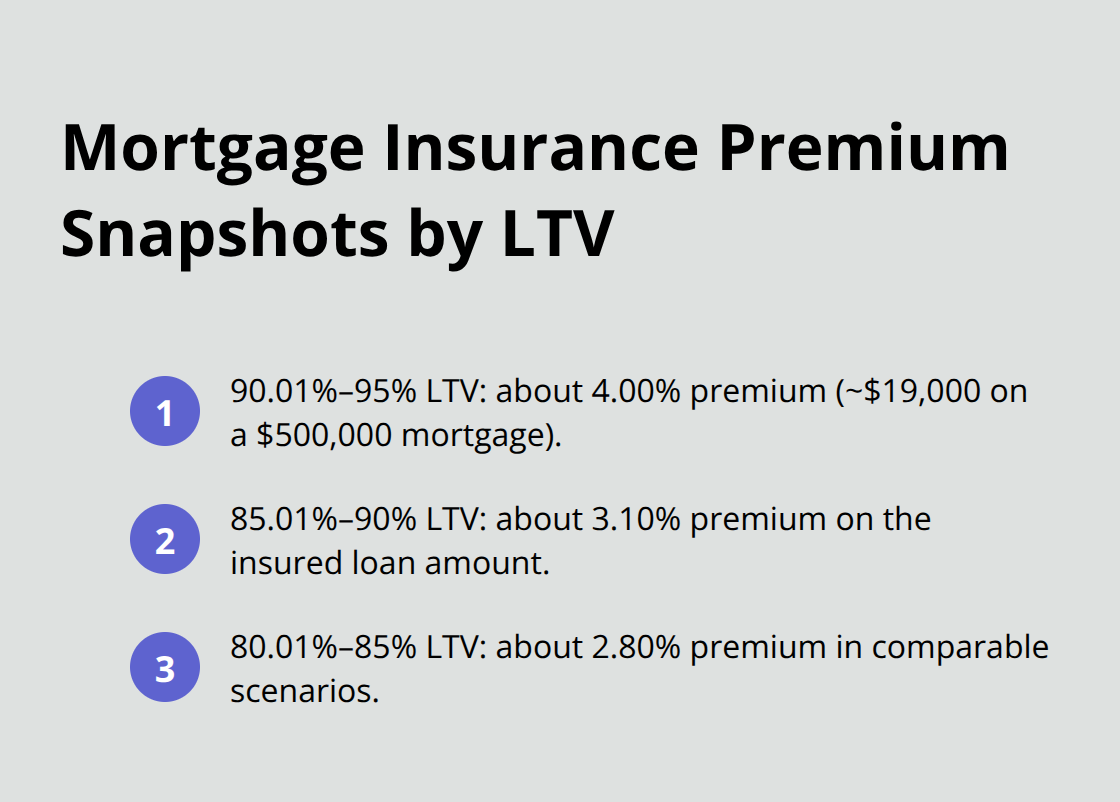
Mortgage insurance in Canada protects lenders, not borrowers-a distinction many homebuyers miss. When you put down less than 20%, lenders require insurance to cover their losses if you default. The Canada Mortgage and Housing Corporation (CMHC) dominates the market, while Sagen and Canada Guaranty also provide coverage. The insurance premium is a one-time cost calculated as a percentage of your total loan amount, ranging from 0.60% to 4.00% based on your loan-to-value ratio. On a $500,000 mortgage at 90.01% to 95% loan-to-value, you’ll pay around 4.00%-roughly $19,000. Drop to 85.01% to 90% and the premium falls to about 3.10%.
You can pay this cost upfront or add it to your mortgage balance, though adding it means you’ll pay interest on the premium for your entire loan term, making it substantially more expensive over time.
Eligibility Requirements and Coverage Limits
Mortgage insurance becomes mandatory when your down payment falls below 20%, but specific requirements apply. You need a minimum credit score of 600, and the home purchase price must stay under $1.5 million-a cap that took effect December 15, 2024. Your amortization cannot exceed 25 years in most cases, though first-time buyers and new builds may qualify for up to 30 years. The insurance covers your outstanding mortgage balance, accumulated arrears, discharge fees, prepayment charges, and any interest owing. Coverage limits reach up to $1 million, which handles the vast majority of Canadian residential mortgages. Ontario, Quebec, and Saskatchewan residents should note that provincial sales tax applies to upfront premiums, and this tax cannot be added to your mortgage payments-it’s an additional out-of-pocket cost at closing.
Why Premium Rates Vary Between Insurers
Different providers charge different premiums for identical loan scenarios. Sagen’s rates at 90.01% to 95% loan-to-value match CMHC’s 4.00%, but Canada Guaranty charges 5.85% for low-documentation mortgages in the same range. At lower loan-to-value ratios, Canada Guaranty’s rates become more competitive-at 80.01% to 85%, they charge 3.75% compared to CMHC’s 2.80%. Shopping between insurers matters significantly. A $400,000 mortgage at 85% loan-to-value costs you $11,200 with CMHC but $15,000 with Canada Guaranty-a $3,800 difference on the same home purchase. CMHC also offers unique products like Eco Plus and Eco Improvement, which provide 25% partial premium refunds for climate-friendly new builds or energy-efficient home upgrades, effectively reducing your insurance cost at closing.
How to Compare Your Options
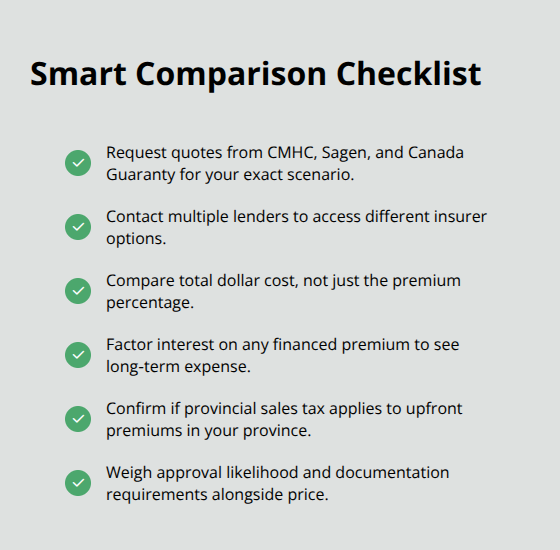
You’ll want to request premium quotes from all three major insurers before you commit. Each lender typically works with specific insurers, so contact multiple lenders to access different options. Compare not just the premium percentage but the total dollar amount you’ll pay, especially if you plan to add the insurance to your mortgage. Calculate the long-term cost by factoring in interest payments on the financed premium-this reveals the true expense over your mortgage term. Some borrowers overlook provincial tax implications, so confirm whether your province applies sales tax to upfront premiums. Understanding these variables positions you to make the most cost-effective choice for your situation.
Which Mortgage Insurer Should You Choose
CMHC’s Market Position and Advantages
CMHC controls nearly 60% of Canada’s mortgage insurance market as of December 2025, and this dominance reflects real advantages for most borrowers. The Crown corporation offers the lowest premiums across most loan-to-value scenarios and provides exclusive products like Eco Plus and Eco Improvement that refund 25% of your premium when you purchase a climate-friendly new home or upgrade an existing one for energy efficiency. CMHC’s market leadership means most lenders maintain established relationships with them, which streamlines your application process. For many homebuyers, CMHC represents the most straightforward path to mortgage approval at competitive rates.
When Sagen and Canada Guaranty Win
CMHC isn’t always your best option, particularly if you operate as a self-employed borrower or carry non-traditional income documentation. Sagen and Canada Guaranty often approve applicants that CMHC rejects, making them essential alternatives for non-standard situations. Sagen holds 24.1% market share and matches CMHC’s rates at higher loan-to-value levels, positioning them as competitive choices when you put down 5% to 10%. Canada Guaranty captures 16.9% of the market and specializes in alternative lending scenarios, though their standard rates run higher-they charge 5.85% at 90% to 95% loan-to-value compared to CMHC’s 4.00%.
Calculating Your True Cost Across Insurers
The real decision hinges on your specific situation and what each insurer will approve you for. A $500,000 mortgage at 85% loan-to-value costs $14,000 with CMHC but $15,000 with Sagen-a $1,000 difference that matters. However, if Sagen approves you when CMHC doesn’t, that $1,000 premium difference becomes irrelevant. You must account for provincial sales tax on upfront premiums in Ontario, Quebec, and Saskatchewan, which adds another 5% to 13% to your closing costs depending on your province. The insurer that offers the lowest premium percentage won’t necessarily be the insurer that approves you or offers the best total cost when you factor in tax and long-term interest charges on financed premiums.
How to Shop Effectively
Contact multiple lenders and request quotes from all three insurers before you commit to any application. Some lenders work exclusively with one insurer, so shopping around exposes options you wouldn’t see otherwise. Ask each lender which insurers they work with and request premium calculations for your specific scenario. This comparison process takes time but protects you from overpaying thousands of dollars on insurance costs. Once you’ve gathered quotes and understand your approval odds with each insurer, you can make an informed choice that balances cost, approval likelihood, and long-term affordability.
How to Cut Your Mortgage Insurance Costs
Save for a Larger Down Payment
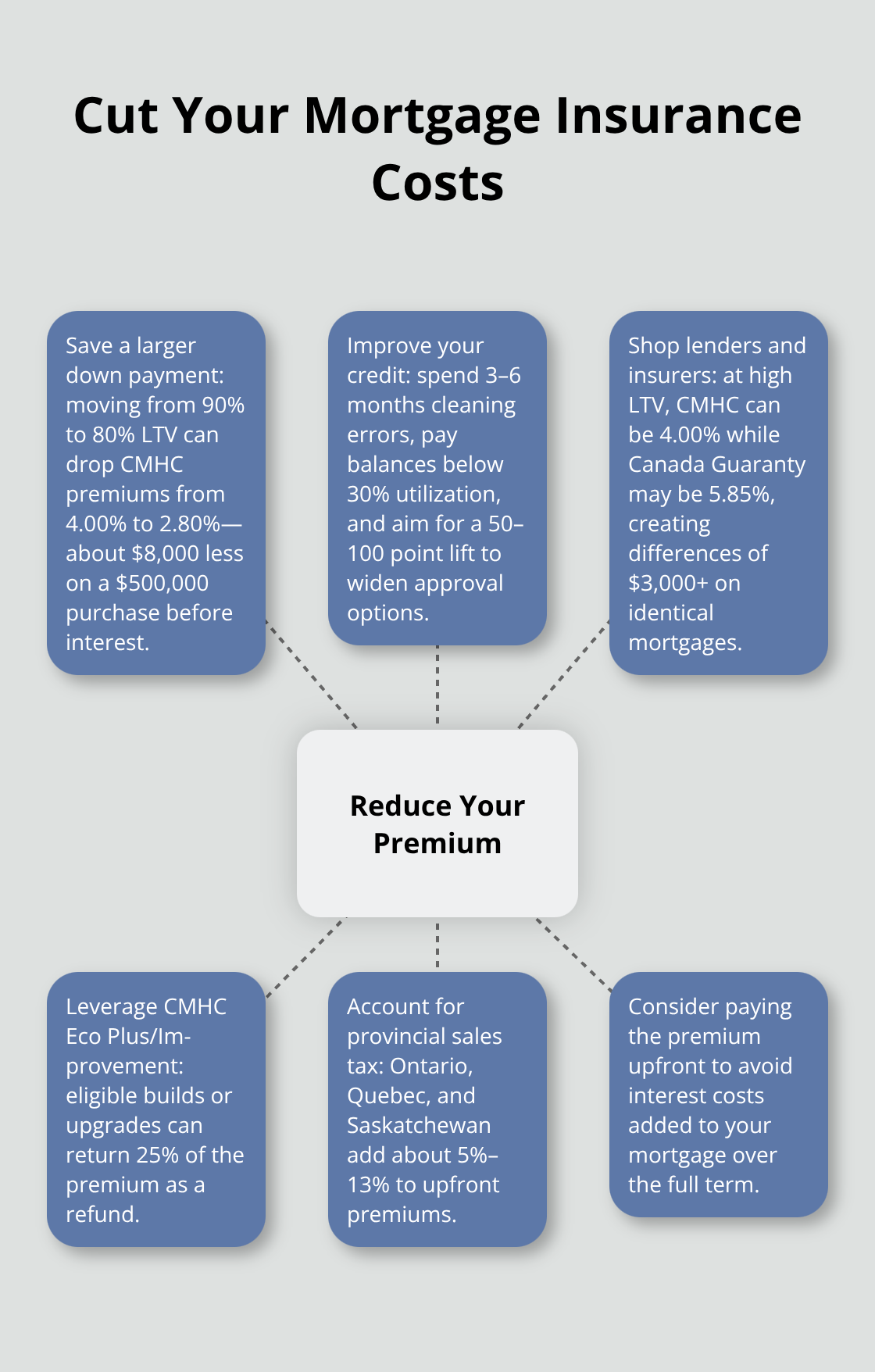
The gap between a 5% down payment and a 15% down payment shrinks your mortgage insurance premium dramatically, and this is where most homebuyers find their biggest savings opportunity. Moving from 90% loan-to-value to 80% loan-to-value drops your CMHC premium from 4.00% to 2.80% on a $500,000 purchase-that’s $6,000 versus $14,000, a difference of $8,000 before interest charges. Even an extra $50,000 for a 10% down payment instead of 5% cuts your premium roughly in half. The math is brutal but clear: every percentage point of down payment you accumulate saves you substantial money upfront and eliminates years of interest payments on a financed premium.
If you’re currently renting and can delay your home purchase by 12 to 24 months, aggressive saving toward a larger down payment savings on CMHC premiums often delivers better returns than any other cost-reduction strategy. Calculate your specific savings using CMHC’s mortgage calculator to see exactly how much extra down payment money translates to premium reductions for your target price range.
Improve Your Credit Score Before Applying
Your credit score directly influences which insurers will approve you and at what rates, making it a legitimate lever for cost control before you apply. A credit score impact on mortgage insurance approval and rates of 650 versus 750 might seem like a small difference, but lenders treat these scores as fundamentally different risk profiles. Sagen and Canada Guaranty both tighten their rates and approval odds as scores drop below 680, while CMHC maintains more consistent pricing across the 600 to 750 range.
Spend three to six months cleaning up your credit report before you apply-dispute errors, pay down revolving balances to below 30% of your credit limits, and never miss a payment. These actions can lift your score 50 to 100 points, positioning you for approval with your preferred insurer rather than settling for whoever will take you.
Shop Between Multiple Lenders and Insurers
Once you’ve gathered mortgage quotes from multiple lenders, you hold real negotiating power. Request premium quotes from CMHC, Sagen, and Canada Guaranty for your exact scenario, then compare the total dollar amount you’ll pay when provincial sales tax is included. A lender working exclusively with Canada Guaranty might charge you 5.85% at high loan-to-value when CMHC would charge 4.00%-that’s thousands of dollars in unnecessary cost.
Contact at least three lenders and explicitly ask which insurers they work with before you commit to any application. This shopping process takes a few hours but protects you from overpaying on insurance, the single most expensive variable within your control at the mortgage approval stage.
Final Thoughts
Mortgage insurance in Canada protects lenders, not you, but understanding how it works gives you real control over your home purchase costs. The mortgage insurance Canada tips we’ve covered throughout this guide boil down to three actionable strategies: save aggressively for a larger down payment, improve your credit score before applying, and shop between multiple lenders and insurers to find the lowest total cost. A 10% down payment instead of 5% saves you roughly $8,000 on CMHC premiums alone, and that gap widens when you factor in interest charges on financed insurance.
Your credit score determines which insurers approve you and at what rates, making those three to six months of credit cleanup worth your time. Shopping between CMHC, Sagen, and Canada Guaranty exposes premium differences that can exceed $3,000 on identical mortgages, yet most borrowers accept their lender’s first offer without comparison. Contact a mortgage specialist to discuss your eligibility and review the terms, benefits, and exclusions in your Certificate of Insurance before purchasing.
Gather quotes from at least three lenders before you commit to any application and request premium calculations from all three major insurers for your specific scenario. This process takes a few hours but protects you from overpaying thousands of dollars on insurance costs. We at Financial Canadian help homebuyers build strong digital strategies for managing their finances, and we encourage you to explore resources that support your financial planning as you navigate this major purchase.











Leave a comment