
Your home is likely your biggest asset. At Financial Canadian, we help homeowners understand how to use that equity strategically for renovations and improvements.
The right financing approach can save you thousands in interest and fees. The wrong one can leave you overstretched and vulnerable to rate increases.
Understanding Home Equity and How to Access It
Home equity represents the difference between your home’s current value and your outstanding mortgage balance. This equity builds through two mechanisms: as you make mortgage payments, you reduce the principal owed, and as your home’s value appreciates over time. Canadian homeowners have accumulated significant equity in recent years, though regional market conditions vary considerably. The Bank of Canada’s interest rate decisions directly influence how quickly you build equity through mortgage repayment, since higher rates direct more of each payment toward interest rather than principal.
Three Ways to Access Your Home Equity
Canada offers three primary methods to tap into your home equity. A Home Equity Line of Credit (HELOC) functions as a revolving credit product tied to your home’s value, typically allowing you to borrow up to 80 percent of your home’s value minus your mortgage balance. HELOC rates are variable and tied to the Bank of Canada’s prime rate, so your borrowing costs fluctuate with policy changes. A Home Equity Loan provides a lump sum upfront with a fixed interest rate and predictable monthly payments over 5 to 20 years, making it ideal for specific renovation projects with known costs. Cash-out refinancing replaces your existing mortgage with a larger one, giving you the difference in cash, though this extends your amortization period.
Comparing Costs Across Options
Each access method carries different expenses. HELOANs typically charge 2 to 5 percent in closing costs, while switching lenders for a HELOC can cost around $300 in discharge fees. The choice depends on whether you need ongoing access to funds or a single lump sum, and how comfortable you are with variable versus fixed rates. Understanding these cost differences helps you select the option that aligns with your renovation timeline and budget.

Tax Considerations for Home Equity Borrowing
Interest paid on home equity borrowing is not tax-deductible in Canada, regardless of how you use the funds. This differs significantly from the United States tax treatment. However, if you use HELOC or HELOAN proceeds for capital improvements that add permanent value to your home, those improvements may increase your home’s adjusted cost base, which affects your capital gains tax when you eventually sell. A tax professional can help you structure the loan correctly and understand the full tax implications for your specific situation. With these foundational concepts in place, you can now evaluate which financing option best suits your home improvement needs.
Which Home Financing Option Costs the Least for Renovations
A HELOC offers flexibility that HELOANs cannot match, but that flexibility carries a critical trade-off. HELOC rates typically run 1 to 2 percent higher than traditional mortgage rates, and they shift with Bank of Canada policy changes. For a $50,000 renovation, a 0.5 percent rate increase adds $250 annually in interest costs. However, if your renovation timeline stretches across multiple years or you need funds in phases, a HELOC lets you borrow only what you use and pay interest only on the drawn amount. A HELOAN, by contrast, locks in a fixed rate upfront and charges 2 to 5 percent in closing costs, but you receive the full amount immediately and your payments remain stable for 5 to 20 years.

This stability matters enormously when you budget for home improvements. If you know your renovation costs precisely and want to complete the work within 12 to 24 months, a HELOAN typically wins on total cost because the fixed rate protects you from future increases. For example, borrowing $75,000 at a fixed 6.5 percent over 10 years costs roughly $866 monthly with a HELOAN, while the same amount on a HELOC at 7.2 percent variable could start at $930 monthly but climb higher if rates rise.
Cash-out refinancing appeals only in specific situations: when mortgage rates have dropped significantly since you obtained your current mortgage, or when you’re already planning to renew. Refinancing resets your amortization clock, potentially adding years and substantial interest costs overall. We recommend avoiding refinancing purely for home improvements unless rate savings clearly offset the extended timeline. Personal loans and credit cards sit at the bottom of the borrowing hierarchy for renovations because unsecured debt carries rates of 8 to 21 percent or higher. Credit card interest at 19.99 percent on a $30,000 renovation becomes financially destructive within months. Use these options only for emergency repairs under $5,000 or when you lack home equity entirely.
The Real Cost of Switching Lenders Mid-Project
Discharge fees of $300 to $500 seem minor until you calculate the full switching picture. If you move a HELOC to a different lender halfway through a renovation, you’ll pay discharge fees, potentially face a requalification process that requires fresh income verification, and lose any preferred rates you negotiated. Many lenders bundle mortgages with HELOCs at discounted rates, so separating them costs you those savings. A $100,000 HELOC at 0.25 percent lower through bundling saves $250 annually, which a $400 discharge fee erases in less than two years. Lock in your financing choice before renovation starts. Shop rates from multiple lenders upfront rather than switching mid-project when you’re emotionally invested and less price-sensitive.
Fixed Rates Protect Against Future Rate Shock
The Bank of Canada’s policy trajectory matters less with a HELOAN because your rate won’t change. This certainty lets you budget accurately and avoid anxiety about payment jumps. If you borrow $60,000 over 15 years at a fixed 6.75 percent, your monthly payment stays at $533 regardless of what happens at the central bank. A HELOC at the same amount starting at 7.2 percent might feel comparable, but when rates climb to 8 percent or beyond, your monthly cost jumps to $600 or higher. Over a decade, that volatility compounds into thousands of dollars in extra interest. For homeowners over age 55 or those on fixed retirement incomes, the HELOAN’s payment certainty outweighs its higher upfront costs.
When Variable Rates Make Sense
HELOC rates do offer advantages in specific scenarios. If you expect the Bank of Canada to cut rates within your project timeline, a variable-rate HELOC could save you money compared to a locked-in HELOAN rate. You also maintain the option to convert a HELOC to a fixed-rate mortgage with some lenders when you move to a new home, preserving your financing while changing the structure. This flexibility appeals to homeowners who anticipate major life changes or want to preserve options as market conditions shift. The key is understanding your own risk tolerance and renovation timeline before you commit to either product.
Common Mistakes That Drain Your Home Improvement Budget
Most homeowners approach home equity financing with incomplete information, and that gap costs real money. The first mistake is borrowing far more than your actual renovation requires. You see that you can access $100,000 through a HELOC and convince yourself that extra cushion protects against cost overruns, but that logic inverts reality. Every dollar you borrow costs interest whether you use it or not. If you draw $80,000 instead of $100,000 on a HELOC at 7.2 percent over five years, you save roughly $1,440 in interest alone.
Get Precise Project Costs Before You Borrow
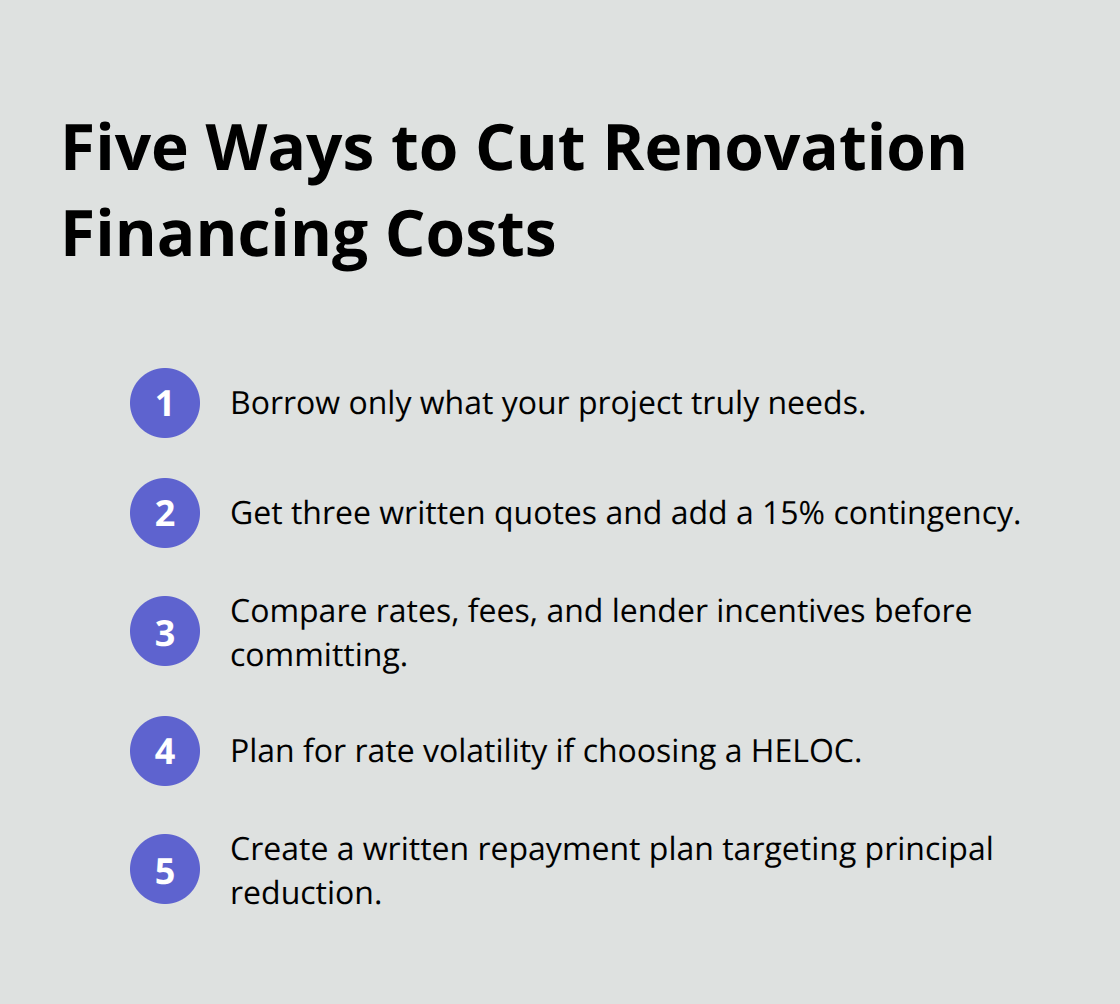
Obtain written quotes from three contractors before you apply for financing. Add 15 percent for genuine contingencies, then borrow exactly that amount. Avoid the psychological trap of round numbers-if your renovation costs $47,300, borrow $47,300, not $50,000. This discipline prevents you from carrying unnecessary debt that compounds over years.
Shop Rates and Fees Like Your Budget Depends on It
The second mistake treats interest rates and fees as afterthoughts rather than deal-breakers. A HELOAN charging 5 percent in closing costs on a $75,000 loan means you start $3,750 in debt before renovation begins. Some lenders waive closing costs for owner-occupied homes, so shop multiple lenders instead of accepting the first offer. Rate differences matter enormously over time. A 0.75 percent difference between two HELOAN offers on $60,000 over 10 years adds roughly $2,700 to your total cost.
Discharge fees when switching lenders mid-project typically run $300 to $500, but they compound when combined with requalification delays that pause your renovation timeline. Lock your rate and lender choice before breaking ground, not halfway through the project when you’re emotionally committed and less price-sensitive.
Account for Rate Volatility With Variable-Rate Products
The third mistake ignores rate volatility when you choose a variable-rate HELOC. If the Bank of Canada raises rates by just 1 percent on a $70,000 HELOC, your annual interest costs increase. This risk intensifies for homeowners nearing retirement or living on fixed incomes who cannot absorb payment shocks.
A fixed-rate HELOAN eliminates this uncertainty entirely. Yes, you’ll pay slightly more upfront, but your monthly payment on a $70,000 loan at 6.75 percent over 15 years stays locked at $580 regardless of what the central bank does next. For anyone uncomfortable with payment volatility, that certainty justifies the higher initial rate.
Create a Written Repayment Plan Before You Borrow
The final practical step involves creating a written repayment plan before you borrow. Specify how much you’ll pay monthly toward the loan, separate from interest costs. If you only pay interest on a HELOC without touching principal, you protect your home equity on paper while eroding it in practice. Set a target payoff date-ideally matching your renovation timeline plus two years-and stick to it. This discipline separates homeowners who build wealth through smart equity access from those who slip into perpetual debt cycles.
Final Thoughts
Choosing the right home improvement financing Canada option depends on three factors: your renovation timeline, your comfort with payment volatility, and your total project cost. If you know exactly what your renovation costs and plan to complete it within 12 to 24 months, a fixed-rate HELOAN wins on total cost and payment certainty. If your project spans multiple years or you need funds in phases, a HELOC’s flexibility justifies its variable rate, provided you can absorb potential payment increases.
Borrow only what you need, lock your rate and lender before renovation starts, and create a written repayment plan that targets principal reduction alongside interest payments. A $50,000 HELOAN at 6.5 percent over 10 years costs roughly $580 monthly and totals about $69,600 in payments, while the same amount on a variable HELOC at 7.2 percent starts at $600 monthly but climbs if rates rise. That difference compounds into real money that either stays in your pocket or flows to your lender.
Avoid borrowing more than your actual costs, ignoring rate differences and fees, and failing to plan for rate volatility. Start by contacting your current lender to understand your available equity and request written quotes for both HELOC and HELOAN products, then compare total costs over your intended repayment period and choose the option that aligns with your timeline and risk tolerance.











Leave a comment