
Your credit score determines whether lenders approve your application and what interest rates you’ll pay. A single error on your report can cost you thousands in higher borrowing costs.
We at Financial Canadian created this Canada credit score checklist to help you verify your information before applying for loans or credit cards. Taking 30 minutes to review your report now prevents costly mistakes later.
Why Your Credit Score Matters Before You Apply
Your credit score is a three-digit number that lenders use to decide whether you qualify for a loan or credit card and what interest rate you’ll pay. In Canada, Equifax and TransUnion calculate scores between 300 and 900, with higher scores indicating lower risk to lenders. A score above 660 generally qualifies you for standard lending products, while scores below 600 make approval difficult and expensive. The difference between a 650 score and a 750 score can mean paying 2-3% more in interest on a mortgage, costing you tens of thousands of dollars over the life of the loan. This is why checking your score before applying matters more than most people realize.
How Lenders Use Your Score
Canadian lenders weight your credit score heavily in their decision-making process. Payment history accounts for 35% of your score, meaning missed or late payments damage your creditworthiness significantly. Credit utilization makes up 30% of your score, so carrying balances above 30% of your available credit limits signals financial stress to lenders. The remaining factors include length of credit history, credit mix, and new credit inquiries. When you apply for a mortgage, lenders typically require a minimum score of 620, though scores above 700 qualify you for the best rates. Credit card companies often have higher thresholds, with 680+ needed for premium cards offering rewards and travel benefits.

The Real Cost of a Lower Score
A borrower with a 620 credit score pays approximately 1.5-2% higher interest on a five-year mortgage compared to someone with a 750 score. On a $400,000 mortgage, this difference amounts to roughly $30,000 in additional interest paid over five years. Auto loans show similar patterns, with lower scores resulting in rates that can be 4-5% higher than prime rates. Even credit cards charge higher interest rates based on your score, with subprime cards starting at 19.99% APR compared to premium cards at 11.99% APR. This is why improving your score before applying for major credit products directly impacts your financial health.
Why Early Action Prevents Problems
Most Canadians don’t check their credit reports until they apply for a mortgage or major loan. Discovering errors or unauthorized accounts at that point costs valuable time and may force you to postpone your application. Checking your report now, before you need credit, gives you months to dispute errors and improve weak areas. Free credit reports are available from Equifax and TransUnion once per year (and you should review both since they sometimes contain different information). Taking action today prevents surprises that could derail your financial plans and leaves you ready to move forward when opportunity arrives.
What to Look for On Your Credit Report
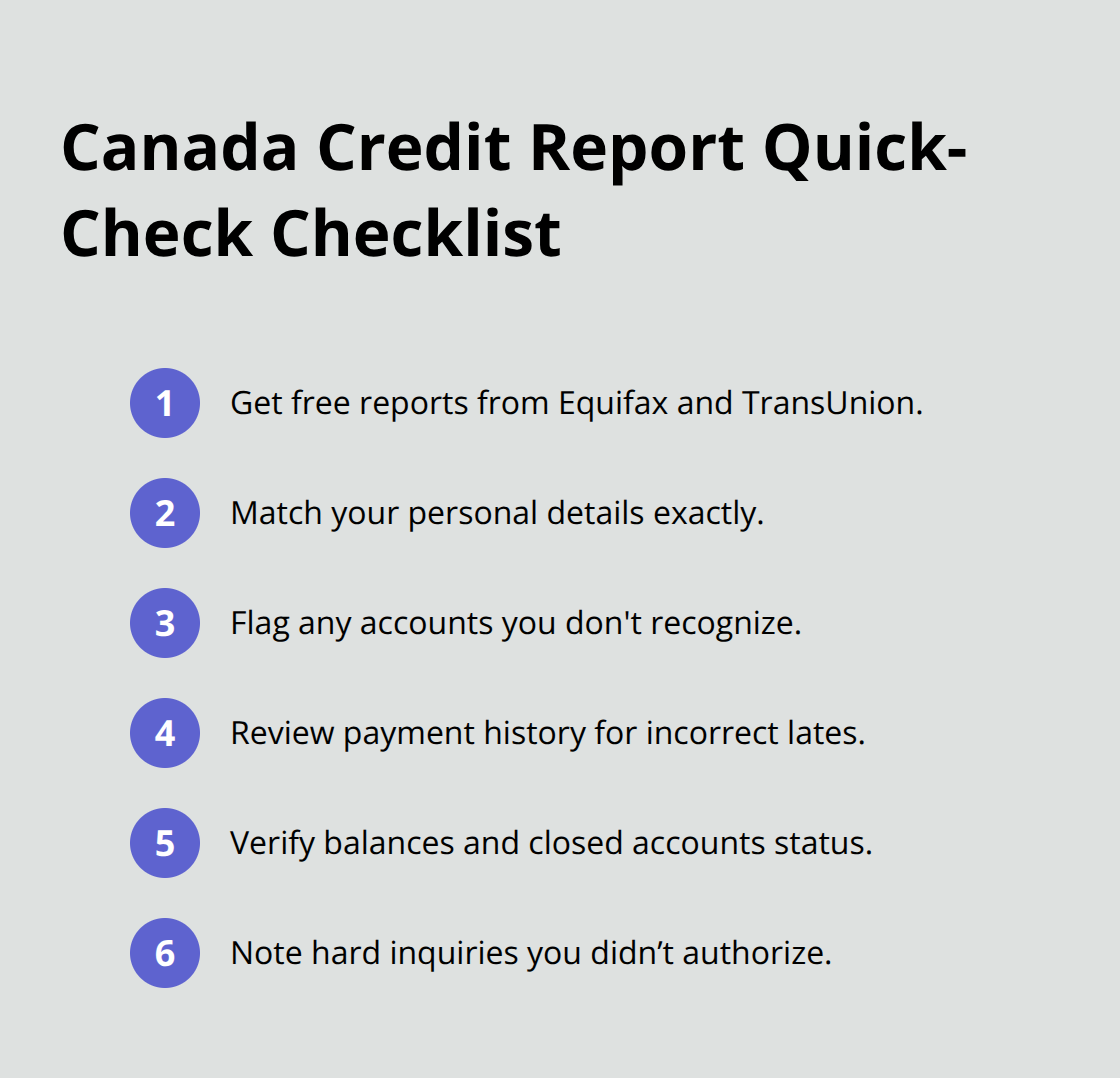
Request Reports From Both Bureaus
Request your free credit report from both Equifax and TransUnion since these two bureaus often contain different information about your accounts and payment history. Many Canadians assume one report is enough, but discrepancies between them are common and can significantly impact your score. You should review both reports to catch errors that appear on only one bureau’s file.
Verify Your Personal Information
When your reports arrive, verify that your personal information matches your actual identity. Check your name spelling, current address, date of birth, and employment details carefully. Incorrect personal information can cause legitimate accounts to appear as errors, and some fraudsters add their own details to your file to open accounts in your name.
Spot Unauthorized Accounts and Fraud
Look specifically for accounts you do not recognize, as unauthorized accounts and fraud indicate identity theft or fraud. If you spot unfamiliar accounts, contact the creditor immediately and file a fraud report with the credit bureau. Multiple hard inquiries within a short timeframe also signal potential fraud, so request that the credit bureau remove any inquiries you did not authorize.
Check Payment History and Outstanding Debts
Examine your payment history for missed or late payments that you know you made on time. Payment history mistakes are surprisingly common; lenders sometimes report late payments incorrectly due to processing errors or disputes that were never resolved. Focus on recent payments since the last 12 months carry much more weight than older history.
Check outstanding debts against your own records to confirm the reported balances match what you actually owe. Many reports show closed accounts with balances still appearing as open, which artificially inflates your credit utilization ratio and damages your score unnecessarily. Dispute these immediately with the credit bureau, providing proof of payment if available. Most people complete this review in 30-45 minutes and catch at least one error worth disputing.
Once you identify errors and unauthorized accounts, the next step involves taking action to correct them before you apply for new credit.
How to Fix Errors and Strengthen Your Score
Dispute Errors With Your Credit Bureau
Errors on your credit report cost real money, and the sooner you dispute them, the sooner your score recovers. When you find an incorrect payment marked as late or an account that doesn’t belong to you, contact the credit bureau in writing within 30 days of receiving your report. Equifax and TransUnion have formal dispute processes that typically take 30-45 days to investigate and resolve.
Provide copies of supporting documents like bank statements or proof of payment, never originals. The credit bureau must investigate your claim and remove inaccurate information if they cannot verify it. Most disputes succeed because creditors fail to respond to the bureau’s verification request, forcing them to remove the item.
Start your dispute immediately after identifying the error rather than waiting until you need to apply for credit, since the process takes weeks and you want your corrected score before submitting applications.
Lower Your Credit Utilization Ratio Fast
Reducing your credit utilization ratio produces faster score improvements than almost any other action. If you carry balances above 30% of your available credit limits, your score suffers regardless of your payment history. A borrower with a $10,000 credit limit carrying a $6,000 balance has 60% utilization, which signals financial stress to lenders and suppresses their score significantly.
Paying this balance down to $3,000 or below immediately boosts the score because utilization recalculates when the creditor reports your updated balance (typically within 30-45 days). This strategy works faster than waiting for on-time payments to accumulate since recent payment history matters more heavily.

If you lack cash to pay down balances, request a credit limit increase from your card issuer, which instantly lowers your utilization ratio without requiring you to pay anything. Many issuers grant increases within days, giving you immediate breathing room.
Build Consistent Payment History
After addressing errors and reducing utilization, consistent on-time payments compound your improvements month after month. Missing even one payment resets your progress and damages your score for up to seven years, so set up automatic payments for at least the minimum amount due on every account.
Most people see their average credit score improve 50-100 points within three to six months of correcting errors and reducing utilization (positioning them strongly for mortgage or loan applications). Automatic payments remove the risk of human error and keep your payment history clean without additional effort.
Final Thoughts
You’ve completed the Canada credit score checklist and taken concrete steps to protect your financial future. Reviewing your credit reports from both Equifax and TransUnion, verifying your personal information, spotting unauthorized accounts, and checking your payment history takes roughly an hour but prevents thousands in unnecessary interest charges. The errors you find and dispute now won’t surprise you when you apply for a mortgage, auto loan, or credit card later.
Monitoring your credit going forward requires minimal effort. Check your reports annually from both bureaus to catch new errors before they damage your score, and set calendar reminders for your free annual reports so you don’t forget. Maintain the habits that improve your score: keep credit utilization below 30%, make all payments on time, and dispute any inaccuracies immediately.
Your next steps depend on your current situation. If you found errors, start your disputes with the credit bureaus today rather than waiting, and if your utilization is high, prioritize paying down balances before applying for new credit. We at Financial Canadian created resources to help you build stronger financial habits and make informed decisions based on accurate information.










Leave a comment