
Your credit score shapes your financial life in Canada. It determines whether you qualify for loans, what interest rates you’ll pay, and even affects your insurance premiums and job prospects.
At Financial Canadian, we believe credit score monitoring in Canada isn’t optional-it’s essential. This guide shows you exactly how to track your score, spot errors, and build the credit profile you need.
How Your Credit Score Affects Your Financial Opportunities
Your credit score directly impacts three major areas of your financial life, and the numbers are significant. Lenders check your score first when you apply for a mortgage. Borrowers with scores above 760 qualify for the best mortgage rates, while those below 620 face rejection or significantly higher rates. A 100-point difference in your credit score can cost you tens of thousands of dollars over a 25-year mortgage. A borrower with a 720 score pays 0.5% more in interest than someone with a 780 score, translating to roughly $15,000 extra on a $400,000 mortgage. Personal loans and car financing follow the same pattern. Banks determine approval odds and set your interest rate within seconds of your application.
The Interest Rate Reality
Interest rates move dramatically based on credit scores, and lenders publish these tiers openly. TransUnion reports that someone with a 650 score pays approximately 2-3% more in interest on auto loans compared to a 750-score borrower. On a $30,000 car loan, this difference amounts to $1,800-$2,700 in additional interest over five years. Credit card companies apply the same logic. A consumer with excellent credit qualifies for cards offering 19.99% rates, while someone with fair credit faces 21.99% rates. Over time, these percentage points add up significantly, especially if you carry a balance. A 50-point improvement in your score can lower your borrowing costs substantially, making credit monitoring financially essential rather than optional.
Insurance Premiums and Employment
Your credit score influences decisions outside of lending that most Canadians overlook. Insurance companies in Canada use credit information to calculate premiums for auto and home insurance. A low credit score might translate into a higher auto insurance premium if insurers deem people with poor credit more likely to make a claim. Employers, particularly in financial services and positions requiring security clearance, review credit reports during hiring. A low score won’t automatically disqualify you, but it raises questions during background checks. Utility companies and cell phone providers also check scores when you open new accounts, sometimes requiring deposits if your score is weak.
What This Means for Your Wallet
These hidden costs of poor credit monitoring add hundreds to your annual expenses across multiple services (insurance, utilities, and employment opportunities combined). The financial impact extends far beyond a single loan rejection. Each service that checks your credit applies its own scoring logic, meaning a weak score compounds across your entire financial life. Understanding these connections shows why monitoring your credit score isn’t just about borrowing-it’s about controlling your total cost of living.
Tools and Services for Credit Score Monitoring in Canada
Canada’s two major credit bureaus-Equifax and TransUnion-control your credit information, and accessing it directly is your strongest move. Equifax offers a free annual credit report through their website, while TransUnion provides the same through theirs. These reports show your credit history, accounts, payment records, and any negative marks. However, these free annual reports don’t include your actual credit score, only the detailed history behind it. To see your score, you’ll pay around $20-$30 per bureau for a one-time access or subscribe to monthly monitoring. Most Canadians check only one bureau, but both track slightly different information because lenders don’t report uniformly to each. Monitoring both matters when you’re applying for major credit, since the bureaus may report different information. The free reports catch errors and fraud, but if you’re actively managing credit or preparing for a mortgage, paid access to your actual score becomes worth the investment since lenders use scores to make approval decisions within days.
Free Score Trackers That Actually Work
Several services offer free credit scores updated monthly, funded by lenders who pay to see consumer data. Borrowell and Wealthsimple provide genuine free access without hidden catches or forced upgrades. These platforms show your score from one bureau and track changes month to month, giving you visibility into whether your actions improve your standing. Free trackers work well for someone with stable credit who wants basic monitoring without expense. They alert you to major score swings, which often signal fraud or reporting errors that need immediate attention. The trade-off is that free services typically show scores from only one bureau, not both, so you miss the full picture that lenders see.
Paid Monitoring Services Worth Considering
Paid credit monitoring services in Canada range from basic score tracking to comprehensive identity theft protection. Equifax and TransUnion’s subscription services cost $10-$20 monthly and alert you to score changes, new accounts, or suspicious activity. Identity theft protection services like LifeLock or IDShield cost $15-$30 monthly and add monitoring across credit bureaus plus dark web scanning. The question isn’t whether to pay-it’s whether you need alerts and protection beyond basic score access. Someone preparing for a mortgage in the next six months benefits from monthly monitoring to catch errors before lenders see them. Someone with stable credit and no major applications planned can rely on free annual reports and occasional free score checks. The paid services excel at catching fraud early, which costs Canadians thousands annually in identity theft cases, but they’re optional if you’re disciplined about checking your report yourself twice yearly.
Building Your Monitoring Routine
Start by pulling your free Equifax and TransUnion reports immediately, then review them for errors-incorrect accounts, wrong payment histories, or accounts you don’t recognize signal fraud or bureau mistakes. Dispute inaccuracies directly with the bureau, not the creditor, since the bureau controls what lenders see. Set a calendar reminder to request your free annual reports every 12 months, spacing them three months apart so you monitor your credit year-round without paying. If you’re rebuilding credit after missed payments or high debt, subscribe to a free score tracker for monthly updates showing your progress. Track which actions improve your score-paying down balances typically shows results within 30-60 days, while removing negative marks takes longer. Most Canadians check their reports far too infrequently; errors sit undetected for years, silently damaging approval odds and rates. The cost of monitoring is minimal compared to the tens of thousands in extra interest from a lower score.
What Errors Look Like and How to Fix Them
Credit reports contain mistakes more often than most people realize. Accounts that don’t belong to you, incorrect payment dates, or duplicate entries appear regularly on Canadian credit files. When you spot an error, contact the bureau in writing with documentation supporting your claim-they must investigate within 30 days. The bureau then contacts the creditor to verify the information, and if the creditor can’t confirm it, the bureau removes it. This process takes time, but it directly protects your score and your wallet. Errors on your credit report can affect your ability to qualify for credit and the interest rates you receive, making the effort to dispute them worthwhile. Once you’ve corrected your reports, your next step involves understanding which behaviors actually move your score upward-and which ones waste your time.
How to Actually Improve Your Credit Score
Your credit score moves based on specific financial behaviors, and understanding which ones matter most saves months of wasted effort. Payment history accounts for 35% of your score, so missing even one payment damages your standing for years. A single missed payment stays on your report for six years, though its impact weakens after two years as newer positive activity accumulates. The second most influential factor is credit utilization at 20-30% of your score-how much of your available credit you actually use. Carrying a balance above 30% of your total credit limit signals financial stress to lenders, even if you pay on time. Dropping utilization from 80% to 20% typically improves your score by 20-50 points within one or two billing cycles since credit card companies report monthly. This makes paying down balances one of the fastest ways to see measurable improvement without waiting years for negative marks to fade.
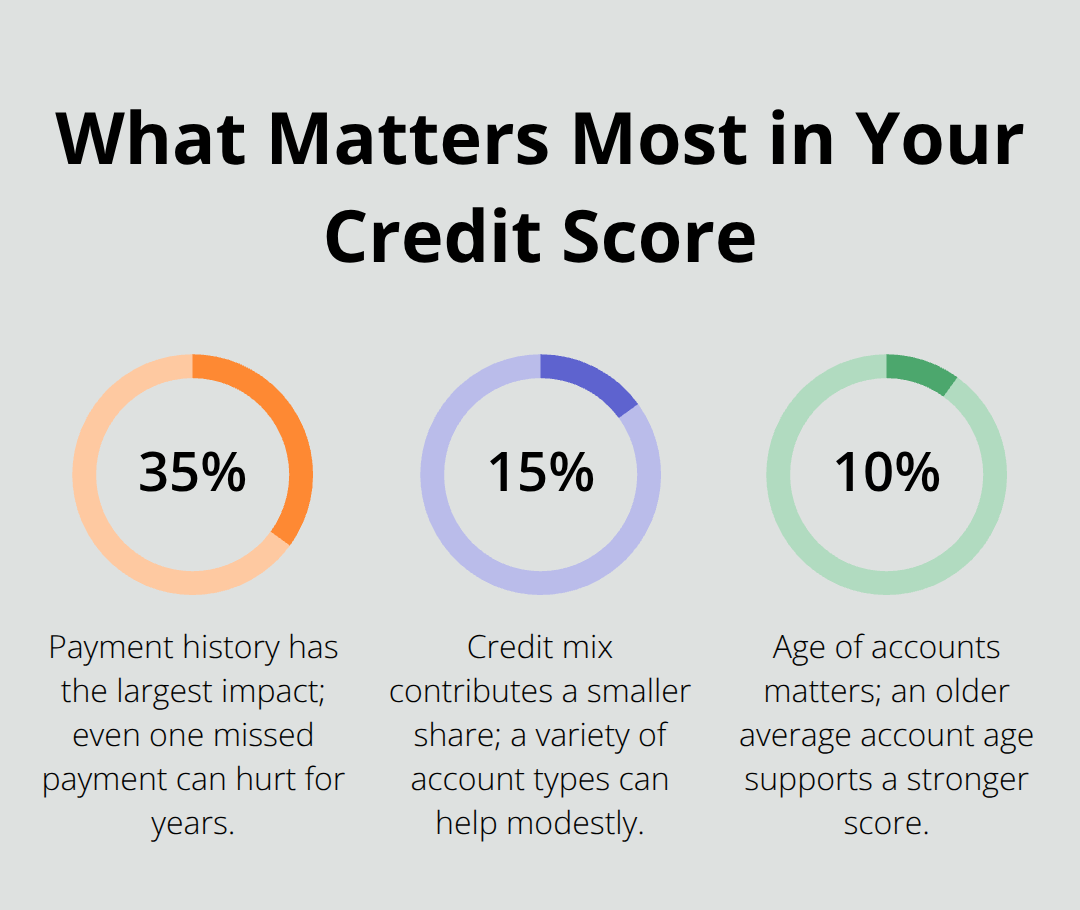
The Factors That Actually Move Your Score
The remaining factors include credit mix (15%), age of accounts (10%), and new credit inquiries (10%), meaning you cannot fix your score overnight but you absolutely can control the timeline through deliberate action. Payment history and utilization together account for 65% of your score, so focusing on these two areas produces the fastest results. Most Canadians waste time on minor factors while ignoring the behaviors that matter most. Concentrate your effort on paying bills on time and reducing what you owe relative to your limits, and your score will respond within months rather than years.
Three Mistakes That Trap You in Mediocre Credit
First, closing old credit accounts after you pay them off actually hurts your score because you lose available credit and reduce your account age, both factors lenders value. Keep old cards open with zero balances instead, using them occasionally to show activity. Second, applying for multiple credit cards or loans within weeks creates hard inquiries that each drop your score by 5-10 points and stay visible for three years. Space applications at least six months apart and only apply when necessary since each inquiry signals desperation to lenders. Third, paying off collections accounts without negotiating deletion first leaves the negative mark on your report for seven years even after you pay. Contact the collections agency before you pay and request a pay-for-delete agreement where they remove the account in exchange for payment, though some agencies refuse this practice.
What Actually Works
These mistakes cost you points unnecessarily when the real work involves consistent on-time payments and low utilization, which require discipline rather than complex strategy. Your score rewards boring financial behavior, not clever tactics. Set up automatic payments for at least the minimum amount on all accounts, eliminating the risk of missed payments that damage your score for years. Request credit limit increases from your card issuers every six to twelve months-higher limits lower your utilization ratio without you spending more money. Pay down balances strategically by targeting cards with the highest utilization first, since this produces the fastest score improvement. These actions take minimal effort once you establish them, yet they produce measurable results within weeks or months rather than the years required for negative marks to disappear naturally.
Final Thoughts
Credit score monitoring in Canada directly controls your financial outcomes, and the evidence throughout this guide proves it. A 100-point difference in your score costs tens of thousands on mortgages, hundreds annually on insurance, and affects employment opportunities in financial sectors. The gap between monitoring your credit and ignoring it isn’t small-it’s the difference between paying thousands in unnecessary interest and keeping that money in your account.
Start today by requesting your free annual reports from Equifax and TransUnion, then review them carefully for errors and dispute anything that doesn’t belong to you. Set up automatic minimum payments to eliminate missed payment risk, then pay down balances strategically to drop your utilization below 30%. These actions produce measurable improvements within weeks, not years, and cost nothing to implement.
The long-term benefit of credit score monitoring in Canada extends far beyond a single loan approval. Consistent monitoring catches fraud early, prevents identity theft from damaging your score for years, and ensures lenders see accurate information when you apply. We at Financial Canadian understand that your financial future depends on the actions you take today, which is why we offer web design services with responsive layouts and SEO optimization to strengthen your online visibility and support your financial goals.











Leave a comment