
Mortgage rates in Canada today are shaped by forces far beyond your control, yet understanding them gives you real power in the market. The Bank of Canada’s decisions, inflation trends, and global bond markets create a complex web that directly impacts your monthly payments.
At Financial Canadian, we’ve broken down exactly what moves these rates and how you can use that knowledge to your advantage. This guide walks you through the current landscape and gives you practical strategies to navigate rate changes with confidence.
What Moves Mortgage Rates in Canada
The Bank of Canada’s Policy Rate Sets the Foundation
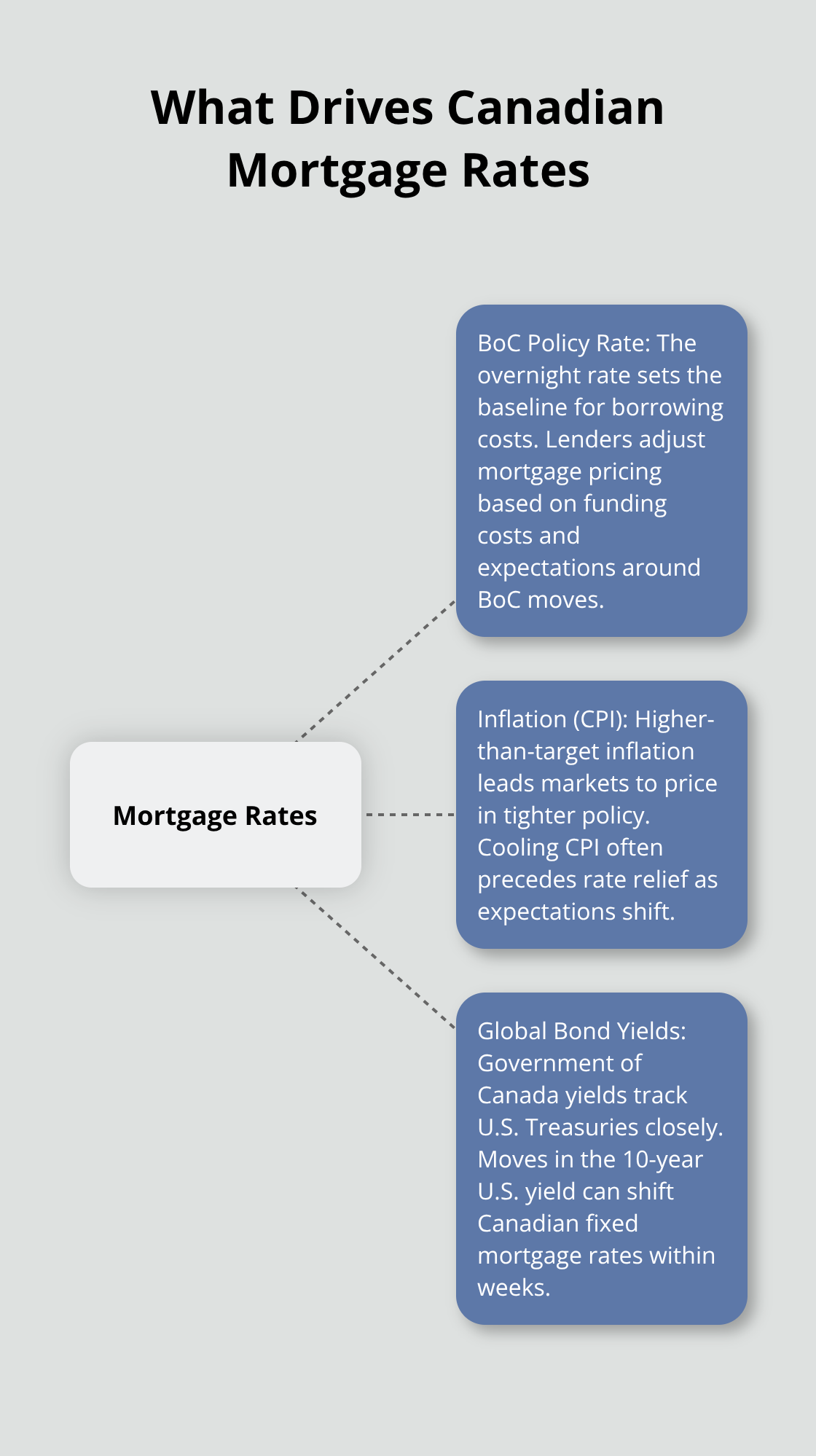
The Bank of Canada’s overnight rate is the primary lever that moves Canadian mortgage rates, but it’s not a direct one-to-one relationship. When the BoC raised its overnight rate from 0.25% in March 2022 to 5% by July 2023, lenders didn’t immediately pass every increase to existing variable-rate mortgages. Instead, they adjusted their lending spreads based on funding costs and competitive pressures. Fixed-rate mortgages respond faster to BoC decisions because lenders price them against bond yields, which shift in anticipation of rate moves.
The actual rate you receive depends on when you apply, which lender you approach, and whether you lock in a fixed or variable product. BoC announcements create market momentum, but they don’t determine your final rate. If you plan to renew or apply for a mortgage within the next three months, BoC meeting dates matter enormously. The central bank adjusts its target for the overnight rate on eight fixed dates annually, and mortgage rates often shift 0.25% to 0.50% within days of these announcements.
Inflation Data Drives the BoC’s Hand
Inflation data shapes the BoC’s thinking, which then shapes your rate. Statistics Canada releases the Consumer Price Index monthly, and when inflation stays above the BoC’s 2% target, lenders immediately price in expectations of higher rates. Throughout 2022 and 2023, inflation peaked at 8.1% in June 2022, forcing the BoC into aggressive rate hikes that pushed five-year fixed mortgage rates above 6%. High inflation means the BoC holds rates higher longer, which keeps mortgage rates elevated.
Watch inflation trends before your renewal date. If CPI readings cool month-over-month, genuine potential for rate relief emerges within six months. This forward-looking approach beats waiting for rate cuts that may take longer than expected.
Global Bond Markets Control the Immediate Direction
Canadian mortgage rates track Government of Canada bond yields more closely than most borrowers realize. When U.S. Treasury yields spike due to Federal Reserve policy or global economic uncertainty, Canadian yields follow within hours. A 0.50% jump in the 10-year U.S. Treasury yield typically pushes Canadian five-year mortgage rates up 0.25% to 0.40% within one to two weeks.
You can’t control global markets, but you can time your application around them. If geopolitical tensions ease or recession fears diminish, bond yields tend to fall, creating windows where lenders offer better rates. This timing advantage becomes your next strategic move when you understand how these market forces interact.
Where Mortgage Rates Stand Today
Fixed Rates Offer Protection Variable Rates Cannot Match
Fixed-rate mortgages in Canada carry a significant advantage right now that variable-rate options cannot match. As of September 2026, five-year fixed rates hover around 4.5% to 4.8% depending on your lender and down payment size, while variable-rate mortgages sit approximately 0.75% to 1.25% lower on paper. This gap creates a false economy for borrowers. The Bank of Canada has signaled rate cuts may continue through late 2026 and into 2027, but locking in a fixed rate protects you from the uncertainty surrounding how far cuts will actually go. If you renew within the next 12 months, fixed rates offer genuine peace of mind that variable rates cannot provide, especially given the volatility experienced since 2022. Mortgage brokers report that clients who locked fixed rates in the 4.2% to 4.5% range during mid-2026 made the right call, as rate movements since then have proven unpredictable. The spread between fixed and variable has narrowed considerably compared to 2023 and 2024, meaning you no longer pay an enormous premium for certainty.
Regional Markets Create Hidden Savings Opportunities
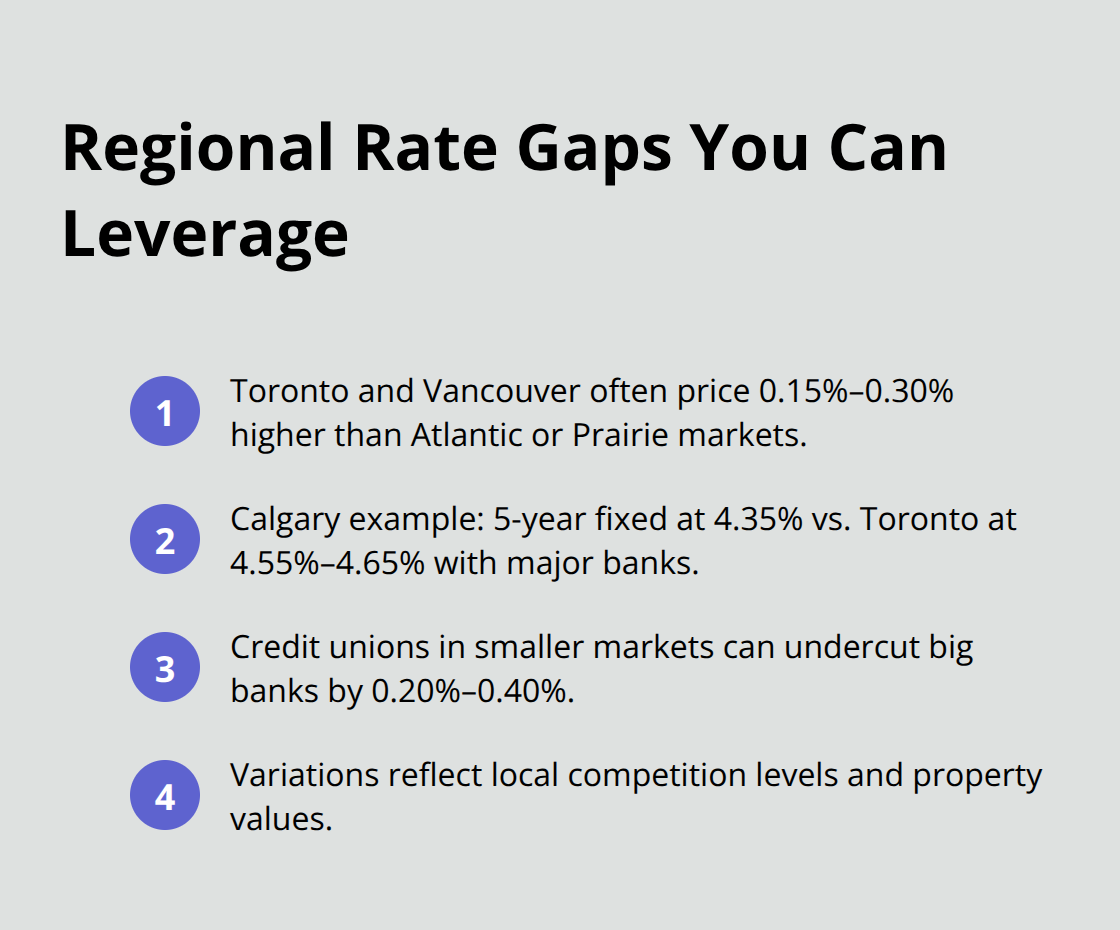
Rates differ meaningfully across Canada’s regional markets, and this is where most borrowers leave money on the table. Toronto and Vancouver borrowers typically see rates 0.15% to 0.30% higher than borrowers in Atlantic Canada or Prairie provinces, reflecting local competition levels and property values. A borrower in Calgary might secure a five-year fixed rate at 4.35%, while the identical mortgage in Toronto costs 4.55% to 4.65% at major banks. Credit unions in smaller markets often undercut the big five banks by 0.20% to 0.40%, yet most borrowers never contact them because they assume rates are standardized nationally.
Shopping Around Yields Substantial Savings
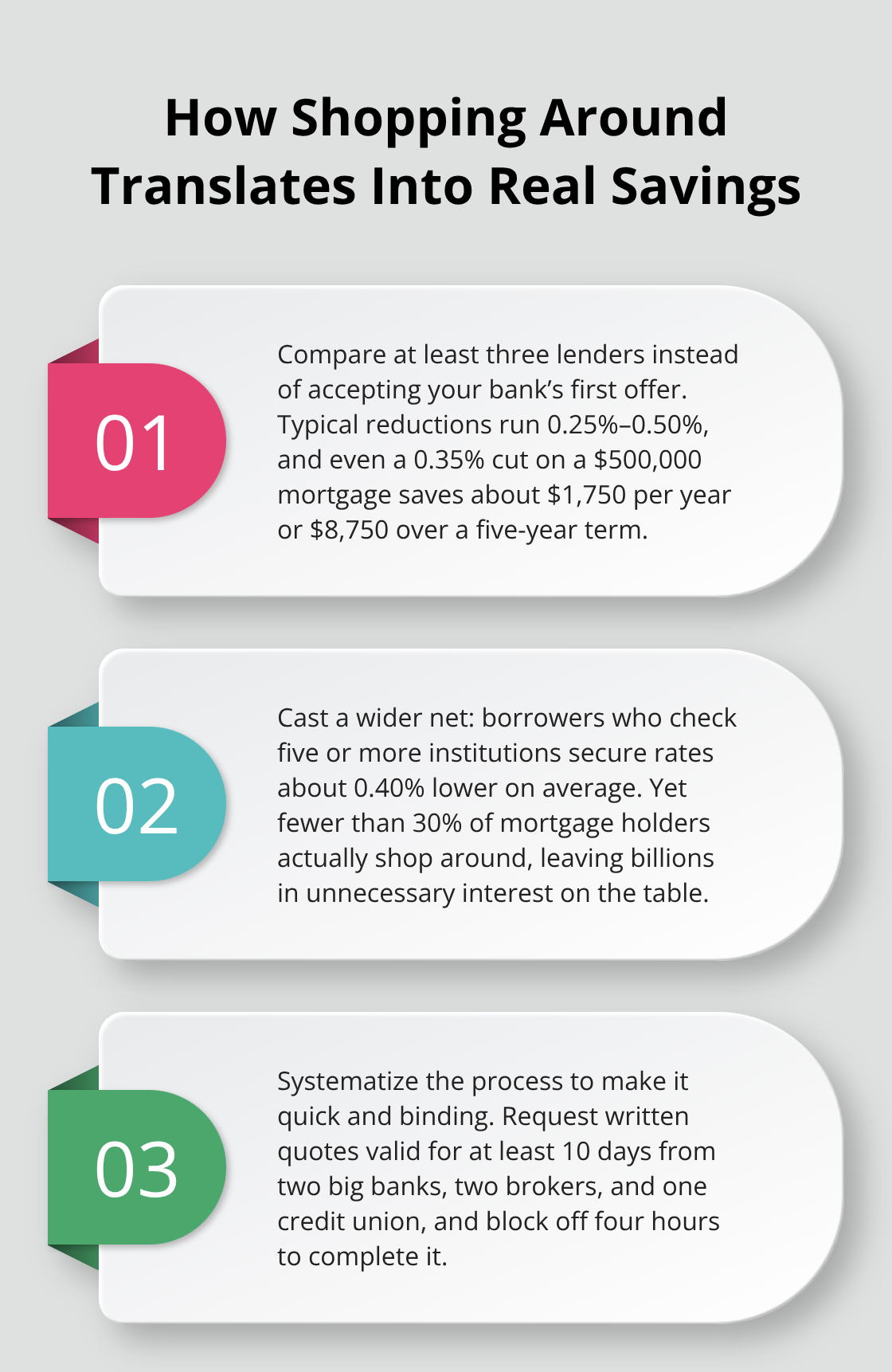
Shopping across at least three lenders, including regional credit unions and mortgage brokers, consistently yields 0.25% to 0.50% rate reductions compared to accepting the first offer from your current bank. Over a $500,000 mortgage, that 0.35% difference saves roughly $1,750 annually or $8,750 over a five-year term. Borrowers who compare rates across five or more institutions secure rates approximately 0.40% lower on average than those who accept their bank’s initial offer, yet fewer than 30% of Canadian mortgage holders actually shop around when renewing. This gap between what borrowers could pay and what they actually pay represents billions in unnecessary interest across the country.
The next section examines how to time your mortgage application and lock in rates before market conditions shift against you.
How to Time Your Mortgage Application and Lock in Rates
Position Your Application Around BoC Announcements
The timing of your mortgage application matters far more than most borrowers realize, and this is where genuine savings emerge. The BoC meets on eight fixed dates annually, and mortgage rates typically shift within one to three days of each announcement. If you know the BoC meets on September 2nd, October 28th, or December 11th in 2026, you can position your application strategically around these dates. Apply one week before an expected rate cut, and you lock in a rate while lenders still price in higher scenarios. Apply immediately after a cut, and you may find rates have already dropped but lenders tighten their spreads to compensate.
Monitor Statistics Canada’s inflation releases two weeks before each BoC meeting, since CPI data shapes what the central bank actually does. If inflation data comes in hotter than expected, wait one week and let the BoC respond first. If inflation cools, lock in your rate within three business days before the next meeting because lenders front-run anticipated cuts by lowering rates preemptively.
Use Rate Hold Periods to Your Advantage
Rate hold periods give you a 120-day window to lock in a quoted rate without committing to a mortgage yet, and this tool deserves serious attention. Mortgage brokers and lenders offer these holds at no cost, meaning you can secure a rate on September 15th and not close your mortgage until early January without paying a penalty if rates fall. Use this window aggressively. If current five-year fixed rates sit at 4.5% and you expect the BoC to cut 0.50% over the next four months, do not lock in today. Instead, apply for a preapproval and wait for two or three BoC cuts to materialize before converting your hold to an actual mortgage commitment. Conversely, if rates are trending upward and bond yields are rising, lock in immediately and extend your hold to the full 120 days.
Compare Quotes Across Multiple Lenders
Shopping across at least five lenders takes roughly four hours and yields measurable savings that most borrowers ignore. Contact two big banks, two mortgage brokers, and one credit union in your province. Request written rate quotes valid for at least 10 days, not just verbal estimates. A $500,000 mortgage at 4.5% versus 4.1% costs $2,000 more annually, yet most people spend more time choosing a coffee maker than comparing these offers.
Document every quote with the exact rate, fees, penalties, and any lender-specific conditions. Credit unions frequently beat the big five banks by 0.20% to 0.35% because they operate with lower overhead and face less regulatory burden. Regional lenders in your area often match or beat national averages because they compete fiercely for local market share rather than relying on brand recognition.
Final Thoughts
Mortgage rates in Canada today move based on three forces you now understand: Bank of Canada policy, inflation data, and global bond markets. None of these factors operate in isolation, and none give you direct control over your rate. What you do control is timing, comparison, and preparation.
The BoC’s rate path through late 2026 and into 2027 remains uncertain, but that uncertainty is exactly why locking in a fixed rate between 4.5% and 4.8% makes sense right now. Variable rates may drop further, but the protection fixed rates offer outweighs the gamble. If you renew within the next year, this decision matters more than almost any other financial choice you’ll make.
Prepare for rate changes through two actions: monitor BoC meeting dates and track Statistics Canada inflation releases. Position your application one week before expected announcements, use 120-day rate holds to your advantage, and never accept the first offer from your current lender. Shopping across five institutions takes four hours and saves thousands of dollars over your mortgage term, while credit unions and mortgage brokers consistently beat the big five banks by 0.20% to 0.40% (money most people leave on the table). We at Financial Canadian help homebuyers navigate these decisions with clarity and confidence through expert guidance and resources that explain exactly what drives your rate and how to secure the best terms available.











Leave a comment