
Payday loans in Canada offer quick cash when you need it most, but they come with real costs and risks that many borrowers overlook. At Financial Canadian, we’ve created this guide to help you understand exactly how these loans work and whether they’re right for your situation.
The fees and interest rates can spiral fast, trapping you in a cycle that’s hard to escape. We’ll show you the numbers, the safer alternatives, and how to make decisions that protect your financial future.
How Payday Loans Work in Canada
A payday loan is a short-term cash advance that you repay when your next paycheck arrives, typically within two weeks. In Ontario, lenders can charge a maximum of $14 per $100 borrowed, which means a $300 loan over two weeks costs about $42 in fees. These loans are available both online and at physical locations across Canada, making them easy to access when you’re in a tight spot. The application process is intentionally simple: lenders typically require proof of three months of continuous employment, proof of address, and a valid chequing account. Most payday lenders perform minimal credit checks, which is why these loans appeal to people with poor credit histories or those living paycheck to paycheck.
What You Actually Borrow and When You Repay
Payday loans typically range from $500 to $1,000, though the exact amount depends on your income and the lender’s policies. Since July 2018, Ontario regulations prevent lenders from lending more than 50% of your net income per loan, which is a critical protection that stops you from borrowing beyond what you can realistically repay. You must repay the full amount plus fees on your next payday-the timeline is fixed and non-negotiable. If you can’t pay on time, some lenders will let you pay only the fee to extend the due date, but this creates a dangerous cycle where you pay fees repeatedly without reducing the principal.
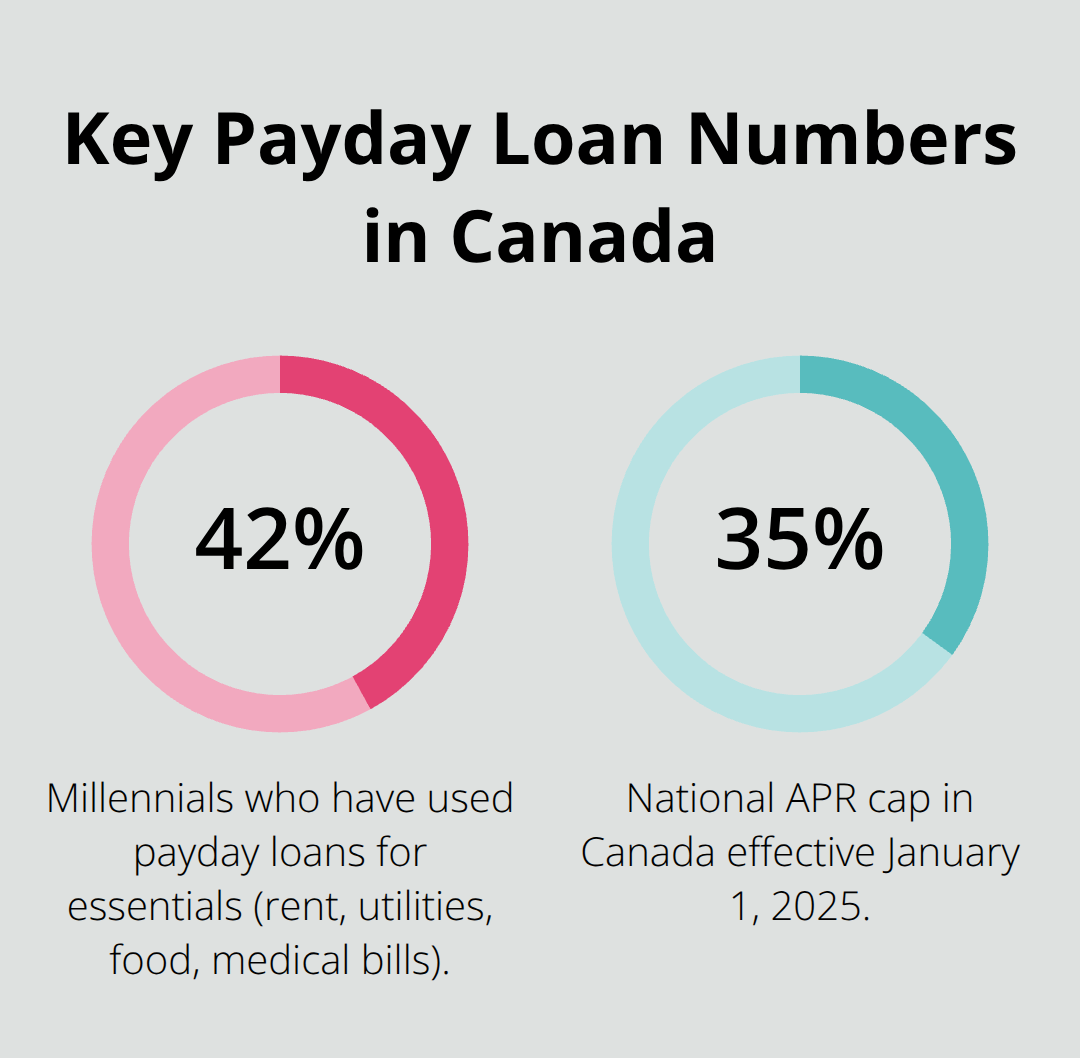
This rollover trap is exactly how people end up trapped in payday loan debt. According to the Global Financial Literacy Excellence Center at George Washington University, 42% of millennials have used payday loans to cover essential expenses like rent, utilities, food, or medical bills, showing how widespread this problem is across younger generations.
Where to Find Payday Lenders
Payday lenders operate through storefronts in most Canadian cities and through online platforms that process applications in hours. Before you borrow from any lender, verify they hold a valid Ontario licence number if you’re in that province, as unlicensed lenders operate illegally. You should be cautious of lead generators that collect your personal information and sell it to multiple lenders, which can result in aggressive contact from companies you never applied to. When you’re ready to apply, ask the lender four specific questions: confirm their licence status, request the total cost of borrowing shown as an APR, ask what costs apply if you miss a payment, and determine whether you qualify for an extended payment plan if you take multiple loans within 63 days. The extended payment plan option (available after three loans within 63 days) spreads repayment over at least three pay periods with a maximum of 35% of the loan plus cost per instalment, giving you breathing room that a standard payday loan doesn’t provide.
What Happens When You Can’t Repay
Missing a payday loan payment triggers consequences that most borrowers don’t anticipate. Lenders cannot contact you more than three times per week or on holidays, and they cannot contact your spouse, family, or friends to collect (Ontario regulations protect you here). If a lender processes a post-dated cheque or pre-authorized debit more than once and it incurs bank fees, you can recover those fees from the lender. A lender cannot charge more than $25 for a dishonoured cheque or pre-authorized debit, and the default interest rate cap is a maximum of 2.5% per month on the outstanding principal. These protections exist because payday lenders have historically used aggressive tactics to collect, but knowing your rights prevents you from falling victim to illegal practices.
Understanding the True Cost of Borrowing
The real danger of payday loans lies in how quickly costs compound. Interest rates on payday loans typically run from 300% to 500% APR when you calculate the fees as an annualized rate-far higher than credit card APRs (which average 15% to 30%) or personal loan rates. A $300 loan that costs $42 in fees might seem manageable, but if you roll it over multiple times, you’ll pay far more in fees than you borrowed in principal. The cost-estimation tool available through the Government of Canada helps you see the end total payoff rather than just the loan principal, which is essential before you commit to borrowing. Understanding these numbers upfront prevents the shock that comes when you realize how much you’ve actually paid.
Now that you understand how payday loans work and what they cost, the next section examines the specific fee structures and hidden costs that vary across provinces-information that will help you compare lenders and identify which ones offer the most transparent pricing.
What You’ll Actually Pay Across Canada
Payday loan costs vary significantly by province, and understanding these differences matters before you borrow. Ontario caps the cost at $14 per $100 borrowed, but this ceiling exists because lenders charged far more before regulations tightened. As of January 1, 2025, federal regulations aligned pricing across provinces by setting the APR at 35% and capping the cost of borrowing at $14 per $100, which means Ontario’s rules now match the national standard. However, this 35% APR figure masks the true annual cost if you borrow short-term: a $300 loan with $42 in fees over two weeks translates to roughly 364% APR when annualized. Dishonoured payment fees are also capped at $20 as of January 2025, down from previous limits.
How Lenders Hide the Real Cost
Most lenders advertise fees rather than APR, which makes direct comparison difficult. When you contact a lender, demand they show you the total cost of borrowing as an APR percentage in writing before you sign anything. This forces transparency and lets you compare one lender against another using the same metric. Many borrowers focus only on the upfront fee ($42 in our example) and ignore the annualized rate, which is exactly how lenders want you to think. If you take three payday loans within 63 days, you automatically qualify for an extended payment plan in Ontario, which allows consumers to repay outstanding loans in installments at no additional charge. This option exists precisely because regulators recognized that multiple short-term loans create a debt spiral, yet most borrowers never ask about it.
What Happens When Payments Fail
The hidden costs emerge when you miss payments or need to extend your loan. If your pre-authorized debit fails and triggers a bank fee, you can recover that fee from the lender (not from your bank), but you need to document it and request reimbursement explicitly. Default interest caps at 2.5% per month non-compounding on the outstanding principal, which seems reasonable until you realize you’re still paying interest on top of the original fee. Some lenders may allow you to pay only the fee to roll over the loan, but this creates the dangerous cycle where you pay repeatedly without reducing what you owe. The Government of Canada provides a cost-estimation tool that calculates exactly what you’ll pay at the end, and using this tool before borrowing prevents the shock that comes later. The tool shows you not just the principal and initial fee, but all accumulated costs including any rollover fees or default interest.
How Payday Loans Stack Up Against Other Credit Options
Compare payday loans against alternatives: a credit card cash advance typically costs 20% to 25% APR plus a 2% to 3% upfront fee, which is substantially cheaper than a payday loan if you can qualify. A personal loan from a bank or credit union runs 8% to 20% APR depending on your credit, making it far superior if you have time to apply. Even an overdraft at your bank costs less than payday lending in most cases. The reality is that payday loans only make financial sense if you cannot access any other form of credit and need the money within hours, not days. Understanding these cost differences positions you to evaluate whether a payday loan truly fits your situation or whether exploring safer alternatives makes more sense. The next section examines the specific risks that trap borrowers in debt cycles and shows you which alternatives actually work when you need fast cash.
Why Payday Loans Trap You in Debt and What Actually Works Instead
The Rollover Cycle That Costs You Hundreds
The debt cycle from payday loans happens faster than most borrowers expect. You borrow $300, pay $42 in fees, and when payday arrives you’re short on cash again. Instead of repaying the full amount, the lender lets you pay just the $42 fee to extend the loan another two weeks. Now you owe $300 plus another $42, and you’re back where you started. This rollover pattern traps people into taking multiple payday loans in a single year, with substantial fees accumulating on the principal. Ontario’s regulations now require lenders to offer an extended payment plan after you take three loans within 63 days, but most borrowers never ask for it because lenders don’t advertise this option. If you qualify, the extended plan spreads repayment over at least three pay periods with a maximum of 35% of the total loan cost per instalment, which gives you real breathing room. The problem is that you’ve already paid substantial fees and damaged your ability to access other credit before you reach this point.
Cheaper Credit Options You Should Explore First
Your alternatives exist and they’re significantly cheaper than payday loans. A cash advance may be a better alternative to a payday loan, though interest rates can still be high. A personal loan from a bank or credit union runs 8% to 20% APR depending on your credit history, and some credit unions specifically help borrowers find solutions beyond payday lending. Contact your bank about overdraft protection before you need it-overdraft fees typically cost $30 to $45 per occurrence, but you pay this only once rather than repeatedly like payday loan fees. The Government of Canada provides a cost-estimation tool that shows you exactly what you’ll pay with any borrowing option, and using this tool forces you to compare payday loans against alternatives side by side.
Non-Borrowing Solutions That Actually Work
If you need emergency cash without borrowing, several paths exist. Contact your employer about cashing out vacation pay, ask family or friends for a short-term loan, or explore whether you qualify for government assistance programs in your province. These options cost nothing and avoid the debt trap entirely. Most people discover they can access cheaper credit or find non-borrowing solutions once they see the actual numbers. The reality is harsh: if you’re borrowing to cover ongoing expenses rather than genuine emergencies, you’re in financial distress, and a payday loan will make that distress worse, not better. A financial wellness counselor (available for free through many organizations) can help you evaluate your specific situation and identify which option actually fits your circumstances.
Final Thoughts
Payday loans in Canada offer speed when you’re desperate, but that speed costs far more than most borrowers anticipate. A $300 loan costs $42 in fees over two weeks, which annualizes to roughly 364% APR, and rolling that loan over three times means you pay $126 in fees on $300 borrowed. This payday loans Canada guide shows you that the real danger isn’t the initial loan-it’s the rollover trap that follows and traps you in repeated borrowing cycles.
The safest approach avoids payday loans entirely by exploring alternatives first. Contact your bank about overdraft protection, explore a personal loan from a credit union, or ask family for help, as these options cost substantially less and don’t trap you in debt. If you’ve already taken payday loans, know your rights: lenders cannot contact you more than three times per week, cannot charge more than $20 for dishonoured payments, and must offer an extended payment plan after three loans within 63 days.
Payday loans only make sense in genuine emergencies when you need cash within hours and have exhausted every other option. Use the Government of Canada’s cost-estimation tool to see exactly what you’ll pay before signing anything, and start building an emergency fund (even $500 prevents the desperation that makes payday loans seem necessary).










Leave a comment