
Borrowing money in Canada means navigating interest rates that shift with the Bank of Canada’s decisions and your personal financial profile. At Financial Canadian, we’ve seen too many people accept the first loan offer without understanding what they’re actually paying for.
Guaranteed loan rates in Canada don’t exist-but the best rates absolutely do, and they’re within reach if you know where to look. This guide walks you through how rates work, what’s happening in today’s market, and exactly how to secure better terms.
How Canada’s Prime Rate Shapes What You Pay
The Bank of Canada’s policy rate forms the foundation of every loan you’ll encounter. As of June 2026, the rate sits at 2.25%, and this single number influences whether your mortgage costs 3% or 7%. The prime rate that banks advertise, currently 4.45% across most of the Big Six banks, is calculated when lenders add a fixed margin to the BoC’s policy rate. When the BoC raises its rate, prime climbs within weeks, and your variable-rate loan costs more immediately. When the BoC cuts, variable rates drop. The Bank of Canada makes eight rate announcements per year, and as of June 2026, it held steady for the fifth consecutive decision, signaling stability through at least mid-July. This matters because it tells you whether to expect rate changes soon or plan for flat borrowing costs. Variable mortgage rates, for example, sit around 3.3% right now because they track prime minus a margin. Fixed rates, by contrast, are priced off government bond yields and currently hover around 4% or higher. That gap exists because fixed rates lock in protection against future rate hikes, while variable rates move with the BoC’s decisions.
Fixed Rates Lock In Your Cost, Variable Rates Move With the Market
Fixed-rate loans charge the same interest for the entire term, whether that’s one year or ten years. Variable-rate loans adjust whenever prime changes, which means your payment could increase or decrease depending on BoC policy. According to Bank of Canada data from March 2026, fixed-rate insured mortgages for three- to five-year terms averaged 3.86%, while variable-rate mortgages sat around 3.79%. Right now, variable rates are substantially cheaper, but that advantage disappears if the BoC raises rates. Your choice depends on risk tolerance.
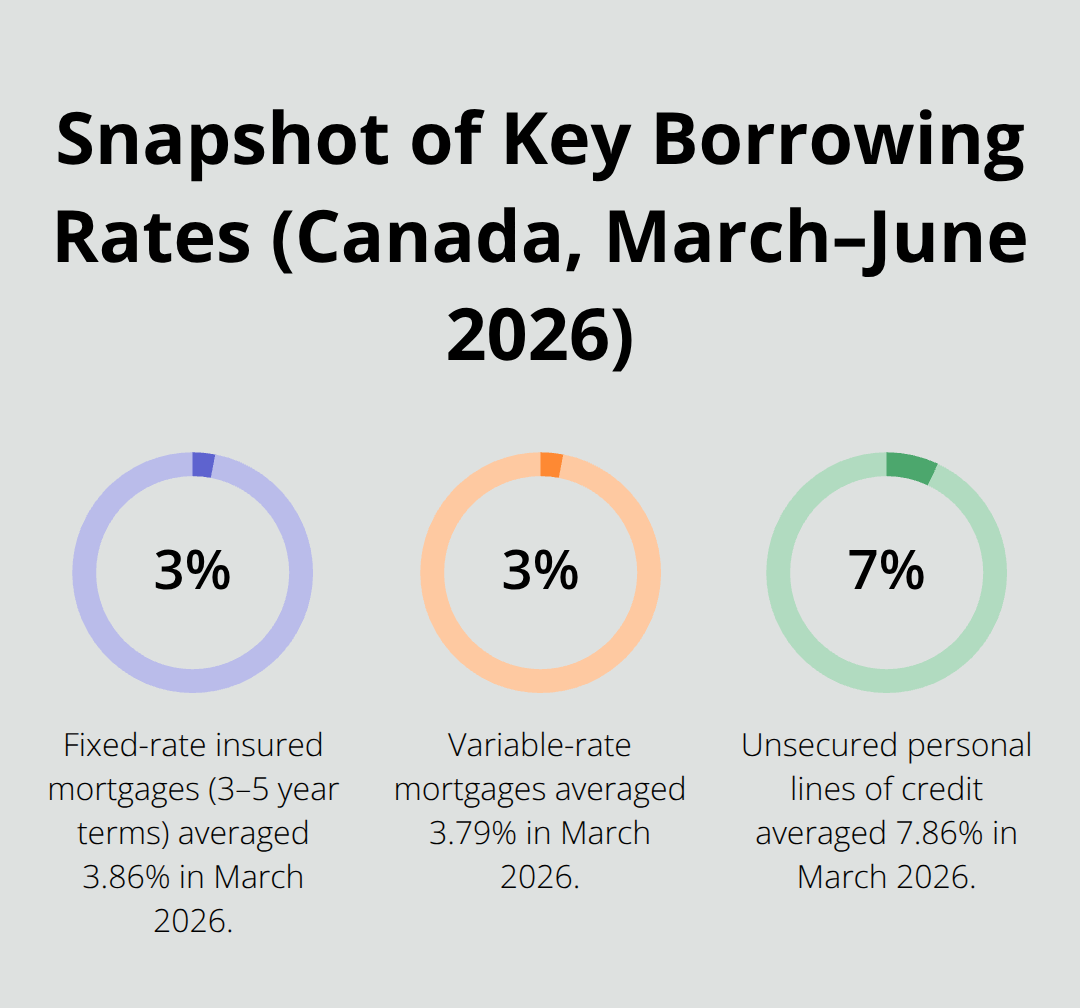
If you expect rates to rise, you can lock in a fixed rate during your pre-approval window to protect yourself, even if rates fall later and you miss out on savings. If rates fall, you can often access a lower rate within the pre-approval window. Personal loans and lines of credit follow the same logic. A secured line of credit charges interest only on what you borrow, making it flexible for unpredictable expenses. Unsecured personal lines of credit averaged 7.86% in March 2026, while secured versions cost about 4.07%. The security reduces risk for the lender, so you pay less. Personal loan plans without collateral averaged 7.69% in March 2026, while auto loans ran about 6.53%. Each product type reflects different risk levels and terms.
Your Credit Profile and Down Payment Size Control Your Actual Rate
Lenders don’t charge everyone the same rate. A credit score of 680 or higher improves your odds of receiving the posted rate or better. Below that, lenders add risk premiums that push your rate up by two, three, or more percentage points. A larger down payment reduces the lender’s exposure if you default, which is why insured mortgages with smaller down payments sometimes cost slightly more than uninsured ones. In March 2026, insured residential mortgages averaged 4.15%, while uninsured averaged 4.19%, a narrow difference that widens when your down payment is smaller. You should pay down existing debt before you apply, as this strengthens your application. Your debt-to-income ratio tells lenders whether you can handle another loan payment. The gap between posted bank rates and actual discounted rates reveals how much room exists to negotiate. Major banks post rates around 6.0% to 6.5% for mortgages, but discounted insured and uninsured rates often run 4.6% to 4.9%. That gap represents thousands of dollars over a mortgage term, and it rewards those who shop around or work with a mortgage broker. Brokers access a wider array of lenders, including B lenders and private lenders, and earn commissions only after the loan closes, aligning their incentive with yours. A few minutes comparing multiple offers can translate into thousands in savings.
Where to Start Your Rate Search
Shopping for rates before you commit to a single lender separates smart borrowers from those who overpay. A mortgage quote requires full pre-approval to lock in a rate; pre-qualification does not lock in a rate. This distinction matters because pre-approval shows lenders you’re serious and gives you a rate window to work within. You can improve your rate by trying for a credit score of 680 or higher, paying down debt, increasing your down payment, and comparing multiple offers. Mortgage brokers can help you navigate this process by accessing lenders that posted bank rates don’t reach. The rate landscape shifts constantly, so what works today may not work next month when the BoC meets again.
What You’ll Actually Pay for Different Loans Right Now
Unsecured vs. Secured Borrowing: The Rate Difference That Matters
Mortgage rates dominate the conversation, but most Canadians borrow for other reasons too. According to Bank of Canada data from March 2026, unsecured personal lines of credit averaged 7.86%, while secured versions cost roughly 4.07%. That difference matters enormously-a secured line of credit cuts your rate nearly in half because the lender holds collateral. Personal loan plans without collateral averaged 7.69% in March 2026, making them expensive for anyone who cannot offer security. Auto loans ran about 6.53% during the same period, sitting between personal loans and lines of credit.

These numbers tell you something critical: the product type and whether you pledge collateral shape your rate far more than shopping alone can fix. If you need cash and have equity in your home or vehicle, a secured product saves thousands compared to an unsecured personal loan. Borrowers often choose unsecured options out of convenience, then wonder why they pay nearly double what secured borrowers pay. The math is straightforward-lenders price risk, and security eliminates most of it.
How Mortgage Term Length Changes Your Rate
Mortgage rates show stark variation by term length. Fixed-rate insured mortgages for three- to five-year terms averaged 3.86% in March 2026, while five-year terms and beyond dropped to 3.96%. Short-term fixed rates tell a different story entirely, with terms under one year hitting 7.92% for insured mortgages. This steep short-term pricing reflects bond-market uncertainty and explains why locking in longer terms makes sense when you plan to stay in your home.
Variable-rate mortgages sat around 3.79% in March 2026, offering the lowest cost available if rates hold steady. The Bank of Canada held its policy rate at 2.25% through June 2026 and signaled stability through mid-July, which means variable-rate borrowers face flat payments in the near term.
Geopolitical Risk and Bond Yields: What Moves Fixed Rates
Geopolitical factors like oil prices and inflation can push bond yields higher without BoC action, raising fixed rates independently. This happened in early 2026 when war-related tensions elevated yields and kept fixed rates elevated despite stable policy rates. You need to understand this distinction because it changes your strategy-if you believe geopolitical risk will persist, variable rates protect you from bond-market shocks that fixed rates cannot avoid.
The choice between fixed and variable rates depends on what you expect to happen next. If bond yields climb due to global tensions, your fixed rate stays locked in while variable-rate borrowers benefit from BoC cuts (if they occur). If the BoC raises its policy rate, variable-rate borrowers pay more immediately while fixed-rate borrowers keep their original payment. Neither option is universally better; your tolerance for payment uncertainty determines which product fits your situation.
How to Improve Your Rate Before You Apply
Fix Your Credit Report and Build Your Score
Your credit score determines whether you qualify for the advertised rate or pay a premium that costs thousands extra. A score of 680 or higher unlocks access to standard rates; anything below that triggers lender risk premiums that push your rate up by two, three, or sometimes four percentage points. A borrower with a 620 score on a $300,000 mortgage pays substantially more over the life of the loan than someone with a 750 score.
Start by pulling your credit report from Equifax or TransUnion and fix errors immediately. Lenders sometimes report late payments that were actually on time, or they list accounts you’ve already closed. Disputing these takes weeks but costs nothing and directly raises your score. After corrections, stop applying for new credit for at least three months before you approach a lender. Each application triggers a hard inquiry that temporarily lowers your score by a few points.
Space Your Rate Inquiries Strategically
Space applications across multiple lenders within two weeks of each other to minimize impact, as credit bureaus treat rate shopping as a single inquiry when it happens in a short window. This approach lets you compare offers without damaging your score repeatedly.
Pay down existing debt aggressively in the months before you apply. Your debt-to-income ratio tells lenders whether you can handle another payment, and reducing what you already owe improves this ratio dramatically. A $5,000 payment toward an existing loan reduces your monthly obligations and strengthens your application far more than waiting to save a larger down payment. If you plan to borrow within six months, make every payment on time and focus on paying down existing debt to boost your score before you apply.
Compare Multiple Lenders and Negotiate Terms
Shopping for rates across multiple lenders is non-negotiable, yet most borrowers call one bank, get quoted, and accept the offer. Major banks post rates around 6.0% to 6.5% for mortgages, but the actual discounted rates they offer qualified borrowers often sit at 4.6% to 4.9%-a gap that represents tens of thousands of dollars over a twenty-five-year term.
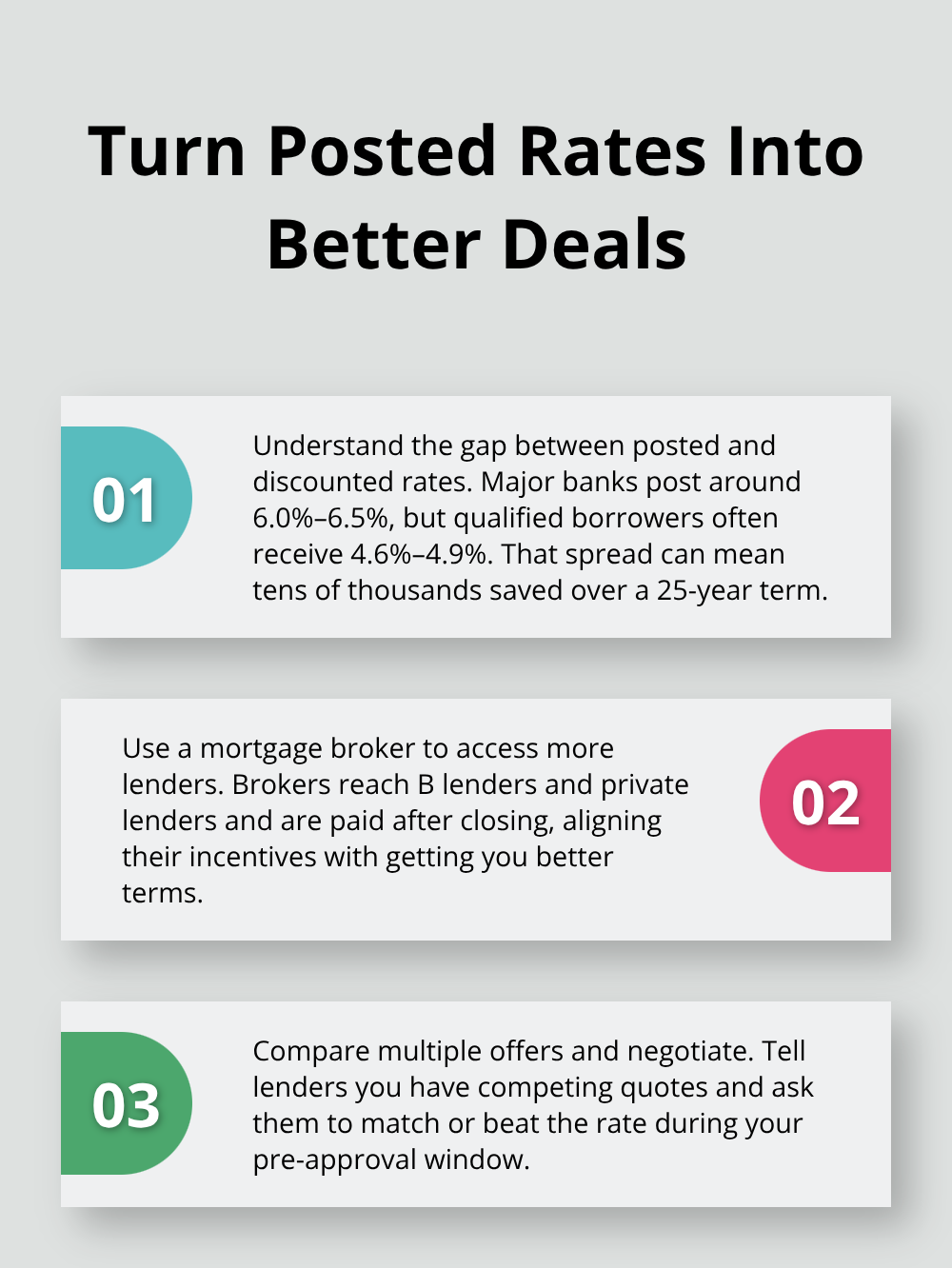
Mortgage brokers access a wider array of lenders, including B lenders and private lenders that posted bank rates never reach, and they earn commissions only after your loan closes, meaning their incentive aligns with getting you the best possible terms. Comparing multiple offers takes a few hours and translates into real savings.
Secure Your Rate Lock and Explore Collateral Options
Get pre-approved rather than pre-qualified, because pre-approval locks in your rate for a specific window (typically thirty to one hundred twenty days) while pre-qualification is just a preliminary assessment with no rate guarantee. During your pre-approval window, you can negotiate directly with lenders. Tell them you have competing offers and ask if they’ll match or beat the rate. Many will, because losing a deal costs them more than shaving a quarter-point off your rate.
If you’re borrowing for a vehicle or personal loan instead of a mortgage, the same principle applies: secured products cost substantially less than unsecured ones. A secured line of credit at 4.07% beats an unsecured personal loan at 7.69% if you have collateral available. The difference adds up to thousands in interest charges over the life of the loan, making it worth the effort to explore security options before defaulting to convenience.
Final Thoughts
Guaranteed loan rates in Canada don’t exist, but the rates you receive depend entirely on the effort you invest before you apply. The difference between accepting the first offer and shopping around translates into thousands of dollars saved over your loan’s life. Your credit score, down payment size, collateral options, and lender choice matter far more than hoping for better terms.
Pull your credit report and fix errors that drag your score down, then pay down existing debt aggressively in the months before you borrow. Space your rate inquiries strategically across multiple lenders within a two-week window to minimize credit score damage, and get pre-approved rather than pre-qualified so you lock in a rate window. When you’re ready to apply, compare offers from at least three sources-major banks post rates around 6.0% to 6.5%, but their actual discounted rates often sit at 4.6% to 4.9%.
Mortgage brokers access lenders that posted rates never reach, and their commission structure means they benefit when you get better terms. For personal loans and lines of credit, always ask whether you can pledge collateral, because secured products cost roughly half what unsecured borrowing costs. Explore resources at Financial Canadian to help you structure your borrowing strategy and make informed financial decisions.











Leave a comment