
When you need cash fast, personal loans Canada online offer a straightforward way to get funds without the lengthy bank visits. We at Financial Canadian know that traditional lending can feel slow and complicated, which is why online lenders have become a game-changer for Canadian borrowers.
In this guide, we’ll walk you through how online personal loans work, compare top lenders, and show you exactly how to find the right fit for your financial situation.
How Personal Loans Work in Canada
Personal loans in Canada come in two main structures: unsecured loans and secured loans. Unsecured loans require no collateral, which means you access funds faster but pay higher interest rates. Secured loans tie your borrowing to an asset like your vehicle, which lowers your rate but puts that asset at risk if you default. You can borrow between $100 and $200,000 depending on your income and credit profile, according to Ratehub data. The loan amount you qualify for directly correlates with your income level and existing debt obligations-lenders assess your debt-to-income ratio to determine how much you can safely carry.
Fixed vs. Variable Rates Shape Your Monthly Budget
Fixed-rate loans keep your monthly payment constant throughout the term, which makes budgeting predictable. Variable-rate loans move with Bank of Canada policy changes, so your payment can shift if rates rise or fall. Most Canadian lenders offer terms ranging from 1 to 7 years, and shorter terms mean you pay less interest overall but accept higher monthly payments.
Interest Rates Vary Widely Based on Your Credit Profile
Current personal loan APRs in Canada range from 6% to 35% depending on credit score, income stability, and lender type. Prime lenders like Scotiabank charge 6%–10%, while BMO sits at 8.99%–22.99% and TD at 8.99%–23.99%. Online lenders and peer-to-peer platforms like Spring Financial offer 9.99%–34.95% and goPeer at 8.99%–34.99%.
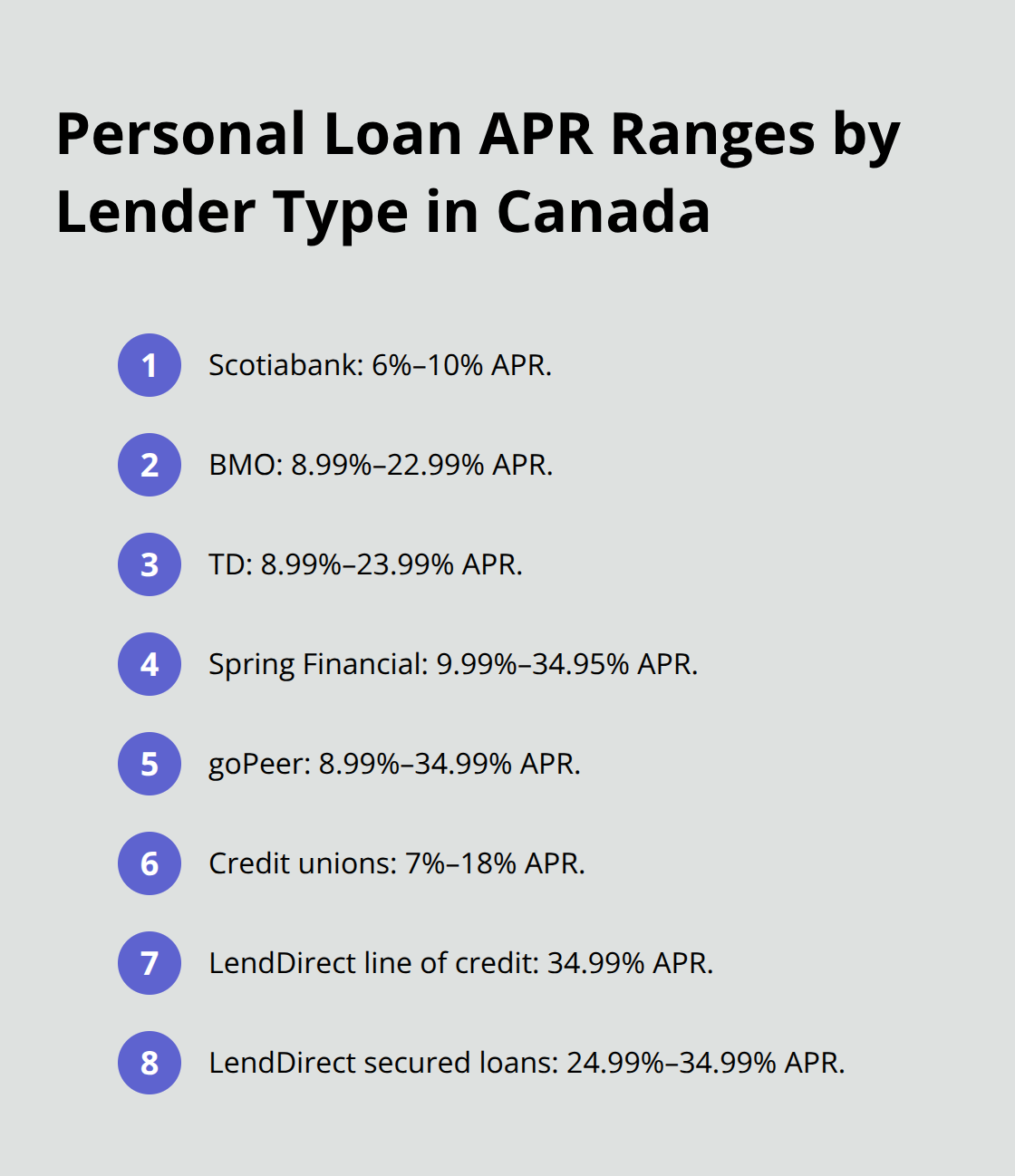
The difference between a 7% rate and a 25% rate on a $10,000 loan over five years amounts to roughly $4,500 in extra interest-so your credit score genuinely matters. A minimum credit score around 600 qualifies you for reasonable rates; lower scores still receive approval but pay significantly more. Check your score free with Equifax Canada or TransUnion Canada before you apply. Beyond interest, origination fees typically range 0.5%–8% of the loan amount and either get added to your balance or deducted from your disbursement. When you compare lenders, always focus on APR rather than just the nominal interest rate, since APR includes both interest and fees-this gives you the true cost of borrowing.
The Approval Process Moves Faster Than You Expect
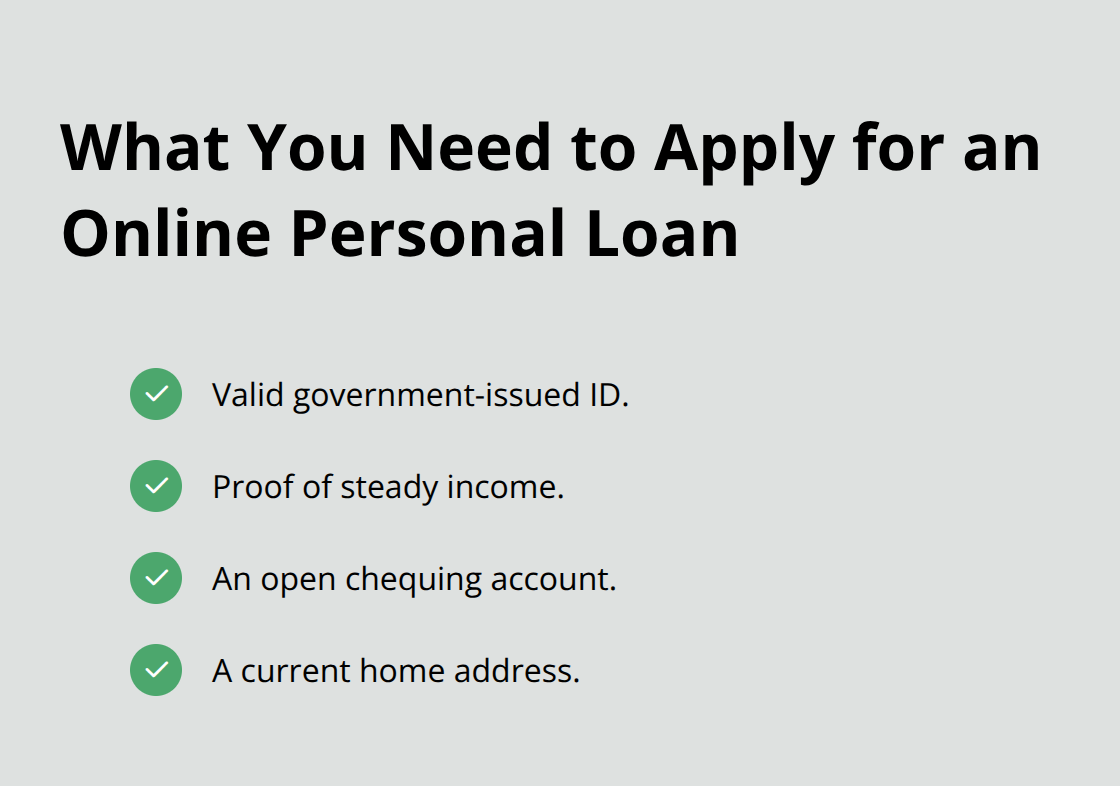
Online lenders deliver personalized quotes in roughly 60 seconds using soft credit inquiries that don’t harm your score, according to Ratehub. Most funded borrowers receive instant approvals with minimal paperwork after they complete the application and accept an offer. The hard credit inquiry that triggers final approval may cause a small temporary score dip, but on-time repayments rebuild your credit history quickly. You’ll need to provide valid ID, proof of steady income, an open chequing account, and a home address. Funds typically arrive within 24 hours after approval and signing, with some lenders offering deposits in as little as 15 minutes.
Traditional banks take 48 hours or longer for lending decisions and require branch visits for secured loans. Most personal loans allow prepayment without penalties, which lets you pay off debt faster and save on interest-but verify this before you sign since some lenders restrict early repayment.
Common Uses Drive Loan Demand Across Canada
Canadians use personal loans for home renovations, debt consolidation, moving costs, weddings, vacations, and other needs. Home renovations often benefit from personal loans because they offer a lump sum with fixed payments, frequently faster than refinancing a mortgage or using a HELOC. Debt consolidation loans can simplify multiple payments into one monthly bill, though you should compare total costs to balance transfers or lines of credit before you commit. Understanding your specific need helps you choose between a personal loan and alternative financing options as you move forward with your borrowing decision.
Why Online Personal Loans Beat Traditional Banks on Speed and Cost
Speed Transforms Your Borrowing Timeline
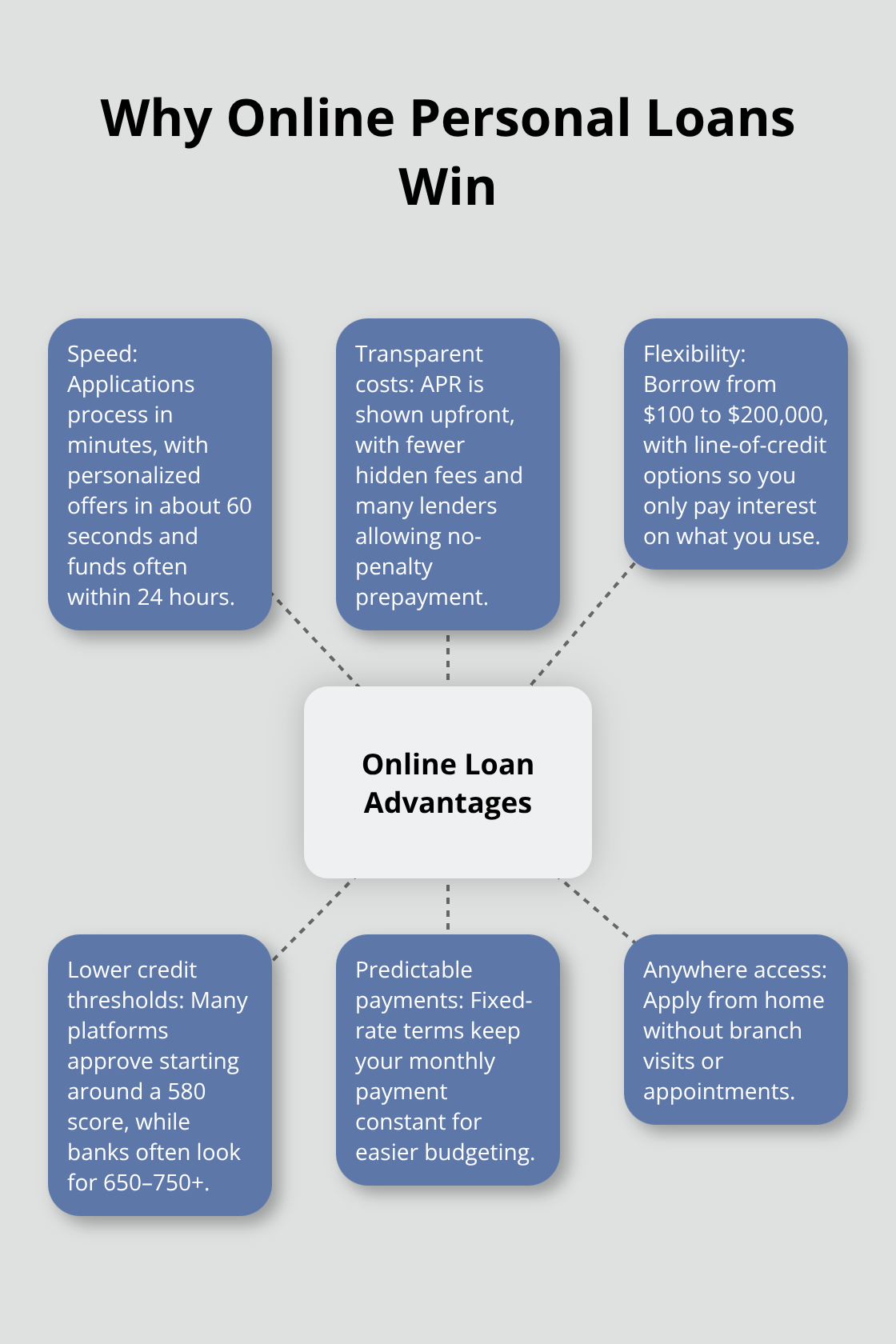
Online lenders process applications in minutes rather than days, which matters when you need cash immediately. According to Ratehub, platforms like LoanFinder deliver personalized offers in about 60 seconds using soft credit inquiries that don’t affect your credit score. You can complete the entire application from home without scheduling branch appointments or sitting across from a loan officer. Most funded borrowers receive instant approvals after completing their application, and funds arrive within 24 hours-some lenders deposit money in as little as 15 minutes via Interac e-Transfer. Traditional banks typically require 48 hours or longer for lending decisions and force you into branches for secured loans, which wastes your time when speed matters most.
Transparent Costs Save You Thousands
The cost advantage is equally compelling. Online lenders offer interest rates from 5.96% to 35.99% according to market data, but many online platforms charge no hidden fees and allow prepayment without penalties. Traditional banks often bundle fees into their APR, making total costs harder to compare upfront. When you borrow $10,000 at 10% APR with a 2% origination fee, you pay roughly $100 in upfront costs plus interest-whereas a traditional bank might hide that fee in a higher rate that costs you more over time. Online lenders also disclose APR upfront so you see the true cost of borrowing including all fees, whereas traditional banks sometimes present only the nominal interest rate. When comparing a 7% rate to a 25% rate on a $10,000 five-year loan, the difference totals roughly $4,500 in extra interest-so comparing APRs rather than nominal rates prevents costly mistakes.
Flexibility Matches Your Real Needs
Online lenders offer borrowing flexibility that banks rarely match. You can access amounts ranging from $100 to $200,000 depending on your income and credit profile, according to Ratehub. Some platforms like LendDirect provide lines of credit up to $10,000 where you borrow only what you need and pay interest solely on the amount you use, then reborrow after repayment without reapplying. This flexibility beats fixed-term loans when your needs are uncertain or evolving.
Lower Credit Score Requirements Open Doors
The approval standards at online lenders also work in your favor compared to brick-and-mortar banks. A minimum credit score of 580 qualifies you for approval at most online platforms, whereas traditional banks often require 650 or higher. If your score falls below 600, online lenders still approve applications but at higher rates-typically between 20% and 35% APR according to Ratehub data. You maintain budget predictability because most online lenders offer fixed-rate terms where your monthly payment never changes, unlike variable-rate options that shift with Bank of Canada policy decisions. Upstart, which connects borrowers to over 100 regulated lenders, serves more than 4 million borrowers with a 4.9-star app rating from roughly 34,000 user reviews, demonstrating that speed and simplicity resonate with Canadian borrowers.
What This Means for Your Next Steps
These advantages position online lenders as the faster, more transparent choice for most borrowers. The real question becomes which specific lender matches your financial profile and borrowing timeline-a decision that depends on comparing rates, terms, and approval speed across multiple platforms.
Which Lenders Actually Deliver the Best Rates
Upstart connects you to over 100 regulated lenders
Upstart stands out among online platforms because it connects you to over 100 regulated lenders rather than lending directly, which means you access competitive quotes from multiple institutions simultaneously. The platform serves more than 4 million borrowers with a 4.9-star rating across roughly 34,000 app reviews, demonstrating real user satisfaction beyond marketing claims. Loan amounts range from $200 to $75,000 with fixed-rate terms, and you can check your rate in minutes using a soft inquiry that doesn’t touch your credit score. Most funded borrowers receive instant approvals with minimal paperwork, and funds arrive within 24 hours after signing. The marketplace model matters because you’re not locked into a single lender’s terms-you see personalized offers tailored to your financial profile before you commit.
LendDirect Offers Secured Loans for Lower Rates
LendDirect operates differently than Upstart by offering both a line of credit up to $10,000 and secured loans up to $25,000 backed by your vehicle. Their line of credit charges 34.99% APR while secured loans range from 24.99% to 34.99% depending on verification, and you access funds in roughly 15 minutes via Interac e-Transfer or direct deposit. The secured loan option works best if you own a vehicle outright and need larger amounts than unsecured lending provides-the collateral typically qualifies you for lower rates than unsecured alternatives.
Traditional Banks Offer Limited Advantages for Most Borrowers
Traditional banks like Scotiabank, BMO, and TD now offer online applications alongside branch services, but their rate advantage disappears when you compare total costs. Scotiabank charges 6%–10% APR, BMO ranges 8.99%–22.99%, and TD sits at 8.99%–23.99%, yet these rates apply only to borrowers with excellent credit scores above 750. If your score falls below 700, bank rates climb dramatically toward online lender territory, which eliminates any cost benefit. Credit unions represent a middle ground-they typically offer rates between 7% and 18% APR depending on membership and creditworthiness, but approval timelines stretch to 5–7 business days compared to online platforms that deliver funds within 24 hours.
Peer-to-Peer Lenders Fill the Gap for Rejected Borrowers
Spring Financial and goPeer provide peer-to-peer lending at 9.99%–34.95% and 8.99%–34.99% APR respectively, which works well if you’ve been rejected by traditional lenders but need to avoid the highest-rate options. These platforms accept borrowers with lower credit scores and offer faster approvals than credit unions, though rates remain higher than what banks charge to their best customers. The trade-off between speed and cost becomes clear when you compare personal loan rates across lenders-you sacrifice lower rates to gain faster access to cash.
Final Thoughts
Choosing the right personal loan depends on matching your financial profile to the lender that offers the best combination of speed, cost, and flexibility. Personal loans Canada online have fundamentally changed how Canadians access credit by eliminating branch visits and cutting approval timelines from days to hours. When comparing lenders, focus on APR rather than nominal interest rates since APR includes both interest and fees and shows you the true cost of borrowing.
Check your score free with Equifax Canada or TransUnion Canada before applying, and try for a minimum of 600 to qualify for reasonable rates. A $10,000 loan at 7% APR costs roughly $4,500 less in interest over five years than the same loan at 25% APR, so your credit score genuinely matters. If your score falls below 700, online lenders often beat traditional banks because bank rates climb dramatically while online platforms maintain competitive pricing across credit profiles.
Start your loan search today by gathering quotes from multiple platforms and comparing total costs rather than just interest rates. Upstart connects you to over 100 regulated lenders simultaneously, LendDirect offers secured loans for lower rates if you own a vehicle, and traditional banks work only if your credit score exceeds 750. We at Financial Canadian provide resources and guidance to help you navigate your borrowing options and choose the lender that matches your timeline and budget.










Leave a comment