
Personal loan rates in Canada vary significantly depending on your lender and credit profile. Getting the right rate matters because it directly affects how much you’ll pay over the life of your loan.
At Financial Canadian, we’ve created this guide to help you understand what influences your rates and how to build a budget that works with your loan payments. The strategies here will show you how to secure better terms and manage your finances smartly.
Personal Loan Rates in Canada: What You’ll Actually Pay
Canadian personal loan rates span a wide range depending on which lender you approach and your financial profile. Major banks charge between 6% and 23.99% in annual percentage rate (APR). CIBC sits at the lower end with rates around 9% to 10%, while BMO and TD range from 8.99% to 22.99% and 8.99% to 23.99% respectively. Online lenders and alternative providers push rates higher, often into the 30% to 46% range, though some promotional offers claim rates as low as 0%-these teaser rates typically come with restrictions you need to understand before committing. The federal government set a criminal interest rate cap at 35% APR as of June 2024, which creates the ceiling for all lenders in Canada. The difference between a 6% rate and a 20% rate on a $20,000 loan over five years amounts to thousands of dollars in extra interest, so shopping around isn’t optional-it’s essential.
Your Credit Score Matters Most
Your credit score is the first thing lenders examine, and most want to see a score around 600 or higher to offer reasonable terms. Check your credit reports with Equifax Canada or TransUnion Canada before applying anywhere, since errors on your report can cost you percentage points. Your debt-to-income ratio comes second; lenders calculate what portion of your gross income already goes toward debt payments, and lower ratios unlock better rates because you appear less risky. Income stability matters too-lenders want proof you can handle new debt alongside existing obligations.
How to Lower Your Rate
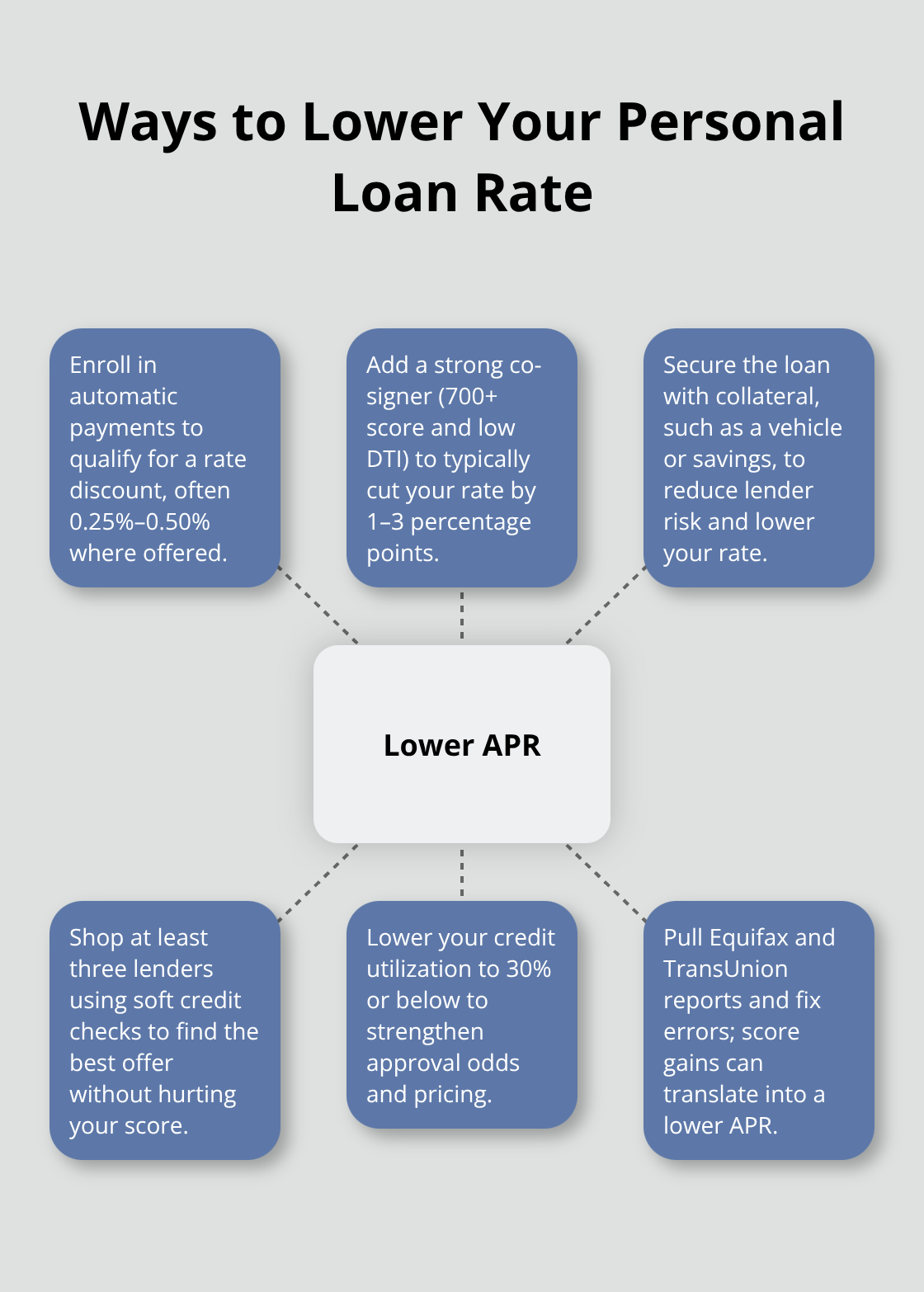
Some lenders offer discounts for automatic payment enrollment, which can trim your rate by 0.25% to 0.50%. If you have a co-signer with strong credit or can secure the loan with collateral like a vehicle, you’ll access lower rates than unsecured borrowing. Origination fees typically range from 0.5% to 8% of your loan amount and get added to your balance or deducted upfront, so factor these into your total cost when comparing offers.
Fixed Rates Lock In Your Payment; Variable Rates Shift With Prime
Fixed-rate loans lock in the same payment every month for your entire term, which makes budgeting predictable and protects you if the Bank of Canada raises its prime rate. Variable-rate loans tie your payments to the prime rate, so when the BoC changes rates, your monthly payment shifts. The Bank of Canada held the overnight rate at 2.25% on April 29, 2026, signaling a pause in rate cuts. This matters because variable-rate products at major banks like CIBC tie directly to the prime rate, meaning your costs can rise or fall without warning. If you value certainty in your monthly budget, fixed rates win every time. If you believe rates will fall and you can handle payment swings, variable rates offer potential savings-but that’s speculation, not a guarantee.
Now that you understand what rates look like and what controls them, the next step is to figure out how much you can actually afford to borrow and how a loan payment fits into your existing financial life.
What Fits Your Budget When You Borrow
Calculate Your Exact Monthly Payment
A personal loan payment that looks affordable on paper can strangle your finances if you haven’t stress-tested it against your real spending. The math sounds simple: divide the loan amount by the number of months in your term, add interest, and you have your monthly payment. Reality is messier. You need to know what that payment actually costs you when combined with rent, groceries, insurance, and the dozen other obligations competing for your paycheque.
Start with a loan calculator from your lender-most banks provide these tools online. For a $20,000 loan at 10% APR over five years, your payment lands around $424 per month. Over seven years at the same rate, it drops to $317 monthly. The temptation to stretch your term is real, but extending from five to seven years adds roughly $2,400 in total interest on that same $20,000 loan. The question isn’t what payment you can squeeze into your budget; it’s what payment leaves you breathing room for emergencies and prevents you from maxing out credit cards the moment your car needs repairs.
Test Your Debt-to-Income Ratio
Your debt-to-income ratio determines whether lenders approve you, but your actual DTI after taking the loan determines whether you’ll stay afloat. Calculate your total monthly debt payments-credit card minimums, car loans, mortgage, student loans-then add your new loan payment. Divide that sum by your gross monthly income. Lenders typically want to see this ratio below 40%, but try aiming for 35% or lower if you have irregular income or dependents.
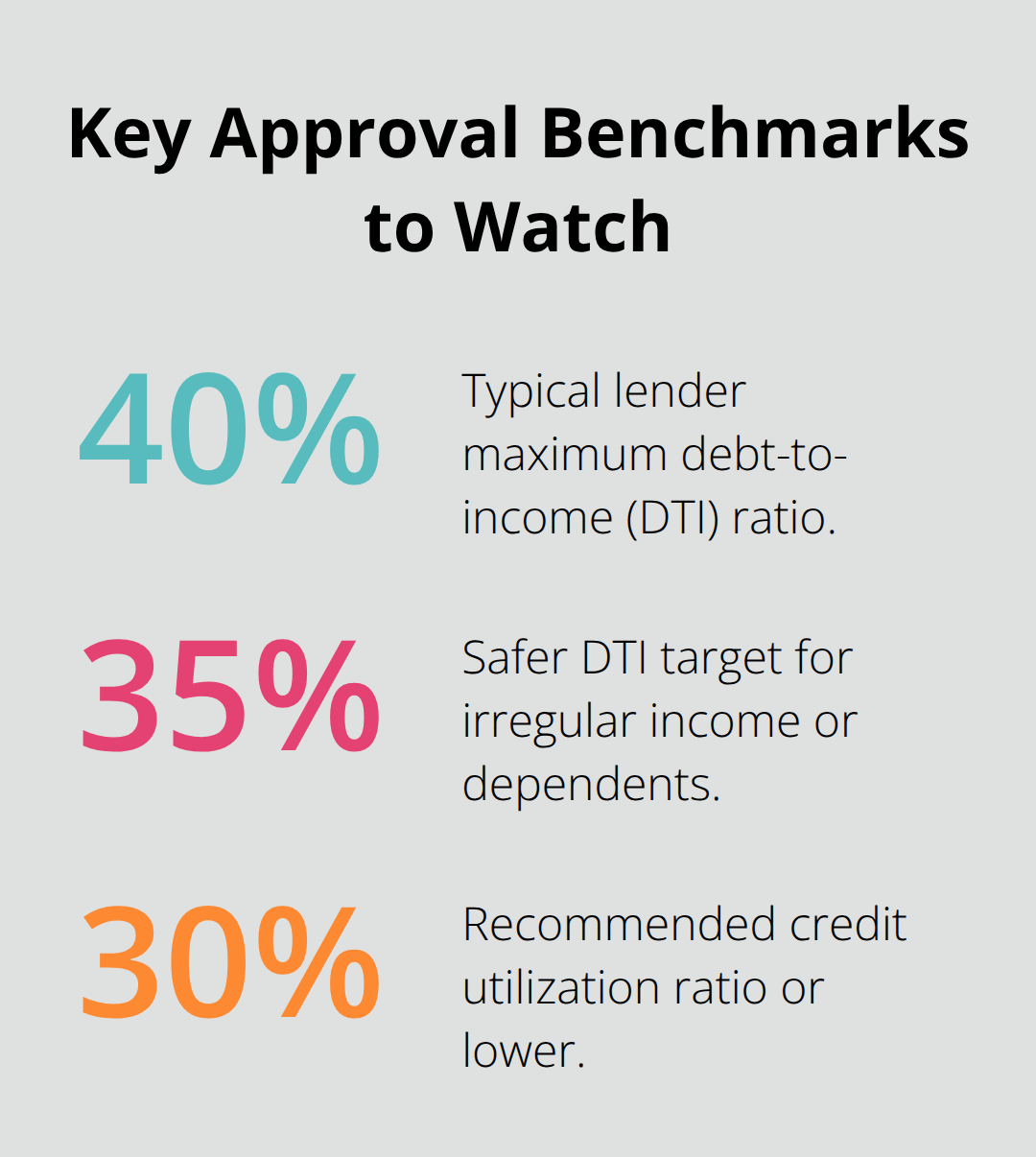
If you earn $4,000 monthly and your debts total $1,200, adding a $424 loan payment pushes you to $1,624 divided by $4,000, which is 40.6%-technically within range but dangerously tight. One missed shift or unexpected expense tips you into trouble. Build a month-by-month spending tracker for three months before applying to see where your money actually goes. Most people discover they spend 15–25% more than they think on groceries, subscriptions, and small purchases. Once you spot these leaks, plug them before taking on new debt.
Secure Your Payment and Plan for Worst-Case Scenarios
Some lenders offer discounts for automatic payment enrollment, so set up automatic transfers on payday to guarantee you never miss a payment and secure that rate reduction. After you’ve confirmed the payment works, run a worst-case scenario: what happens if your hours drop, you face a medical bill, or your heating bill spikes? If you can’t cover three months of loan payments from savings or reduced spending, the loan is too large.
The next step involves taking action to lower your interest rate before you apply-and that starts with your credit score.
How to Raise Your Credit Score and Lock in Better Rates
Pull Your Credit Reports and Fix Errors
Your credit score is the single fastest way to lower your rate, and waiting three to six months to improve it before applying can save you thousands in interest. Lenders use your score as the primary filter, and the difference between a 600 score and a 750 score can mean a 5–10% difference in your APR. Pull your credit reports from Equifax Canada and TransUnion Canada right now-most Canadians find errors that drag their scores down. Dispute any inaccurate accounts, late payments, or inquiries you didn’t authorize. These corrections take 30–45 days but they’re free and often yield immediate score improvements.
Lower Your Credit Utilization Ratio
Your credit utilization ratio accounts for about 30% of your score. If you carry balances on credit cards, lower your credit utilization ratio to at or below 30% of your limits to signal financial control to lenders. A $5,000 credit card limit with a $4,500 balance screams risk; the same card with a $1,400 balance tells a different story. Pay down high-balance cards aggressively over the next two to three months. Set up automatic minimum payments on all accounts to eliminate late payments entirely-a single 30-day late payment can drop your score by 100 points and stay on your report for six years. If you have no credit history or a thin file, become an authorized user on someone else’s account with perfect payment history to boost your score within weeks.
Shop Around With Soft Credit Checks
Once your score sits above 650, you qualify for rates in the 9–12% range at major banks like CIBC, BMO, and Scotiabank instead of the 18–24% range reserved for lower scores. Rate quotes use soft credit checks that don’t damage your score. Contact at least three lenders and request rate quotes before accepting any offer. Scotiabank quotes come back within hours online, and CIBC lets you check rates through their website without a hard inquiry. Write down each APR, the origination fee percentage, and any available discounts.

A lender offering 10% APR with a 2% origination fee costs more than 9.5% APR with a 0.5% fee on the same loan amount-APR is what matters.
Add a Co-signer or Secure Your Loan
If you have access to a co-signer with a credit score above 700 and a debt-to-income ratio below 35%, add them to your application to typically lower your rate by 1–3 percentage points. A secured loan backed by your vehicle or savings account also reduces your rate because the lender’s risk drops-you offer collateral they can seize if you stop paying. Secured loans run 2–4 percentage points lower than unsecured options, but only pursue this route if you’re confident in your ability to repay, because missing payments costs you your collateral.
Final Thoughts
Smart personal loan budgeting starts with understanding what you can actually afford, not what lenders will approve. The strategies we’ve covered-calculating your real monthly payment, testing your debt-to-income ratio, and improving your credit score before applying-work together to lower your costs and protect your financial stability. Personal loan rates in Canada range from 6% to 46% depending on your lender and profile, which means the difference between a good decision and a costly mistake can be thousands of dollars over your loan term.
Pull your credit reports from Equifax Canada or TransUnion Canada and dispute any errors you find. While those corrections process, contact at least three lenders for rate quotes using soft credit checks-CIBC, Scotiabank, and BMO all offer online quote tools that won’t damage your score. Write down each APR, origination fee, and available discounts, then compare the true cost of each offer rather than just the advertised rate.
Once you’ve selected a lender, set up automatic payments on payday to lock in any available discounts and guarantee you never miss a payment. Run your worst-case scenario one final time: can you cover three months of loan payments if your income drops or an emergency hits? At Financial Canadian, we provide resources and tools to help you manage your finances effectively and make confident decisions about personal loans.










Leave a comment