
Your credit score determines whether lenders approve you for mortgages, car loans, and credit cards-and at what interest rate. In Canada, Equifax and TransUnion calculate your score based on payment history, credit utilization, and other factors that directly impact your financial opportunities.
We at Financial Canadian have created this guide to show you exactly how to build and maintain a stronger rating. The practical moves ahead work whether you’re starting from scratch or recovering from past setbacks.
How Equifax and TransUnion Calculate Your Score
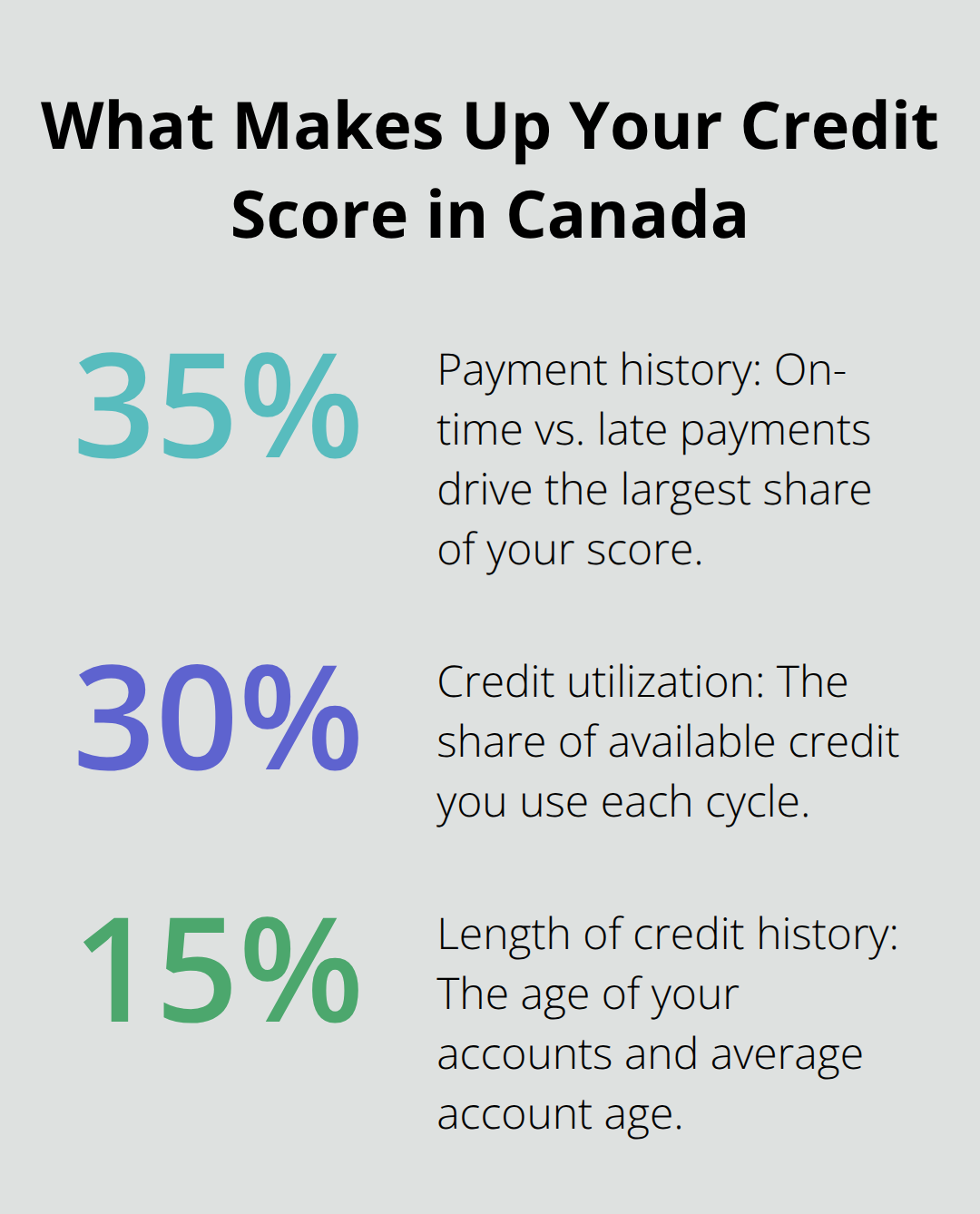
Equifax and TransUnion are Canada’s two primary credit bureaus, and they calculate your score using data from your credit accounts and payment history. Your score ranges from 300 to 900, with higher scores opening doors to better interest rates and faster loan approvals. Payment history accounts for roughly 35% of your score, which means a single late payment can damage your rating for years. Credit utilization-the percentage of available credit you actually use-makes up about 30% of your score. The remaining factors include length of credit history (15%), credit mix (10%), and new credit inquiries (10%). This breakdown tells you exactly where to focus your efforts for the fastest improvements.
Payment History is Your Foundation
Late payments stay on your credit report for six years in Canada, and even one missed payment can drop your score by 50 to 100 points. Setting up automatic payments is non-negotiable if you want to build credit quickly. If you’ve already missed a payment, contact your lender immediately to negotiate a repayment plan or request late-payment relief. Paying off a collection account won’t erase it from your report, but newer scoring models increasingly ignore paid collections, so the effort still pays off. Consistency matters far more than perfection-lenders want to see a pattern of on-time payments over months, not a single perfect month followed by missed payments.
Credit Utilization Requires Strategic Action
Try keeping your credit utilization below 30%, though top scorers typically operate below 10%. Research shows that utilization directly influences your score, so this isn’t theoretical. If your current balances are too high, you have two immediate options: pay down your balances before your statement closes (since reporting happens around the end of your billing cycle), or request a credit limit increase. A higher limit lowers your utilization ratio instantly without requiring you to pay down debt, though you’ll need the discipline to avoid spending more. The 15/3 trick works exceptionally well here-pay roughly half your balance 15 days before your statement closes, then pay the remaining balance about 3 days before. This approach keeps your reported balance artificially low while you work toward paying everything off.
Timing Your Payments for Maximum Impact
Your lenders report information to the bureaus around the end of your billing cycle, which means the balance they report depends on when you make your payments. Paying multiple times throughout your month reduces the balance that appears on your credit report. If you charge $2,000 on a card with a $5,000 limit but pay $1,500 before the reporting date, the bureaus see a $500 balance instead of $2,000. This single tactic can shift your utilization from 40% to 10% without changing your actual debt level. The timing advantage disappears only when you’ve paid off your balances completely, so this strategy works best as a bridge while you eliminate debt.
Building Your Path Forward
These three factors-payment history, utilization, and reporting timing-form the foundation of credit improvement in Canada. Most people see meaningful score improvements within 1 to 3 months after addressing high-impact moves like reducing utilization and establishing on-time payments. Your next step involves identifying which of these areas needs the most attention in your specific situation, then applying the right strategy to move forward.
How to Actually Improve Your Credit Score This Month
Set Up Automatic Payments First
Automatic payments eliminate the biggest threat to your credit rating. You should set them up today for at least your minimum payment, and your payment history drives 35% of your score-becomes nearly impossible to damage. Late payments destroy credit fast; even a single missed payment can drop your score by 50 to 100 points and stay on your report for six years in Canada. If you’ve already missed one, call your lender immediately. Many will negotiate a repayment plan or offer late-payment relief, especially if you contact them before the account goes to collections. Paying off a collection account won’t remove it from your record, but modern scoring models increasingly ignore paid collections, so the effort still produces real results.
Reduce Your Reported Balance Before Statement Close
The second actionable move is reducing your reported balance before the statement closes, since that’s when lenders report to Equifax and TransUnion. If you carry $3,000 on a $10,000 card, you’re reporting 30% utilization-acceptable but not optimal. Pay $2,000 before reporting day, and suddenly you’re at 10% utilization, even though you haven’t eliminated the debt. This timing advantage works because the bureaus only see what lenders report at month-end, not your actual balance throughout the cycle. The 15/3 trick amplifies this effect: pay roughly half your balance 15 days before your statement closes, then pay the remainder 3 days before. This keeps your reported balance artificially low while you work toward elimination.
Dispute Errors on Your Credit Report
Incorrect information directly damages your score, which makes disputing errors more important than most people realize. You should access your free credit reports from Equifax and TransUnion and check them thoroughly for inaccuracies-wrong payment dates, accounts you didn’t open, or balances that don’t match your records. The bureaus typically investigate disputes within 30 to 45 days, and correcting errors can yield quick score improvements. File disputes immediately rather than waiting when you spot mistakes.
Handle New Credit Applications Strategically
You should treat new credit applications with caution because each hard inquiry temporarily dips your score, and opening multiple accounts in a short period signals risk to lenders. If you’re planning a major purchase like a car or home, space out applications and use prequalification when possible to avoid multiple hard inquiries. When you absolutely need to build credit mix by adding a new account, do it strategically-one account at a time, with months between applications. New accounts also reduce your average account age, which affects the 15% of your score tied to credit history length. The damage from new credit is temporary, typically fading within 3 to 6 months, but it’s avoidable if you plan ahead.
What Happens Next
Most people see meaningful improvements within 1 to 3 months after tackling payment history and utilization, so you should focus on these high-impact moves first before adding complexity. Once you’ve established consistent on-time payments and reduced your utilization, you’re ready to explore credit-building strategies tailored to your specific situation-whether you’re recovering from past setbacks or building credit from scratch as a new Canadian.
Credit-Building Strategies for Your Situation
Rebuilding Credit After Missed Payments
Rebuilding credit after missed payments requires aggressive action on two fronts: establish new positive payment history while managing what’s already on your report. Late payments stay visible for six years in Canada, but their impact weakens significantly after 24 months of on-time payments. Start by setting up automatic payments immediately, then focus on reducing credit utilization below 10% if possible. The combination of perfect payment history plus low utilization can improve your score by 50 to 100 points within three months, according to credit scoring research. If you have collection accounts, paying them off won’t erase them, but newer FICO models increasingly ignore paid collections, so the effort produces measurable results even if the negative item remains visible.
Contact your creditors directly before accounts reach collections-many offer hardship programs or will accept partial settlements that stop further damage. Consider using a secured credit card with your deposit becoming your credit limit; this approach rebuilds history faster than waiting for old negative items to age off. The secured card must report to all three bureaus (Equifax, TransUnion, and Experian) to be effective, so verify this before applying.
Building Credit From Scratch as a New Canadian
Building credit from scratch as a new Canadian faces different obstacles than rebuilding damaged credit. You lack the account history that lenders use to assess risk, which means traditional credit cards reject most new arrivals. Start with a secured credit card requiring a cash deposit, typically $500 to $2,500, which becomes your credit limit. Use this card for small recurring charges like a streaming subscription, then pay the full balance automatically each month. After 6 to 12 months of perfect payment history, many issuers graduate you to an unsecured card and return your deposit.
Simultaneously, explore rent reporting and utility payment reporting services like Experian Boost, which add your on-time housing and utility payments to your credit file. These services can produce measurable score improvements within 30 to 45 days since they demonstrate reliable payment behavior across multiple accounts. A credit-builder loan offers another path: you borrow money that sits in a locked savings account while you make monthly payments. This simultaneously builds payment history and adds installment credit to your mix, addressing two critical scoring factors.
Managing Credit While Dealing With Significant Debt
Managing credit while dealing with significant debt demands ruthless prioritization rather than spreading effort across all accounts. Focus exclusively on the highest-utilization cards first, using the 15/3 payment technique to keep reported balances artificially low while you eliminate actual debt. A $10,000 card with a $9,000 balance reporting at 90% utilization damages your score far more than a $5,000 card at 50% utilization, so concentrate payments where they move the utilization needle most dramatically.
If debt feels overwhelming, contact a non-profit credit counselor through Credit Counselling Canada rather than pursuing debt consolidation or settlement, which typically damage your score further. These counselors negotiate with creditors on your behalf and create manageable repayment plans without the score damage that consolidation produces. Your priority remains consistent on-time payments on all accounts while aggressively reducing the highest utilization cards-this combination addresses the two factors controlling 65% of your score.
Final Thoughts
Payment history and credit utilization control 65% of your score, which means focusing on automatic payments and reducing reported balances delivers faster results than chasing minor improvements elsewhere. The credit score tips Canada lenders actually care about boil down to three actions: pay on time, keep utilization low, and dispute errors when you spot them. Meaningful improvements typically appear within 1 to 3 months after you address these high-impact moves, though your timeline varies based on your starting point and the severity of negative items on your report.
Late payments fade in impact after 24 months of perfect payment history, and paid collections increasingly get ignored by modern scoring models (meaning your past doesn’t permanently define your credit future). Small, consistent actions compound into meaningful score improvements that open doors to better interest rates and faster loan approvals. Your next step is straightforward: pull your free credit reports from Equifax and TransUnion, identify which factor needs the most attention in your situation, then apply the specific strategy that addresses it.
Set up automatic payments today, reduce your utilization this month, and monitor your progress over the coming months. We at Financial Canadian provide additional resources and guides designed to support your financial journey-visit Financial Canadian to explore tools that simplify credit management. Take action now rather than waiting for the perfect moment, because every month of on-time payments strengthens your rating and moves you closer to the financial opportunities you deserve.











Leave a comment