
A secured credit card is one of the most direct ways to rebuild credit in Canada when traditional lenders won’t approve you. We at Financial Canadian have reviewed the best secured cards Canada offers, and they work differently than you might expect.
Your deposit becomes your credit limit, but the real value lies in how issuers report your activity to the credit bureaus. This guide shows you exactly which cards deliver results and how to use them strategically.
How Secured Cards Actually Work
A secured credit card operates on a straightforward principle: you deposit cash, and that deposit becomes your credit limit. If you deposit $500, your credit limit is $500. Neo Secured Mastercard starts at just $50, while Home Trust Secured Visa requires a $500 minimum and Capital One Guaranteed Secured Mastercard begins at $75. The deposit sits in a locked account and never disappears-it’s collateral that protects the lender if you default. This structure makes approval nearly guaranteed, which is why secured cards work for people with poor credit, recent bankruptcies, or no Canadian credit history at all.
The deposit amount you choose matters strategically: deposit too little and you won’t have enough credit room for meaningful purchases, but deposit more than you can afford to lock away and you’ll strain your finances. Most people should deposit between $300 and $1,000 to give themselves realistic spending room while maintaining financial flexibility.
What You’ll Actually Pay in Fees and Interest
Secured cards carry higher interest rates than unsecured cards because lenders view you as riskier. Expect APRs between 19.99% and 29.99% on purchases. Neo Secured Mastercard charges $7.99 monthly, which totals $95.88 annually, while Home Trust Secured Visa has zero annual fees and Capital One Guaranteed Secured Mastercard also charges no annual fee. This fee difference matters enormously over time-a $7.99 monthly fee on a card you keep for two years costs nearly $192, which could offset any rewards you earn.
If you carry a balance beyond the first month, interest becomes your real enemy. A $500 balance at 25% APR costs $10.42 monthly in interest alone, so the only way to make a secured card work financially is to pay the full statement balance every month. Set up automatic payments from your bank account to avoid late payments, since payment history accounts for 35% of your credit score.

How Reporting to Credit Bureaus Actually Builds Your Score
Not all secured cards report to Canada’s credit bureaus equally. You need an issuer that reports to Canada’s credit bureaus – Equifax, TransUnion and Experian – because this doubles your credit-building impact. Neo Secured Mastercard reports to all three bureaus, as does Capital One Guaranteed Secured Mastercard and Home Trust Secured Visa. Some prepaid cards masquerade as credit-building tools but report to neither bureau, making them useless for your goal.
When you make on-time payments, the issuer sends that information to the bureaus, and it appears on your credit report. After 12 to 18 months of consistent, on-time payments and low credit utilization (ideally under 10% to 20% of your limit), your credit score typically improves within three to six months of opening a reporting secured card, depending on your starting position. Check your credit reports yourself through Equifax Canada and TransUnion to confirm the issuer is actually reporting. Many people find their card isn’t reporting after six months of perfect payments, which wastes valuable time.
Moving From Secured to Unsecured
After 12 months of responsible use, contact your issuer about upgrading to an unsecured card-some will automatically increase your limit or convert your account without requiring a new application. The deposit you locked away returns to you once you upgrade or close the account, provided your balance is paid in full. This transition marks the real payoff of your secured card strategy: you’ve proven yourself creditworthy, and traditional lenders now view you differently. Understanding which cards offer the clearest upgrade paths helps you choose the right starting point for your credit-building journey.
Which Secured Card Actually Delivers Results
Neo Secured Mastercard stands out as the strongest choice for most Canadians rebuilding credit, and the numbers prove it. The $50 minimum deposit is the lowest available in Canada, making it accessible even if your finances are tight. More importantly, Neo reports to all three credit bureaus-Equifax, TransUnion, and Experian-which accelerates your credit score improvement compared to cards reporting to only one or two bureaus.
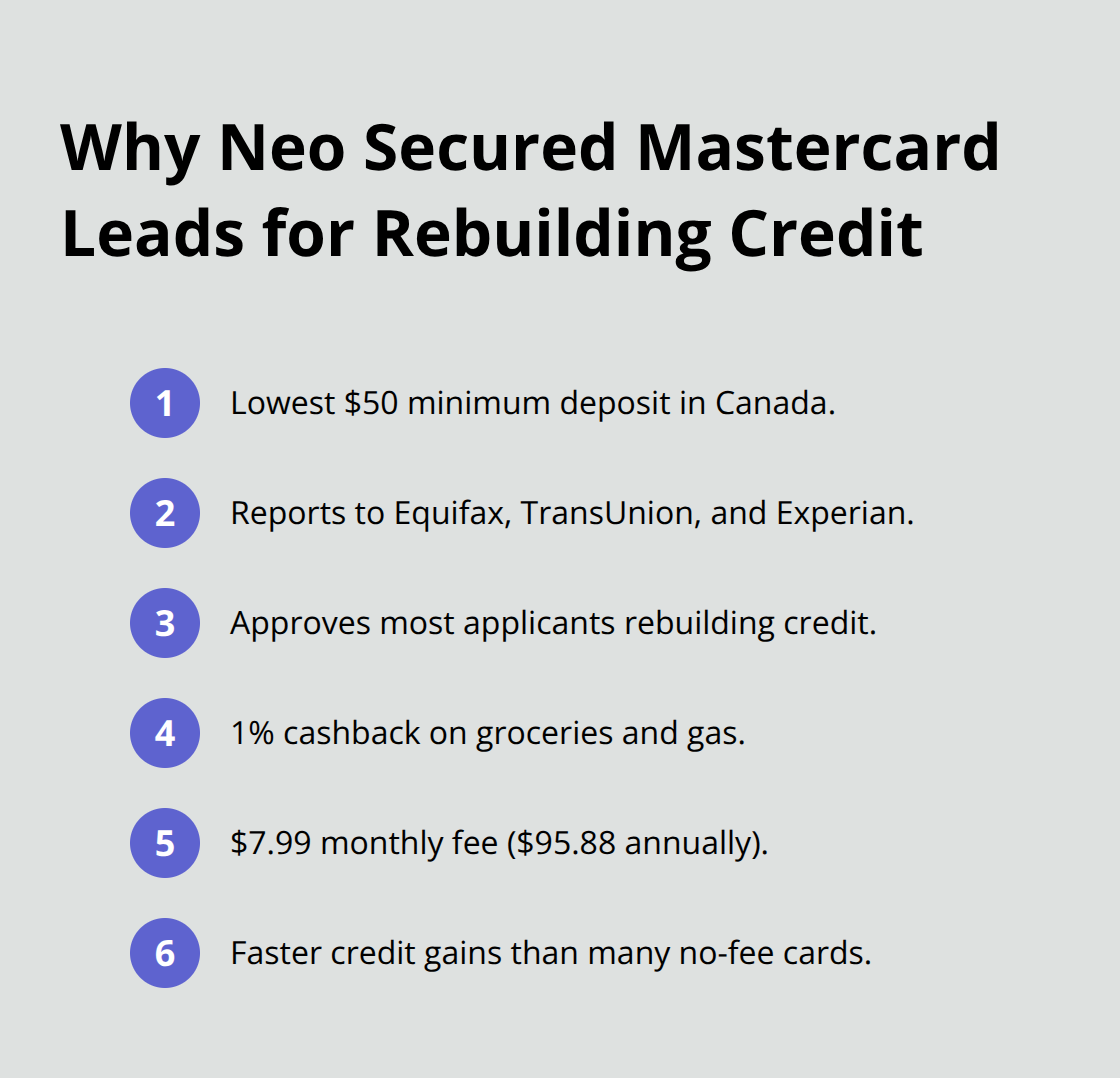
You earn 1% cashback on groceries and gas, which means you actually get paid while you build credit, not just pay fees to lenders. The $7.99 monthly fee totals $95.88 annually, which sounds high until you realize this card approves nearly everyone and delivers faster results than no-fee alternatives. NerdWallet Canada ranks Neo as the best overall secured option for exactly this reason: the combination of low deposit, triple bureau reporting, and genuine cashback rewards creates a faster path to creditworthiness than competitors charging no fees but reporting to fewer bureaus. If you start from poor credit or no Canadian credit history, Neo eliminates the friction that kills most credit-building attempts.
Capital One and Home Trust Serve Different Situations
Capital One Guaranteed Secured Mastercard offers no annual fee with a $75 minimum deposit and includes travel protections and purchase assurance that Neo lacks. This card works well if you travel occasionally and want insurance coverage without monthly fees, though it reports to only two bureaus instead of three. Home Trust Secured Visa requires a $500 minimum deposit with zero annual fees and zero monthly charges, but it’s not available in Quebec and also reports to only two bureaus. All three cards approve applicants traditional lenders reject-they’re designed for that purpose-but the real difference emerges after 12 months. Neo and Capital One both offer upgrade paths to unsecured cards, while Home Trust’s upgrade process remains less transparent. If you can afford the $7.99 monthly fee and want to maximize credit-building speed, Neo wins. If you cannot afford monthly charges and have $500 available to deposit, Home Trust works, but expect your credit score improvement to take longer since you report to fewer bureaus.
Rewards Actually Matter During Credit Building
Most people assume secured cards offer no rewards, which is wrong. Neo’s 1% cashback on groceries and gas means a $500 monthly grocery budget generates $5 in rewards annually-small but real money that offsets the monthly fee. Capital One includes no rewards but provides travel insurance that protected purchases would cost $100 to $200 annually through separate policies. Home Trust and other no-fee cards offer zero rewards and zero protections, which means you pay with your time and slower credit improvement instead of monthly fees. The Tim Hortons Secured Mastercard offers 12x rewards on Tim Hortons purchases and 2x on groceries and transit, but this card’s approval standards are stricter than Neo’s and it’s not recommended for applicants with serious credit damage. The practical truth: if you qualify for Neo, you should choose it over no-fee competitors because the monthly fee generates rewards that save you money, while faster triple-bureau reporting cuts months off your credit-building timeline. A $300 deposit at Neo costs $95.88 annually but saves you 4 to 6 months of waiting compared to Home Trust, which means you access unsecured cards and better interest rates faster.
Moving Forward With Your Card Choice
Your secured card selection determines how quickly you reach creditworthiness and what costs you’ll absorb along the way. The lowest deposit doesn’t always mean the lowest total cost-Neo’s monthly fee actually saves money compared to slower alternatives when you factor in the value of faster credit improvement. Once you’ve selected your card and made your deposit, the next phase requires a different strategy: you need to use the card in ways that maximize credit-building impact while avoiding the mistakes that trap people in the secured card cycle indefinitely.
Using Your Secured Card to Actually Build Credit
Opening a secured card means nothing without a deliberate strategy for the next 12 to 18 months. The deposit sits in your account, your credit limit is set, and now you face the hardest part: using the card in ways that improve your credit score instead of trapping you in debt. Most people fail here because they either use the card too aggressively or not at all, both of which waste months of potential credit-building. You need to treat this card as a tool with specific rules, not as extra spending money.
Make Small Purchases and Pay Immediately
Start with one small purchase every month on your secured card, then pay the full balance within days of receiving the statement. A $25 to $50 grocery purchase, paid in full before the due date, accomplishes everything you need: it creates a payment record that the issuer reports to the credit bureaus, it demonstrates you can manage credit responsibly, and it keeps your credit utilization below 10 percent, which is optimal for credit score improvement. Many people assume they need to use 30 percent of their limit to build credit faster, but this is backwards. TransUnion’s credit-scoring research shows that borrowers with utilization below 10 percent see significantly faster score improvements than those using 20 to 30 percent of available credit.
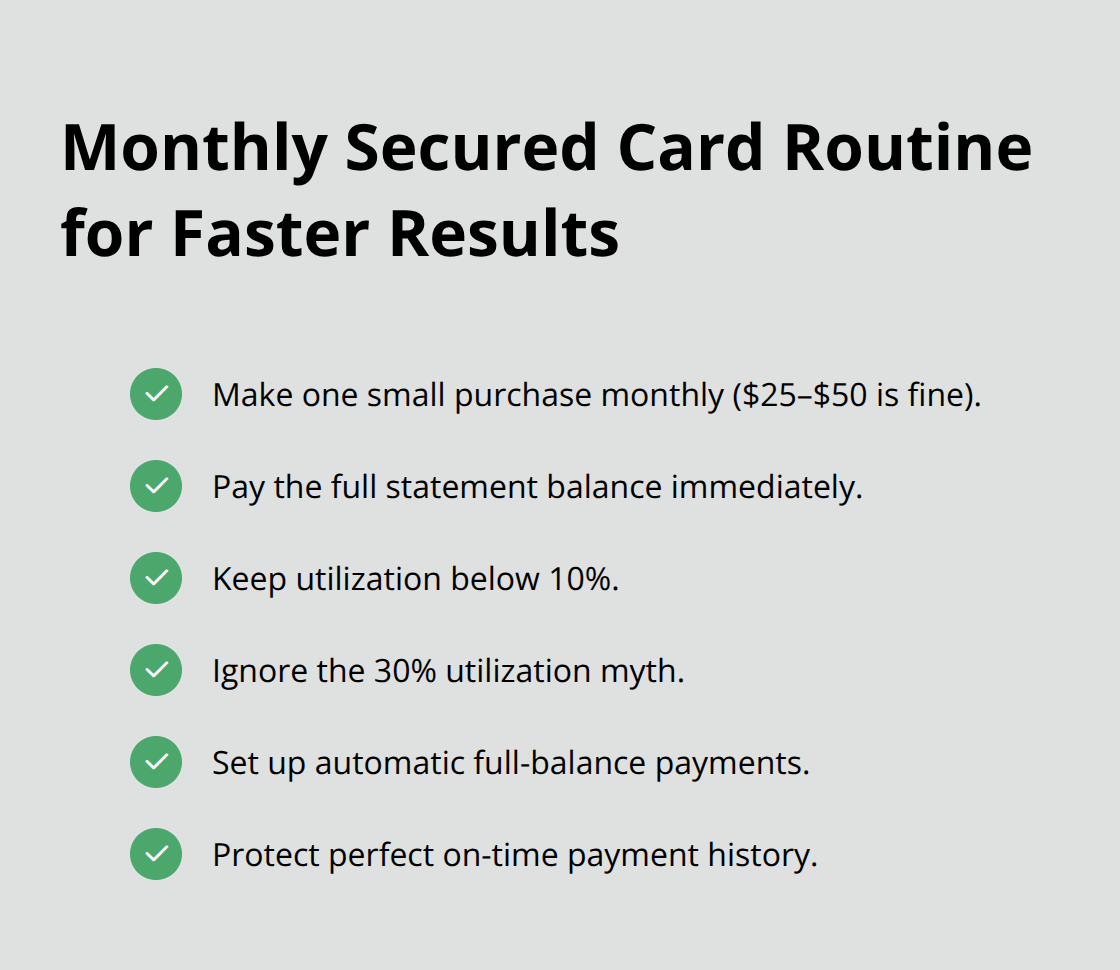
The psychology here matters too: when you make small purchases and pay immediately, you never risk missing a payment, and payment history accounts for 35 percent of your credit score. Set up automatic payments through your bank account for the full statement balance on the day your bill arrives, which eliminates the possibility of forgetting a payment deadline. One missed payment can damage your score by 100 points or more, erasing months of careful work in a single mistake.
Verify Your Issuer Reports to Credit Bureaus
After three months of on-time payments, check your credit report with both Equifax Canada and TransUnion through their websites to confirm the issuer actually reports your activity. Some secured card issuers fail to report properly, which means you’ve made payments that don’t help your credit score at all. If your issuer isn’t reporting, contact them immediately and request confirmation in writing that they report to the bureaus. If they refuse or cannot confirm, close the account and move your deposit to a card that actually reports.
This verification step separates people who build credit in 12 months from those who waste 18 months on a non-reporting card. After six months of consistent on-time payments and low utilization, your credit score should begin improving noticeably. Most people starting from poor credit or no Canadian history see score increases of 50 to 100 points within six months on a properly reporting secured card. Track this progress through TransUnion’s CreditView tool or Equifax’s free credit monitoring, which shows you exactly how your actions affect your score.
Upgrade to an Unsecured Card After 12 Months
After 12 months of perfect payment history, contact your secured card issuer and request an upgrade to an unsecured card or a credit limit increase. Neo Secured Mastercard and Capital One Guaranteed Secured Mastercard both offer clear upgrade paths, while some issuers require you to apply for an entirely new unsecured product. If your issuer approves an upgrade, your deposit returns to your bank account within 7 to 10 business days, and you’ve officially graduated from the secured card system.
Your new unsecured card likely carries a lower interest rate and better rewards, which means your credit-building work has paid off materially. If your issuer denies an upgrade after 12 months, this signals a problem: either your payment history wasn’t actually as clean as you thought, or the issuer doesn’t offer upgrade paths at all. In this case, apply for an unsecured card from a different lender using your improved credit score as leverage. Your secured card deposit can be closed and returned regardless of whether you upgrade through the same issuer. The goal is to reach true unsecured credit within 18 months maximum, because staying on a secured card longer than this wastes the credit-building momentum you’ve created and keeps you paying higher interest rates than necessary.
Final Thoughts
Secured credit cards work because they remove the barrier that traditional lenders create for people with damaged credit or no Canadian history. You deposit cash, use the card responsibly, and within 12 to 18 months, you’ve built enough creditworthiness to access unsecured cards with better terms. The best secured cards Canada offers, like Neo Secured Mastercard, deliver results faster than alternatives because they report to multiple credit bureaus and provide rewards that offset their fees.
Your choice of card matters, but your behavior matters more-one missed payment erases months of progress, while consistent small purchases paid in full create the payment history that credit bureaus reward with higher scores. Most people starting from poor credit see meaningful score improvements within six months on a properly reporting card, and after 12 months of on-time payments and low utilization, you qualify for unsecured cards that charge lower interest rates and offer better rewards. This timeline isn’t arbitrary; lenders need to see that you’ve genuinely changed your financial habits, not just made temporary improvements.
The path forward is straightforward: select a card that reports to multiple bureaus, make small monthly purchases, automate full-balance payments, and verify after three months that your issuer actually reports your activity. After 12 months, request an upgrade to an unsecured product, or apply elsewhere using your improved credit score if your issuer denies the upgrade. Explore our credit-building resources to stay informed on personal finance strategies and discover which secured card fits your situation best.










Leave a comment