
Debt can feel overwhelming, but it doesn’t have to control your financial future. At Financial Canadian, we’ve created this guide with practical debt help Canada tips to show you exactly how to take back control.
Whether you’re juggling multiple debts or struggling with high interest rates, the strategies in this post will help you build a clear path forward. You’ll learn proven methods to tackle your debt, when to seek professional support, and what resources are available to you.
Know Your Actual Debt Position
The first step toward regaining control is understanding exactly what you owe. Most Canadians underestimate their total debt or ignore their interest rates, which makes it impossible to create an effective repayment strategy. Start by listing every debt you carry: credit cards, lines of credit, personal loans, car loans, student loans, and any other obligations. For each one, write down the current balance and the interest rate. This isn’t fun, but it’s non-negotiable. Canadian credit card interest rates typically range from 19.99% to 25.99%, which means a $5,000 balance at 22% interest costs you roughly $1,100 annually in interest alone if you only make minimum payments. That money disappears without reducing your principal.
Calculate What You’re Actually Paying
Once you have your complete list, add up your total debt and calculate how much interest you pay monthly. Statistics Canada data shows that in Q1 2025, Canadian households owed approximately $3.07 trillion in total credit-market debt, and the average non-mortgage consumer debt per person was $26,415. The household debt-to-disposable-income ratio hit 175.35%, meaning for every dollar of after-tax income, households owed $1.75. This context matters because it shows how widespread this problem is, but your situation is unique to you. A debt calculator reveals exactly how long it will take to pay off each debt at your current payment rate. Most people are shocked to discover that paying only minimums on a $3,000 credit card balance could take over a decade.
Identify Which Debts Deserve Your Attention First
Not all debts are created equal. Secured debts like mortgages or car loans are backed by collateral, meaning the lender can seize your home or vehicle if you default. Unsecured debts like credit cards carry higher interest rates but no collateral risk. The catch is that unsecured debt can still destroy your credit score and lead to legal action. Prioritize paying down high-interest unsecured debt first because it costs you the most money over time. If you have a $10,000 credit card balance at 23% interest and a $10,000 personal line of credit at 7%, paying extra toward the credit card saves you significantly more money.
Map Out Your Monthly Cash Flow
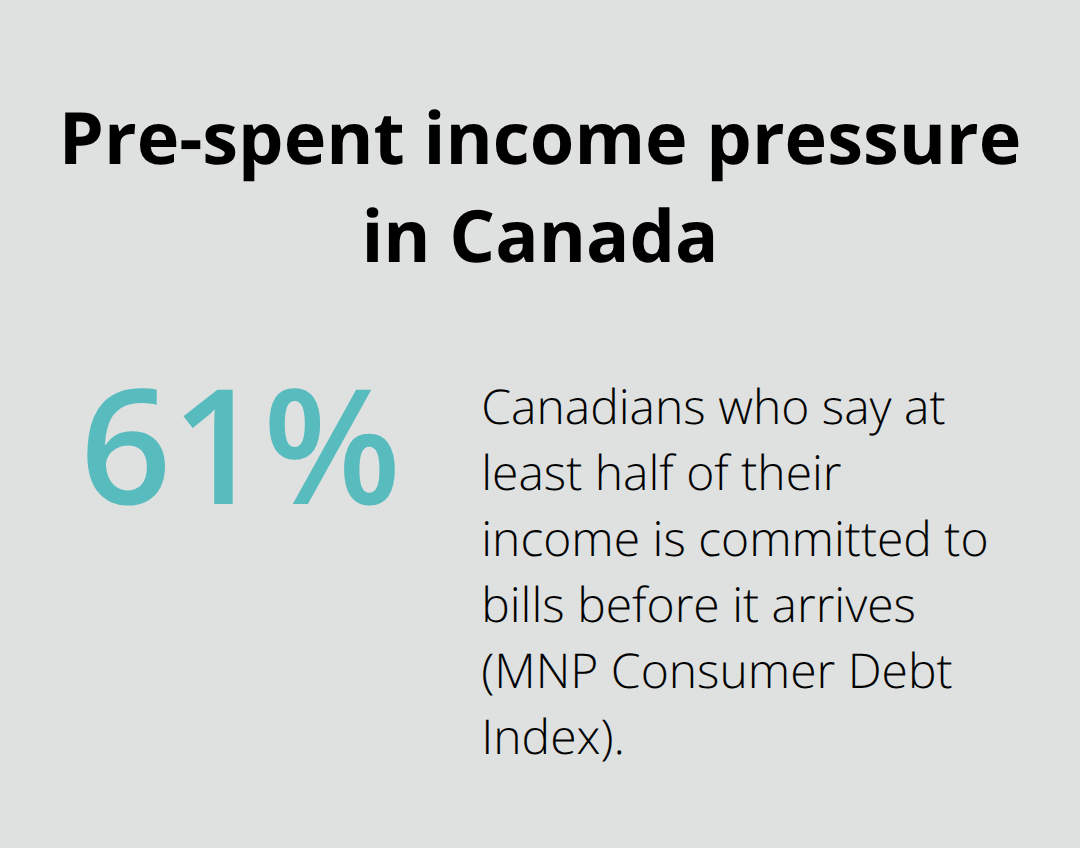
Your monthly budget matters tremendously. According to the MNP Consumer Debt Index, 61% of Canadians say at least half of their income is committed to bills before it even arrives. You need to know where every dollar goes. Track your actual spending for one month, categorize it into needs and wants, and identify where you can cut.
Small changes like reducing subscriptions, adjusting utilities, or changing your commute add up fast. This budget becomes your foundation for determining how much you can realistically put toward debt repayment each month.
With a clear picture of what you owe and how much you can pay, you’re ready to explore the specific strategies that work best for your situation.
Practical Debt Repayment Strategies
Choose Between Snowball and Avalanche Methods
The two most popular debt repayment approaches are snowball and avalanche, and your choice between them matters more than people realize. The snowball method targets your smallest debt balance first regardless of interest rate, then rolls that payment into the next smallest debt once you pay it off. The avalanche method attacks your highest interest rate debt first while you make minimum payments on everything else.
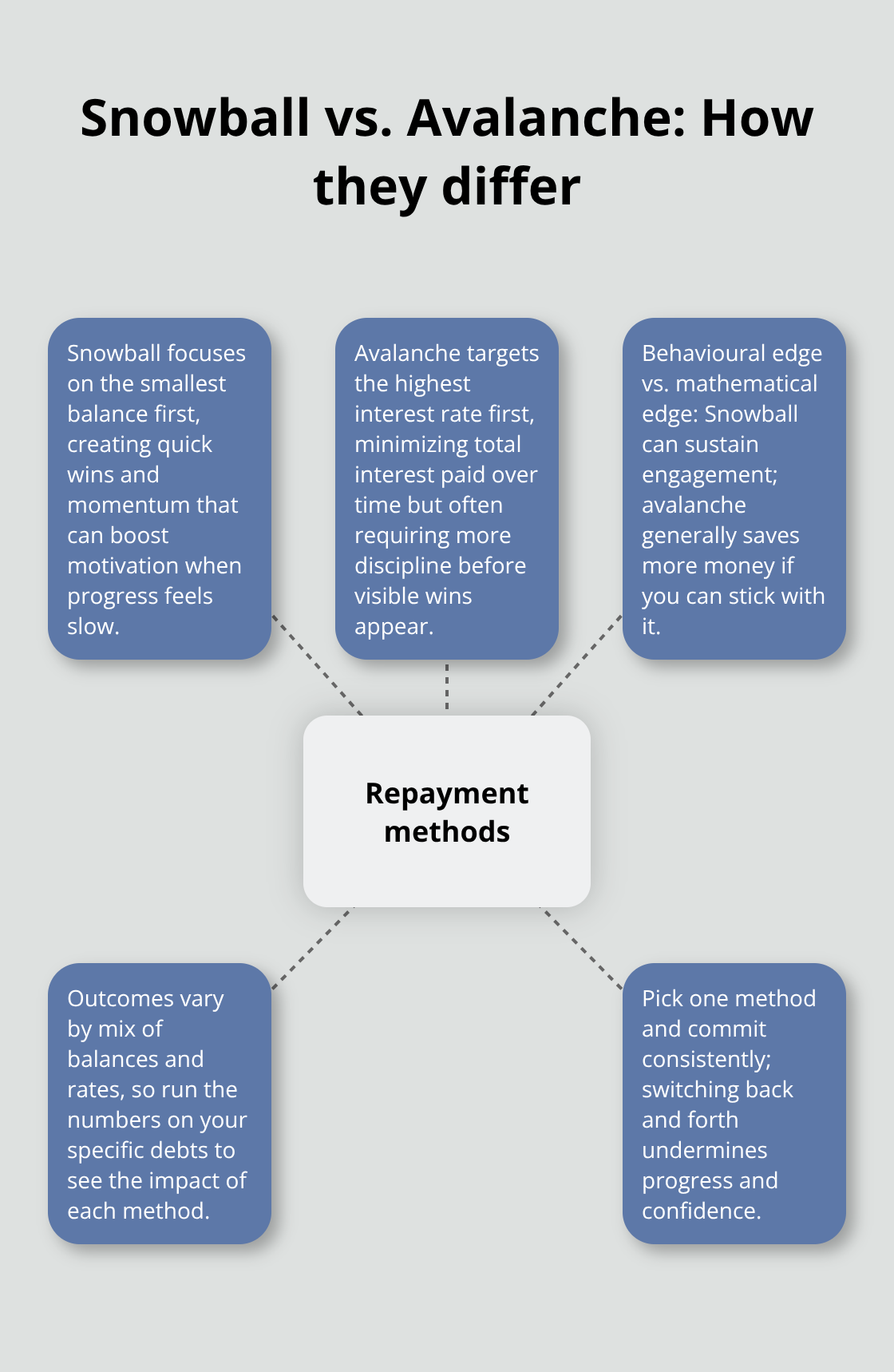
Mathematically, snowball and avalanche methods have different financial outcomes depending on your situation. If you have a $2,000 credit card at 23% interest, a $5,000 personal loan at 8% interest, and a $1,500 line of credit at 6% interest, each method produces different results.
However, avalanche requires discipline because you won’t see quick wins for months or years. Snowball delivers psychological momentum by eliminating debts faster, which keeps many people motivated when they’re exhausted from financial stress. We recommend avalanche for anyone with strong financial discipline and a realistic timeline, but snowball works better if you’ve struggled with motivation in the past. The critical factor is choosing one method and sticking with it rather than bouncing between strategies. Most people who fail at debt repayment abandon their plan within three months, not because the math was wrong but because they lost confidence.
Accelerate Your Payoff With Extra Payments
Whichever method you choose, make extra payments beyond your minimums whenever possible. Even an additional $50 monthly on your highest priority debt accelerates payoff significantly and reduces total interest costs. This simple action compounds over time and demonstrates to creditors that you take your obligations seriously.
Negotiate Better Terms With Your Creditors
Your next move is contacting your creditors directly because most people never ask for better terms. Credit card companies, lenders, and banks negotiate constantly with customers who demonstrate financial hardship or a commitment to repayment. If you’ve missed payments or face hardship, call and explain your situation honestly. Many creditors will temporarily reduce your interest rate, waive fees, or restructure your payment schedule rather than watch you default.
A secured debt like a mortgage or car loan offers more negotiation power than unsecured debt, but even credit card issuers often work with customers who show they’re serious about repayment. Document everything in writing after verbal conversations to protect yourself and maintain a clear record of any agreements.
Explore Consolidation and Refinancing Options
If negotiation doesn’t produce results, explore debt consolidation options. A consolidation loan replaces multiple debts with a single loan at a lower interest rate if your credit score qualifies (typically 650 or higher for reasonable terms). This simplifies payments and reduces monthly interest costs, though watch for extended repayment terms that increase total interest paid despite lower monthly amounts.
Debt consolidation programs through non-profit credit counselling agencies offer another path, combining unsecured debts into one affordable monthly payment while potentially reducing interest significantly. These programs typically run three to five years and stop collection calls immediately, but they require you to surrender unsecured credit cards during the program period. The Financial Consumer Agency of Canada recommends verifying any counselling agency’s accreditation and not-for-profit status before you commit. These structured programs work best for people who earn steady income and need clear structure and creditor cooperation rather than traditional bank loans.
When you’ve exhausted negotiation and consolidation options, professional debt relief services become your next consideration.
When Professional Help Becomes Necessary
Most people wait far too long to seek professional debt help. The warning signs are unmistakable: your debt isn’t shrinking despite minimum payments, you can’t afford monthly minimums, collection agencies call constantly, your credit score drops monthly, you shuffle balances between credit cards, you avoid opening statements, or financial stress affects your sleep and health. According to the MNP Consumer Debt Index, 61% of Canadians report that at least half their income is committed to bills before it arrives, and this pre-spent paycheque cycle creates impossible situations where professional intervention becomes the only realistic option. The moment you recognize these patterns, contact a Licensed Insolvency Trustee or non-profit credit counselling agency immediately. Waiting makes everything worse because debt compounds while your credit score deteriorates further, limiting your options.
Understanding Your Three Main Debt Relief Paths
Three primary debt relief options exist in Canada, and each one serves different financial situations. A Debt Consolidation Program through non-profit agencies combines your unsecured debts into a single monthly payment, typically reduces interest rates significantly, and runs three to five years. These programs stop collection calls immediately and work for people with stable income who need structure, though you’ll surrender unsecured credit cards during the program. Debt consolidation loans from banks or private lenders replace multiple debts with one loan at a lower interest rate if your credit score qualifies at 650 or higher, but watch for extended terms that increase total interest paid.
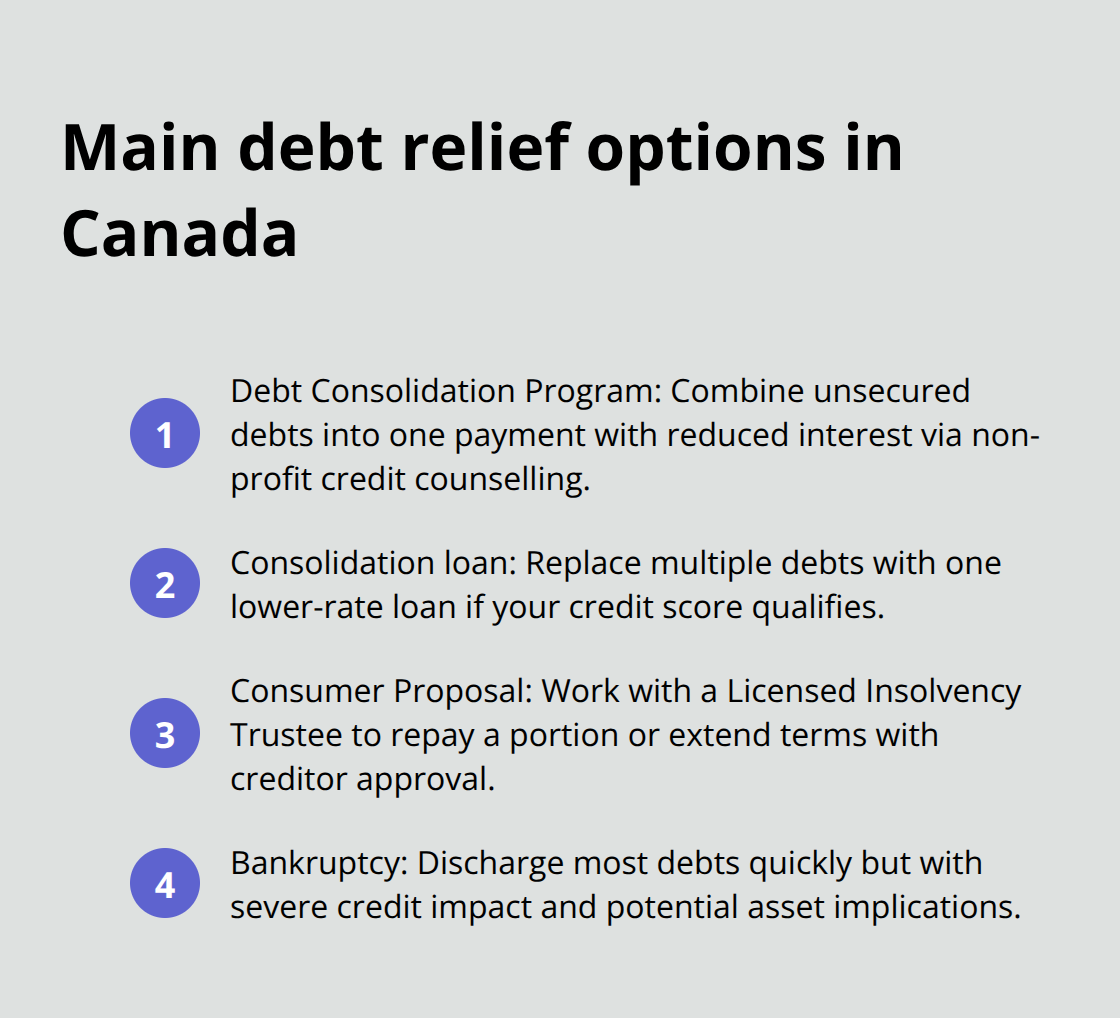
Consumer Proposals, filed with a Licensed Insolvency Trustee, allow you to pay a portion of your debt or extend repayment periods, and creditors often accept them to recover something rather than nothing. Bankruptcy discharges most debts quickly but devastates your credit score for six years and may require selling non-exempt assets.
Verifying Legitimate Services and Credentials
The Financial Consumer Agency of Canada emphasizes that only Licensed Insolvency Trustees can administer bankruptcies or consumer proposals legally in Canada, so verify credentials through the Office of the Superintendent of Bankruptcy before engaging any service. Credit counsellors at accredited non-profit agencies provide one-on-one guidance and create personalized repayment plans without judgment or hidden fees. Check that any agency holds AFCPE or Canadian Credit Counselling Association accreditation, maintains not-for-profit status, and shows strong ratings on Google or Trustpilot. Avoid debt relief companies that charge large upfront fees, guarantee elimination of all debt, use high-pressure sales tactics, or provide vague contracts.
Taking Your First Step Forward
A free confidential consultation with a Licensed Insolvency Trustee costs nothing and reveals which options actually fit your situation. Gather all financial statements and information before your appointment so the professional can provide accurate recommendations. The transition from struggling alone to working with a counsellor eliminates the shame that keeps many Canadians trapped in debt cycles. Professional guidance restructures your finances, stops creditor harassment, and creates a realistic timeline to debt freedom that you can actually maintain.
Final Thoughts
Regaining control of your debt requires honest assessment, realistic planning, and decisive action. You now understand how to calculate your total debt, identify which obligations demand immediate attention, and choose between proven repayment strategies that match your financial discipline. The snowball method builds momentum through quick wins, while the avalanche method saves the most money on interest, and either approach works if you commit to it consistently and make extra payments whenever possible.
Negotiating with creditors costs nothing and often produces results, while consolidation programs and loans provide structure when you need professional intervention. The moment you recognize warning signs like missed payments, collection calls, or constant financial stress, contact a Licensed Insolvency Trustee or non-profit credit counselling agency. These professionals eliminate shame, stop creditor harassment, and create realistic timelines you can actually maintain.
Start today by listing every debt with its balance and interest rate, then calculate how much interest you pay monthly. Identify which debts deserve priority based on interest rates and collateral risk, then commit to either snowball or avalanche repayment and make extra payments beyond minimums. If you need guidance on these debt help Canada tips or want to explore professional options, visit our debt consolidation resource to learn more about your choices.










Leave a comment