
Carrying multiple debts drains your energy and your bank account. Online debt consolidation in Canada offers a straightforward way to combine what you owe into one manageable payment.
At Financial Canadian, we’ve seen how consolidation transforms finances for thousands of Canadians. This guide walks you through how it works, what benefits await, and how to pick the right lender for your situation.
How Online Debt Consolidation Works in Canada
Online debt consolidation in Canada operates through a straightforward mechanism: you combine multiple debts into one. This means instead of paying many different accounts, you make 1 payment to manage. The process starts when you submit an application to a lender, either a bank or a private finance company, detailing your income, debts, and assets. The lender conducts a credit check and verifies your financial stability, then offers you a loan amount and interest rate based on your creditworthiness. Once approved, funds transfer directly to your creditors, eliminating your old obligations and the mental burden of tracking multiple payment due dates.
Speed Matters When Interest Compounds Daily
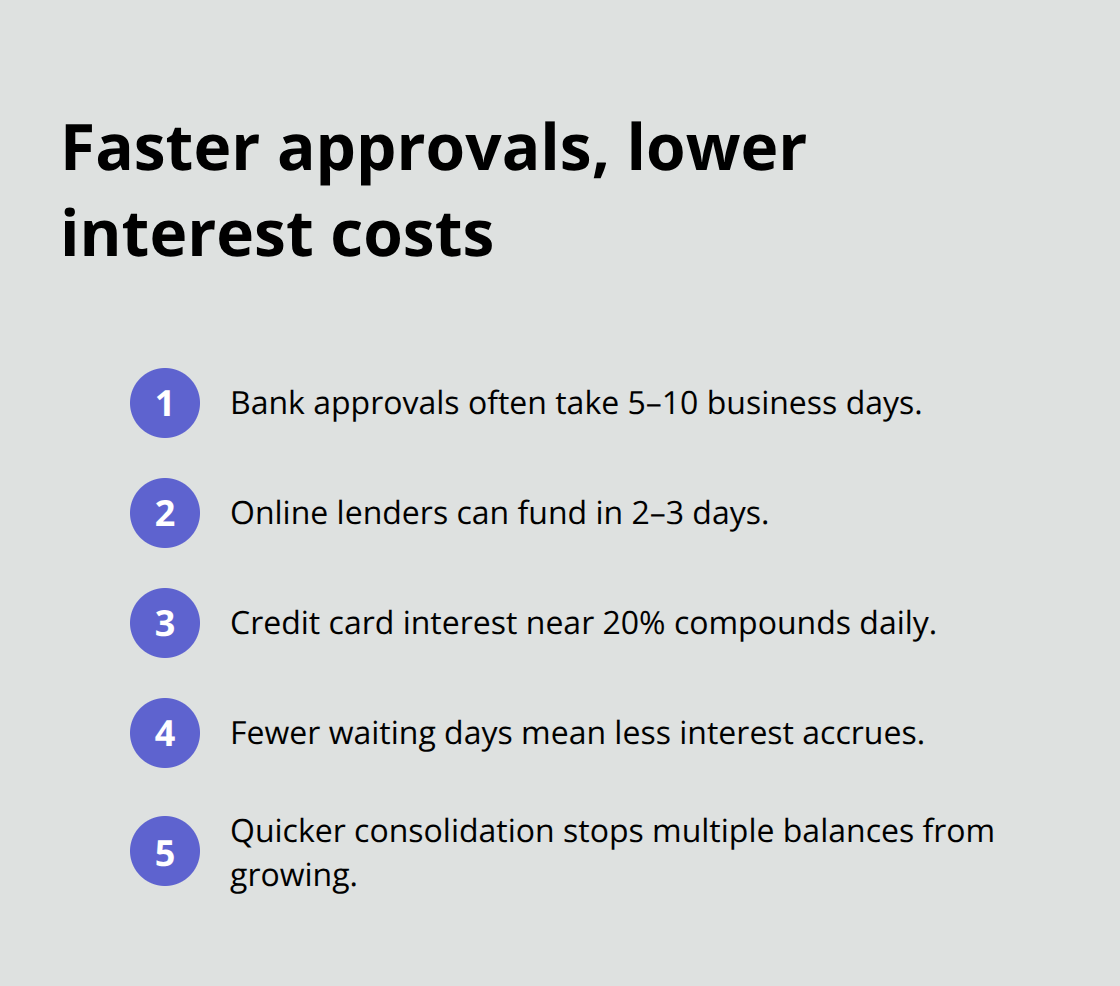
The timeline separates winners from losers in debt consolidation. Major Canadian banks like TD, RBC, and Scotiabank typically approve consolidation loans within 5 to 10 business days, while online-only lenders often complete the process in 2 to 3 days. Credit card interest in Canada averaged 19.99% in 2024. Every day your debts remain unconsolidated, interest compounds against you, so faster approval translates directly to money saved.
Online Lenders vs. Traditional Banks
Online lenders cut overhead costs by eliminating physical branches, which they pass to you through lower rates and faster processing. Traditional banks require in-person meetings and paperwork, dragging out approval timelines. However, online lenders demand stronger credit scores, typically 650 or above, while some credit unions and non-profit debt management programs work with people carrying damaged credit.
Home Equity Options for Lower Rates
If you own a home with equity, a HELOC offers a more flexible alternative: you borrow against your home’s value at rates roughly 2 to 4 percentage points lower than unsecured consolidation loans, and you only pay interest on funds you actually use. A debt consolidation mortgage refinance works similarly but locks you into a longer commitment and triggers closing costs averaging 2 to 4 percent of the loan amount.
What to Avoid and Better Alternatives
Forget guaranteed consolidation loans; they’re predatory traps charging 30% or more. Instead, explore a Debt Consolidation Program through a non-profit like Credit Canada, which negotiates with creditors to drop interest rates to 0% or near-zero on unsecured debts without requiring a hard credit pull. These programs cost a one-time $50 setup fee plus a small monthly admin charge, compared to the thousands you’ll pay in interest on a high-rate consolidation loan. Understanding which option fits your credit profile and financial situation determines whether you save thousands or waste money on the wrong approach.
Why Your Monthly Payment Drops When You Consolidate
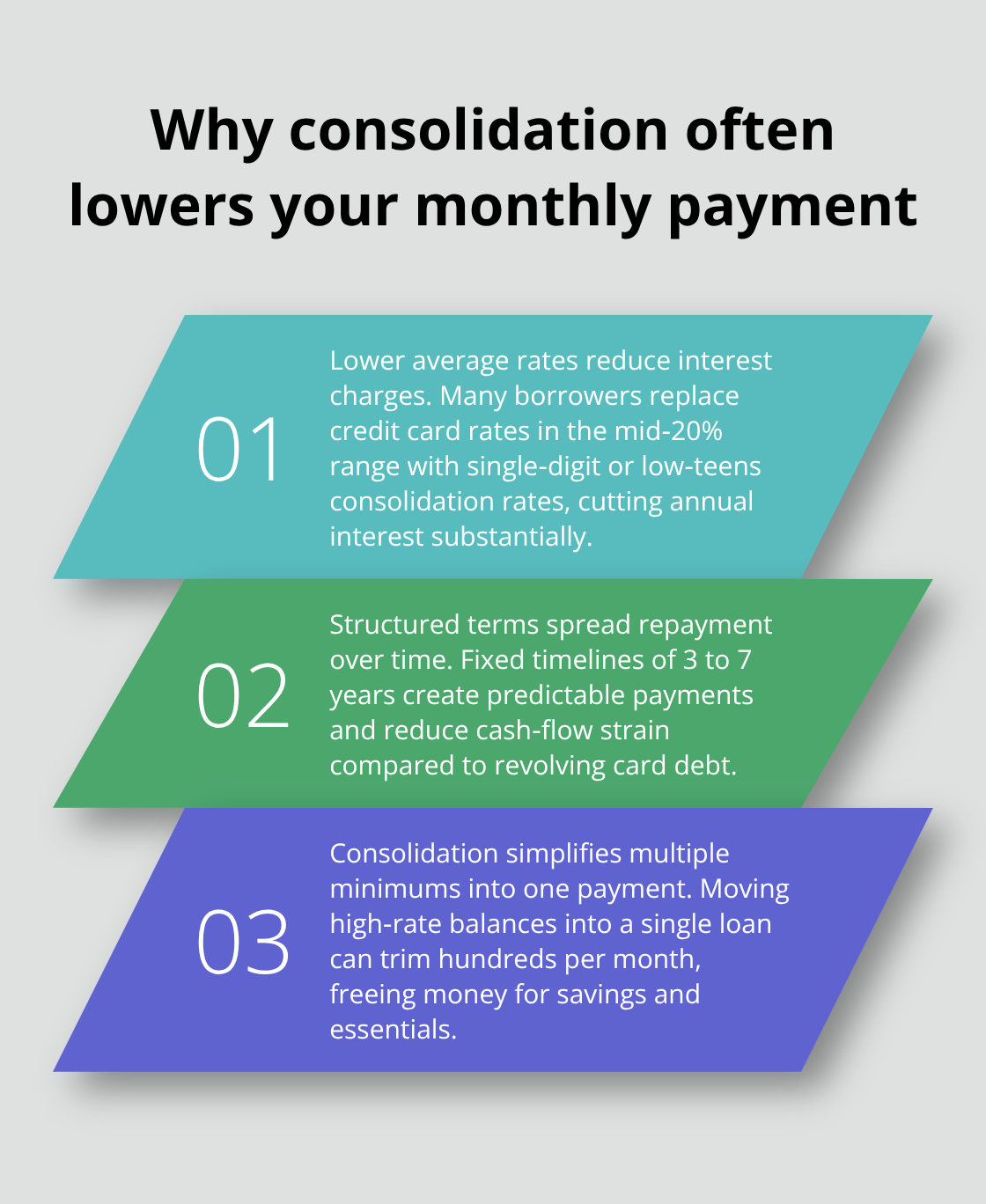
Consolidating debt online produces tangible financial relief that compounds over months and years. When you combine multiple debts into a single loan, the interest rate you receive often sits 5 to 10 percentage points below what you currently pay across credit cards and personal loans. Credit card debt in Canada carried an average yield of 26.4% in 2024, while a consolidation loan from a major bank typically ranges between 8% and 14%, depending on your credit score and the lender. On a $25,000 debt, moving from 26.4% to 10% cuts your annual interest expense by roughly $4,100. Your monthly payment shrinks not just because the rate drops, but because consolidation loans stretch repayment over a fixed timeline, usually 3 to 7 years. A person juggling four separate debts with minimum payments totaling $800 monthly might consolidate into a single $550 payment, freeing up $250 monthly for other priorities.
How Interest Rate Differences Add Up Fast
The gap between your current rate and a consolidation rate matters more than most people realize. Credit card companies charge high rates on average, while personal loans run between 12% and 18%, and payday loans exceed 400% annually. A consolidation loan at 10% (assuming good credit) saves thousands compared to these alternatives. On a $30,000 balance, you’d pay roughly $9,900 in interest over five years at 10%, versus significantly more at higher rates over the same period. That difference funds vacations, home repairs, or emergency savings. The math works even better if you secure a HELOC at 6% to 8% by leveraging home equity, cutting your interest expense nearly in half compared to unsecured consolidation loans.
Single Payments Eliminate Tracking Chaos
Managing five separate due dates across different creditors wastes time and invites missed payments. One late payment triggers penalty fees of $25 to $40 per account and damages your credit score by 50 to 100 points. Online consolidation eliminates this complexity. You set one auto-payment date, and the lender handles distribution to creditors. Faster approval timelines matter here too: online-only lenders complete funding in 2 to 3 days, meaning your old debts disappear quickly and interest stops compounding on multiple accounts simultaneously. Traditional banks take 5 to 10 business days, extending the period when you’re paying interest on debts you’ve already committed to consolidating.
Non-Profit Programs Offer Interest Reduction Without New Debt
Non-profit debt consolidation programs through organizations like Credit Canada offer another path entirely. These programs negotiate directly with creditors to reduce or eliminate interest without requiring a new loan. This approach costs a one-time $50 setup fee plus modest monthly administration charges, making it the cheapest option if your credit score sits below 650 or if you want to avoid borrowing altogether. You stop using unsecured credit during the program, but you avoid the debt trap of taking on new borrowing to pay old debt.
What Comes Next Depends on Your Credit Profile
Your credit score determines which consolidation method works best for your situation. Strong credit (above 680) opens doors to bank loans and HELOCs with competitive rates. Moderate credit (650 to 679) qualifies you for online lenders, though rates run higher. Damaged credit (below 650) makes traditional loans impossible, but non-profit programs and credit unions remain accessible options that don’t require perfect financial history.
How to Pick a Lender Without Wasting Time on Bad Rates
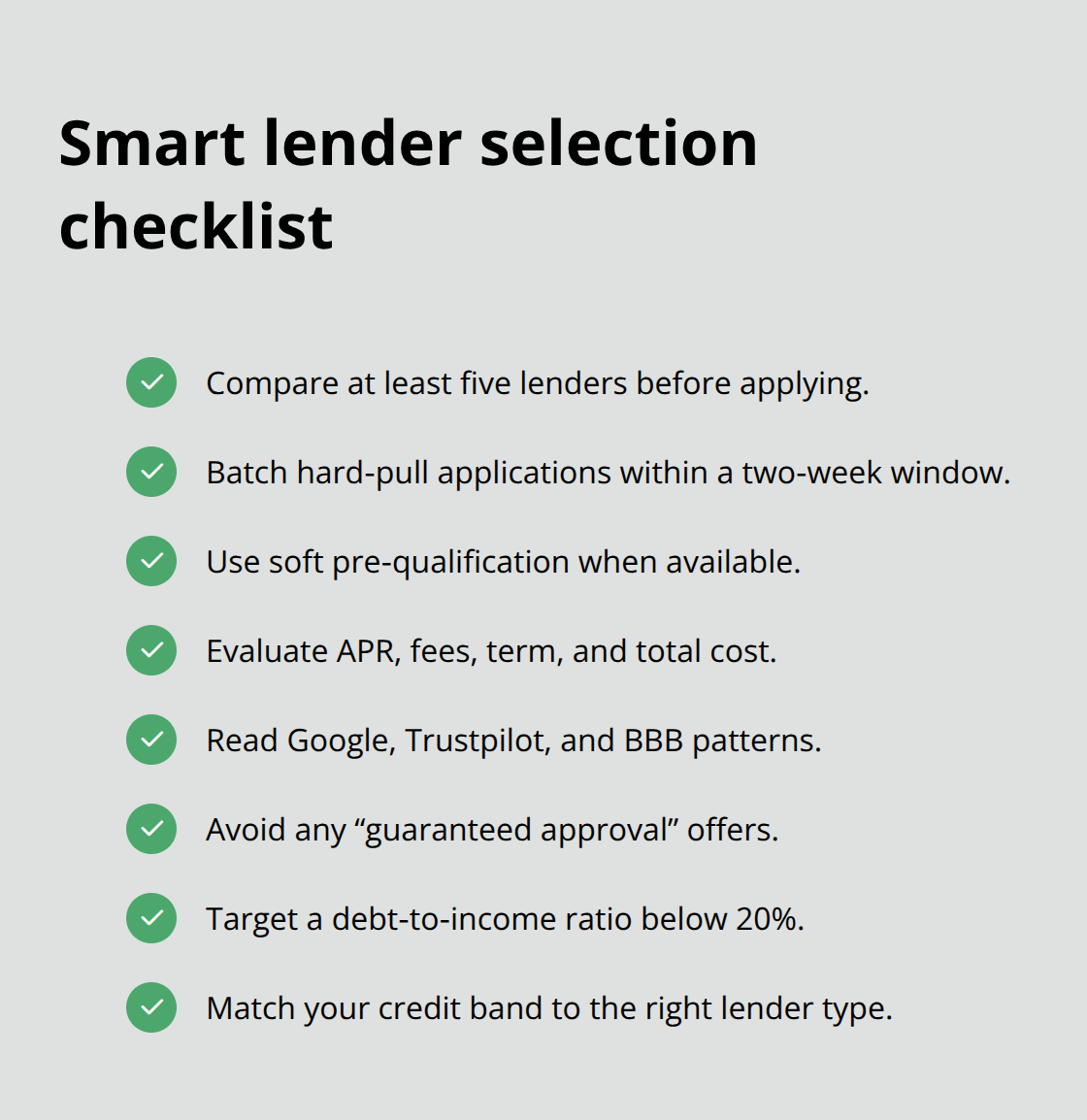
Shopping for a consolidation lender wastes hours if you approach it wrong. Most people check one or two banks, see mediocre rates, and accept whatever gets approved fastest. That mistake costs thousands. We recommend comparing at least five lenders before committing, because rate spreads between providers run 3 to 6 percentage points on the same loan amount. A $25,000 consolidation at 8% versus 14% costs you an extra $1,500 in interest over five years.
Start With Your Credit Report and Strategic Applications
Pull your credit report from Equifax or TransUnion to understand your score before you apply anywhere. Each application triggers a hard inquiry that temporarily dips your score by 5 to 10 points, so batch your applications within a two-week window to minimize damage. Major Canadian banks like TD, RBC, BMO, CIBC, and Scotiabank publish rates online, but you’ll see actual offers only after full application. Online lenders show pre-qualified rates within minutes using soft inquiries that don’t hurt your credit.
Compare Total Cost, Not Just Interest Rates
Compare the total cost of borrowing, not just the interest rate. A lender charging 9% with a $500 origination fee costs more than one charging 10% with no fee, depending on your loan term. Request the disclosure statement from every lender you seriously consider; Canadian lenders must provide interest rate, monthly payment amount, and total borrowing cost upfront. That document shows exactly what you’ll pay over the loan’s life.
Evaluate Customer Reviews and Red Flags
Customer reviews reveal red flags that rates alone won’t show. Search Google, Trustpilot, and the Better Business Bureau for each lender you’re considering. Look for patterns, not isolated complaints. One angry customer means nothing; dozens reporting slow funding or hidden fees means something. Avoid lenders offering guaranteed approval or rates locked in without a credit check; these typically charge 25% to 40% interest and target desperate borrowers.
Match Your Credit Profile to the Right Lender
Your eligibility hinges on credit score, income stability, and debt-to-income ratio. Lenders generally want monthly debt payments below 20% of gross income, meaning someone earning $4,000 monthly shouldn’t exceed $800 in total monthly debt obligations. If your ratio exceeds that threshold, a non-profit debt consolidation program becomes your better option because these programs work with people carrying higher debt loads and negotiate interest down to zero or near-zero without requiring new borrowing. A credit score above 680 qualifies you for competitive bank rates between 7% and 12%. Scores between 650 and 679 push you toward online lenders charging 12% to 18%. Below 650, traditional consolidation loans disappear, leaving non-profit programs and credit union options as realistic paths forward.
Final Thoughts
Online debt consolidation in Canada works best when you match your financial situation to the right solution. If your credit score sits above 680, bank loans and HELOCs deliver competitive rates between 7% and 12%, cutting your interest expense dramatically compared to credit cards averaging 26.4%. If your score falls between 650 and 679, online lenders remain accessible, though rates climb to 12% to 18%. Below 650, non-profit debt consolidation programs become your strongest option, negotiating interest down to zero without requiring new borrowing.
The decision hinges on three factors: compare total borrowing costs across at least five lenders (not just interest rates, since origination fees and loan terms shift the real expense), verify lender legitimacy through Google reviews and the Better Business Bureau while avoiding any outfit promising guaranteed approval, and calculate your debt-to-income ratio to confirm you qualify. Lenders want monthly debt payments below 20% of gross income, and if you exceed that threshold, a non-profit program handles higher debt loads better than traditional loans. Pull your credit report from Equifax or TransUnion to establish your baseline, then batch applications within two weeks to minimize credit score damage.
Request disclosure statements from every serious contender, showing interest rate, monthly payment, and total cost. We at Financial Canadian help Canadians build strong financial foundations through expert guidance and resources tailored to your needs. Start your comparison today, and within weeks you’ll consolidate multiple payments into one manageable obligation, freeing cash flow for savings and reducing the stress that multiple debts create.










Leave a comment