
Personal loans in Canada range from $500 to $50,000, with rates varying between 6% and 32% depending on your credit profile. A personal loan comparison Canada helps you identify which lender offers the best terms for your situation.
At Financial Canadian, we’ve seen borrowers save thousands by comparing options before applying. The difference between the highest and lowest rates for identical loan amounts can exceed 15%, making comparison essential before you commit.
What Type of Personal Loan Do You Actually Need
Unsecured personal loans dominate the Canadian market and for good reason: they require no collateral, which means you won’t lose your home or car if you fall behind on payments. These loans work best when you need quick access to cash without pledging assets. Banks like Scotiabank, BMO, CIBC, TD, and RBC offer unsecured loans starting at 6% to 10% APR for borrowers with strong credit, though rates climb significantly for weaker profiles. The trade-off is real: lenders compensate for risk by charging higher rates and setting lower maximum loan amounts, typically capping around $50,000. Approval timelines move faster than secured alternatives, often within 1 to 2 business days, and some digital lenders like SoFi fund same-day after approval. You’ll encounter origination fees ranging from 0.5% to 8%, which either get deducted from your loan proceeds or added to your balance, so the true cost extends beyond the advertised interest rate.
When Secured Loans Make Financial Sense
Secured personal loans tie your borrowing to collateral, usually your home or vehicle, and this changes the entire equation. Lenders offer dramatically lower rates because they hold less risk: a home equity loan typically runs 6% to 11% APR compared to 9% to 35% for unsecured loans, according to Ratehub data. If you own your home with equity built up, a HELOC gives you flexibility to draw funds as needed rather than receiving a lump sum. The catch is obvious: default on payments and the lender can seize your collateral. Secured loans also allow higher borrowing amounts, sometimes reaching $75,000 to $250,000, making them suitable for major expenses like home renovations or debt consolidation. Your approval odds improve significantly with collateral, which matters if your credit sits in the fair or poor range. However, the application process moves slower than unsecured loans since lenders must verify collateral value.
Lines of Credit as a Flexible Alternative
A line of credit works differently than a traditional personal loan: instead of receiving a lump sum, you access funds as needed up to an approved limit, paying interest only on what you actually use. This flexibility appeals to borrowers managing ongoing expenses or unpredictable costs. Unsecured lines of credit carry higher rates similar to unsecured personal loans, while secured lines backed by home equity offer the lowest rates available in the Canadian market. You only pay interest during the draw period when you actively borrow, then switch to repayment mode where you pay down the principal. This structure suits debt consolidation poorly since you could accumulate new debt while paying off old balances, yet it excels for home renovations where expenses arrive in stages. Calculate your actual funding needs to compare a line of credit against a personal loan: if you need the full amount upfront, a personal loan delivers certainty; if you’ll draw funds incrementally, a line of credit saves you interest costs on unused capital.
Finding Your Best Fit
Your choice between these three options hinges on three factors: how much you need to borrow, when you need the money, and what collateral you can offer. Unsecured loans suit borrowers who lack home equity or prefer to keep assets unencumbered, while secured loans reward those with property and lower risk tolerance.
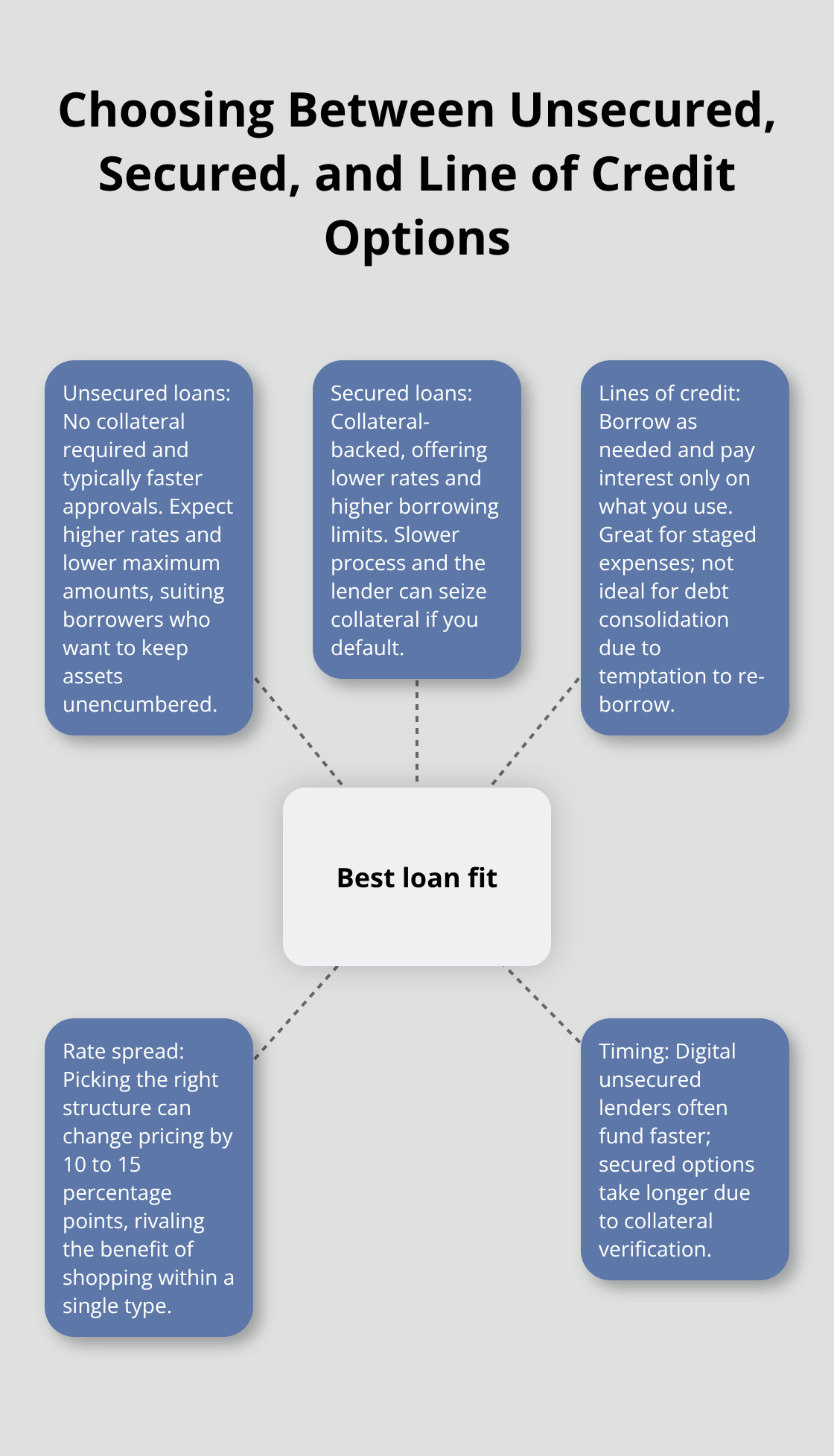
Lines of credit fit borrowers with variable expenses or those who want to avoid paying interest on funds they haven’t yet used. The rate difference between options can reach 10 to 15 percentage points, so selecting the right structure matters as much as shopping for the lowest rate within that structure. Your next step involves understanding what lenders actually look for when they evaluate your application.
How to Compare Loan Offers Without Wasting Time
APR is the only number that matters when comparing personal loans, and this is non-negotiable. The advertised interest rate means nothing because it excludes origination fees, which range from 0.5% to 8% according to Ratehub data. When a lender quotes you 9% interest but charges a 3% origination fee, your true cost climbs to approximately 12%.
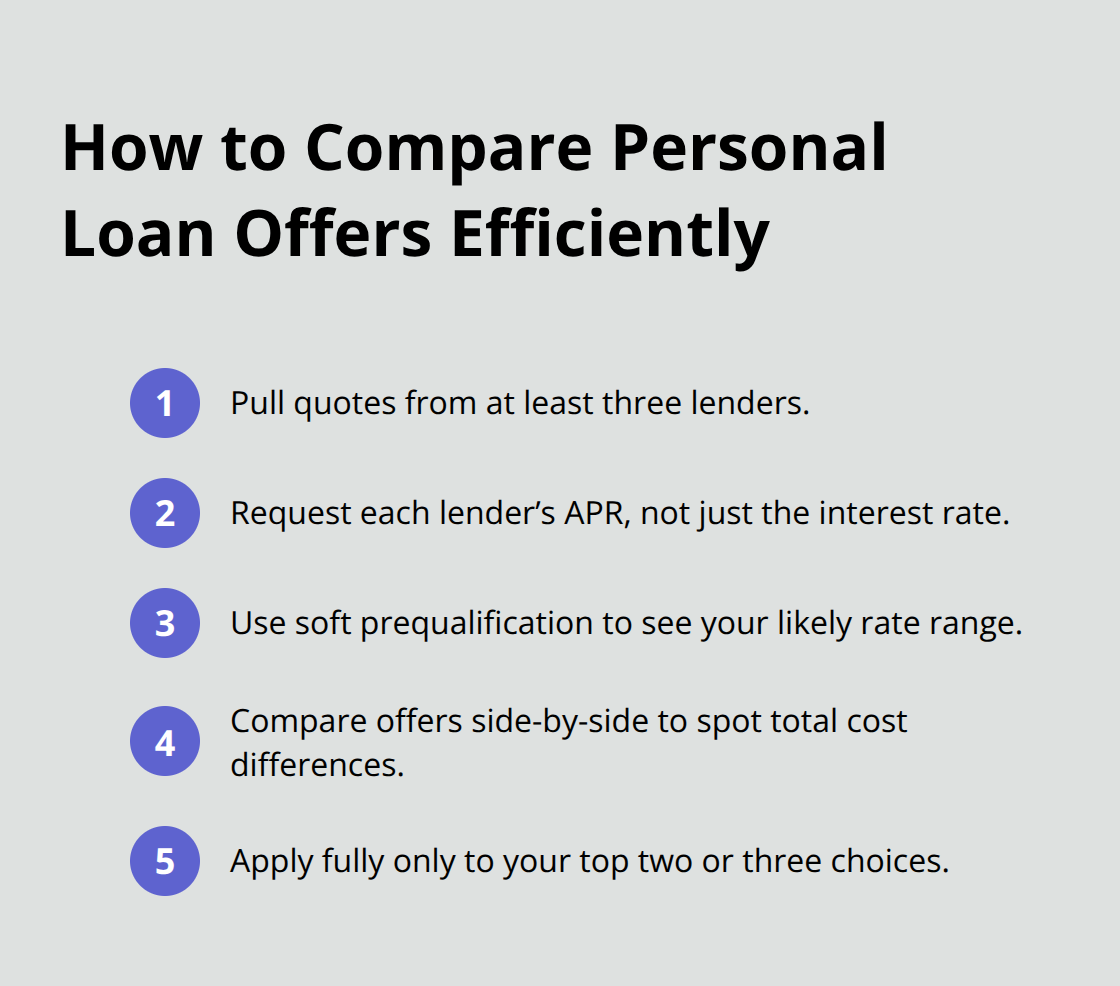
APR captures both the interest rate and all fees rolled into one figure, making it the legitimate basis for comparison across lenders. Pull quotes from at least three lenders before deciding anything, and always request the APR explicitly. Compare lender options to view multiple offers at once and understand your actual rate range. If you have excellent credit around 800 to 850, expect APRs near 10.08% based on recent market data. Fair credit between 580 and 669 pushes you toward 29.09%, while poor credit below 580 lands you at 29.67%. This spread reveals why shopping matters: the difference between excellent and fair credit can mean paying 19 percentage points more in interest. Use soft prequalification tools first, which won’t damage your credit score, to understand your likely rate range. Only proceed to full applications once you’ve narrowed your choices to two or three lenders.
Identify Hidden Fees That Drain Your Wallet
Origination fees get deducted from your loan proceeds or added to your outstanding balance, and this distinction matters significantly. A $10,000 loan with a 3% origination fee costs you $300, but if that fee gets deducted upfront, you only receive $9,700 while owing $10,000. Some lenders advertise lower rates then compensate with higher origination fees, so comparing APR prevents this trap entirely. Prepayment penalties exist at certain lenders and can cost hundreds if you pay off early, so ask explicitly whether your loan allows penalty-free prepayment.
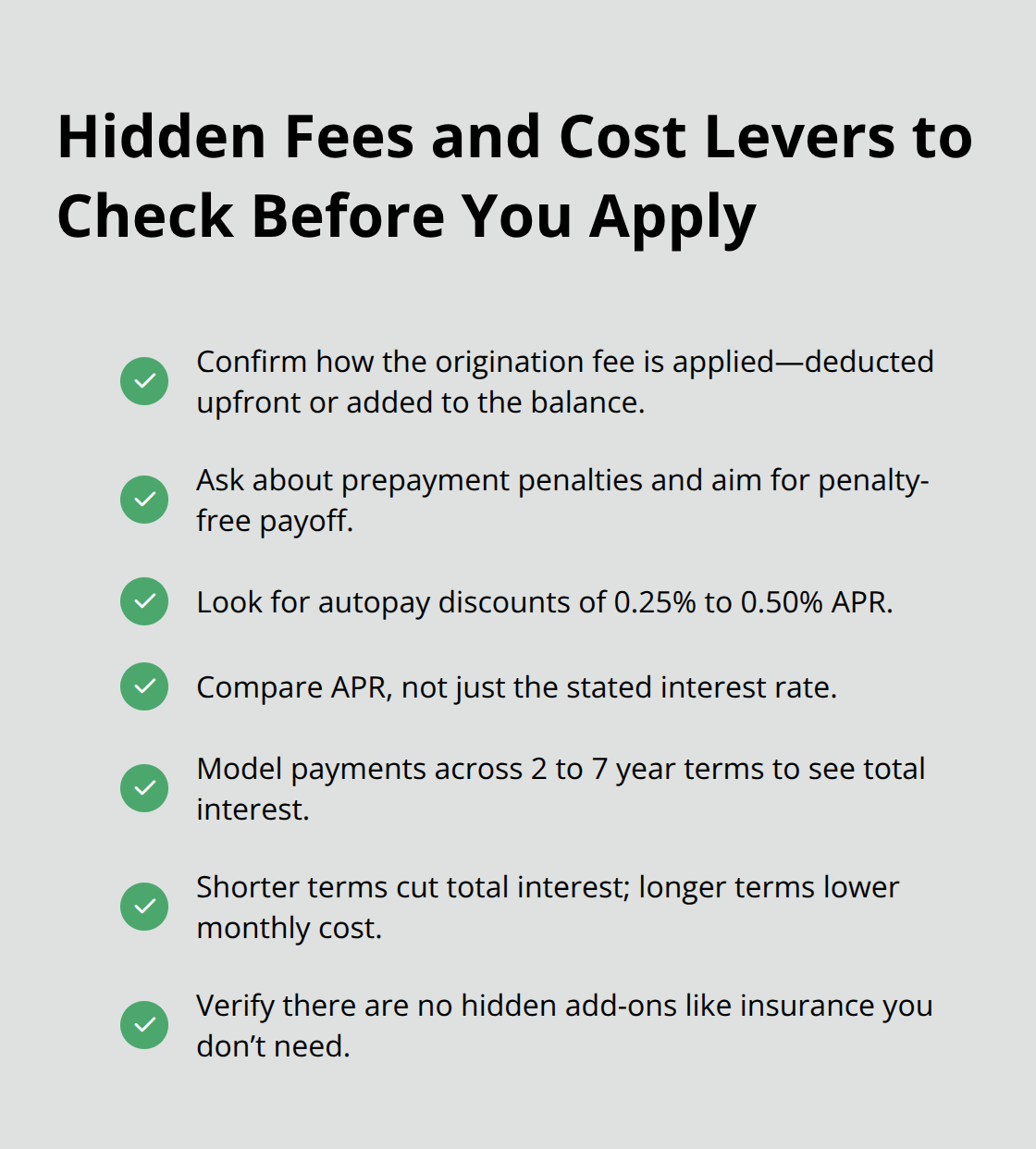
Autopay discounts typically reduce your APR by 0.25% to 0.50%, which sounds small but saves real money over multi-year terms. A $15,000 loan at 12% APR over five years costs approximately $3,566 in interest, but dropping to 11.75% through autopay reduces that to $3,496. Request term options between 2 and 7 years because extending your term lowers monthly payments but increases total interest paid. Shorter terms suit borrowers who can afford higher payments and want to escape debt faster, while longer terms help those managing cash flow tightly.
Prioritize Speed When Time Matters
Approval speed varies dramatically between traditional banks and digital lenders, with some funding same-day while others require 5 to 7 business days. If you need money urgently, prioritize lenders with rapid underwriting rather than chasing the absolute lowest rate from a slower institution. Digital lenders approve applications faster than banks because they use AI underwriting instead of manual review, sometimes delivering decisions within hours. Traditional banks typically require 2 to 5 business days for approval after submission. If speed matters, apply with an online lender first, then compare their offer against bank quotes.
Assess Your Debt-to-Income Ratio and Documentation Needs
Your debt-to-income ratio determines both approval odds and the maximum loan amount any lender will offer you. Most lenders cap loans at 40% to 50% of your gross monthly income, meaning a $4,000 monthly earner typically qualifies for $16,000 to $20,000 maximum. Calculate this number before applying because requesting $30,000 when you only qualify for $20,000 wastes time and triggers unnecessary credit inquiries. Employment stability matters more than job title, so lenders want to see consistent income history rather than recent job changes. Gig workers and self-employed borrowers face stricter documentation requirements and often pay higher rates because income fluctuates. Gather your documents before applying: government ID, recent pay stubs covering at least two months, last year’s tax returns, and banking information showing consistent deposits.
Protect Your Credit Score During the Shopping Phase
Hard credit inquiries lower your score by a few points to 10 points for up to one year, so limit your applications to a two-week window to minimize damage. Certain lenders delay hard pulls until you accept an offer, protecting your score during the shopping phase. This strategy lets you compare multiple lenders without the cumulative damage that separate hard inquiries would inflict. Once you’ve selected your preferred lender and rate, the hard pull happens only when you move forward with the full application. Your next step involves understanding what lenders actually look for when they evaluate your application beyond just the numbers on your credit report.
Factors That Affect Your Personal Loan Rate
Credit Score and Payment History
Your credit score sits at the top of every lender’s evaluation checklist, and the numbers prove this matters more than anything else. Lenders using Credible’s marketplace approved 81.9% of applicants with excellent credit around 800 to 850, but that approval rate plummeted to just 0.5% for those below 580. The rate difference is staggering: excellent credit qualified for 10.08% APR while poor credit faced 29.67% on identical loan structures. This 19-point spread means a $10,000 loan costs roughly $1,008 in interest over two years at excellent rates versus $2,967 at poor rates.
Your credit history shows payment patterns over time, so a single late payment can haunt you for years even after you’ve recovered. Check your actual score with Equifax Canada or TransUnion Canada before you apply anywhere, since most lenders won’t reveal your rate until they pull your credit. Most lenders require a minimum score of around 580 to qualify, though you’d be quoted less competitive rates and terms. Anything below 670 becomes increasingly costly, which is why some borrowers with weaker profiles consider secured loans backed by home equity where rates drop to 6% to 11% instead.
Employment Stability and Income Level
Employment stability and income level determine not just whether you qualify, but how much you can borrow and at what rate. Lenders want to see consistent income history rather than recent job changes, so someone employed at the same company for three years gets better terms than someone who switched jobs last month. Self-employed borrowers and gig workers face steeper documentation requirements and typically pay 2% to 5% higher rates because income fluctuates unpredictably.
Your debt-to-income ratio is calculated by dividing your monthly debt payments by your monthly gross income, and it caps borrowing at roughly 40% to 50% of your gross monthly income. This matters because requesting $35,000 when you only qualify for $20,000 wastes time and triggers unnecessary hard inquiries that damage your score. Calculate this number before you apply: add all monthly debt payments (car loans, credit cards, existing personal loans) and divide the total by your gross monthly income.
Collateral and Loan Amount
Collateral transforms your borrowing power entirely: a $10,000 unsecured loan might carry 18% APR, but the same amount secured against home equity drops to 8% APR. Larger loan amounts actually improve your rate slightly because origination fees become a smaller percentage of the total, meaning a $50,000 loan spreads costs more efficiently than a $5,000 loan. Home equity loans and HELOCs offer the lowest rates available in Canada (6% to 12% APR), making them attractive for borrowers who own property with built-up equity.
Final Thoughts
A $20,000 loan at 10% APR over five years costs $5,275 in total interest, but the same loan at 20% APR costs $10,640-that $5,365 difference represents real money you could spend elsewhere. Personal loan comparison in Canada reveals this gap consistently, and overlooking this step costs borrowers thousands. We at Financial Canadian have watched applicants regret skipping the comparison phase, and the math proves why it matters.
Start by checking your credit score with Equifax Canada or TransUnion Canada to understand your actual rate range before applying anywhere. Use soft prequalification tools from at least three lenders to see what rates you qualify for without damaging your credit score, then compare APRs explicitly since APR includes origination fees and reveals your true cost. Gather your documents now-government ID, recent pay stubs, tax returns, and banking information-so you move fast once you select a lender.
Secured loans backed by home equity deserve serious consideration if you own property, since rates drop from 9% to 35% for unsecured loans down to 6% to 11% for secured options (this rate advantage compounds over multi-year terms and saves thousands). Digital lenders fund same-day in some cases while banks typically require 2 to 5 business days, so prioritize speed if you need funds urgently. Compare personal loan options from multiple lenders today and make the smart financial decision instead of an expensive mistake.










Leave a comment