
Most Canadian homebuyers put down less than 20%, which means mortgage insurance becomes mandatory. This added cost can range from 1.6% to 4.00% of your mortgage amount, making it one of the biggest expenses you’ll face.
At Financial Canadian, we break down mortgage insurance tips for Canada so you understand exactly what you’re paying for and whether you can avoid it altogether. The right strategy depends on your down payment size, income, and timeline.
Mortgage Insurance in Canada: Who It Protects and When You Need It
Understanding Who Mortgage Insurance Actually Protects
Mortgage insurance in Canada protects the lender, not you. This distinction catches most homebuyers off guard. If you default on your mortgage payments, the insurance pays the lender’s losses, not your down payment or equity. You’re essentially paying for protection that benefits the financial institution lending you money, which is why the cost adds up quickly over your mortgage term.
Three providers offer this coverage across Canada: CMHC, Sagen, and Canada Guaranty. CMHC operates as a crown corporation and dominates the market, handling mortgages on properties with 1 to 4 units. Sagen and Canada Guaranty serve similar borrower segments. For multi-unit properties with 5 or more units, CMHC stands as your only option. Your lender’s partnerships determine which insurer you’ll work with, but all three charge premiums based on your loan-to-value ratio-how much you’re borrowing relative to the home’s value.
Down Payment Thresholds That Trigger Insurance Requirements
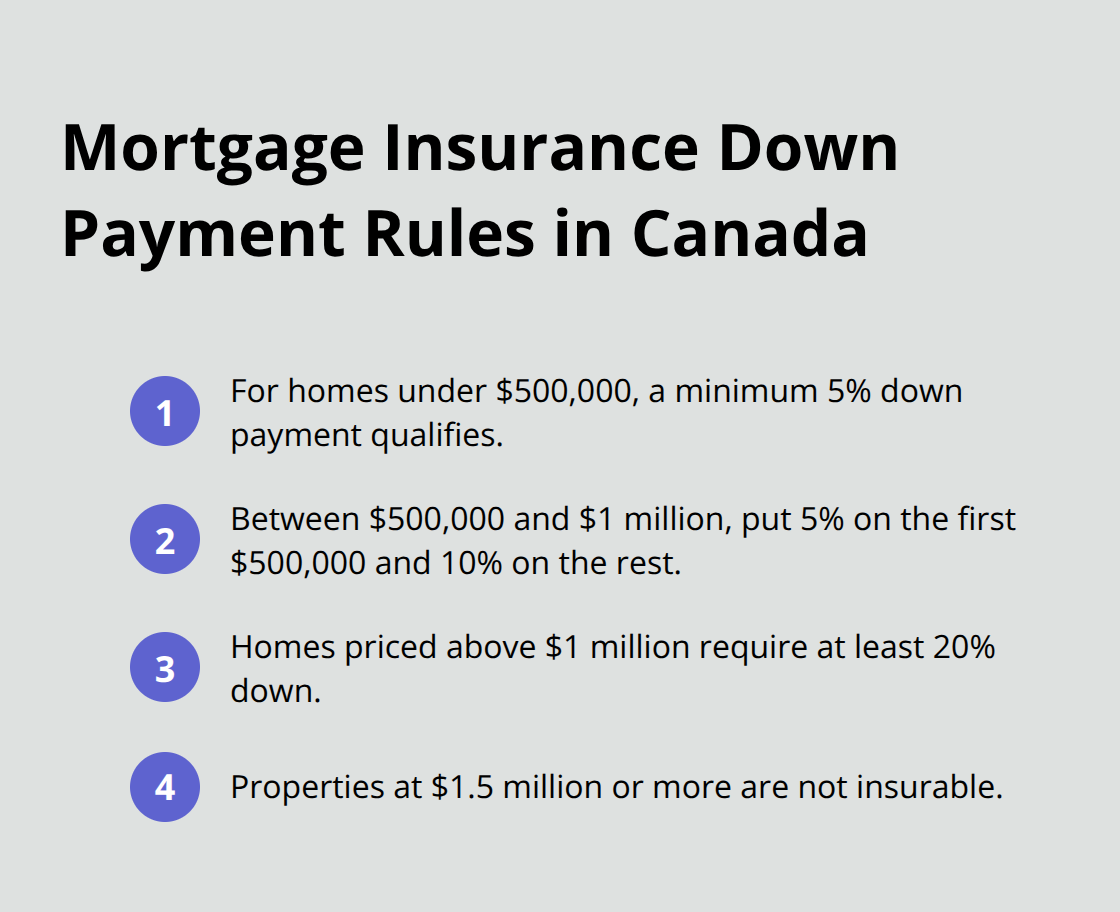
The moment your down payment falls below 20% of the purchase price, mortgage insurance becomes mandatory. For homes under $500,000, you can put down as little as 5% and still qualify. Between $500,000 and $1 million, you need 5% on the first $500,000 and 10% on the remaining amount. Above $1 million, the rules tighten: you must put down at least 20% of the entire purchase price. Homes valued at $1.5 million or higher don’t qualify for insurance at all, meaning a $1.2 million home requires a $240,000 down payment minimum.
Credit and Debt Service Ratios That Lenders Examine
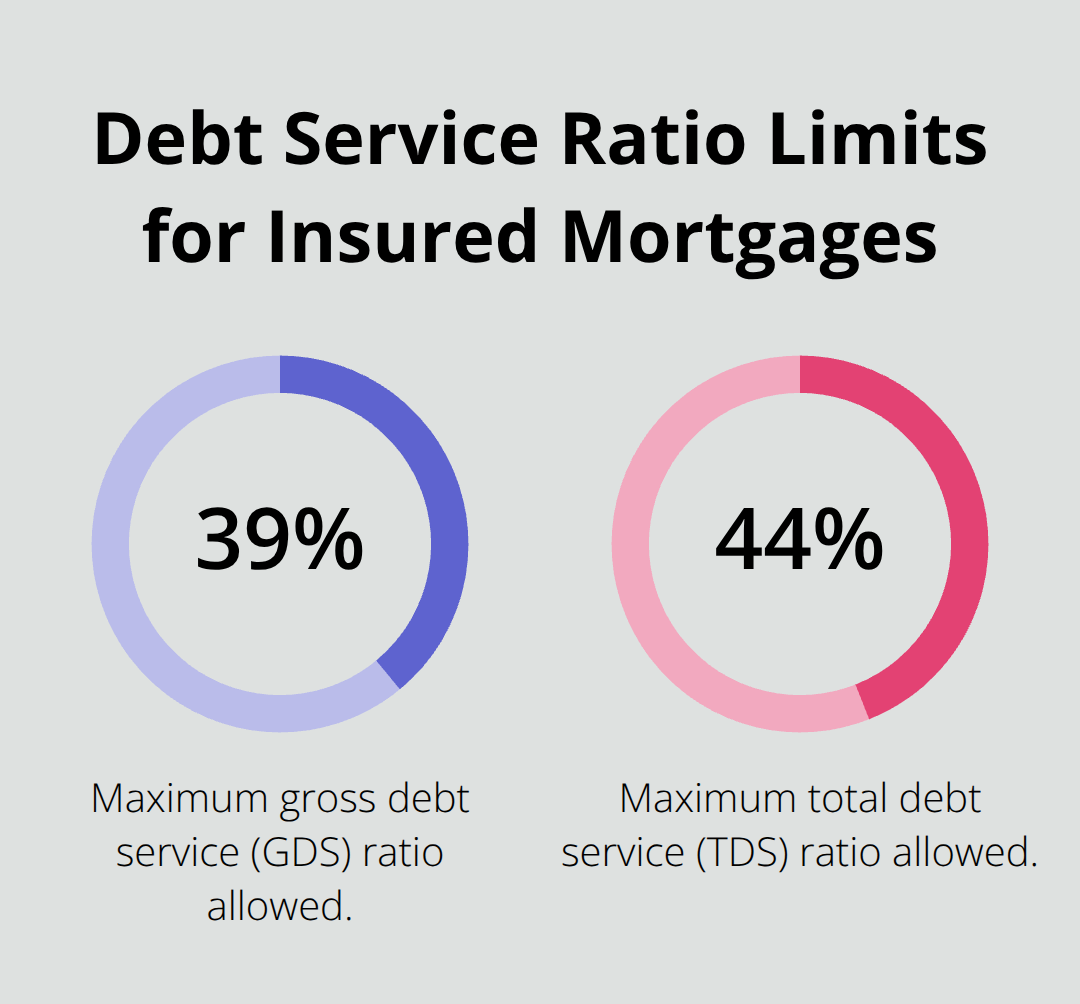
Your credit score needs to reach at least 600 with CMHC or Sagen, though Canada Guaranty requires what they call a strong credit profile. Your gross debt service ratio should stay under 39%, and your total debt service ratio under 44%. These ratios measure how much of your income goes toward housing costs and all debt payments combined. Lenders use these thresholds to determine whether you qualify for an insured mortgage at all, regardless of how much you’ve saved for a down payment. Understanding these requirements helps you assess your readiness before you apply, which brings us to the actual costs you’ll face when mortgage insurance enters your equation.
How Mortgage Insurance Actually Costs You
Your Loan-to-Value Ratio Sets Your Premium
Your loan-to-value ratio determines your insurance premium, and this single number matters more than almost anything else in your mortgage calculation. If you purchase a $400,000 home with 5% down, you borrow $380,000 against a $400,000 property, giving you a 95% LTV. CMHC charges 4% of your loan amount for this risk level, which equals $15,200 in insurance costs. Drop your down payment to 10% on the same home, and your LTV falls to 90%, reducing the premium to 3.1% or $11,160. Jump to 15% down and the premium shrinks to 2.8%, costing $9,520. These aren’t small differences-over a 25-year mortgage, that extra $15,200 in insurance at 5% down translates to roughly $20,000 when you factor in the interest you’ll pay on the financed premium.
How Financed Premiums Add Up Over Time
Most lenders roll your insurance premium directly into your mortgage, which means you pay interest on the insurance amount for the entire amortization period. This financing approach makes your monthly payments lower initially but costs you substantially more over time. Some borrowers in Ontario, Manitoba, Saskatchewan, and Quebec face an additional burden: provincial sales tax on the insurance premium, which gets charged upfront as part of your closing costs. If you have the cash available, paying the premium upfront avoids this tax and prevents interest from accumulating, but few buyers have $15,000 sitting around when they’re already stretching their down payment savings.
Making the Down Payment Decision
Saving an additional 5% for your down payment often makes financial sense, even if it delays your purchase by a year or two. Calculate your actual insurance cost using CMHC’s online tools before you commit to a purchase price or down payment amount. Knowing that a $20,000 down payment costs you $15,200 in insurance versus a $40,000 down payment costing you $11,160 gives you concrete numbers to work with when deciding whether to wait or buy now. Don’t let lenders quote you an interest rate without also showing you the full insurance premium and what it adds to your total borrowing cost. Understanding these concrete costs positions you to evaluate whether strategies exist to reduce or eliminate your insurance obligation altogether.
How to Reduce Your Mortgage Insurance Cost
The path to avoiding mortgage insurance entirely comes down to one number: your down payment. Most Canadian homebuyers accept mortgage insurance as inevitable, but this assumption costs them tens of thousands of dollars. If you can push your down payment from 5% to 20%, you eliminate insurance entirely and avoid the 4% premium charge that would otherwise follow you for years. The math is stark. On a $400,000 home, the difference between 5% and 20% down is $60,000 in saved capital, but it also saves you $15,200 in insurance costs plus roughly $5,000 in interest on that financed premium over 25 years. That’s $20,200 in total savings just from waiting another year or two to accumulate more down payment funds.
Build Your Down Payment Faster
Most people can redirect $500 to $1,000 monthly toward a down payment fund without drastically changing their lifestyle. If you’re currently renting and paying $1,500 monthly, allocate $750 toward down payment savings while reducing discretionary spending. This strategy gets you to a 15% down payment within 18 to 24 months on a $400,000 home. At 15% down, your insurance premium drops to 2.8%, cutting your total insurance cost to roughly $9,500. That’s $5,700 less than the 5% down scenario.
Accept Family Gifts Without Complications
Gifts from family members toward your down payment don’t trigger mortgage insurance consequences the way some borrowers fear. Your lender cares about the actual down payment percentage, not where the money originates. If your parents gift you $50,000 toward a $400,000 purchase, you now have a 12.5% down payment instead of whatever you’d accumulated alone. This gift moves you from the 4% insurance bracket into the 3.1% bracket, saving $3,040 in premium costs immediately.
Some borrowers explore purchasing property directly from family at below-market prices, treating it as a down payment strategy. This approach carries risk. Lenders scrutinize sales to family members, and if a property valued at $400,000 sells for $350,000, the lender bases mortgage qualification on the appraised value, not the purchase price. You’d still need to document a legitimate reason for the below-market sale, and many lenders require independent appraisals that often reveal the market value anyway. The cleaner approach is accepting a family gift outright rather than restructuring the entire purchase price.
Leverage Combined Income to Qualify Faster
Spousal or partner income becomes your leverage when your individual earnings fall short of qualifying ratios. If you earn $60,000 annually and your partner earns $70,000, your combined $130,000 income opens mortgage qualification doors that neither of you could access alone. Your total debt service ratio needs to stay under 44% according to CMHC guidelines, meaning your combined housing costs plus all debt payments can’t exceed 44% of your gross household income.
With $130,000 combined income, you can carry roughly $57,200 annually in total debt service costs. This translates to approximately $4,767 monthly. On a $400,000 purchase with 10% down, your mortgage payment sits around $2,200, leaving substantial room for your debt service ratio to accommodate the purchase. The timing matters here. Adding a spouse’s income to your mortgage application takes weeks of documentation and verification. If you’re targeting a specific property or closing timeline, start this process immediately rather than waiting until you’ve found your home. Lenders move slowly on income verification, and delays can cost you the property or force you into a higher insurance bracket if rates change during processing.
Final Thoughts
Mortgage insurance becomes mandatory the moment your down payment falls below 20%, and this reality shapes the financial decisions of most Canadian homebuyers. The cost ranges from 1.6% to 4.00% of your mortgage amount, with lower down payments triggering the highest premiums. A 5% down payment on a $400,000 home costs $15,200 in insurance alone, plus roughly $5,000 in interest over 25 years-that’s real money that disappears from your equity building.
The mortgage insurance tips Canada homebuyers should prioritize focus on three concrete strategies. Save aggressively toward a 15% or 20% down payment, even if it delays your purchase by a year or two, since the insurance savings justify the wait. Accept family gifts without hesitation, as they directly reduce your loan-to-value ratio and lower your premium bracket.
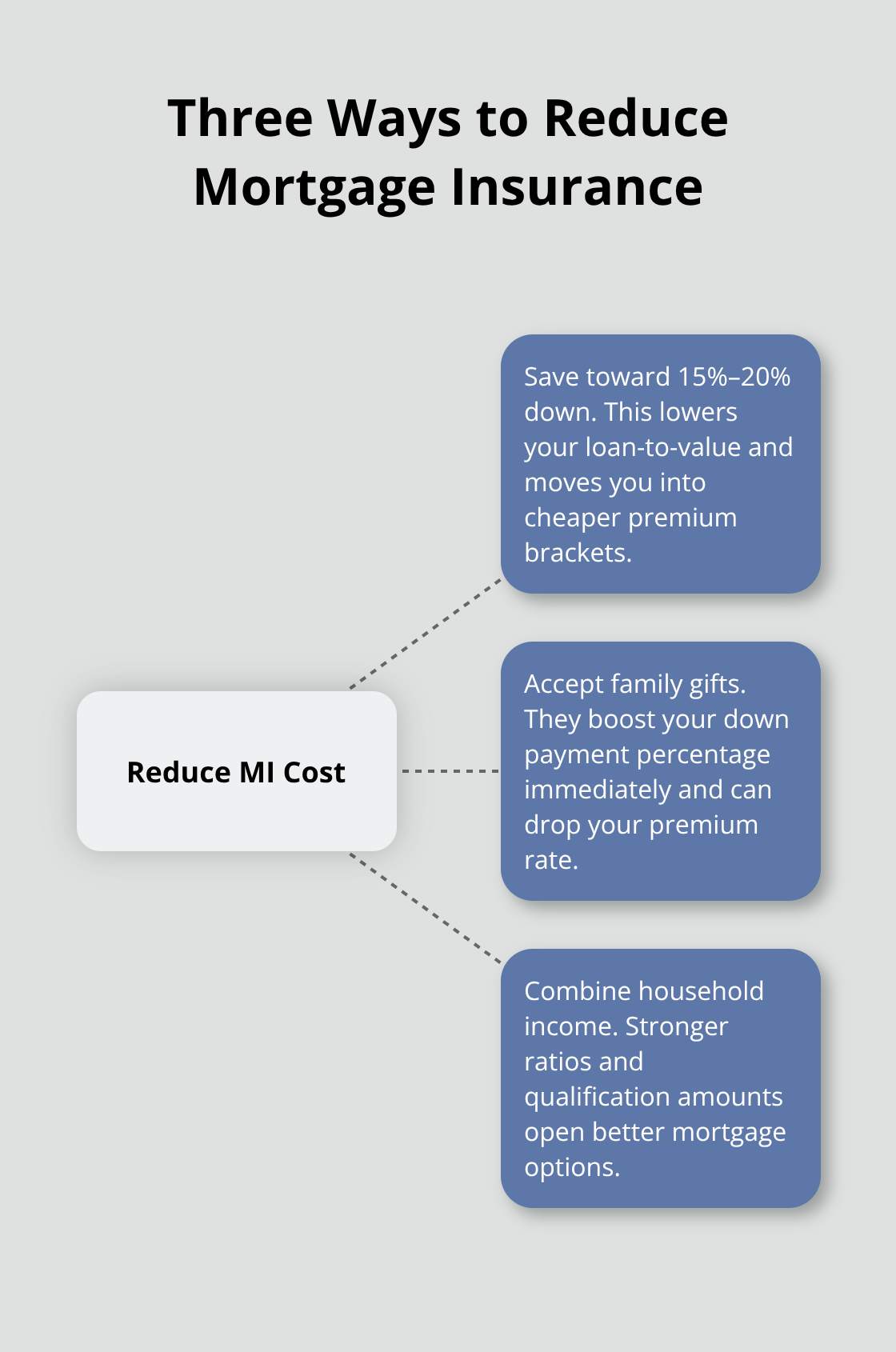
Combine household income with a spouse or partner to qualify for larger mortgages and better debt service ratios, which opens doors that individual income alone cannot reach.
Your next step depends on your current situation. If you’re renting and can allocate $750 monthly toward down payment savings, you’ll reach 15% down within two years on most properties. If family support is available, pursue it immediately, and if you’re partnered, gather your combined income documentation and discuss mortgage qualification with lenders before you start house hunting. We at Financial Canadian help you navigate complex financial decisions with clarity-visit our financial resources to explore tools and guidance that support your homebuying strategy.











Leave a comment