
When you need cash fast, same day payday loans in Canada offer a straightforward way to bridge a financial gap. We at Financial Canadian break down how these loans work, what they cost, and whether they’re right for your situation.
The reality is that payday loans aren’t for everyone, but for some Canadians facing urgent expenses, they can be a practical option. This guide walks you through the facts so you can make an informed decision.
How Same Day Payday Loans Actually Work
What You Need to Qualify
Getting a payday loan in Canada is faster than traditional bank loans, but lenders still need to verify your income and identity before handing over cash. You’ll need proof of 3 months of continuous employment, a valid ID, proof of address, and an active chequing account. Most lenders won’t run a credit check, which is why payday loans appeal to people with damaged credit histories. This speed comes with a cost-lenders charge up to $14 per $100 borrowed, meaning a $300 loan for 2 weeks costs roughly $42.
The Application and Approval Timeline
The application itself takes minutes online or in-branch, and approval happens within hours for legitimate licensed lenders. Funds typically arrive within the same business day through direct deposit, though some lenders may take 24 hours depending on your bank’s processing speed. This is where payday loans genuinely stand apart from personal loans or credit card advances, which can take days or weeks to process.
Verify Your Lender’s Legitimacy
The critical step most Canadians miss is verifying the lender is actually licensed in their province. Ontario, for example, requires lenders to display their licence number prominently on contracts and advertising. Unlicensed lenders and lead generators (sites that collect your information and sell it to multiple lenders) are common pitfalls that expose you to identity theft and predatory terms. Before applying, confirm the lender operates legally and ask upfront what you’ll pay in total, whether late fees apply, and what happens if you miss your repayment date.
Know Your Legal Protections
Federal regulations cap the cost of borrowing at $14 per $100 borrowed, and Ontario’s Payday Loans Act limits dishonoured payment fees to $20. You also have 2 business days to cancel any payday loan without penalty, which gives you a genuine safety window if terms aren’t what you expected. The extended payment plan is valuable if you’re worried about multiple loans-if you take three payday loans within 63 days, you can spread repayment over at least three pay periods without extra fees, capping each installment at 35% of the loan amount plus costs.
Now that you understand how same day payday loans work and what protections exist, the next step is comparing them to other fast cash options available to Canadian borrowers.
Comparing Payday Loans to Other Fast Cash Options
Personal Installment Loans: Lower Rates, Longer Wait
Personal installment loans sound appealing because they stretch repayment over months instead of weeks, but the math often works against you when speed matters. A $500 personal installment loan from a Canadian bank or credit union typically carries between 8% and 20% APR depending on your credit score and the lender. Over a 12-month term, that amounts to $20 to $100 in interest alone. A payday loan for the same $500 over two weeks costs $70 at the $14 per $100 rate, which appears high until you realize you repay it immediately rather than carry debt for a year.
The real advantage of installment loans is predictability and lower total cost if you actually need the money for longer than two weeks. Most banks require a credit check and take 3 to 5 business days to approve, which eliminates the speed advantage payday loans offer. If you have decent credit and can wait a few days, an installment loan from your bank beats a payday loan every time.
Credit Card Cash Advances: Expensive and Risky
Credit card cash advances are deceptively expensive and you should avoid them at almost all costs. While your credit card may advertise a 19% purchase APR, cash advances typically carry 22% to 25% APR plus an upfront fee of 3% to 5% of the amount withdrawn. A $500 cash advance costs $15 to $25 immediately, then accrues interest at roughly 22% annually with no grace period. That totals $110 in interest over a year, plus your initial fee-making it significantly more expensive than a payday loan for short-term borrowing.
Lines of Credit: Flexible but Slow to Access
Lines of credit function like flexible overdraft protection tied to your home or other assets. Canadian lenders offer lines of credit at prime plus 0.5% to 2%, which currently sits around 6.95% to 8.95% APR for most borrowers. The catch is approval takes weeks and you need solid credit and collateral. For someone facing a genuine emergency with poor credit and no time to wait, a payday loan at $14 per $100 borrowed is actually cheaper than a credit card cash advance and faster than any bank product.
When Payday Loans Make Financial Sense
That doesn’t make payday loans ideal, but it makes them rational in specific situations where other options simply don’t exist or won’t arrive in time. The next section breaks down the actual costs, rates, and terms you’ll encounter with Canadian payday lenders so you can compare them directly to your other available options.
What Payday Loans Actually Cost You
The Base Borrowing Cost
The federal cap of $14 per $100 borrowed sets the ceiling across Canada, but what you actually pay depends on your loan amount and lender. A $300 loan for two weeks costs $42, while a $1,000 loan over the same period runs $140. These numbers sound manageable until you realize what happens when borrowers take multiple loans.
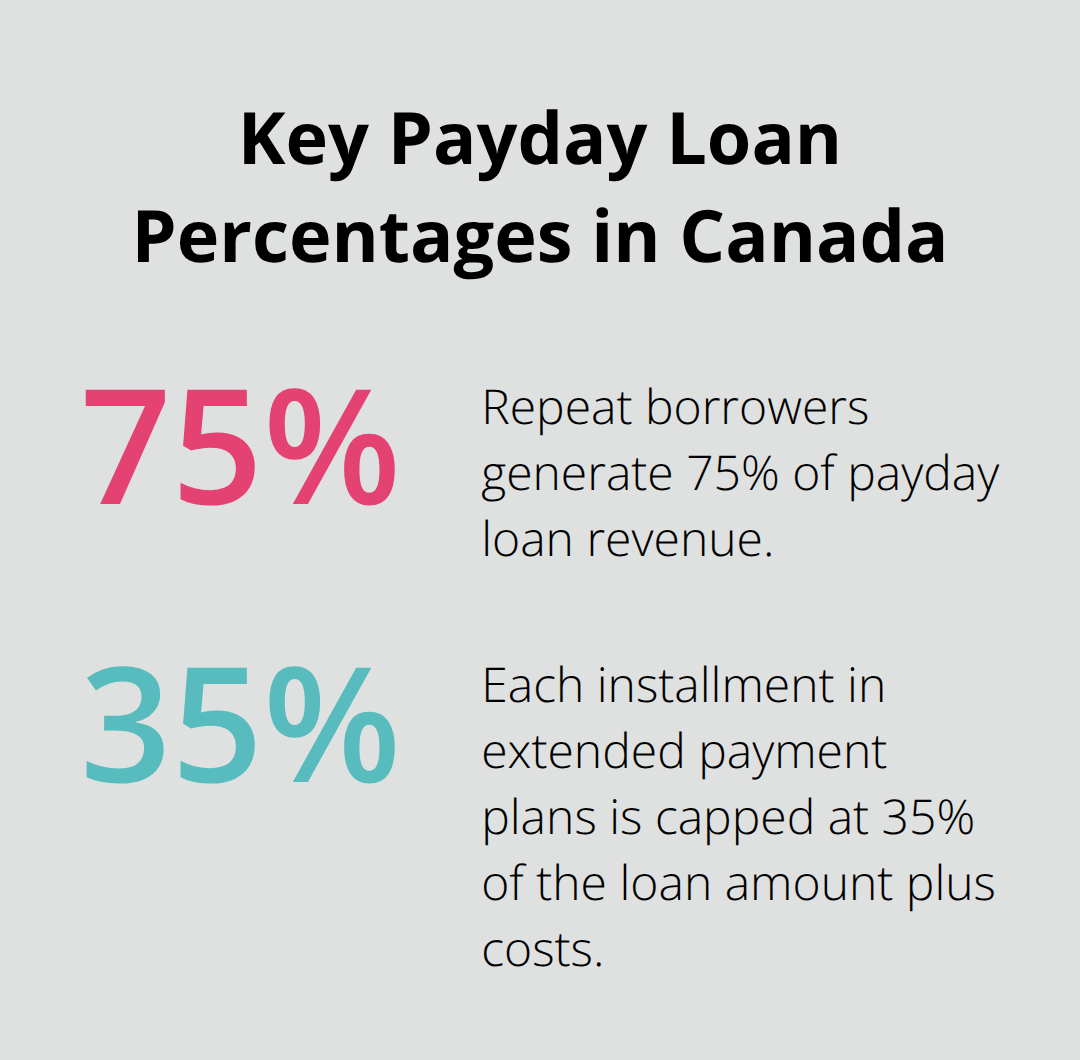
Statistics from provincial regulators show that roughly 75% of payday loan revenue comes from repeat borrowers caught in a cycle of rolling debt. Once you borrow again before repaying the first loan, costs compound quickly.
The Rollover Trap and Extended Payment Plans
Ontario’s Payday Loans Act prohibits rollovers, meaning you cannot roll outstanding balance into a second loan from the same lender, but nothing stops you from borrowing from a different lender. That’s the trap. The extended payment plan becomes critical if you take three payday loans within 63 days-you can spread repayment over at least three pay periods with installments capped at 35% of the loan amount plus costs, avoiding the spiral entirely.
Hidden Fees That Add Up
Beyond the base borrowing cost, watch for fees that stack up. Dishonoured cheques or failed pre-authorized debits cost $20 maximum under current federal rules, though some lenders charge less. Late payment interest on defaulted principal maxes out at 2.5% monthly non-compounding. The real risk lies with unlicensed lenders who ignore these caps entirely.
Questions to Ask Before You Sign
Ask your lender three concrete questions: What is the total dollar amount I will pay back? Are there any fees beyond the $14 per $100? What happens if my cheque bounces or my account lacks funds? Licensed lenders must display APR in advertising and contracts, making comparison straightforward. If a lender won’t answer these questions directly or avoids showing APR, walk away immediately.
Verify Legitimacy and Compare Actual Costs
Your province’s financial regulator maintains a list of licensed lenders-Ontario’s Consumer Protection Ontario database lets you verify legitimacy in seconds. Comparing actual dollar costs across lenders matters far more than discussing APR in abstract terms, since a $400 loan for 14 days from Lender A might cost $56, while the same loan from Lender B costs $48 (a difference of $8 that reflects different fee structures rather than different rates).
Final Thoughts
Same day payday loans Canada serve a specific purpose: you need cash within hours when traditional lenders won’t move fast enough, your credit is too damaged for bank approval, and you can repay within two weeks without rolling into another loan. Verify your lender is licensed in your province before you apply anywhere-Ontario lenders must display their licence number on contracts and advertising, and your provincial regulator maintains a database to confirm legitimacy. Ask three questions upfront: What’s the total dollar amount I’ll repay? Are there fees beyond the $14 per $100 base cost? What happens if I miss my payment date?
Licensed lenders answer these questions directly and show APR in writing, while unlicensed operators and lead generators expose you to identity theft and predatory terms that ignore federal borrowing caps. If you take three loans within 63 days, use the extended payment plan immediately to avoid the debt spiral that traps most repeat borrowers-roughly 75% of payday loan revenue comes from repeat borrowers, which tells you everything about the risk. Treat payday loans as a genuine last resort, not a convenient shortcut, and exhaust safer alternatives like borrowing from family, credit unions, or personal installment loans first.
Informed borrowers make better financial decisions. Visit our resource center where we help you navigate lending options with clarity and confidence.









Leave a comment