
When you need cash fast, an instant loan in Canada today might be the answer. We at Financial Canadian understand that unexpected expenses don’t wait, and traditional bank loans can take weeks to process.
This guide walks you through how instant loans work, how they compare to conventional financing, and how to pick the right option for your situation.
How Instant Loans Work in Canada
The Application Process
You can apply for an instant loan online in minutes, a stark contrast to traditional bank loans that demand branch visits and weeks of paperwork. Most lenders start with a soft credit check, which doesn’t impact your credit score, then verify your basic eligibility. You’ll need to be 18 or older, have valid identification, proof of steady income, an open chequing account, a home address, and a phone number. The application itself is simple: you complete a quick form online and choose your funding method (direct deposit or Interac e-Transfer). If you’re approved and accept the offer, a hard credit inquiry occurs, which can affect your credit score by a few points. Understanding eligibility requirements helps you prepare the right documents before applying.
Speed of Funding
Funding speed varies by lender and method, but this is where instant loans truly outpace traditional financing. Direct deposit typically takes 24 hours, while Interac e-Transfer can arrive in as little as 15 minutes, though some transfers take up to 24 hours depending on your bank’s processing times and Interac availability. This rapid access to cash makes instant loans genuinely different from conventional bank loans, which require weeks of processing before you see any money.
Types of Instant Loans Available
Canada offers several instant loan categories tailored to different needs. Line of Credit products let you borrow up to an approved limit, pay interest only on what you use, and automatically replenish available credit as you repay. Secured Loans require collateral like a vehicle and typically offer higher amounts (up to $25,000) with lower APRs, though you must visit a branch for approval and bring your vehicle for verification. Installment Loans cover $500 to $25,000 with fixed repayment terms from 6 to 84 months, giving you predictable monthly payments. For example, a $4,500 installment loan over 36 months costs approximately $203.42 monthly. Payment frequency options include weekly, biweekly, monthly, and bi-monthly arrangements, letting you align repayment with your income schedule.
High-Cost Loan Options
Payday loans represent the shortest-term option, offering amounts up to $1,500 and available online in Alberta, Ontario, Nova Scotia, Saskatchewan, and Prince Edward Island. These loans carry significantly higher costs with APRs around 365% in Ontario. Understanding which loan type matches your situation prevents overpaying and helps you manage repayment realistically. Now that you know how these loans work, the next step is comparing them to traditional financing options to see which approach truly fits your financial picture.
Comparing Instant Loans to Traditional Bank Financing
Interest Rates: The Speed Premium
Instant loans and traditional bank financing operate in completely different worlds when it comes to cost. While the average personal loan interest rate is 12.75%, borrowers with excellent credit may have access to rates as low as 5.96%. Instant loans charge significantly higher rates-Lines of Credit run 34.99% APR, Secured Loans range from 24.99% to 34.99% APR, and Installment Loans sit between 34.56% and 34.95% APR. The trade-off is explicit: you pay more per dollar borrowed, but you receive cash today instead of next month.
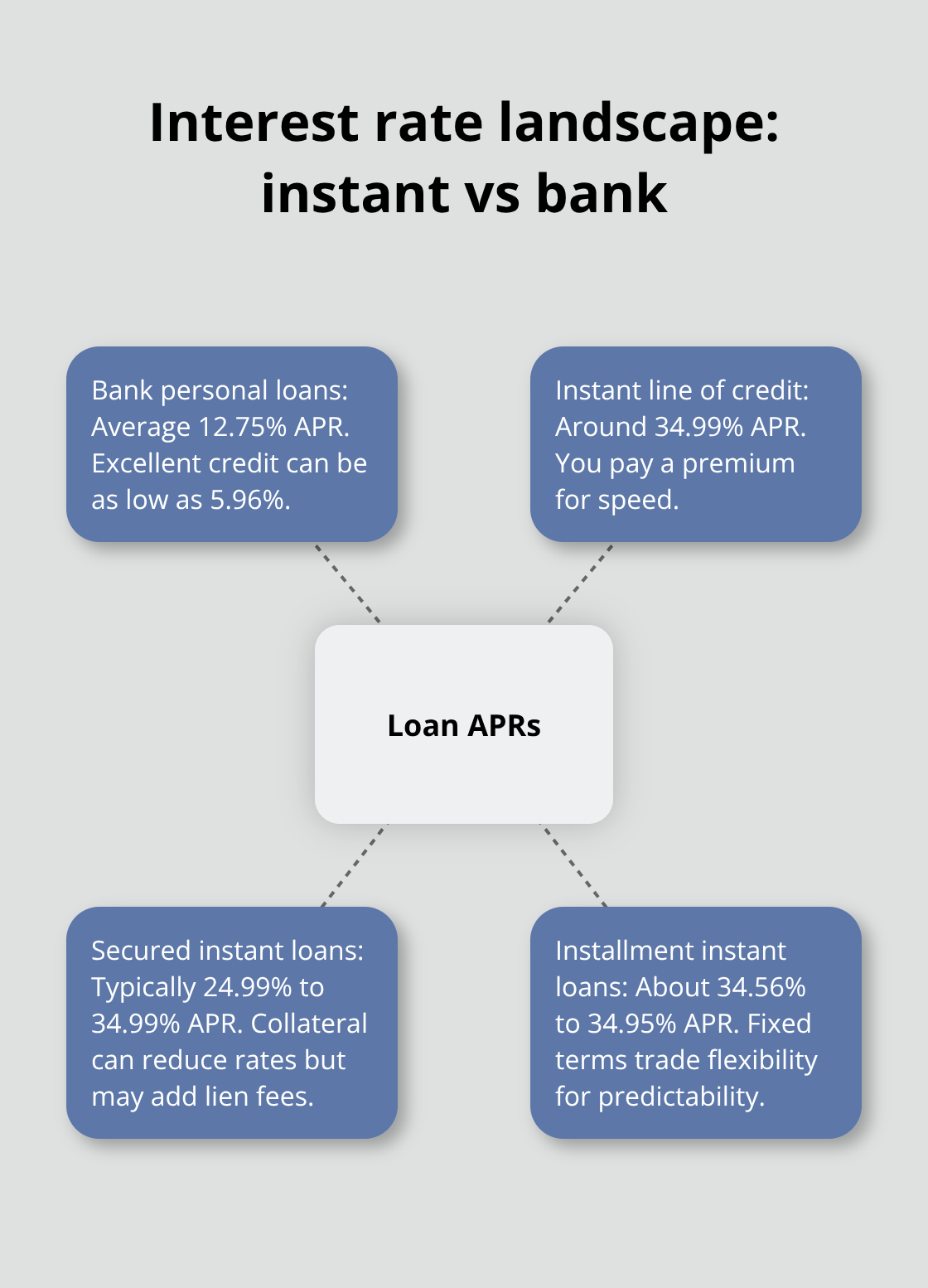
Beyond interest rates, instant lenders add lien and security search fees for secured products that vary by province, while traditional banks bundle these costs into their overall loan structure. This means comparing a bank loan to a 35% instant loan looks straightforward on paper, but the real comparison should factor in how quickly you need the money and whether waiting weeks costs you more in late fees or missed opportunities.
Credit Requirements and Approval Standards
Traditional banks demand extensive documentation and perfect credit scores, typically requiring a minimum of 650 or higher. Instant lenders accept applicants with lower credit scores because they evaluate your current income rather than your historical credit behavior. If you’ve had payment struggles in the past but earn steady income now, an instant lender will approve you where a bank won’t.
The eligibility gap matters in real situations: if you need $2,000 in three days and your credit score is 580, a traditional bank will reject you outright, but multiple instant lenders will fund you within hours.
Repayment Flexibility and Payment Timing
Repayment flexibility differs significantly between these two financing approaches. Instant lenders offer weekly, biweekly, monthly, or bi-monthly payment schedules aligned with your payday, while banks lock you into fixed monthly payments regardless of when you actually earn money. This payday-friendly approach reduces the risk of missing payments simply because your paycheck doesn’t sync with your due date.
When your income arrives on specific days, matching your loan payments to those dates prevents the cash flow gaps that traditional monthly payment schedules create. This alignment transforms how you manage your budget and reduces the likelihood of overdraft fees or late charges.
Moving Forward: Finding Your Right Fit
The choice between instant loans and traditional financing ultimately depends on your timeline and credit profile. Understanding these differences prepares you to evaluate which option actually serves your financial situation, rather than assuming one approach works universally for everyone.
Choosing the Right Instant Loan for Your Situation
Calculate Your Exact Need
Start by calculating exactly how much you need and when you need it, because this determines everything else. If you need $1,500 in two days, a payday loan online in Alberta, Ontario, Nova Scotia, Saskatchewan, or Prince Edward Island works fast. If you need $8,000 and can visit a branch, a secured loan against your vehicle offers lower rates (24.99% to 34.99% APR) compared to unsecured options at 34.99% APR. If you need $3,000 and want predictable payments, an installment loan costs approximately $203.42 monthly for a $4,500 loan over 36 months, letting you budget with certainty. The amount and timeline directly determine your best option, not general preference.
Evaluate Lenders on Three Core Criteria
Evaluate lenders on three concrete criteria: funding speed, actual APR cost, and whether they report to Equifax Canada. Funding speed matters because Interac e-Transfer arrives in 15 minutes to 24 hours depending on your bank, while direct deposit takes up to 24 hours. Some lenders advertise 15-minute funding but only if your bank processes instantly; verify your specific bank’s processing time before applying.
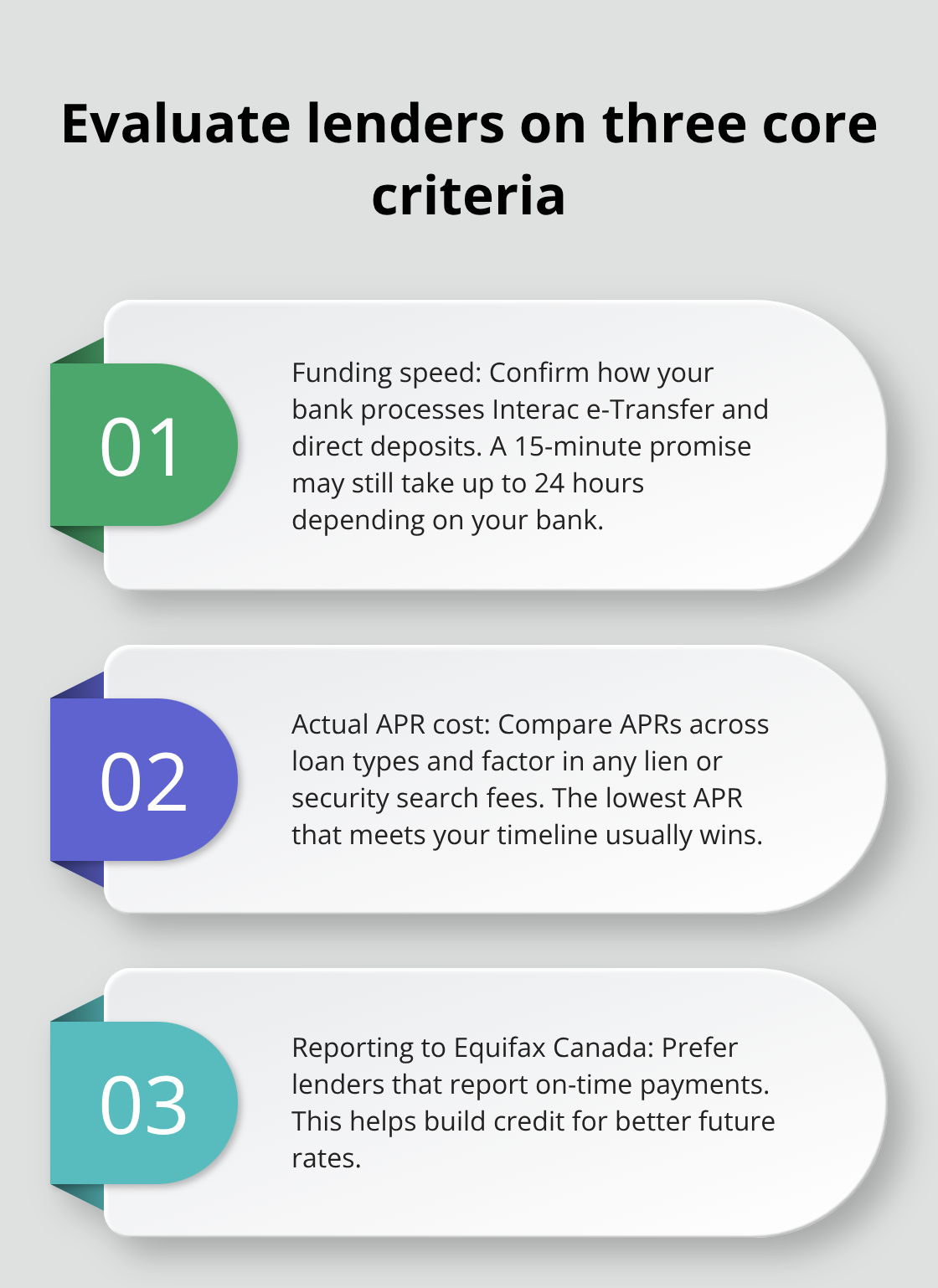
APR cost varies significantly even within loan types-a line of credit at 34.99% costs more than a secured loan at 24.99%, so the loan type you choose directly impacts how much interest you pay. Lenders that report payment history to Equifax Canada help you build credit when you repay on time, which matters if you want better rates on future loans. Lenders that don’t report provide no credit-building benefit, making them purely transactional. Check whether your chosen lender reports to Equifax before signing anything.
Account for Hidden Costs and Add-Ons
Hidden costs include lien and security search fees for secured loans that vary by province. Some lenders bundle these into the APR, while others charge separately; get the total cost in writing. Loan Protection Plans are optional add-ons underwritten by Canadian Premier Life Insurance Company and Canadian Premier General Insurance Company that cover job loss, injury, sickness, or death. These typically cost extra monthly, so calculate whether the protection justifies the expense for your situation. Read the cancellation terms because some plans lock you in while others allow immediate cancellation.
Align Payments With Your Income Schedule
Payment frequency alignment matters more than most borrowers realize-if you’re paid biweekly, try biweekly payments to avoid cash flow gaps. Missing a payment because your paycheck arrives three days after your due date costs late fees and damages your credit, so this scheduling detail prevents real financial damage.
Final Thoughts
An instant loan in Canada today serves a real purpose: it bridges the gap between unexpected expenses and traditional financing timelines. The speed advantage is genuine-funding in 15 minutes to 24 hours versus weeks through a bank-but this convenience carries a cost. Interest rates between 24.99% and 34.99% APR mean you’ll pay significantly more than traditional lenders charge, so this option works best when timing matters more than cost.
Before applying, honestly assess whether you actually need the speed or whether you’re simply impatient. If you can wait two weeks for a bank loan at 12% APR, that’s substantially cheaper than an instant loan at 35% APR. If you genuinely need cash within 48 hours and your credit score is below 650, an instant loan becomes the only realistic option, not just a convenient one. The three decisions that matter most are your exact borrowing amount, your required timeline, and which lender actually reports to Equifax Canada (since lenders that report payment history help you build credit for future borrowing, while those that don’t provide zero credit-building benefit).
Read the full terms before accepting any offer, particularly regarding lien fees for secured loans and cancellation terms for optional protection plans. These details shift your actual cost significantly. We at Financial Canadian help you make informed financial decisions by providing reliable information whenever you need it.











Leave a comment