
Your credit score shapes whether you get approved for mortgages, car loans, and credit cards-and what interest rates you’ll pay. A weak credit history can cost you thousands in higher borrowing costs over your lifetime.
At Financial Canadian, we’ve created this guide with practical build credit Canada tips you can start using immediately. Whether you’re rebuilding from scratch or optimizing an existing score, these steps will show you exactly how to strengthen your credit history.
What You Need to Know About Canadian Credit Scores
Canada’s credit scoring system operates on a 300 to 900 scale, with most lenders viewing scores above 680 as a meaningful threshold for approval odds. TransUnion and Equifax track your payment history and account activity, then sell that information to banks, credit card companies, and other lenders who use it to decide whether to lend to you and at what rate. Your score reflects five key components: payment history accounts for roughly 35% of your score, which is why a single late payment can drop your rating by 10 to 50 points depending on how overdue it was. Credit utilization makes up about 30% of your score, meaning if you have a $1,000 credit limit and carry a $400 balance, you’re at 40% utilization and damage your score. The remaining 35% comes from credit history length, new credit inquiries, and credit mix, so applying for multiple cards within a short window signals desperation to lenders and temporarily lowers your score by a few points each time.

The Score Ranges That Actually Matter
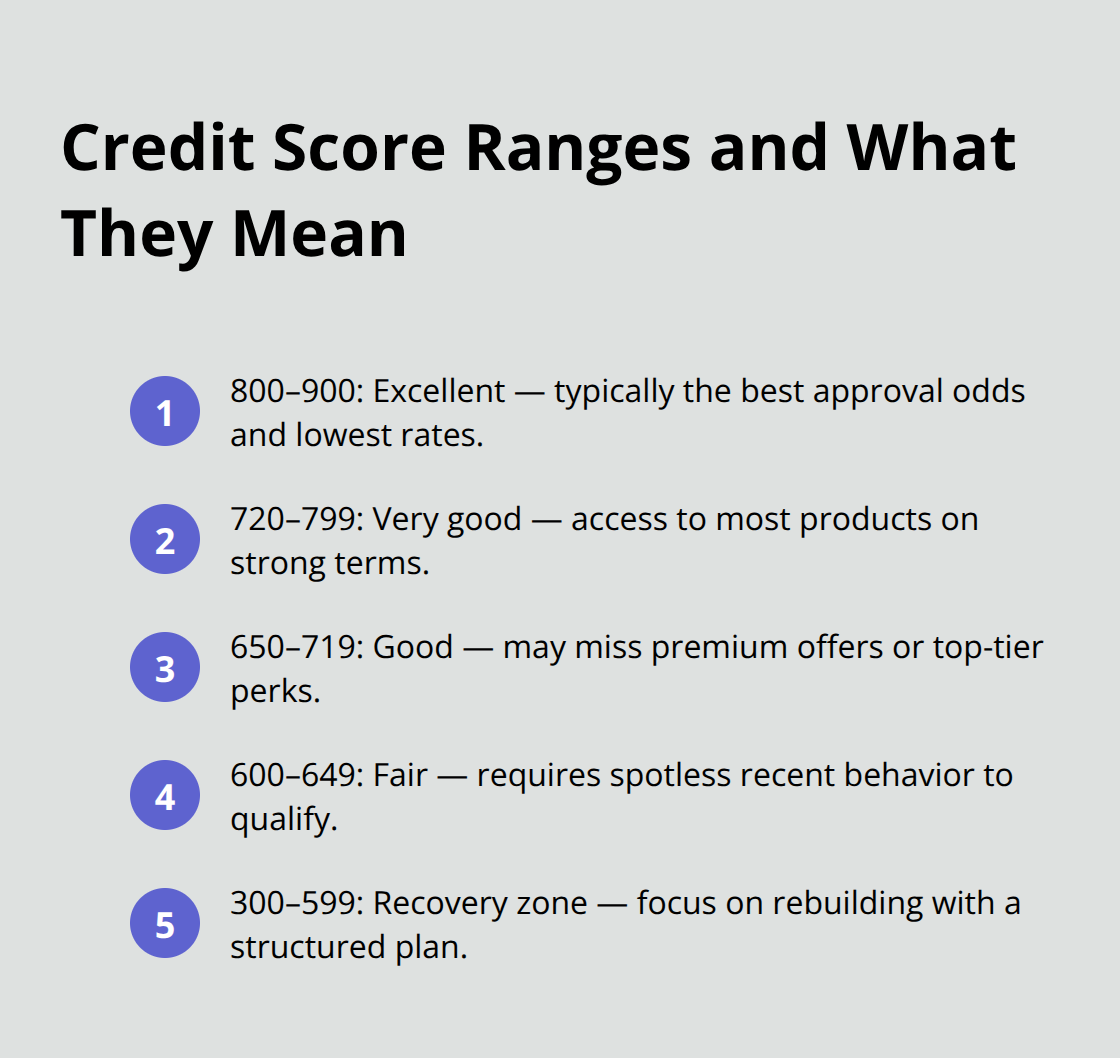
Credit Karma breaks down the ranges like this: 800 to 900 is excellent and gets you the best interest rates, 720 to 799 is very good and opens most doors, 650 to 719 is good but may exclude you from premium offers, 600 to 649 is fair and requires spotless recent behavior to compensate, and 300 to 599 means you need a focused recovery plan. Most people overestimate how quickly scores improve, but consistent on-time payments for six months start showing measurable gains. Your two bureaus often report slightly different scores because not all creditors report to both, so checking your score through your bank’s online portal and then pulling your actual credit report from both TransUnion and Equifax separately gives you a complete picture.
Newcomers to Canada face a particularly steep climb since past credit history doesn’t transfer, so you start from zero and must rebuild entirely through Canadian accounts and payment records.
Why Payment History Dominates Everything Else
A missed payment by 30 days stays on your report for six years and costs you far more than the late fee itself. A single missed payment can knock 100+ points off a strong score, while someone rebuilding from fair credit might lose only 20 to 30 points because they have less to lose. Setting up automatic payments for at least your minimum amounts removes the most common reason people damage their credit: simple forgetfulness. Keeping balances under 30% of your limit is your second-most powerful lever, so if you have $5,000 in total credit available across all cards, try staying under $1,500 in total balances. The difference between paying $1,400 and $1,500 on those same accounts can be the difference between a 750 and a 780 score, which translates directly into lower mortgage rates and better approval odds for future credit.
How to Start Taking Action Today
You now understand the mechanics behind your score and the ranges that matter to lenders. The next section walks you through the specific, practical steps that move your score upward month after month.
The Three Actions That Actually Move Your Score
Set Up Automatic Payments to Eliminate Missed Deadlines
Automatic payments represent the single most effective tactic for credit building because they eliminate the human error that derails most people. Payment history accounts for 35% of your score, and even one missed payment by 30 days can drop a strong score by 100+ points. Configure automatic payments for at least your minimum balance on every credit account you hold, then set a calendar reminder to review your accounts monthly and pay any balance above the minimum if you can afford it. This approach guarantees you never miss a due date while preserving flexibility to pay more when cash flow allows.
Most Canadian banks including TD, RBC, and BMO offer automatic payment setup through their online portals, and the process takes fewer than five minutes per account. If you have five credit products and miss one payment on each, you’re looking at 500 points of damage across your credit file, which takes months of perfect behavior to recover from. The setup removes your reliance on memory and protects your score from preventable harm.
Keep Credit Utilization Below 30% to Signal Financial Responsibility
Keeping your credit utilization below 30% demonstrates you’re not desperate for credit and can manage borrowed money responsibly. If you have a $1,000 limit on one card and a $4,000 limit on another, your total available credit is $5,000, which means you should carry no more than $1,500 across both cards combined. The difference between 40% utilization and 20% utilization on the same accounts can swing your score by 30 to 50 points, so this metric matters far more than most people realize.
The mechanics here are straightforward: pay down balances before your statement closing date, not just before your due date, because your credit utilization is calculated based on what appears on your statement. If your statement closes on the 15th of each month, paying on the 20th does nothing for your utilization that month even though it prevents a late payment. This timing distinction separates people who maintain 750+ scores from those stuck in the 650 to 700 range despite making all their payments on time.
Add Different Credit Products Strategically, Not Frantically
Diversifying across different credit products matters far less than people think, but it does account for roughly 10% of your score. Adding a car loan, mortgage, or secured credit card to your file alongside revolving credit like standard credit cards shows you can handle different borrowing types responsibly. However, never apply for multiple new accounts within a short window because each hard inquiry drops your score by a few points and signals financial distress to lenders.

Space new credit applications at least three to six months apart and only apply when you genuinely need the product, not to artificially boost your credit mix. This disciplined approach protects your score while still building the account diversity that lenders view favorably. Once you’ve mastered these three levers-automatic payments, low utilization, and strategic diversification-you’re ready to monitor your progress and catch any errors that might be holding your score back.
How to Monitor Your Credit Progress
Pull Your Credit Report Annually and Scan for Errors
Checking your credit report and score regularly transforms vague anxiety into concrete action. Pull your full credit report from the three nationwide credit reporting agencies at least once per week, which you can do for free through their official websites without harming your score. You can get one free credit report weekly from each of TransUnion, Equifax, and Experian through their consumer portals, and you can request them directly without going through third-party services that claim to be free but often upsell monitoring packages you don’t need.
When you pull your report, scan for errors like accounts you never opened, incorrect payment statuses, or duplicate entries, because 44 percent of those who checked their credit report found at least one mistake. Disputing inaccurate information takes two to four weeks but can lift your score by 20 to 50 points if the error was significant. This step alone separates people who passively accept their scores from those who actively improve them.
Access Free Credit Score Monitoring Through Your Bank
Your major banks including TD, RBC, BMO, and Scotiabank now offer free credit score monitoring through their online portals, which means you likely already have access without paying extra for third-party apps. Check your score quarterly rather than obsessively tracking it monthly, because scores fluctuate based on payment posting schedules and statement closing dates, so constant monitoring creates false panic when it dips five points one month then climbs back up the next.
Paid credit monitoring services like Borrowell and Credit Karma offer free tiers that show your TransUnion score and basic monitoring, which works adequately for most people building or rebuilding credit. The paid tiers costing 10 to 20 dollars monthly add features like fraud alerts and identity theft insurance, but these overlap with protections your bank already provides, so evaluate whether the extra cost justifies the peace of mind for your situation.
Work With a Credit Counselor for Serious Recovery
If you’re stuck below 650 or recovering from bankruptcy or collections, working with a non-profit credit counselor through Credit Counselling Canada becomes worthwhile because they review your entire financial picture and create a customized recovery timeline at no cost or low cost depending on your income. These counselors have access to lender relationships and hardship programs that individual borrowers cannot access alone, and they negotiate with creditors on your behalf in ways that DIY approaches cannot match.
Track Three Metrics Monthly to Measure Progress
Track three metrics monthly: your payment due dates, your statement balances versus your credit limits, and your overall score trend across quarters (this triangle of data tells you whether your actions are working or whether you need to adjust your strategy). This disciplined approach keeps you focused on what actually moves your score rather than chasing vanity metrics that don’t matter to lenders.
Final Thoughts
Building credit in Canada requires consistency, not perfection. The three actions we’ve outlined-automatic payments, low utilization, and strategic diversification-form the foundation of every strong credit profile. Most people underestimate how quickly these habits compound, but six months of disciplined behavior typically produces measurable score improvements of 30 to 50 points.
Your timeline depends entirely on where you’re starting. Someone rebuilding from 550 will see faster percentage gains than someone optimizing from 750, but both benefit from the same core build credit Canada tips. Newcomers to Canada should expect eighteen to twenty-four months to establish a solid credit file because you’re building from zero, while those with existing accounts can accelerate progress by three to six months through aggressive utilization reduction.
The real work starts after you’ve set up automatic payments and pulled your credit report. You’ll stay disciplined when tempted to max out a card during a sale, resist the urge to apply for new credit when you’re bored, and review your accounts monthly-this separates people who talk about building credit from those who actually do it. At Financial Canadian, we understand that managing your financial reputation matters as much as managing your actual finances, and our web design service helps establish the professional digital presence that complements your financial credibility.











Leave a comment