
Buying your first home in Canada is one of the biggest financial decisions you’ll make. Most first time homebuyers in Canada face the same questions: How much can I borrow? What mortgage type suits me best? What happens at closing?
We at Financial Canadian have created this guide to walk you through each step of the mortgage journey, from assessing your finances to signing the final papers.
Building Your Financial Foundation
Your credit score is the first number lenders examine, and it determines whether you qualify for a mortgage and what interest rate you’ll pay. In Canada, scores range from 300 to 900, with lenders typically preferring 680 or higher for mortgage approval. Pull your credit report from Equifax or TransUnion before you apply-not after-because errors happen frequently and can cost you thousands in higher rates. If your score sits below 680, spend three to six months paying down debt and making on-time payments rather than rushing into a mortgage application. A 50-point improvement in your credit score can reduce your interest rate by 0.5%, which saves approximately $15,000 over a 25-year amortization on a $500,000 mortgage.
How Much Can You Actually Borrow?
Banks will offer you the maximum amount you qualify for, but that number is not what you should borrow. Lenders typically cap your mortgage at 32% of your gross household income for the mortgage payment itself, and 40% when you include property taxes, condo fees, utilities, and other debts. If you earn $120,000 annually, that translates to roughly a $650,000 mortgage at current rates. However, this assumes zero job loss, zero emergencies, and zero lifestyle changes-none of which are realistic. We recommend staying 10% below the maximum the bank offers.
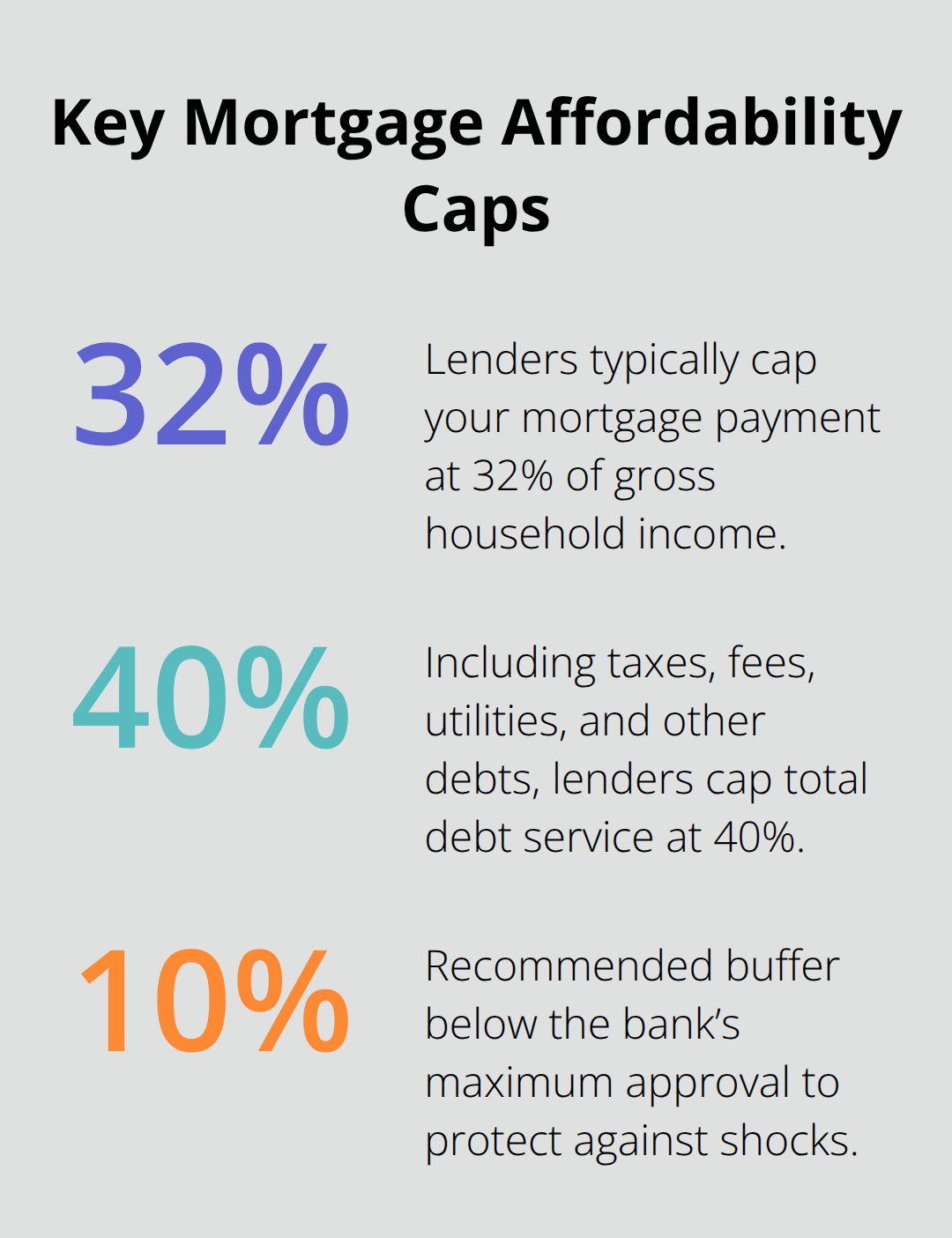
If the bank approves you for $650,000, borrow $585,000 instead. This buffer protects you if interest rates spike during renewal or if one partner loses employment. Statistics Canada data shows that since 2016, multi-party purchases have increased significantly in Ontario, meaning more couples are buying together-yet many couples don’t stress-test their affordability against a single income. That’s a mistake.
Down Payment Options and Tax-Advantaged Accounts
A 20% down payment eliminates mortgage insurance and keeps your monthly payments lower, but most first-time buyers in Canada don’t have 20% saved. According to Tarion’s research on new home buyers, the typical first-time buyer is a single millennial aged 36, and about 35% of first-time buyers were born outside Canada. These demographics tell you that saving a massive down payment takes years. A 5% down payment is legal and available, but you’ll pay mortgage insurance premiums of 2.8% to 4% of your mortgage amount-roughly $14,000 to $26,000 on a $500,000 home. The Home Buyers’ Plan allows you to withdraw up to $60,000 tax-free from your RRSP per person, or $120,000 as a couple, with 15 years to repay it interest-free. The Tax-Free First Home Savings Account lets you contribute up to $8,000 annually with a lifetime cap of $40,000, and contributions are tax-deductible.
Provincial Incentives and Closing Costs
Many first-time buyers overlook provincial incentives entirely-Ontario offers a Land Transfer Tax Refund for first-time buyers, while Quebec provides the Home Buyers’ Tax Credit. Check your specific province’s website because these programs reduce your effective down payment requirement or closing costs. Closing costs themselves run 2% to 3% of the purchase price for legal fees, inspections, and title insurance, so a $650,000 home requires $13,000 to $19,500 in closing costs on top of your down payment. Once you understand what you can afford and what down payment sources are available to you, the next step is to compare the mortgage products that will actually fund your purchase.
Navigating Mortgage Types and Rates
Fixed-rate mortgages lock your interest rate for the entire term, typically five years, meaning your payment never changes regardless of what happens to the Bank of Canada’s prime rate. Variable-rate mortgages tie your rate to the prime rate, so when the central bank cuts rates, your payment drops immediately. The trade-off is straightforward: fixed rates offer predictability and peace of mind, while variable rates offer savings when rates fall but expose you to payment increases when rates rise. In June 2026, fixed rates sit around 4.99% to 5.49% depending on your lender and down payment size, while variable rates hover near 6.20% because lenders charge a premium for the uncertainty. Most first-time buyers should choose fixed rates, not because variable rates are inherently worse, but because your finances are already stretched thin. You’re juggling a new mortgage, moving costs, and home maintenance emergencies. Adding rate volatility on top of that is unnecessary stress.
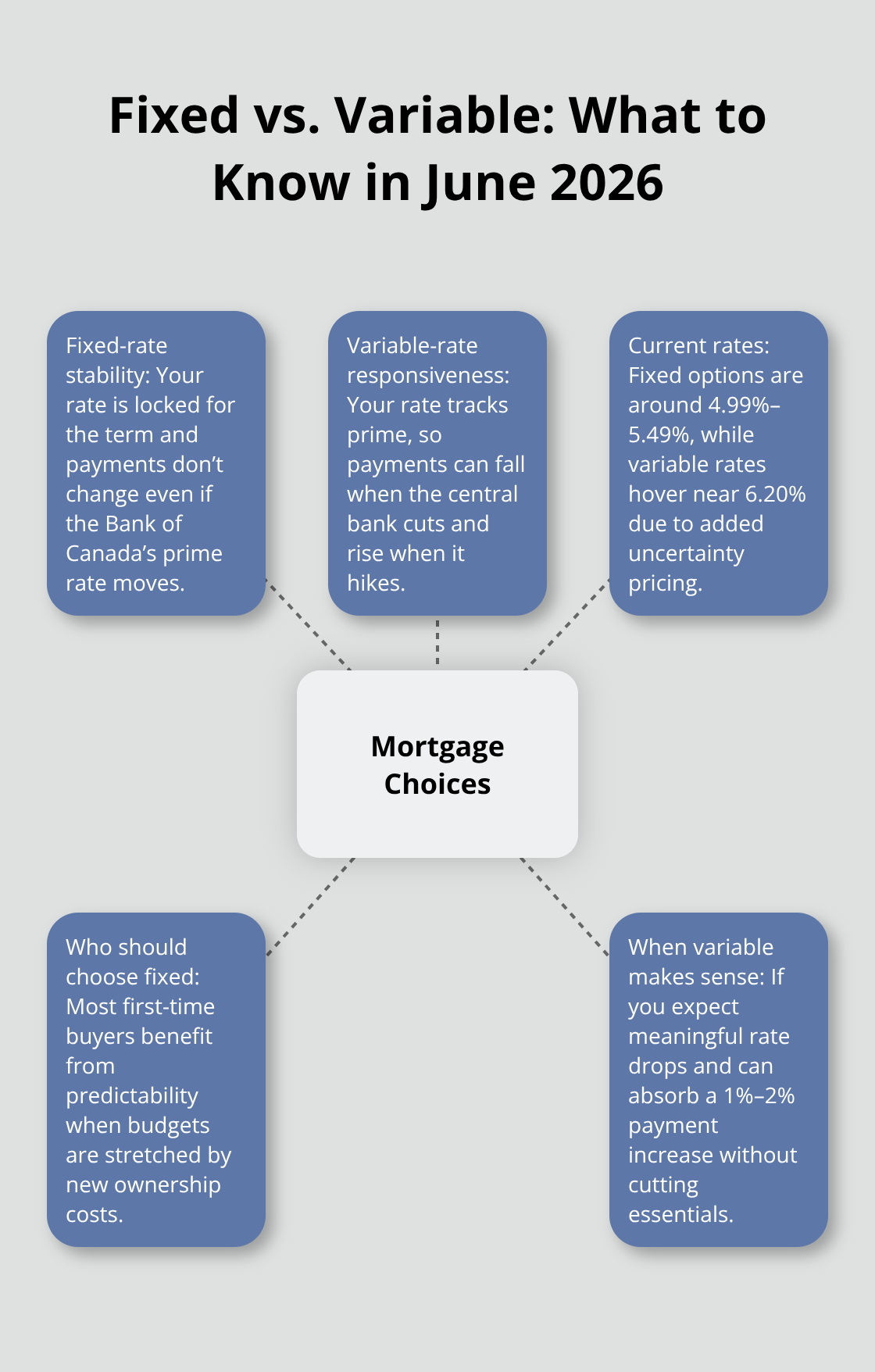
The math only favors variable rates if you’re confident rates will fall significantly within your five-year term and you have a financial cushion to absorb a 1% to 2% payment increase without cutting back on essentials.
Securing Pre-Approval and Rate Locks
A mortgage pre-approval from a lender establishes your maximum borrowing capacity and locks your rate for 120 days at most major banks. This step is not optional-it’s your foundation for house hunting. Without pre-approval, you shop blind and will lose bidding wars to buyers who can close quickly. When you get pre-approved, ask your lender explicitly whether the rate is guaranteed or merely indicative. Some lenders lock your rate immediately, others only lock it when you formally apply for the mortgage. The difference matters enormously. If rates climb 0.75% between pre-approval and closing, a locked rate saves you roughly $3,750 annually on a $500,000 mortgage. Shop across at least three lenders before choosing one-your bank, a mortgage broker, and a credit union if your province has one. Brokers access wholesale rates that banks don’t advertise publicly, and they often negotiate better terms because they bring volume to lenders. A mortgage broker costs you nothing; the lender pays their commission. Negotiating 0.25% off your rate through a broker saves $1,250 per year on a $500,000 mortgage, which compounds to over $30,000 across a 25-year amortization.
Federal Programs That Reduce Your Costs
The federal First-Time Home Buyer Incentive allows you to borrow up to 15% of your home’s purchase price as a second mortgage with no monthly payments for the first two years. This program remains vastly underused because lenders don’t advertise it aggressively. If you’re buying a $500,000 home with only 10% down, the incentive lets you borrow an additional $75,000 without increasing your monthly payment during the first 24 months. That’s real money that reduces your immediate financial strain. CMHC’s Eco Plus program refunds 25% of your mortgage insurance premium if you buy a new energy-efficient home or upgrade an existing home’s efficiency. On a $500,000 mortgage with a 10% down payment, mortgage insurance costs roughly $18,000, and a 25% refund returns $4,500 directly to you.
Provincial Incentives That Stack on Top
Many provinces layer additional incentives on top of federal programs. Ontario’s Land Transfer Tax Refund eliminates the land transfer tax entirely for first-time buyers, saving between $4,000 and $15,000 depending on your purchase price. Quebec’s Home Buyers’ Tax Credit provides a federal tax credit of 15% on up to $35,000 of eligible home purchase costs. Alberta, British Columbia, Saskatchewan, Nova Scotia, and other provinces each offer their own programs-some provide tax credits, others offer down payment assistance or rebates on new homes. These programs exist specifically to offset your down payment and closing costs, so ignoring them means leaving thousands on the table. Before you finalize your mortgage, visit your provincial government’s website and confirm which programs apply to your situation. Once you understand your mortgage options and have locked in your rate, you’re ready to move into the actual home purchase process-making an offer, navigating inspections, and preparing for closing.
From Offer to Keys in Hand
Submitting Your Offer With the Right Conditions
Your pre-approval becomes real leverage the moment you find a property. Your realtor will submit an offer that includes your proposed price, closing date, and conditions. The most critical condition is financing-you must include language stating the offer is conditional on mortgage approval. Without this clause, you become legally obligated to complete the purchase even if your lender rejects you, which is financial suicide. The second condition should be a professional home inspection within 10 days of offer acceptance. Home inspections cost $400 to $600 and uncover structural issues, electrical problems, roof condition, and foundation concerns that appraisers miss.
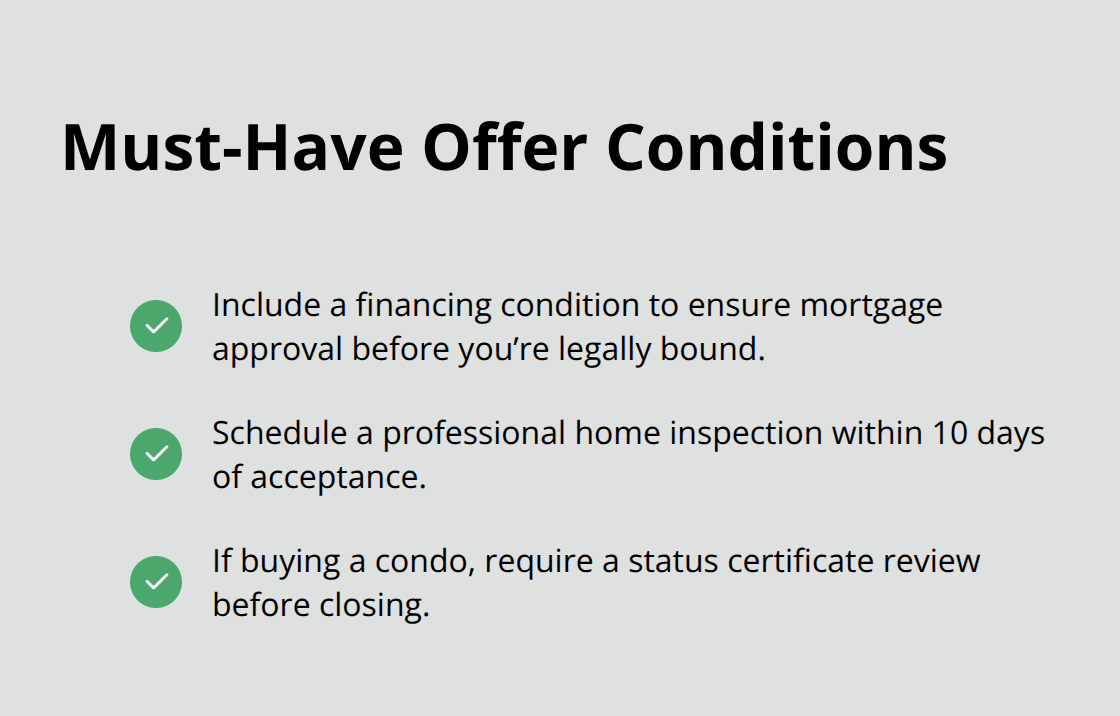
In Toronto’s competitive market, sellers often demand you waive the inspection condition to win bidding wars-never do this. A $20,000 foundation repair discovered after closing becomes your problem, not the seller’s. If you purchase a condo, add a third condition requiring you to review the status certificate before closing. This document reveals the building’s reserve fund health, pending assessments, and condo fee increases. If the reserve fund is critically low or major repairs are imminent, you will know before you are locked in. Status certificates typically cost $200 to $400 and take 10 business days to arrive, so request it immediately after your offer is accepted.
Negotiating Conditions and Preparing for Underwriting
Statistics Canada data shows that since 2016, Ontario has seen increasing multi-party purchases, meaning many couples are purchasing together-yet fewer couples stress-test their affordability against losing one income. If your offer includes conditions, the seller can counter-offer by rejecting them. Expect this. Your realtor should negotiate a reasonable inspection timeline and certificate review period into the final agreement. Once conditions are satisfied and removed, you move into the formal mortgage approval stage, where your lender’s underwriting team verifies every detail of your application.
Final mortgage approval takes 7 to 14 days and involves your lender ordering an appraisal, reviewing your employment verification, and confirming your down payment source. The appraisal is critical-if the home appraises below your purchase price, your lender will only finance the lower amount, forcing you to cover the gap in cash or renegotiate the sale price. On a $500,000 home appraising at $475,000, you would owe an extra $25,000 at closing if you cannot renegotiate. Your financing condition in the offer protects you-if the appraisal fails, you can walk away.
Verifying Your Down Payment and Securing Your Commitment
Your lender will request bank statements, pay stubs, and tax returns to confirm your down payment is legitimate savings, not borrowed money. If you used the Home Buyers’ Plan to withdraw RRSP funds, provide the CRA approval letter showing the withdrawal amount. Once underwriting clears, your lender issues a formal mortgage commitment letter specifying your exact rate, amortization, and monthly payment. Lock this document in a safe place.
Understanding Closing Costs and Final Documentation
Closing costs arrive next-your lawyer or notary will request 2% to 3% of your purchase price for legal fees, title insurance, land transfer tax (unless you qualify for a provincial first-time buyer exemption), and property tax adjustments. On a $650,000 home, closing costs run $13,000 to $19,500 before the down payment. Many first-time buyers are shocked by this figure because they only budgeted for the down payment.
Your lender will send a final mortgage statement three days before closing confirming your exact payment amount, interest rate, and amortization. Review this carefully-if it does not match your commitment letter, contact your lender immediately. On closing day, you will sign mortgage documents, transfer your down payment and closing costs to your lawyer’s trust account, and receive the keys. Your lawyer coordinates with the seller’s lawyer to ensure the property deed transfers and your mortgage is registered on title.
Timeline and Moving Logistics
From offer to keys typically takes 30 to 45 days, depending on inspection timelines and how quickly your lender completes underwriting. Plan your moving date for the day after closing to avoid overnight hotel costs if something delays the transfer.
Final Thoughts
Your mortgage journey as a first-time homebuyer in Canada doesn’t end when you receive the keys. The real work starts with maintaining your home, managing your payments, and avoiding the pitfalls that trap many new owners. The biggest mistake first-time homebuyers Canada make is borrowing the maximum amount their lender approves, which treats the bank’s ceiling as your target rather than their limit. If the bank approves you for $650,000, borrow $585,000 instead and protect yourself against rate increases at renewal or income disruptions.
Many buyers skip the stress test entirely, which creates genuine financial risk for couples purchasing together. Statistics Canada shows multi-party purchases have increased significantly in Ontario since 2016, yet couples rarely test whether they can afford the mortgage on a single income. Provincial incentives also slip past most buyers-Ontario’s Land Transfer Tax Refund, Quebec’s Home Buyers’ Tax Credit, and programs in every other province reduce your costs substantially. Before closing, verify which programs apply to your purchase and claim thousands of dollars you’ve earned.
Budget for maintenance immediately after you close, setting aside 1% to 4% of your home’s value annually for repairs and emergencies. A new roof costs $15,000, a foundation crack costs $10,000, and these expenses arrive without warning. First-time homebuyers Canada often underestimate ongoing ownership costs because they focus entirely on the mortgage payment, yet maintenance costs determine whether homeownership remains affordable. For additional guidance on mortgages and homebuying strategy, visit Financial Canadian to explore resources designed specifically for Canadian homebuyers.










Leave a comment