
Buying your first home in Canada is one of the biggest financial decisions you’ll make. The process involves multiple steps, from checking your credit score to closing on your property, and it’s easy to feel overwhelmed without proper guidance.
We at Financial Canadian have created this step-by-step guide to help first time homeowners in Canada navigate each phase with confidence. Whether you’re saving for a down payment or comparing mortgage rates, you’ll find practical advice to move forward.
Understanding Your Financial Foundation
Before you start house hunting, you need to know exactly how much you can afford to borrow and how much cash you need upfront. Your down payment size directly impacts your mortgage amount, the interest you’ll pay over time, and whether you’ll need mortgage default insurance. In Canada, minimum down payments range from 5% on homes up to $500,000 to 10% on amounts over $500,000 for homes between $500,000 and $1,499,999. A $300,000 home requires a minimum $15,000 down payment at 5%, while a $1 million home demands at least $50,000 (5% on the first $500,000 plus 10% on the remainder).
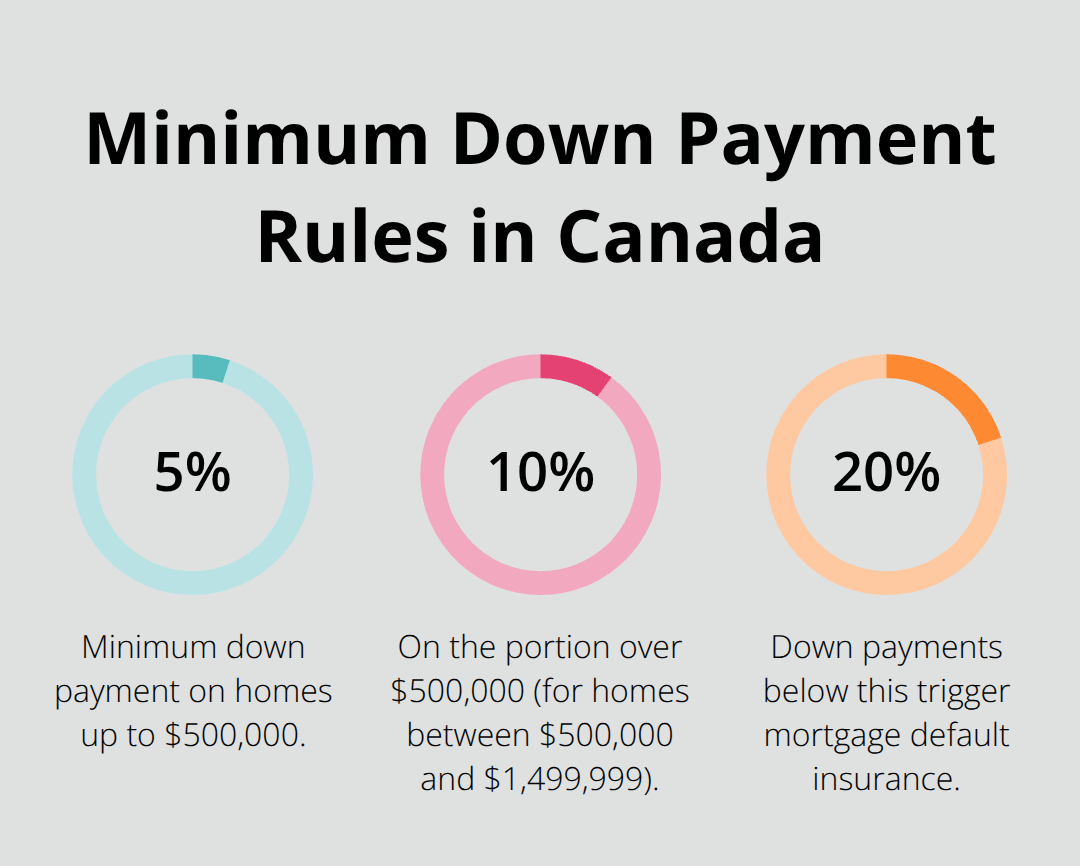
Any down payment below 20% triggers mortgage insurance costs that get added directly to your mortgage balance, increasing what you ultimately owe. This is why calculating your exact down payment options matters before you commit to a price range.
Calculate What You Can Actually Afford
Start with your savings and check if you have access to registered accounts like an RRSP or FHSA. The FHSA allows tax-deductible contributions with a $40,000 lifetime limit, and you can invest these funds in stocks, bonds, or GICs for your down payment. The Home Buyers’ Plan lets you withdraw up to $60,000 tax-free from your RRSP, though you must repay this amount within 15 years. Next, understand closing costs in your province. Closing costs typically run 3–5% of the home’s purchase price and cover land transfer taxes, appraisals, and legal fees. Provincial costs vary significantly-Ontario and British Columbia have different transfer tax structures than Alberta or Saskatchewan. Use a closing costs calculator specific to your province to get an accurate estimate.
Your Credit Score Determines Your Mortgage Terms
Lenders check your credit score to assess risk and set your interest rate. A score above 680 typically qualifies you for standard mortgage rates, while scores below 620 face higher rates or rejection. Pull your credit report from Equifax or TransUnion to identify errors or missed payments that drag down your score. If your score is below 700, spend 3–6 months paying down existing debt and making all payments on time before you apply for a mortgage. Each month of on-time payments boosts your score. Paying down revolving debt like credit cards reduces your credit utilization ratio, which heavily influences scoring.
Get Pre-Approved to Strengthen Your Position
Pre-approval strengthens your negotiating position and sets a realistic budget ceiling. A mortgage professional will review your income, debts, credit history, and down payment to determine how much you qualify to borrow. Pre-approval is not a guarantee, but it shows sellers you’re a serious buyer and helps you avoid wasting time viewing homes outside your actual price range. Most pre-approvals last 120 days, giving you a window to find and make an offer on a property. With your financial foundation solid and pre-approval in hand, you’re ready to explore mortgage options and understand how different rate structures affect your long-term costs.
Choosing the Right Mortgage Structure for Your Situation
Once pre-approved, you face a critical decision that most first-time buyers rush through without understanding the real impact on their finances. Fixed-rate mortgages lock in your interest rate for the entire term, meaning your payment stays identical whether rates rise or fall. This predictability matters most when you’re budgeting tight, because a rate increase at renewal won’t shock your household cash flow. Variable-rate mortgages track the prime rate, so your payment fluctuates with market conditions. When prime rates drop, you pay less; when they rise, you pay more. The trade-off is that variable rates typically start lower than fixed rates, sometimes 0.5% to 1% cheaper initially.
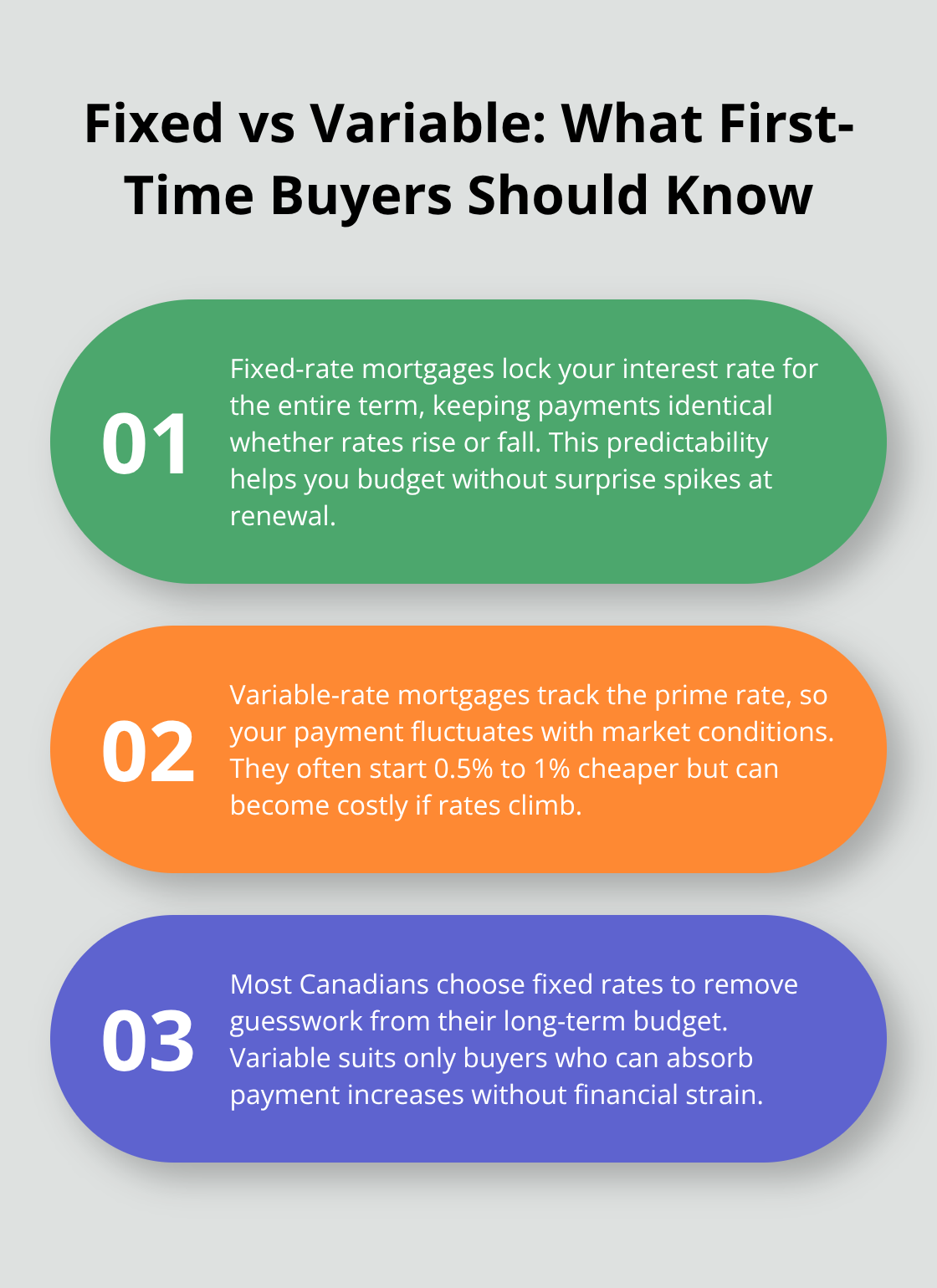
However, that savings evaporates quickly if rates climb. Most Canadian homeowners choose fixed rates precisely because they eliminate guesswork from their long-term budget.
Fixed vs. Variable: Which Rate Structure Suits You
Your mortgage term (the period your rate applies) typically runs 1 to 10 years, though 5-year terms dominate the market. A shorter term like 2 years means you renegotiate sooner, exposing you to rate increases faster. A longer 10-year term locks in stability but usually costs more upfront. First-time buyers should try 5-year fixed terms as the baseline, since this balances rate certainty with reasonable pricing. Fixed rates eliminate the stress of wondering whether your payment will spike next month. Variable rates appeal only to buyers who can absorb payment increases without financial strain, which rarely applies to first-time homeowners carrying maximum debt loads.
Rate Locks Protect You from Market Swings
Once you find a home and your offer is accepted, your lender will lock your rate for a specific period, usually 120 days. This lock prevents rate increases from eating into your equity before you close. If rates drop during this window, some lenders allow you to renegotiate lower, though this varies by institution. Rate holds are free, but don’t assume they’re automatic-ask your lender explicitly to confirm the lock date and expiration. If your closing extends beyond the lock period due to inspections or financing delays, you face a rate hold extension fee, typically 0.25% to 0.50% of your mortgage amount. This cost adds up fast on larger mortgages, so coordinate closing dates carefully with your lawyer and lender.
Amortization: The Hidden Cost Driver
Finalizing your mortgage terms means confirming your amortization period, which is how long you take to repay the full balance. Standard amortization runs 25 years, but you can choose 20, 30, or 35 years. A shorter amortization means higher monthly payments but substantially less interest paid over time. A 25-year mortgage at 5.5% on $400,000 costs roughly $2,300 monthly, while a 30-year term at the same rate costs about $2,070. That $230 difference seems minor until you calculate the total: you’ll pay approximately $36,000 more in interest over five additional years. First-time buyers often stretch to 30 years to ease monthly pressure, but this decision locks you into higher lifetime costs and delays building equity quickly. The amortization period you select today determines how much wealth you accumulate in your home over the next decade. With your mortgage structure locked in, you’re ready to move into the actual home search and learn how to find the right property at the right price.
Finding Your Home and Making It Official
Now that your mortgage is locked in, the real search begins. Most first-time buyers start by scrolling through Realtor.ca or calling a real estate agent, but this approach often leads to viewing homes outside your actual budget or in neighbourhoods that don’t match your lifestyle. A better strategy is to work backwards from your pre-approved amount and closing costs. If you’re approved for $450,000 and closing costs run 3–5% of purchase price, you can realistically afford a home around $420,000 to $430,000, not the full $450,000. Next, use local data from your municipal or provincial real estate board instead of national headlines. National price averages mean nothing when you’re buying in a specific neighbourhood. Realtor.ca shows sold prices and days-on-market for your target areas, which reveals whether you’re entering a buyer’s market where negotiation favours you or a seller’s market where bidding wars are common. Set a strict price ceiling before you view a single property and stick to it ruthlessly. The temptation to stretch $5,000 or $10,000 higher happens constantly during showings, and this overreach is exactly how first-time buyers end up house-poor.
Select an Agent Who Protects Your Interests
A real estate agent who understands your budget and priorities saves enormous amounts of time. Interview three agents before committing to one. The agent is typically paid by the seller, so cost isn’t your concern, but their market knowledge and negotiating skill directly impact whether you overpay. Ask each candidate about their sales volume in your target neighbourhood, how they handle bidding wars, and their strategy for getting you the best price. An agent who immediately suggests offering above asking in a competitive market may be steering you toward a poor decision rather than protecting your interests.
Make an Offer With Protective Conditions
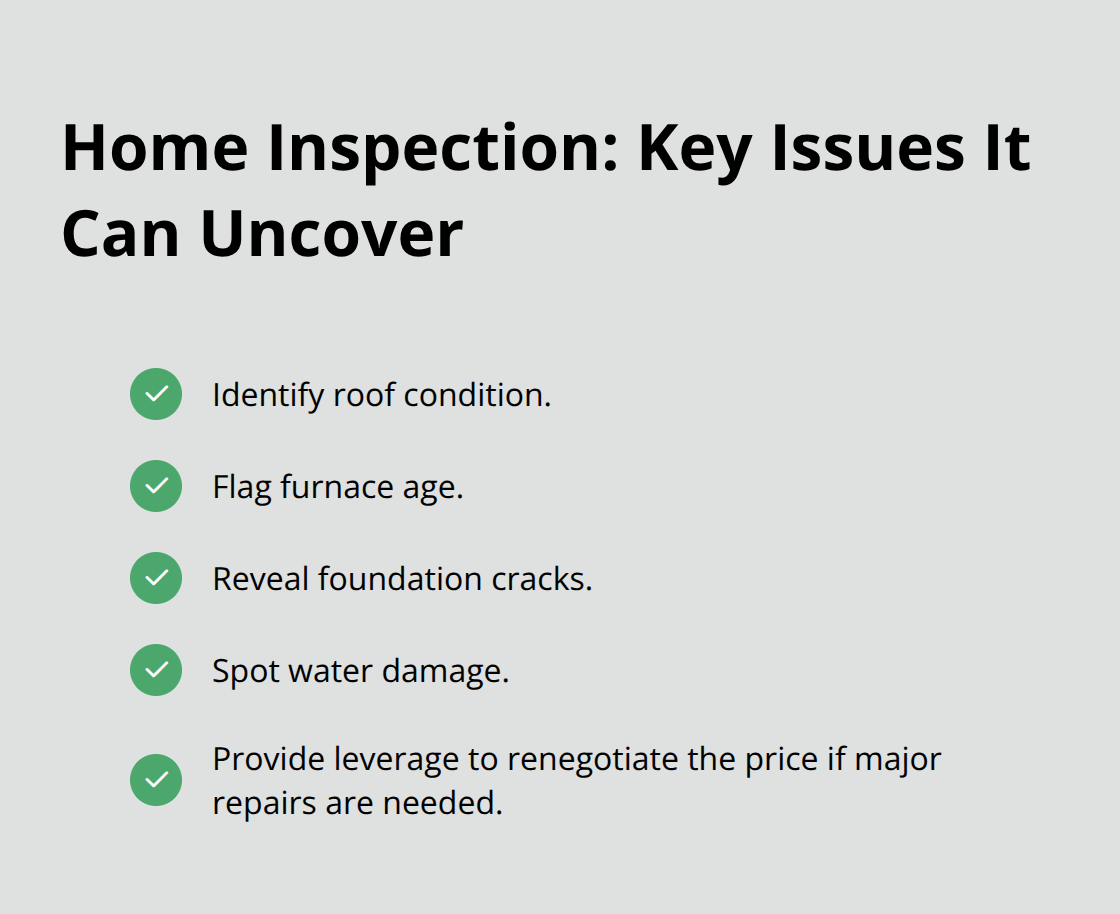
When you find a property, the inspection and offer phase is where inexperienced buyers make costly mistakes. Your offer should include conditions for financing and a professional home inspection-non-negotiable protections that allow you to walk away if problems emerge. Many sellers pressure buyers to remove inspection conditions to strengthen offers in competitive markets, but this is a terrible gamble on a $400,000+ asset. A thorough home inspection identifies issues like roof condition, furnace age, foundation cracks, and water damage that aren’t visible during a casual walkthrough. The inspector’s report gives you ammunition to renegotiate the price downward if major repairs are needed.
Understand Hidden Repair Costs Before Closing
One long-term homeowner reported roughly $40 per month in routine maintenance costs, but a single roof replacement runs $5,000 to $15,000 depending on size and materials. Roofs typically require replacement every 10–20 years, and furnaces last roughly 20–25 years before needing replacement. Windows commonly need replacement about every 20–30 years. Knowing these costs before you commit is essential. After your offer is accepted and inspection is complete, request a final walkthrough 24 to 48 hours before closing to verify the seller hasn’t removed fixtures, damaged the property, or left behind unwanted items. This walkthrough also confirms that any negotiated repairs were actually completed.
Coordinate Closing to Avoid Rate Lock Delays
Once you sign closing documents with your real estate lawyer, you receive the keys and officially own the property. Coordinate this timing carefully with your mortgage lender, since delays beyond your rate lock period trigger extension fees that cost hundreds or thousands of dollars depending on your mortgage amount.
Final Thoughts
The first-time homeowner Canada journey demands discipline across multiple financial decisions, from your down payment to your mortgage structure to your inspection process. Most first-time buyers stretch their budget beyond what they can comfortably afford, and 42% of homeowners later experience regret because financial strain follows them into ownership. You qualify to borrow a certain amount, but qualifying doesn’t mean you should borrow it-leave room for property taxes, insurance, utilities, and maintenance that easily exceed $500 monthly on top of your mortgage payment.
Skipping the home inspection or removing inspection conditions to strengthen your offer in a competitive market destroys finances faster than almost any other mistake. A roof replacement, furnace failure, or foundation crack costs thousands and derails your budget if you haven’t built an emergency fund beforehand. The inspection fee of $300 to $500 is the cheapest insurance you’ll buy on a $400,000 asset, so treat it as non-negotiable.
After closing, your real work starts. Set aside money monthly for maintenance and major system replacements, track your property taxes and insurance costs carefully since these increase over time, and revisit your financial plan annually to stay on track. If you want to strengthen your financial foundation before buying or need guidance navigating homeownership, we at Financial Canadian offer resources to help you make informed decisions and build wealth through real estate.











Leave a comment