
Juggling multiple debt payments each month drains your energy and your wallet. Guaranteed debt consolidation in Canada offers a straightforward way to combine those obligations into one manageable payment.
At Financial Canadian, we’ve seen how consolidation transforms people’s financial lives by lowering interest rates and simplifying their monthly commitments. This guide walks you through your options so you can make the right choice for your situation.
How Debt Consolidation Works in Canada
Debt consolidation merges your existing obligations into a single loan or payment plan. When you consolidate, you borrow money at a new interest rate to pay off multiple creditors at once. The key is that your new rate must be lower than what you currently pay across all debts combined. If you carry $16,000 in credit card debt at 20.99% alongside a $20,000 line of credit at 11.69%, consolidating these into a personal loan at 8–12% could save you hundreds monthly. On that $36,000 in combined debt, the difference between a weighted average rate of roughly 17% and a consolidated rate of 10% translates to approximately $2,100 in annual interest savings. This is why debt consolidation works best when your credit score sits above 700, which unlocks access to better rates from banks and lenders.
What Happens to Your Credit Score
Your credit score will take a temporary hit when you apply for consolidation because lenders conduct a hard inquiry and you add new credit accounts to your profile. Expect a 5–10 point dip initially. However, this damage reverses within 3–6 months as you make on-time payments on your consolidation loan. The real credit-building opportunity comes from reducing your overall utilization ratio. If you run 51% utilization across multiple cards, consolidating that debt into a loan removes those balances from your credit card accounts, dropping your utilization to near zero. That shift alone can boost your score by 20–30 points within a few months. The Government of Canada notes that debt management plans can remain on your credit report for two years after payoff, so timing matters if you pursue formal consolidation through non-profit agencies.
Interest Rates and Terms You’ll Encounter
Banks do not offer one-size-fits-all consolidation rates. Your actual rate depends on your credit score, income, employment history, and the type of collateral you offer. A secured consolidation loan using home equity as collateral typically ranges from 6–10%, while unsecured personal loans sit between 10–18% depending on your profile. Balance transfer cards advertise 0% APR for 12 months, but they charge 3–5% transfer fees upfront, which eats into your savings if you cannot eliminate the balance before the promotional period ends. Licensed Insolvency Trustees in Canada can structure Consumer Proposals that consolidate debts and stop interest accumulation entirely, though this carries an R7 credit rating that gradually fades. Calculate your total cost over the entire repayment period, not just the promotional rate. A 0% balance transfer that costs you $1,200 in fees might cost more than a 9% personal loan with no fees if you spread payments over 36 months.
Choosing Between Secured and Unsecured Options
Secured loans use your home or other assets as collateral, which lowers your risk to the lender and typically results in better rates (6–10%). Unsecured personal loans carry higher rates (10–18%) because the lender has no asset to claim if you default. Home equity lines of credit offer significant interest savings but carry the risk of losing your home if you default, plus closing costs that add to your total expense. If you lack home equity or prefer to keep your assets unencumbered, an unsecured personal loan remains a viable path, especially if your credit score exceeds 720. The trade-off is straightforward: lower rates come with collateral risk, while higher rates protect your assets. Your choice depends on your comfort level with that risk and your ability to repay consistently.
Moving Forward with Your Consolidation Strategy
Now that you understand how consolidation affects your credit and what rates you’ll actually encounter, the next step is evaluating which consolidation option matches your specific debt situation. Different strategies work for different financial profiles, and choosing the wrong one can cost you thousands in unnecessary interest or fees.
Types of Debt Consolidation Options Available
Bank personal loans and lines of credit remain the most straightforward consolidation path for Canadians carrying high-interest debt. A personal loan provides you with a fixed monthly payment, predictable interest rate, and a defined payoff timeline, which eliminates the temptation to accumulate new balances while you repay. Lines of credit work differently: you access funds as needed and pay interest only on what you draw, making them flexible but riskier if you lack discipline.
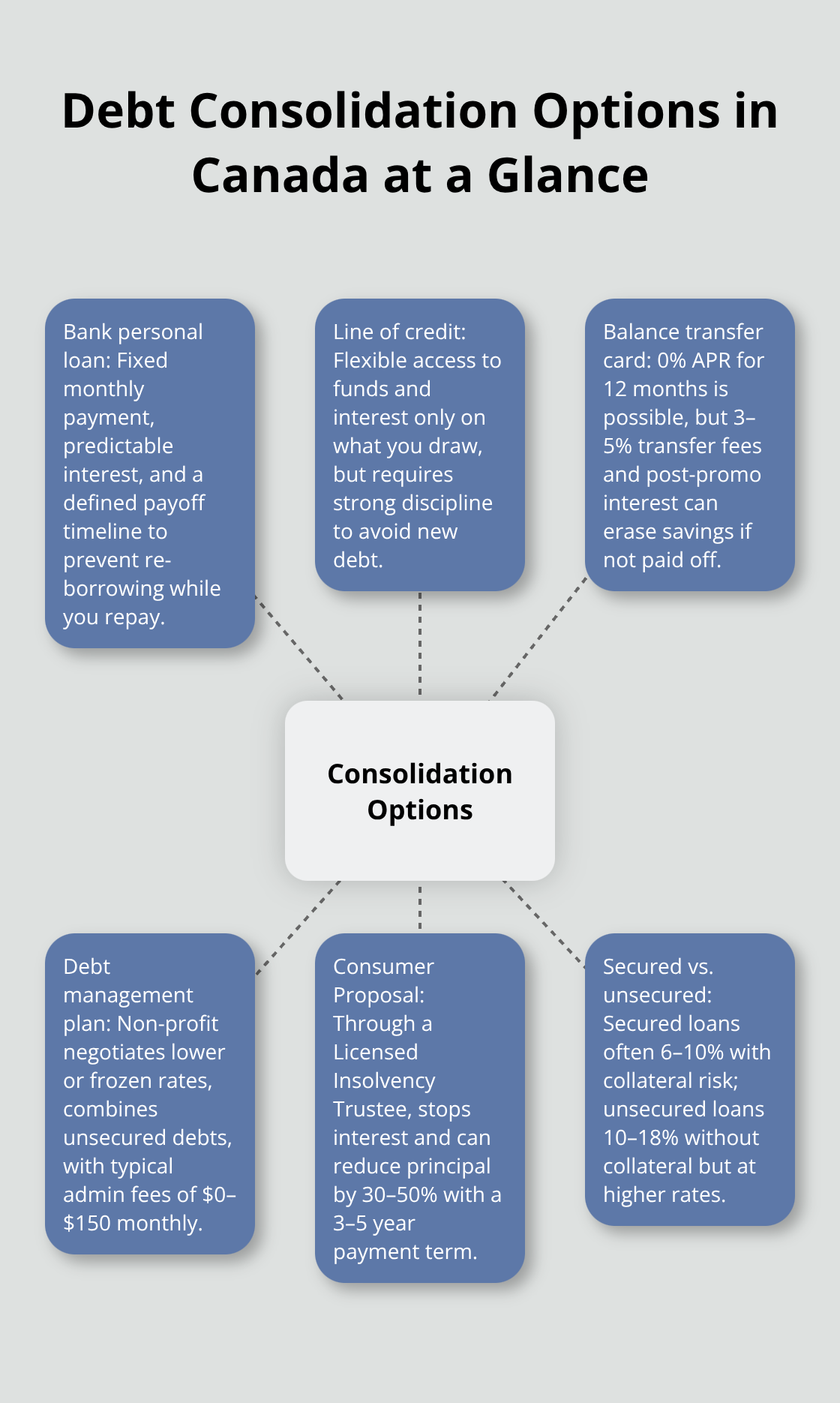
After consolidation, your monthly payment becomes fixed and manageable, which is why this option works best if you commit to avoiding new debt. The downside is that banks move slowly-approval takes 5–10 business days-and you’ll need solid income documentation. If you’re impatient or have marginal credit, this route frustrates more than it helps.
Balance Transfer Cards: The Math Behind the Promise
Balance transfer cards promise 0% APR for 12 months, but the math reveals why they fail for most people. That 3–5% transfer fee costs you $1,080–$1,800 on a $36,000 balance, and you must eliminate the entire balance before month 13 or face a retroactive interest charge that wipes out your savings. To clear $36,000 in 12 months requires $3,000 monthly payments, which is unrealistic for most households.
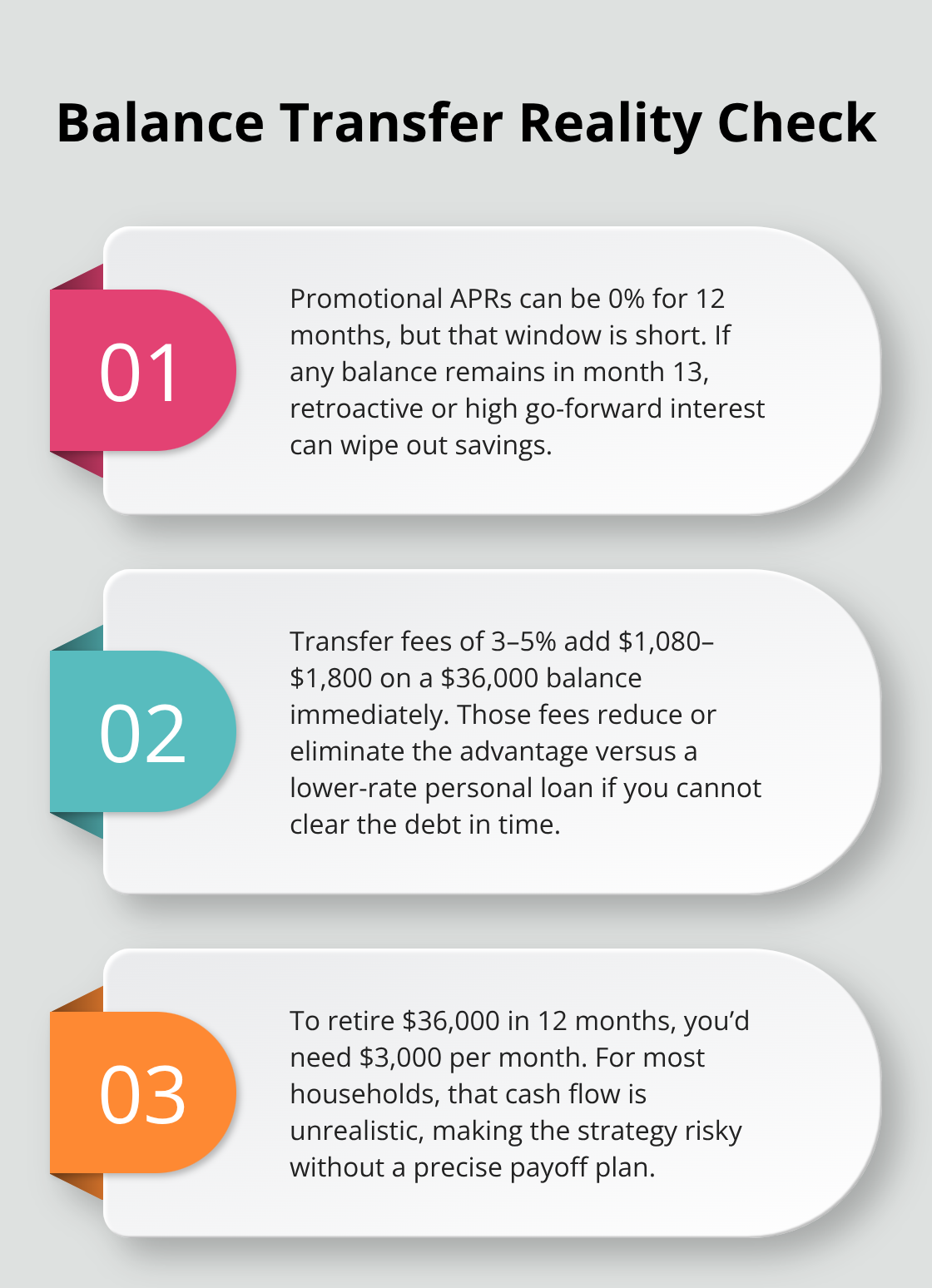
Try balance transfers only if your debt sits below $10,000 and your monthly surplus exceeds $1,000. This strategy works best when you have a clear exit plan and the discipline to avoid rolling debt from one card to another without reducing your principal.
Debt Management Plans: Negotiated Relief Through Non-Profits
Debt management plans through non-profit agencies like Credit Counselling Society negotiate directly with your creditors to lower or freeze interest rates, consolidate unsecured debts into one monthly payment, and typically cost $0–$150 monthly in administration fees. This option suits people with $15,000–$50,000 in unsecured debt who cannot qualify for bank loans. The trade-off is a credit impact that lasts two years after you finish paying, according to Government of Canada guidance, though many find this preferable to bankruptcy. You work with a counselor who handles all creditor communications, which removes stress from the process and often yields better negotiation outcomes than you could achieve alone.
Consumer Proposals: Debt Reduction Through Licensed Trustees
Consumer Proposals through Licensed Insolvency Trustees in Canada stop interest immediately, reduce your debt principal (often to 30–50% of what you owe), and consolidate everything into one payment over 3–5 years. The credit rating you receive gradually improves after completion, and the entire process costs nothing upfront since the trustee’s fees come from your settlement. This path works if you’re drowning in debt above $50,000 and cannot sustain payments under any other plan. The catch: creditors must approve your proposal, though acceptance rates exceed 80% in Canada. You should obtain free consultations from multiple trustees before choosing, since their fee structures and negotiation strength vary significantly. Each trustee operates independently, so comparing their approaches helps you identify which one aligns with your financial goals and timeline.
Your debt profile determines which option makes the most sense. The next section walks you through assessing your current situation so you can match the right strategy to your specific numbers.
When Debt Consolidation Actually Works for Your Situation
Assess Your Actual Numbers
Start with your actual numbers, not your feelings about debt. Pull together your most recent statements for every credit card, line of credit, personal loan, and other obligation you carry. Write down the balance, interest rate, and minimum monthly payment for each one. This step takes 30 minutes but saves you from making a costly mistake.
Add up your total monthly payments across all debts. Most people are shocked to discover they send $800–$1,500 to creditors while barely reducing principal. Next, calculate your total interest charges over the next 12 months by multiplying each balance by its interest rate and dividing by 12. If that number exceeds $4,000 annually, consolidation likely makes sense.
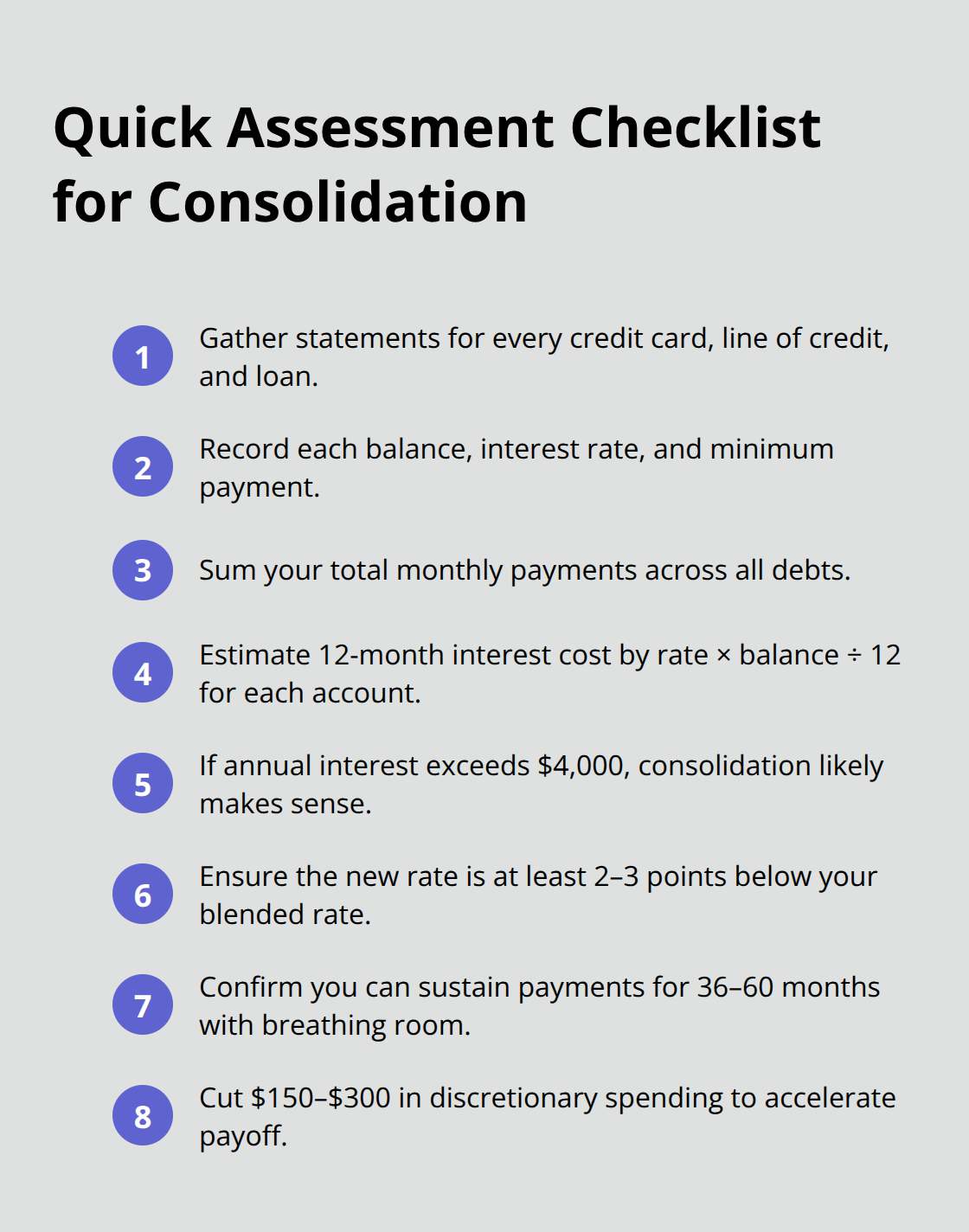
Someone carrying $36,000 across credit cards at 20.99% and a line of credit at 11.69% will pay roughly $5,400 in interest this year alone. A consolidated loan at 9–10% on that same balance drops annual interest to approximately $3,240–$3,600, creating real savings. The math only works if your new consolidated rate sits at least 2–3 percentage points below your blended current rate. If a lender offers you 15% on a consolidation loan when you’re currently paying an average of 14.5%, walk away.
Test Your Ability to Sustain Payments
Test whether you can actually afford consolidation before committing. Take your current total monthly debt payment and ask yourself: can I sustain this payment for 36–60 months without adding new balances? If your monthly surplus (income minus essential expenses like rent, utilities, food, insurance) is less than $200 after your consolidated payment, you lack breathing room.
A household earning $3,300 monthly with $2,500 in essential expenses has only $800 to work with. If a consolidated payment claims $600 of that, you’re one car repair away from failure. Consider whether you can increase income through side work or freelancing instead of consolidating. Sometimes earning an extra $300 monthly by picking up gig work eliminates the need for consolidation entirely while avoiding the credit impact and fees altogether.
Cut Discretionary Spending Aggressively
If consolidation is your path forward, cut discretionary spending aggressively. Review your last three months of bank statements and identify every subscription, dining expense, and non-essential purchase. Most people find $150–$300 monthly in cuts without affecting their quality of life. That money goes directly to accelerating your debt payoff, not to new spending.
Address Your Spending Habits First
Be honest about your spending habits. Consolidation fails when people treat it as a quick fix rather than addressing why they accumulated debt in the first place. If you maxed out credit cards because you spent beyond your means, consolidating without changing that behavior means you’ll rebuild the same debt within 18–24 months while carrying both old and new obligations.
A Licensed Insolvency Trustee offers a free confidential consultation to assess whether consolidation, a Consumer Proposal, or another path suits your situation better. This conversation costs nothing and provides clarity on which option aligns with your financial goals and timeline.
Final Thoughts
Consolidating your debt transforms a chaotic payment schedule into a single, manageable monthly obligation that frees up money in your pocket. Someone carrying $36,000 across high-interest credit cards and lines of credit saves thousands annually through guaranteed debt consolidation Canada, money that accelerates payoff and builds breathing room in your budget. The real benefit isn’t just simplification-it’s the financial control you regain.
Starting your consolidation journey requires three concrete steps. First, gather your actual numbers: total balances, interest rates, and monthly payments across all debts. Second, contact a Licensed Insolvency Trustee or non-profit credit counselor for a free consultation to compare your options-bank loans, balance transfers, debt management plans, or Consumer Proposals. Third, choose the path that matches your debt level, credit score, and ability to sustain payments without accumulating new balances.
The worst choice is doing nothing, as every month you delay costs you hundreds in unnecessary interest while your debt grows. Contact a trustee this week for that free consultation, and they’ll assess your situation honestly to recommend the path forward that actually works for your numbers, not a generic solution that fails within months.











Leave a comment